Shesha Myth Meaning & Symbolism
The primordial serpent who supports the worlds, embodies infinite time, and offers a throne of stillness from which the universe is sustained.
The Tale of Shesha
Listen. Before the first breath, in the silence between the dissolution of one universe and the birth of the next, there is a great exhale. From this void, from the unformed potential, he emerges. Not from a womb of earth or water, but from the womb of time itself. He is Shesha, whose name means “The Remainder,” that which endures when all else has passed.
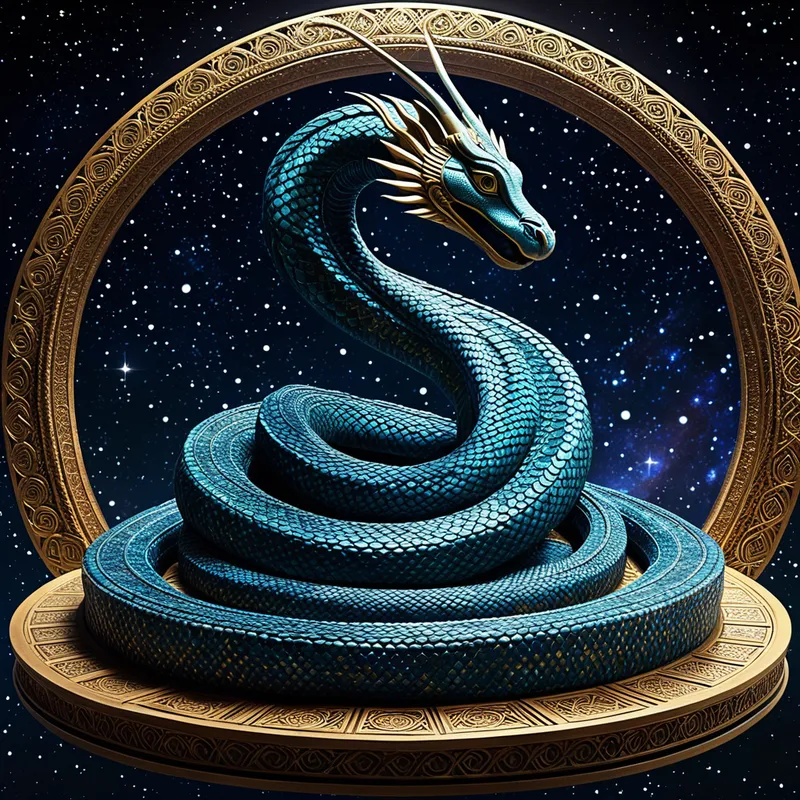
He is vast beyond the comprehension of mountains. His body is the color of a thundercloud at twilight, and upon his great head bloom a thousand hoods, each like a celestial canopy. He has no need for feet, for he does not walk upon the earth. The earth, and all the worlds, will one day rest upon him. In that primordial dark, he coils upon himself, a great, living circle, and within the sanctuary of his coils, he rests. And as he rests, he dreams.
His dream is not of pastures or palaces. It is the dream of foundation. It is the dream of a place for things to be. From the depths of his yogic sleep, a luminous presence manifests, drawn to this perfect support. It is Vishnu, the sustainer, whose skin is the blue of infinite space. Without a word, Shesha unfurls one mighty coil, fashioning it into a throne—a bed—upon the swirling waters of causality. Vishnu reclines upon this living foundation. The serpent raises his hoods, a living canopy against the chaos of non-being. Here, upon Shesha, Vishnu closes his eyes and enters a meditation so deep it sustains all of creation.
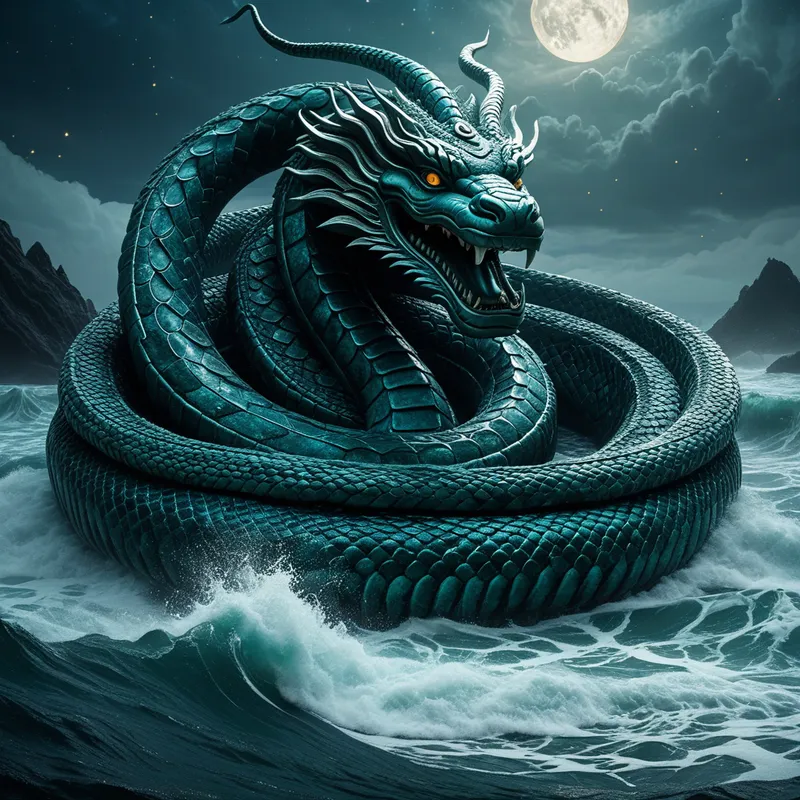
But Shesha’s tale is not only one of stillness. In another age, when the gods and demons sought the nectar of immortality, they required a churn for the cosmic ocean. They uprooted the great mountain Mandara, but it had no base. They called upon Shesha’s brother, the mighty serpent Vasuki. Vasuki, with a heart of fierce loyalty, allowed himself to be coiled around the mountain. Gods grasped his tail, demons his head, and they pulled. Back and forth, in a great cosmic tug-of-war, Vasuki’s body groaned and stretched, his breath becoming the poisonous fumes that threatened all. Yet he endured, for the work of creation often demands a great tension. From that churning, born of a serpent’s sacrifice, arose treasures, poisons, and finally, the amrita—the nectar of life itself.
And when the great demon Hiranyaksha dragged the earth to the bottom of the cosmic ocean, it was Vishnu, incarnated as the boar Varaha, who dove into the abyss. And who was there, in those lightless depths, to offer a point of leverage, a foundation from which to lift the world? Shesha, present even in the darkest places, his body the first solid thing in the formless deep.
Cultural Origins & Context
The myth of Shesha emerges from the vast corpus of Hindu Puranic literature, texts like the Mahabharata, the Vishnu Purana, and the Bhagavata Purana. These were not dry histories, but living narratives recited by sages and storytellers (Sutas) at festivals and in temple courtyards. The story of the cosmic serpent served a profound societal function: it provided a cosmological model that was both awe-inspiring and intimately structured.
In a culture deeply attuned to cycles—of days, seasons, and vast cosmic ages (Yugas)—Shesha represented the ultimate continuity. He was the narrative answer to a terrifying question: what holds up the world? The answer was not inert stone, but a conscious, devoted being. This framed the universe not as a cold machine, but as a living entity sustained by relationship—the relationship between the supporter (Shesha) and the sustained (Vishnu/the worlds). It taught that order (Dharma) itself rests upon a principle of selfless support and endurance.
Symbolic Architecture
Shesha is the ultimate symbol of the supportive matrix of existence. He is not the actor, but the stage. Not the dreamer, but the bed upon which the dreamer rests. His coiled form is the very shape of potential energy, of infinite time (Kala) circling back upon itself.
The foundation of consciousness is not a thought, but a presence that allows thinking to occur.
His thousand hoods symbolize omnidirectional awareness, a protective, canopy-like consciousness that witnesses all without being scattered. As “Ananta” (the endless one), he embodies the infinite, but an infinite that is coiled, contained, and therefore usable as a foundation. This is the paradox of Shesha: he is boundless time and space made into a specific, supportive form.
Psychologically, Shesha represents the psychic ground, the often-unconscious foundation of the Self. This includes the somatic foundation of the nervous system and spine, the ancestral foundation of lineage and memory, and the archetypal foundation of the collective unconscious. He is the part of the psyche that “holds everything up,” that endures through all our personal transformations and traumas, the silent, supportive substrate of our being.
The Dreamer’s Resonance
When the archetype of Shesha stirs in the modern unconscious, it often manifests in dreams of profound support or its terrifying absence. One might dream of discovering a massive, ancient pillar in their basement, holding up their house—a house they never knew was so fragile. Or they may dream of their own spine transforming into a luminous, flexible column of great strength.
Conversely, the absence of Shesha appears as dreams of foundational collapse: the ground dissolving into water, a building with no foundation tilting into an abyss, or a feeling of having nothing solid to stand on. These dreams point to a somatic and psychological process where the individual’s sense of inner support is being challenged or re-configured. The psyche is asking: What is my foundation? What supports me when everything else falls away? The emergence of serpentine imagery in such contexts is the unconscious offering the symbol of the ultimate supporter, hinting at the need to connect with one’s own enduring, coiled strength.
Alchemical Translation
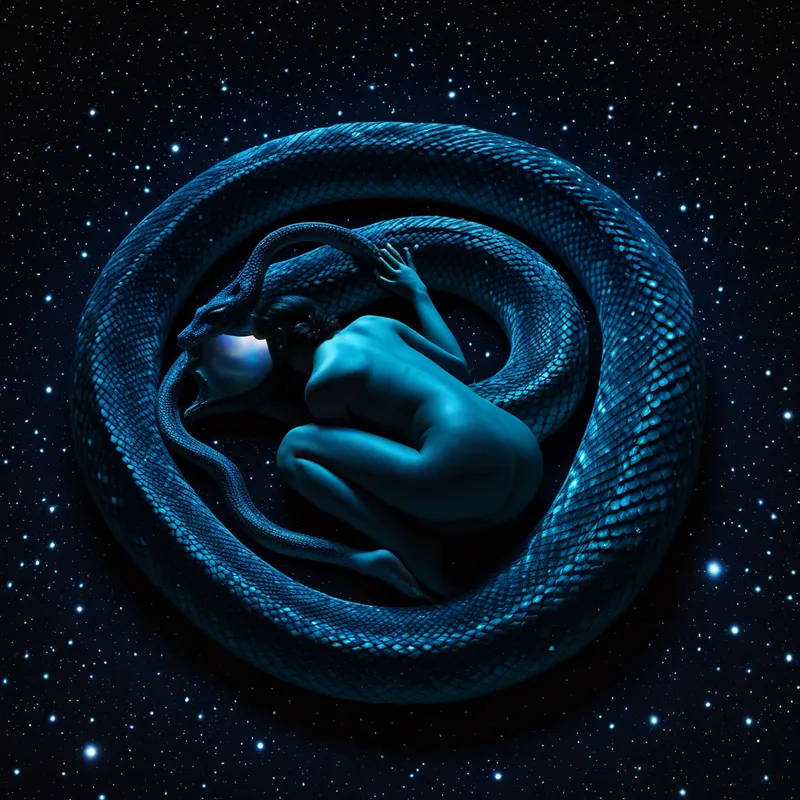
The alchemical process modeled by Shesha is not one of heroic conquest, but of becoming the base. In the journey of individuation, we often focus on the brilliant figure of the Self (Vishnu) who integrates the psyche. But Shesha reminds us that this figure cannot operate in a void. The first and most critical transmutation is the creation of an inner foundation capable of supporting the weight of consciousness.
The work is to coil the chaos of your history into a throne for your own sovereignty.
This involves the “coiling” work of introspection—gathering the scattered, often painful threads of one’s past, one’s instincts, and one’s raw, unconscious material, and weaving them into a stable, contained structure. It is the act of making peace with one’s own infinite nature—the endless cycles of thought, emotion, and pattern—not by fleeing from it, but by giving it a form that serves. To “find your Shesha” is to develop the capacity to be your own support system, to become the calm, enduring presence that can hold the turmoil of transformation without collapsing.
Ultimately, the myth teaches that the goal is not to escape the cyclical nature of existence (samsara), but to become so grounded within it that you become its support. You become the stable axis around which the wheel turns. In reclining upon the serpent, Vishnu does not master it; he enters a sacred partnership with it. So too, the individuated psyche does not eradicate the unconscious, primal serpent-force; it learns to rest upon it, in a state of profound, creative trust, from which a new world of meaning can be sustained.
Associated Symbols
Explore related symbols from the CaleaDream lexicon: