Shango Becomes Thunder
The myth of Shango's transformation into the thunder god reveals his divine power, fiery temper, and enduring influence in Yoruba spirituality.
The Tale of Shango Becomes Thunder
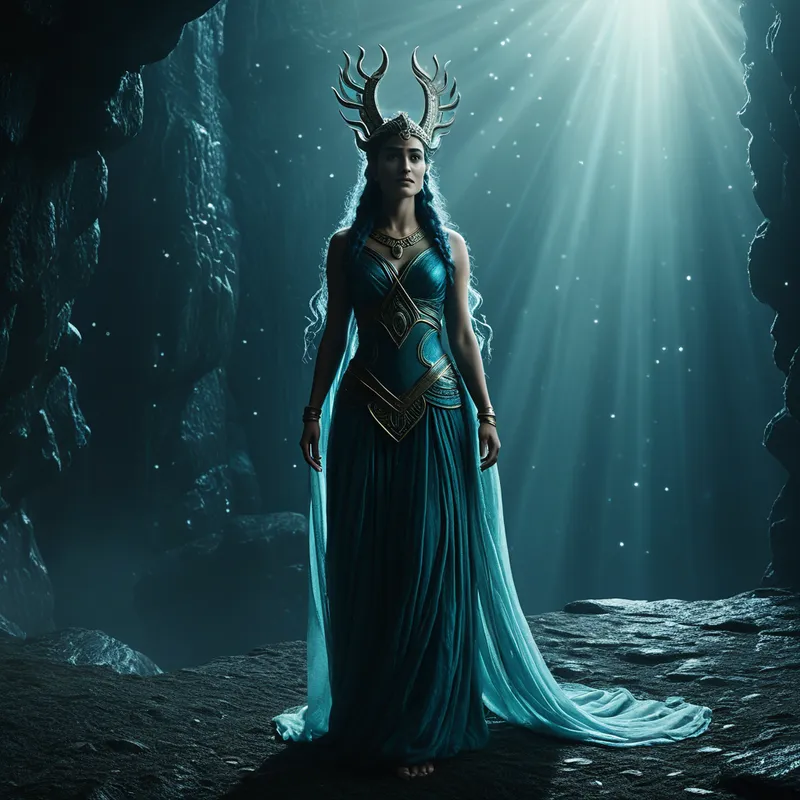
The story begins not with a god, but with a king. [Shango](/myths/shango “Myth from African Diaspora culture.”/), the fourth Alaafin of Oyo, was a ruler of formidable presence, a man whose charisma was as intense as his wrath. His reign was marked by both prosperity and a simmering tension, for within Shango burned a fire that was both creative and destructive. He was a master of the mystical arts, a wielder of potent àṣẹ (authority, command), and his favored tools were stones—edun ara, thunderstones—that held the very essence of lightning. When he spoke, his words carried weight; when he was angered, the air itself seemed to crackle.
The precipice of his transformation was a tragedy born of his own power. In a display meant to awe his subjects and silence his enemies, Shango summoned the primal force within his stones. He called down lightning from the heavens. But the power, raw and untamed, overshot its mark. The bolts did not strike the barren earth or a symbolic target; they fell upon his own palace. The resulting conflagration consumed his home, his treasures, and, in the most devastating blow, his beloved wives and children. The king who commanded [the sky](/myths/the-sky “Myth from Persian culture.”/) found himself utterly destroyed by it.
Consumed by a grief so profound it fused with his legendary rage, Shango fled the ruins of his kingdom. The weight of his guilt and the magnitude of his loss were unbearable for a mortal frame. He wandered into the deep forest, a broken sovereign in [the wilderness](/myths/the-wilderness “Myth from Biblical culture.”/). His subjects, seeing only the catastrophe and not the catastrophic sorrow behind it, believed he had chosen exile in shame.
The tale reaches its zenith at a great ayán tree. Here, at the boundary between the human world and the wilderness, Shango’s inner storm could no longer be contained. The fire of his temper, the lightning of his power, and the ocean of his grief coalesced into a single, cataclysmic release. He did not die as a man. Instead, he underwent a divine apotheosis. He hung his òkè̀ (the royal beaded crown) upon the branches of the tree and ascended, his mortal essence dissolving into the elemental fury he had always carried within. He became what he had wielded. Shango was no longer a king who controlled thunder; he was Thunder. He did not merely throw lightning; his voice was the [thunderclap](/myths/thunderclap “Myth from Various culture.”/), his gaze the flash that splits the sky. He left the earthly plane and took his seat in the heavens, transforming from a historical ruler into an Orisha of immense power and complex humanity.
Cultural Origins & Context
Shango’s myth is deeply rooted in the historical kingdom of Oyo, one of the most powerful empires in West Africa from the 15th to the 19th centuries. He is one of the few Orisha with a verifiable historical lineage, remembered as a formidable Alaafin. This dual identity—historical king and deified force of nature—is central to his veneration. He is not a distant, abstract god, but a deified ancestor whose passions and flaws are remembered and respected.
In the Yoruba [pantheon](/myths/pantheon “Myth from Roman culture.”/), Shango’s domain is [justice](/myths/justice “Myth from Tarot culture.”/), masculine virility, political authority, and the awe-inspiring power of nature manifested as storm. His worship, characterized by intense, rapid drumming (the bàtá), vigorous dancing, and the color red, reflects his dynamic and fiery essence. He is a god of action, not contemplation. His priests and devotees channel his energy, seeking his protection, his swift justice, and the raw, life-giving power of the rain that follows his thunder. The myth of his self-destruction and rebirth as an Orisha serves as a foundational narrative explaining the origin of this crucial aspect of the natural and spiritual world, while also providing a profound commentary on the nature of power and its consequences.
Symbolic Architecture
The myth of Shango is a masterclass in symbolic transformation. It maps the perilous [journey](/symbols/journey “Symbol: A journey in dreams typically signifies adventure, growth, or a significant life transition.”/) of raw, personal power evolving into a structured, divine function. His edun ara (thunderstones) are not mere tools; they are vessels of concentrated àṣẹ, the very power-to-make-things-happen. They symbolize potential—a potential that, when misdirected by [human](/symbols/human “Symbol: The symbol of a human represents individuality, complexity of emotions, and social relationships.”/) ego and unchecked [emotion](/symbols/emotion “Symbol: Emotion symbolizes our inner feelings and responses to experiences, often guiding our actions and choices.”/), becomes self-annihilating.
The great [tree](/symbols/tree “Symbol: In dreams, the tree often symbolizes growth, stability, and the interconnectedness of life.”/) where he undergoes his [apotheosis](/symbols/apotheosis “Symbol: The transformation of a mortal into a divine or godlike state, representing ultimate spiritual elevation and transcendence of human limitations.”/) is [the world](/myths/the-world “Myth from Tarot culture.”/) [axis](/symbols/axis “Symbol: A central line or principle around which things revolve, representing stability, orientation, and the fundamental structure of reality or consciousness.”/), the [axis mundi](/myths/axis-mundi “Myth from Various culture.”/). It is the point where the personal [crisis](/symbols/crisis “Symbol: A crisis symbolizes turmoil, urgent challenges, and the need for immediate resolution or change.”/) of a [king](/symbols/king “Symbol: A symbol of ultimate authority, leadership, and societal order, often representing the dreamer’s inner power or external control figures.”/) intersects with the cosmic order. By hanging his [crown](/symbols/crown “Symbol: A crown symbolizes authority, power, and achievement, often representing an individual’s aspirations, leadership, or societal role.”/) upon it, Shango sheds his temporal, individual [identity](/symbols/identity “Symbol: Identity represents the sense of self, encompassing personal beliefs, cultural background, and social roles.”/). The [crown](/symbols/crown “Symbol: A crown symbolizes authority, power, and achievement, often representing an individual’s aspirations, leadership, or societal role.”/), [symbol](/symbols/symbol “Symbol: A symbol can represent an idea, concept, or belief, serving as a powerful tool for communication and understanding.”/) of earthly rule, is surrendered so that the essence of the ruler can be transmuted into a ruling principle of the [universe](/symbols/universe “Symbol: The universe symbolizes vastness, interconnectedness, and the mysteries of existence beyond the individual self.”/). His [ascent](/symbols/ascent “Symbol: Symbolizes upward movement, progress, spiritual elevation, or striving toward higher goals, often representing personal growth or transcendence.”/) is not an escape, but an assumption of a greater [responsibility](/symbols/responsibility “Symbol: Responsibility in dreams often signifies the weight of duties and the expectations placed upon the dreamer.”/). He becomes the personification of a necessary, cleansing, and terrifying force.
The fire that destroys Shango’s palace is not a punishment from without, but the eruption of an inner chaos. His transformation into thunder is the cosmos integrating that chaos, giving it form, voice, and purpose. The storm is born from the unendurable pressure of a soul’s conflict.
This [narrative arc](/symbols/narrative-arc “Symbol: A narrative arc represents the structured path that a story follows from introduction to resolution, reflecting growth and transformation.”/)—from mastery to catastrophe, from [exile](/symbols/exile “Symbol: Forced separation from one’s homeland or community, representing loss of belonging, punishment, or profound isolation.”/) to deification—frames power not as a [static](/symbols/static “Symbol: Static represents interference, disruption, and the breakdown of clear communication or signal, often evoking feelings of frustration and disconnection.”/) possession, but as a dynamic [relationship](/symbols/relationship “Symbol: A representation of connections we have with others in our lives, often reflecting our emotional state.”/). True power, the myth suggests, must ultimately be surrendered to a [purpose](/symbols/purpose “Symbol: Purpose signifies direction, meaning, and intention in life, often reflecting personal ambitions and core values.”/) greater than [the self](/myths/the-self “Myth from Jungian culture.”/) to achieve its full, divine [expression](/symbols/expression “Symbol: Expression represents the act of conveying thoughts, emotions, and individuality, emphasizing personal communication and creativity.”/).
The Dreamer’s Resonance
For the individual [psyche](/myths/psyche “Myth from Greek culture.”/), Shango’s myth resonates with the tumultuous process of integrating one’s own formidable, and often frightening, inner forces. He represents the archetypal Ruler energy within us—the part that strives for control, commands respect, and wields influence. Yet, his story warns of the Ruler’s shadow: the tyrannical temper, the pride that leads to a fall, the creative fire that can incinerate one’s own world.
Dreaming of storms, lightning, or uncontrollable anger may signal a “Shango moment” in the psyche. It points to a potent energy seeking recognition and channeling. The myth teaches that repressing this fiery power leads only to internal ruin (the burned palace of the self). Instead, one must face the catastrophic grief and guilt that often accompany the misuse of one’s own strength. The transformation occurs when we consciously “hang our crown” on the symbolic tree—when we relinquish [the ego](/myths/the-ego “Myth from Jungian culture.”/)’s rigid control over this power and allow it to be transmuted. The goal is not to eliminate one’s thunder, but to become a conscious vessel for it, directing its lightning with wisdom rather than wrath, understanding that its purpose is ultimately to clear the air and bring nourishing rain.
Alchemical Translation
Psychologically, Shango’s journey is an alchemical [nigredo](/myths/nigredo “Myth from Alchemical culture.”/) and [rubedo](/myths/rubedo “Myth from Alchemical culture.”/)—the blackening of despair followed by the reddening of spiritual rebirth. The initial stage is the [calcinatio](/myths/calcinatio “Myth from Alchemical culture.”/): his worldly life and identity are burned away in the fire of his own making. The subsequent [solutio](/myths/solutio “Myth from Alchemical culture.”/) is his exile, a dissolution into the formless wilderness of grief. The crucial turning point is the [coagulatio](/myths/coagulatio “Myth from Alchemical culture.”/) at the tree: his scattered essence re-coagulates, not back into a man, but into a new, divine form.
The lightning bolt is the ultimate symbol of sudden, illuminating insight that arrives with destructive force. It shatters old structures of the self to make way for a new consciousness. Shango’s myth is the story of a psyche that becomes that illuminating force, internalizing the shock so completely that it ceases to be something that happens to you and becomes what you are.
His enduring worship, with its ecstatic drumming and dance, reflects this alchemical completion. The devotee does not merely pray to a distant god of storms; they ritually embody his energy, allowing the thunder to move through them in a controlled, sacred manner. This is the human parallel to Shango’s transformation: taking the chaotic, potentially destructive power of raw emotion and instinct, and through ritual (the conscious container), translating it into a vital, life-affirming expression.
Associated Symbols
Explore related symbols from the CaleaDream lexicon:
- Thunder — The voice of divine authority and sudden, transformative power breaking through the stagnant atmosphere of the mundane world.
- Lightning — A flash of devastating insight or truth that cleaves reality, simultaneously destructive and illuminating, revealing what was hidden in the dark.
- Fire — The primal element of purification, passion, and destruction, capable of reducing the old to ashes so new growth may begin.
- Crown — The symbol of sovereign authority and conscious identity, which must sometimes be surrendered for a higher integration to occur.
- Tree — The axis mundi, the living bridge between heaven and earth, where mortal suffering meets divine transformation.
- Grief — The profound, oceanic sorrow that follows catastrophic loss, a necessary solvent for the hardened structures of the self.
- Rage — The raw, unmediated fire of the psyche that, when unintegrated, destroys but when alchemized, becomes a formidable creative force.
- Transformation Cocoon — The liminal, hidden space—like the forest or the moment at the tree—where the old form dissolves so a new, more potent one can emerge.
- Power Dynamics — The shifting interplay of control, influence, and authority, both within the self and in the external world, which Shango’s myth dramatizes and resolves.
- Thunderclap — The sudden, shocking announcement of a new reality, the audible moment where hidden tension erupts into unavoidable presence.
- Dance — The sacred, ecstatic movement that channels and harmonizes primal energy, transforming chaotic force into patterned, communicative ritual.
- Rebirth — The essential promise following annihilation; the emergence of a more authentic, powerful, and divinely-aligned self from the ashes of the old.