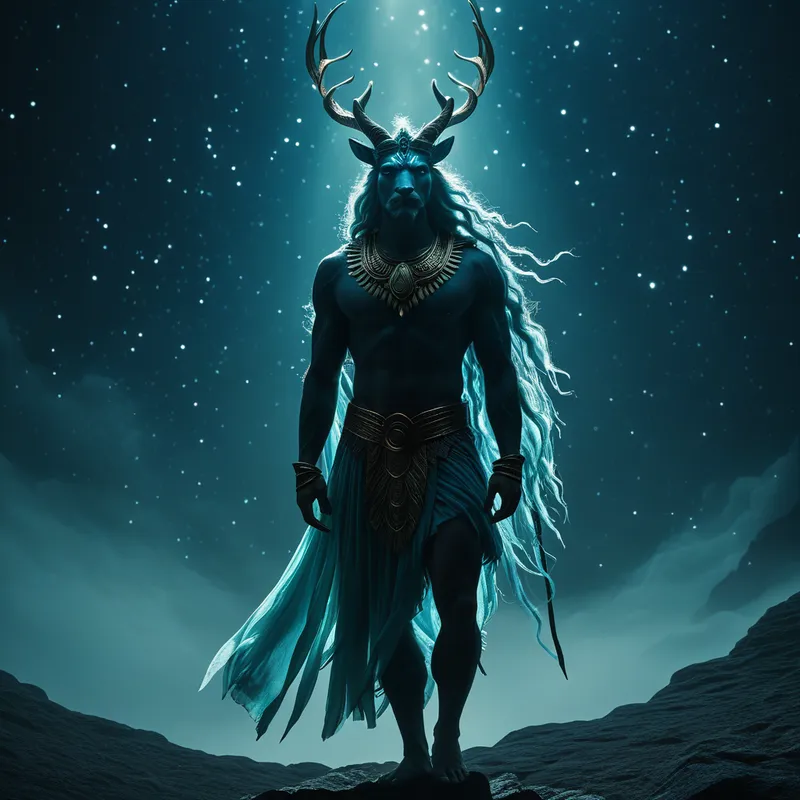
Shango and the Thunder Axe
The Yoruba god of thunder wields a legendary axe that symbolizes his power, justice, and fiery temperament, shaping myths of divine authority and retribution.
The Tale of Shango and the Thunder Axe
The story begins not with a god, but with a king. [Shango](/myths/shango “Myth from African Diaspora culture.”/), the fourth Alaafin of the Oyo Empire, was a ruler of immense charisma and terrifying force. His reign was marked by both prosperity and a simmering, volcanic temper. He was a man who commanded the elements, whose very anger seemed to draw the storm. Yet, his greatest power was also his deepest flaw. Betrayed by his subjects and accused of tyranny, Shango chose a fate of self-imposed exile and ultimate transformation. In a grove of ayan trees, consumed by a righteous fury that mirrored the coming storm, he performed the ultimate act of will: he hanged himself.
But from the physical [death](/myths/death “Myth from Tarot culture.”/) of the king, the divine orisha was born. His passage was not into silence, but into the roaring heart of the heavens. He ascended, taking his seat among the primordial forces. His essence became the storm itself. And from this apotheosis, his supreme tool was forged: the Thunder Axe, Oṣè.
The axe is not a mere weapon; it is the crystallized manifestation of his authority and his nature. When injustice stains [the earth](/myths/the-earth “Myth from Hindu culture.”/), when oaths are broken, or when the cosmic balance is threatened, Shango’s wrath is not a blind strike. It is a precise, terrifying adjudication. The Thunder Axe cleaves [the sky](/myths/the-sky “Myth from Persian culture.”/), a blinding fork of lightning that is its descent, and [the world](/myths/the-world “Myth from Tarot culture.”/)-shaking [thunderclap](/myths/thunderclap “Myth from Various culture.”/) that follows is the sound of its judgment striking home. It purifies through fire, shatters deception, and enforces a brutal, immediate form of [justice](/myths/justice “Myth from Tarot culture.”/). To hear the axe fall is to know that a line has been crossed, that a truth too long buried has been violently exhumed. Shango does not negotiate; he renders verdicts.
Cultural Origins & Context
Shango’s myth is deeply woven into the historical and spiritual fabric of the Yoruba people and the African diaspora. He is one of the most revered orisha in the Yoruba [pantheon](/myths/pantheon “Myth from Roman culture.”/), a deified ancestor-king whose worship spread from ancient Oyo across the Atlantic through the transatlantic slave trade. In the Americas, he became known as Changó in Santería/Lucumí, Xangô in Candomblé, and Nago Shango in Trinidad.
His dual nature as both a historical king and a primordial force of nature reflects a core Yoruba worldview: the profound interconnection between human lineage, political authority, and cosmic power. The Alaafin of Oyo was considered a sacred ruler, and Shango’s myth elevates this concept to its ultimate conclusion—the king who becomes the storm. His worship is not merely about fearing thunder; it is about venerating the principles of leadership, justice (ododo), and the assertive, sometimes destructive, power required to maintain social and cosmic order. His devotees seek his aid in matters of justice, protection, and the cultivation of personal power and confidence, embodying his fiery, charismatic energy.
Symbolic Architecture
The myth of Shango and his axe is a complex [structure](/symbols/structure “Symbol: Structure in dreams often symbolizes stability, organization, and the framework of one’s life, reflecting how one perceives their environment and personal life.”/) built on foundational symbols of [authority](/symbols/authority “Symbol: A symbol representing power structures, rules, and control, often reflecting one’s relationship with societal or personal governance.”/), transformation, and psychic force.
The Thunder Axe is the divine instrument that separates truth from falsehood. Its lightning is the sudden, illuminating insight that destroys old structures of deception; its thunder is the psychic shockwave that follows, rearranging the inner landscape.
Shango himself embodies the [archetype](/symbols/archetype “Symbol: A universal, primordial pattern or prototype in the collective unconscious that shapes human experience, behavior, and creative expression.”/) of the Ruler in its most dynamic and formidable [aspect](/symbols/aspect “Symbol: A distinct feature, quality, or perspective of something, often representing a partial view of a larger whole.”/). His is not a passive, inherited sovereignty, but an authority earned through a transformative ordeal—his symbolic [death](/symbols/death “Symbol: Symbolizes transformation, endings, and new beginnings; often associated with fear of the unknown.”/) and [rebirth](/symbols/rebirth “Symbol: A profound transformation where old aspects of self or life die, making way for new beginnings, growth, and renewal.”/). The axe represents the executive function of this rulership: the [capacity](/symbols/capacity “Symbol: A measure of one’s potential, limits, or ability to contain, process, or achieve something, often reflecting self-assessment or external demands.”/) to make decisive cuts, to enforce boundaries, and to deliver consequences. This is not cruelty, but a form of severe love for order. The [tension](/symbols/tension “Symbol: A state of mental or emotional strain, often manifesting physically as tightness, pressure, or unease, signaling unresolved conflict or anticipation.”/) in the myth lies in the balance between this necessary, righteous force and the potential for its descent into unchecked rage or tyranny, a [shadow](/symbols/shadow “Symbol: The ‘shadow’ embodies the unconscious, repressed aspects of the self and often represents fears or hidden emotions.”/) that Shango himself, as the historical [king](/symbols/king “Symbol: A symbol of ultimate authority, leadership, and societal order, often representing the dreamer’s inner power or external control figures.”/), had to confront.
The [thunderstorm](/symbols/thunderstorm “Symbol: A thunderstorm often symbolizes emotional upheaval, intense change, or the necessity for cleansing and renewal.”/), his primary manifestation, is a complete symbolic [event](/symbols/event “Symbol: An event within dreams often signifies significant life changes, transitions, or emotional milestones.”/): the gathering clouds (suppressed tension), the [lightning](/symbols/lightning “Symbol: Lightning symbolizes sudden insights or revelations, often accompanied by powerful emotions or disruptive change.”/) (sudden release and [clarity](/symbols/clarity “Symbol: A state of mental transparency and sharp focus, often representing resolution of confusion or attainment of insight.”/)), the [thunder](/symbols/thunder “Symbol: A powerful natural sound symbolizing divine communication, sudden change, or emotional release in arts and music contexts.”/) (audible impact and consequence), and the rain (purification and the return of [fertility](/symbols/fertility “Symbol: Symbolizes creation, growth, and abundance, often representing new beginnings, potential, and life force.”/) after the storm’s [passage](/symbols/passage “Symbol: A passage symbolizes transition, movement from one phase of life to another, or a journey towards personal growth.”/)). His colors, red and white, signify the duality of [blood](/symbols/blood “Symbol: Blood often symbolizes life force, vitality, and deep emotional connections, but it can also evoke themes of sacrifice, trauma, and mortality.”/)/fire/power and purity/justice/[spirit](/symbols/spirit “Symbol: Spirit symbolizes the essence of life, vitality, and the spiritual journey of the individual.”/).
The Dreamer’s Resonance
When the figure of Shango or his Thunder Axe strikes the dreamer’s [psyche](/myths/psyche “Myth from Greek culture.”/), it heralds an encounter with immense inner power. This is not a gentle nudge, but a wake-up call written in lightning. On a personal level, Shango represents the eruption of long-suppressed will, the moment when one can no longer tolerate injustice—whether from others or from one’s own self-betrayal. He is the courage to finally say “no,” to set a boundary with explosive finality.
Psychologically, he maps onto the process of confronting the Shadow in its most potent, aggressive form. Integrating Shango’s energy is not about becoming angry, but about reclaiming one’s right to exist with force and authority, to own one’s capacity for righteous indignation. He challenges the dreamer: Where have you been powerless? Where have you allowed falsehoods to stand? The thunderclap is the sound of a psychic breaking point, after which compromise is impossible and action is inevitable. He calls for the transformation of passive grief or simmering rage into focused, authoritative expression.
Alchemical Translation
The alchemical journey of Shango is one of [solve et coagula](/myths/solve-et-coagula “Myth from Alchemical culture.”/)—dissolve and coagulate—through the element of fire. The mortal king must be dissolved in the flames of his own downfall and public shame to be reconstituted as [the immortal](/myths/the-immortal “Myth from Taoist culture.”/) god. His axe is the tool of this sacred operation.
The lightning bolt is the spark of the soul, the divine fire that in an instant reduces the complex dross of circumstance to its essential truth. The alchemist seeking Shango’s wisdom must be willing to let their old, compromised structures be struck and burned away.
This is the fire of purification and discrimination. In the inner work, the Thunder Axe represents the incisive power of discernment. It is the ability to cut through confusion, emotional entanglement, and self-deception to see the core of a matter. The subsequent “thunder” is the vibrational integration of that new truth into one’s being, a process that can feel disruptive and overwhelming. The goal of this inner alchemy is not destruction for its own sake, but the creation of a stronger, more authentic, and justly ordered self—a self that can wield its own power with responsibility and clarity, having passed through the storm of its own becoming.
Associated Symbols
Explore related symbols from the CaleaDream lexicon:
- Thunder — The audible proclamation of divine power and judgment, the shockwave that follows a moment of transformative clarity or decisive action.
- Lightning — The sudden, illuminating strike of truth or inspiration that cleaves darkness and ignorance, representing instantaneous change and divine force.
- Fire — The purifying and destructive element of transformation, symbolizing Shango’s temperament, his cleansing wrath, and the spiritual energy of ashé.
- Justice — The core principle of moral order and retribution that Shango’s axe serves to enforce, representing cosmic and social balance.
- Power — The raw capacity for action and authority, embodied by Shango as both a political ruler and a natural force, demanding responsible engagement.
- Rage — The volatile, passionate energy that can be destructive but also a catalyst for necessary upheaval and the defense of boundaries.
- King/Ruler — The archetype of sovereign authority, leadership, and the responsibility to maintain order, reflected in Shango’s dual role as deified monarch and orisha.
- Storm — The complete atmospheric phenomenon of gathering tension, explosive release, and subsequent cleansing, mirroring psychological cycles of crisis and renewal.
- Axe — The tool of decisive separation and execution of will, symbolizing the ability to cut away falsehood and enact judgment.
- Thunderclap — The moment of shocking realization or impact that irrevocably changes a situation, the sound of consequence arriving.
- Mountain — A symbol of stability, majesty, and a meeting place between heaven and earth, akin to Shango’s role as an intermediary of celestial power.
- Rebirth — The fundamental process of dying to an old state and being born into a new, higher one, as exemplified by Shango’s transformation from hanged king to thunder god.