Shamrock Myth Meaning & Symbolism
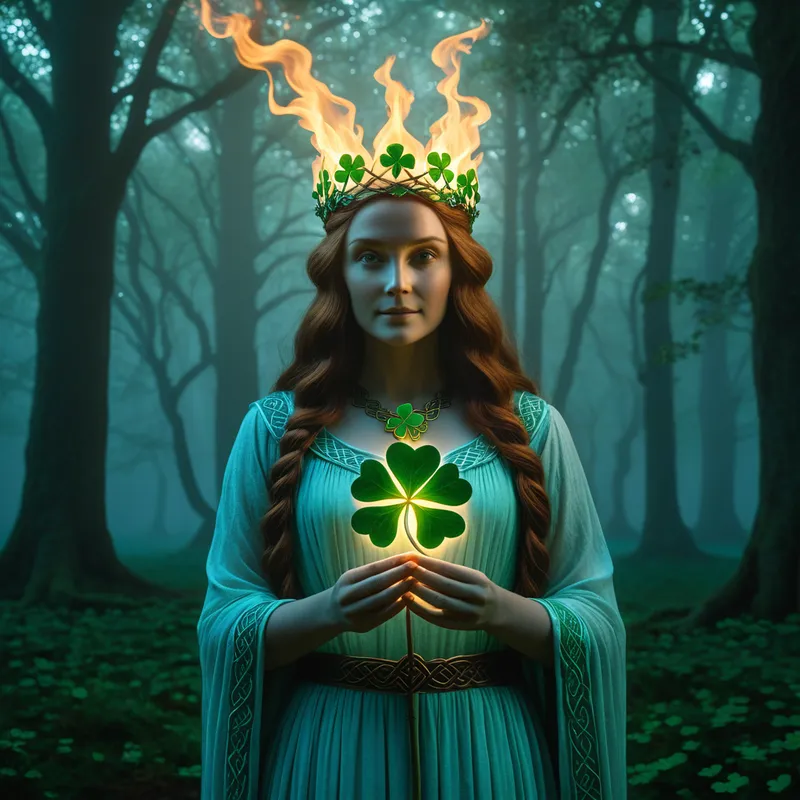
A tale of the goddess Brigid weaving a three-leafed charm from memory, light, and shadow to guide lost souls back to wholeness.
The Tale of Shamrock
Listen, and let the fire’s crackle become the rustle of oak leaves in a time before time. [The world](/myths/the-world “Myth from Tarot culture.”/) was younger, and [the veil](/myths/the-veil “Myth from Various culture.”/) between the realms—[Tír na nÓg](/myths/tr-na-ng “Myth from Celtic culture.”/), [the world](/myths/the-world “Myth from Tarot culture.”/) of mortals, and the deep [underworld](/myths/underworld “Myth from Greek culture.”/) of memory—was thin as morning mist.
In those days, the light of Brigid was a constant comfort. Her flame warmed the forge, inspired [the bard](/myths/the-bard “Myth from Celtic culture.”/)’s tongue, and healed the warrior’s wound. But a creeping forgetfulness began to spread. Mortals, in their toil and [triumph](/myths/triumph “Myth from Roman culture.”/), started to lose the thread. They forgot the songs of their ancestors, the language of the land, and the sacred paths that connected the three realms of their own being: body, mind, and spirit. Lost in a single realm, they became fragmented, anxious shadows of themselves.
Brigid walked the green hills of Éire, her heart heavy. She saw a farmer who knew only the weight of his plow, forgetting the story of the seed. She saw a chieftain who knew only the strength of his arm, forgetting the wisdom of the council. A deep, psychic winter threatened to settle, not of frost, but of amnesia.
She went to the oldest well, at the foot of the world-tree, where the waters of the three realms mingled. There, she did not call for a weapon or a shout, but for a remembrance. She knelt and scooped not [water](/myths/water “Myth from Chinese culture.”/), but the very substance of the realms. From the first light of dawn, she drew a strand of pure, guiding Illumination. From the fertile, dark soil beneath the oak, she drew a strand of grounded Substance. And from the silver mist rising from the well—the breath of all who had come before—she drew a strand of eternal Memory.
With fingers that could shape a sword or a lullaby, she began to weave. The light, the dark, and [the mist](/myths/the-mist “Myth from Celtic culture.”/) braided together, not in a line, but in a circle, finding a perfect, triune balance. As she whispered a blessing of belonging, the braid settled into a form: three heart-shaped leaves joined at a single stem. It was not a flower of fleeting beauty, but a humble, resilient plant. She breathed upon it, and it took root in the moss by the well.
Where it grew, the fog in the mind lifted. The fragmented souls who wandered near would see its simple form. The three leaves spoke wordlessly to their own tripartite nature. The farmer remembered the song of [the earth](/myths/the-earth “Myth from Hindu culture.”/). The chieftain felt the counsel of his ancestors. They were not conquered, but re-membered. [The shamrock](/myths/the-shamrock “Myth from Celtic culture.”/) did not shout its truth; it hummed it, a green, living sigil against the grey of forgetting, a map for the soul’s return home.
Cultural Origins & Context
The shamrock, as a definitive mythological narrative, is not found in the great epic cycles like the Mythological Cycle or the Ulster Cycle. Its power flows from a deeper, more pervasive source: the folk tradition and the intimate, daily spirituality of the Gaelic world. This is a “small myth,” one told not by bards in chieftains’ halls, but by grandmothers, healers, and wise women at the hearthside.
Its association with Lugh or, more commonly, with the goddess Brigid, ties it to the fundamental Celtic reverence for the triad. The Celtic mind saw sacredness in threes: the three realms (Land, Sea, Sky), the three phases of life, the triple aspects of the goddess (as maiden, mother, and crone). The shamrock became a living emblem of this worldview. Its societal function was pedagogical and integrative. It was a teaching tool, a natural symbol used to explain complex spiritual concepts of unity, balance, and interconnection. Before it became a national symbol, it was a spiritual one—a key to understanding the structure of a cosmos that was inherently triune.
Symbolic Architecture
The shamrock’s symbolic power is deceptively simple, residing in the [number](/symbols/number “Symbol: Numbers in dreams often symbolize meaning, balance, and the quest for understanding in the dreamer’s life, reflecting their mental state or concerns.”/) three and the act of joining. It is a [mandala](/symbols/mandala “Symbol: A sacred geometric circle representing wholeness, the cosmos, and the journey toward spiritual integration.”/) of wholeness.
The triad is the first pattern to emerge from the unity, the simplest structure that can contain tension, relationship, and dynamic balance.
Psychologically, the three leaves represent fundamental aspects of [the self](/myths/the-self “Myth from Jungian culture.”/) often at odds. We can frame them as [Body](/symbols/body “Symbol: The body in dreams often symbolizes the dreamer’s self-identity, personal health, and the relationship they have with their physical existence.”/) (Substance), Mind ([Illumination](/symbols/illumination “Symbol: A sudden clarity or revelation, often representing spiritual awakening, intellectual breakthrough, or the dispelling of ignorance.”/)), and [Soul](/symbols/soul “Symbol: The soul represents the essence of a person, encompassing their spirit, identity, and connection to the universe.”/) ([Memory](/symbols/memory “Symbol: Memory symbolizes the past, lessons learned, and the narratives we construct about our identities.”/)); or as Conscious, Personal Unconscious, and [Collective Unconscious](/symbols/collective-unconscious “Symbol: The Collective Unconscious refers to the part of the unconscious mind shared among beings of the same species, embodying universal experiences and archetypes.”/); or even as Past, Present, and Future. The myth of Brigid weaving them addresses the primal [human](/symbols/human “Symbol: The symbol of a human represents individuality, complexity of emotions, and social relationships.”/) wound of [fragmentation](/symbols/fragmentation “Symbol: The experience of breaking apart, losing cohesion, or being separated into pieces. Often represents disintegration of self, relationships, or reality.”/)—the feeling that we are not one, but many conflicting parts. The single stem is the essential, indivisible Self that underlies all these aspects. The shamrock does not erase the differences between the leaves; it sanctifies their union. It is an [antidote](/symbols/antidote “Symbol: A substance or remedy that counteracts poison, illness, or harmful influences, symbolizing healing, protection, and restoration.”/) to [dissociation](/symbols/dissociation “Symbol: A psychological separation from one’s thoughts, feelings, or identity, often experienced as a journey away from the self during trauma or stress.”/), a [symbol](/symbols/symbol “Symbol: A symbol can represent an idea, concept, or belief, serving as a powerful tool for communication and understanding.”/) that one can be grounded, inspired, and connected to [lineage](/symbols/lineage “Symbol: Represents ancestral heritage, family connections, and the transmission of traits, values, and responsibilities across generations.”/) all at once.
The Dreamer’s Resonance
When the shamrock appears in a modern dream, it rarely arrives with fanfare. It is found growing through a crack in the concrete, glimpsed in a forgotten corner of a dream-garden, or held quietly in the hand of a dream guide. Its appearance signals a process of psychic integration.
Somatically, the dreamer may experience a release of tension, a deep sigh, or a feeling of “coming together.” Psychologically, they are navigating a situation where they feel pulled in different directions—torn between career, family, and personal passion; or conflicted between logic, emotion, and intuition. The shamrock in the dream is the unconscious offering a model for resolution. It suggests that the solution is not to choose one leaf over the others, but to find the central stem, the core identity or value from which all these aspects healthily grow. It is a dream of reconciliation, urging the dreamer to stop fighting their own complexity and to instead discover the unifying pattern within it.
Alchemical Translation
The alchemical journey is one of separating, purifying, and recombining ([solve et coagula](/myths/solve-et-coagula “Myth from Alchemical culture.”/)) to create a more refined, golden self. The myth of the shamrock models a profound, yet gentle, version of this transmutation.
The “base material” is the fragmented, forgetful state of the mortal soul. Brigid, the anima figure or spiritual catalyst, performs the operation. She separates (solve) the pure essences of Light, Shadow, and Mist from their chaotic blend in the world. She purifies them by intention, drawing out their core qualities. Finally, she recombines (coagula) them into a new, sacred unity—the shamrock. This is the creation of the [Lapis Philosophorum](/myths/lapis-philosophorum “Myth from Alchemical culture.”/), not as a stone, but as a living pattern of being.
Individuation is not the cultivation of a single, perfect leaf, but the courageous gardening of the entire plant—tending the shadows as diligently as the light, and watering all with the deep waters of memory.
For the modern individual, the struggle is the feeling of being pulled apart by life’s demands. The triumph modeled by the myth is not a heroic victory over an external foe, but the quiet, internal work of weaving. It is the act of consciously connecting our practical daily life (Body/Substance), our intellectual and creative sparks (Mind/Illumination), and our inherited traumas, gifts, and deep cultural soul (Spirit/Memory). To “find your shamrock” is to perform this alchemy on yourself, to become your own Brigid, and to root your complex existence in a simple, unshakable unity. You become both the weaver and the woven, [the gardener](/myths/the-gardener “Myth from Christian culture.”/) and the sacred, three-leafed green.
Associated Symbols
Explore related symbols from the CaleaDream lexicon: