Seven Years of Famine Myth Meaning & Symbolism
A pharaoh's prophetic dream of seven fat and seven lean cattle reveals a coming famine, prompting a cycle of preparation, endurance, and eventual restoration.
The Tale of Seven Years of Famine
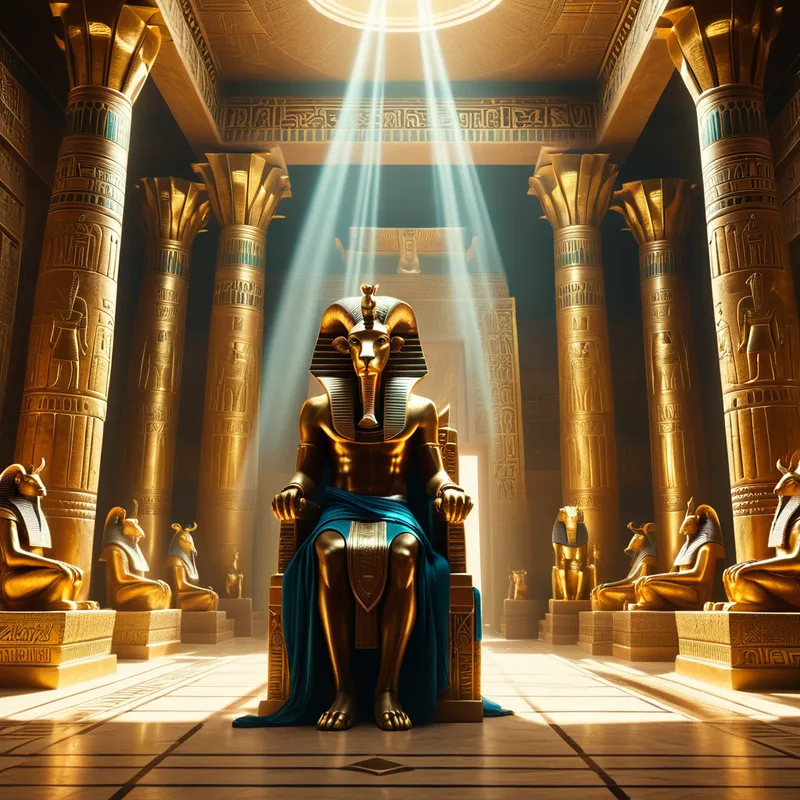
The air in the palace of Pharaoh Djoser was thick with the scent of lotus and fear. Sleep, that fickle gift of the gods, had abandoned the Lord of the Two Lands. When it finally came, it was not rest, but a visitation. In the silent, star-dusted chamber of his mind, the Nile itself seemed to speak. He saw the great river, and from its fertile black waters emerged seven cattle, sleek and magnificent, their hides gleaming like polished obsidian, their muscles rolling like the river’s current. They grazed upon the emerald banks, a vision of boundless prosperity.
But the vision turned. The waters grew troubled. From the same depths came seven more cattle, wretched and gaunt, their ribs like the struts of a broken boat, their hides clinging to bone. They consumed the fat cattle, yet their hunger was not sated; they remained skeletal, a blight upon the land. The pharaoh awoke, his heart a drum of dread. The dream returned, a second terrible prophecy: seven ears of grain, full and golden on a single stalk, were devoured by seven thin, blasted ears, withered by the east wind.
Terror gripped the kingdom. The priests of every nome burned incense, searching the sacred texts. But the meaning lay hidden, a secret known only to the gods. In his despair, Djoser sent for his chief architect, the sage Imhotep. This man, whose mind was a library of stone and star, did not consult scrolls alone. He journeyed to the temple of Khnum, the potter-god who shaped the very Nile from his celestial wheel.
There, in the incense-heavy dark before the god’s statue, the truth was revealed. Imhotep returned to the pharaoh, his face etched with solemn understanding. “The seven fat cattle and the full ears are seven years of great abundance,” he declared, his voice echoing in the hushed court. “The seven lean cattle and the withered ears that follow are seven years of famine. The dream was doubled because the thing is fixed by the god, and He will shortly bring it to pass.”
But this was not a sentence of doom; it was a blueprint for salvation. The god’s message, through Imhotep, was a command of foresight. “Let the king appoint commissioners over the land,” the sage instructed. “And let them take one-fifth of all the harvest of the seven years of plenty. Let them gather all the food and store the grain under the authority of Pharaoh, to be used as a reserve for the seven years of famine.”
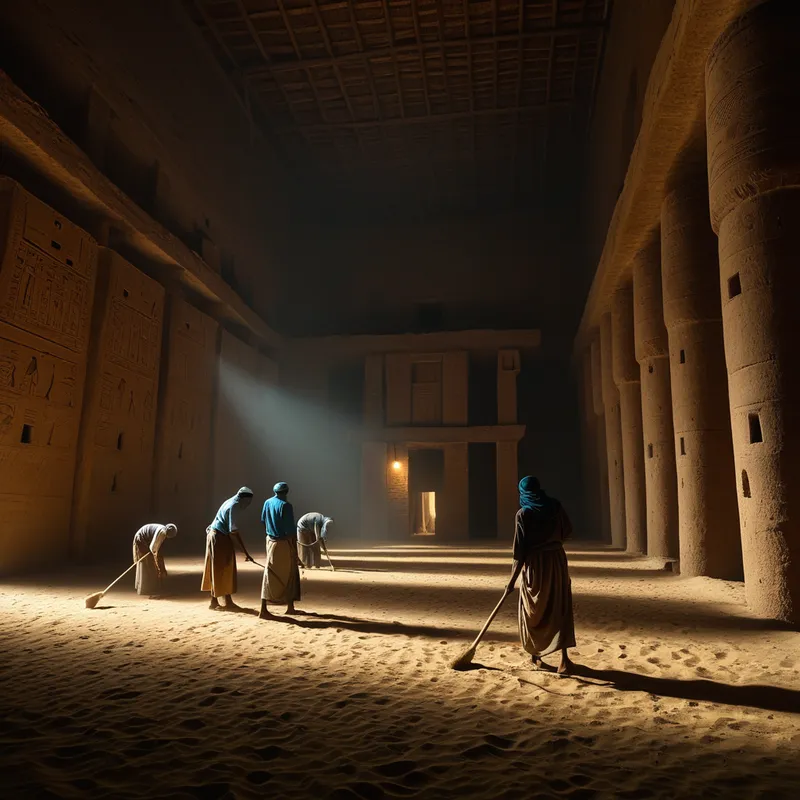
And so it was done. For seven years, the Kemet yielded a bounty unheard of. Granaries rose like mountains along the river, built of stone to last for ages, filled to their ceilings with golden grain. Then, as foretold, the life-giving inundation failed. The east wind, the breath of the desert god Set, grew hot and relentless. The earth cracked. The Nile ran low and slow. Famine gripped the Two Lands.
Yet in the midst of the great hunger, the granaries of the pharaoh stood full. The people came, not as beggars to an empty throne, but as subjects to a prepared ruler. The grain was measured out, a steady ration sustaining the kingdom through the long, parched years. The lean cattle did not devour the land, for the wisdom of the dream had turned prophecy from a curse into a covenant. The kingdom endured, and when the Nile’s flood finally returned, strong and sweet, it was a restoration born not of chance, but of sacred, enacted foresight.
Cultural Origins & Context
The myth of the Seven Years of Famine is most famously recorded on the Famine Stela at Sehel Island, a Ptolemaic-era text that hearkens back to the reign of the much earlier Pharaoh Djoser of the Third Dynasty. While the stela itself is a later commemoration, it anchors the story in a deep cultural memory of cyclical crisis and divine kingship. This was not mere folklore; it was a political and theological document. By linking Djoser and Imhotep—both figures of immense cultural authority—to the direct intervention of Khnum, the stela validated Ptolemaic rule during a period of stress, demonstrating that a true pharaoh is one who intercedes with the gods to ensure the Nile’s bounty.
The story functioned as a societal anchor. In a civilization utterly dependent on the Nile’s annual, unpredictable flood, the threat of famine was the ultimate existential fear. This myth provided a narrative framework for that fear. It explained suffering not as random cruelty, but as part of a divine, knowable pattern. More importantly, it prescribed the solution: the centralization of authority and resources. The pharaoh, as the intermediary with the divine, was responsible for reading the signs (the dreams) and enacting the practical, earthly strategy (the granaries) to shepherd the people through the inevitable lean years. It was a myth that justified the state’s tax (“one-fifth of all the harvest”) as a sacred insurance policy.
Symbolic Architecture
At its heart, this is a myth about the confrontation with cyclical time and the shadow of abundance. The seven fat years and seven lean years represent the inevitable polarity of existence: expansion and contraction, fullness and emptiness, summer and winter of the soul. The doubling of the dream signifies its immutable, archetypal nature.
The famine is not an invasion from outside; it is the latent potential within the bounty itself. The lean cattle emerge from the same sacred river as the fat ones.
The central symbolic figure is not the pharaoh, but the sage Imhotep. He represents the awakened consciousness—the part of the psyche that can interpret the disturbing symbols from the unconscious (the dreams) and translate them into a plan for consciousness. The god Khnum is the archetypal source, the Self that communicates through dreams. The granaries are the critical symbol of the constructed container—the ego-structure, tradition, or conscious discipline built during times of psychic energy (libido) that can preserve sustenance when that energy inevitably recedes into the unconscious.

The Dreamer's Resonance
When this myth pattern stirs in the modern dreamer, it often manifests not as Egyptian imagery, but as a profound somatic and emotional landscape. One may dream of a bountiful garden that suddenly withers, of a feast that turns to dust in the mouth, or of saving vast resources for a “rainy day” that lasts for years. The body may feel the dream: a sudden chill in a warm room, a sense of hollow hunger after a full meal.
This is the psyche signaling a transition from a period of psychic expansion—a time of creativity, relationship, or outward success—into a necessary period of contraction. The “famine” is the onset of what Jung called a numinous depression. It feels like barrenness, but it is a sacred barrenness. The dream is a warning from the Self: the easy nourishment of the previous phase is ending. The dreamer is being called to identify their “granaries”—what inner resources, insights, or practices did they build during the good times that they can now draw upon? The anxiety in the dream is the ego’s fear of the coming depletion, but the deeper message is one of preparation and trust in the cycle.

Alchemical Translation
The alchemical journey mirrored in this myth is the process of mortificatio and separatio leading to a more conscious individuation. The seven fat years represent the initial, unconscious state of identification with abundance, success, or the persona. One is simply in the flow, “grazing” on what life provides. The terrifying dream is the nigredo, the first blackening, where the shadow (the lean cattle) is seen to be part of the whole system.
The alchemical work begins not when the famine strikes, but in the moment of prophetic dread. Consciousness is born from the disruption of bliss.
The hero’s task, embodied by Imhotep and enacted by Djoser, is the separatio: to consciously separate one-fifth of the harvest. This is the crucial psychological act of setting aside a portion of one’s psychic energy for introspection and inner work during the good times, when it is most tempting to spend it all outwardly. Building the granary is the discipline of journaling, therapy, meditation, or creative practice—the structure that will hold meaning when the inner Nile fails.
The seven years of famine are the extended mortificatio, the necessary dissolution of the old, inflated identity that lived only in the “fat” years. One must live on the stored, distilled grain of insight, not on fresh, easy emotion. This is a period of endurance, of living consciously from the core. The return of the flood is not a return to the old, unconscious bounty, but a renewal—the albedo or whitening. The land is the same, but the people and the king have been transformed by the ordeal. They now know the cycle intimately. The individual who navigates this myth consciously moves from being a passive subject of life’s cycles to becoming the steward of their own soul, building inner granaries against the inevitable, and sacred, winters of the spirit.
Associated Symbols
Explore related symbols from the CaleaDream lexicon: