Seven Sleepers Arabian Version Myth Meaning & Symbolism
Young believers flee persecution, sleep for centuries in a cave, and awaken to a world transformed, becoming timeless witnesses to divine protection.
The Tale of Seven Sleepers Arabian Version
Hear now a tale whispered by the desert wind, carried on the trade routes from the Levant to the Jazirat al-Arab. It begins not in peace, but in the shadow of a tyrant’s wrath.
In the city of Ephesus, under the rule of a pagan king who demanded worship of stone and fire, lived seven young men of noble heart. They served in the king’s court, but in secret, they had turned their faces to the One, the Unseen God, rejecting the idols of their fathers. When the decree came—bow to the idols or face death—their souls knew no compromise. With a faith as fierce and pure as the noonday sun, they cast aside their titles and riches. They fled into the wild, pursued by the king’s soldiers, their only wealth the conviction in their hearts.
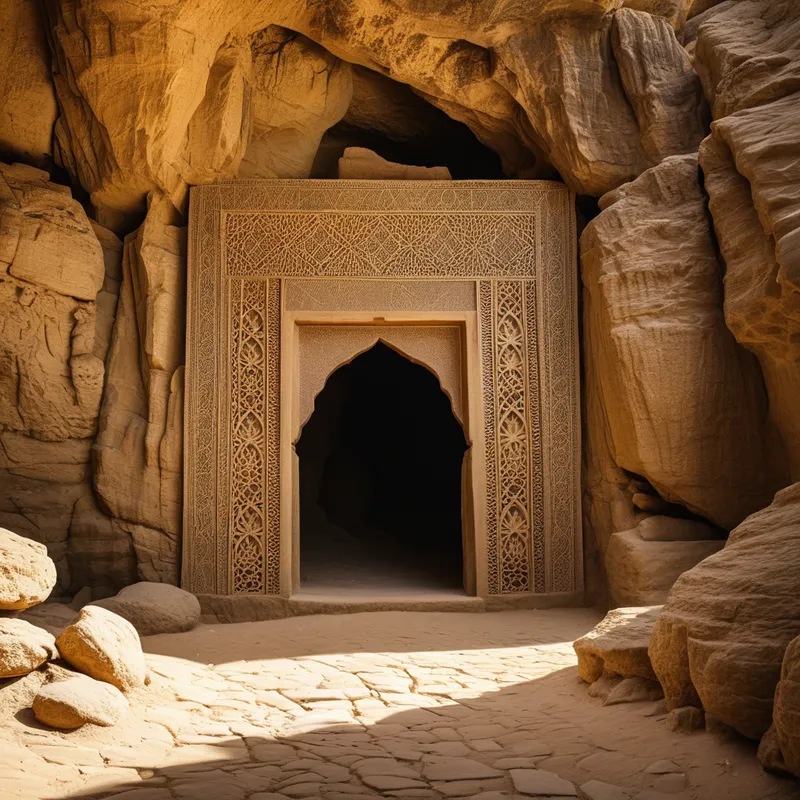
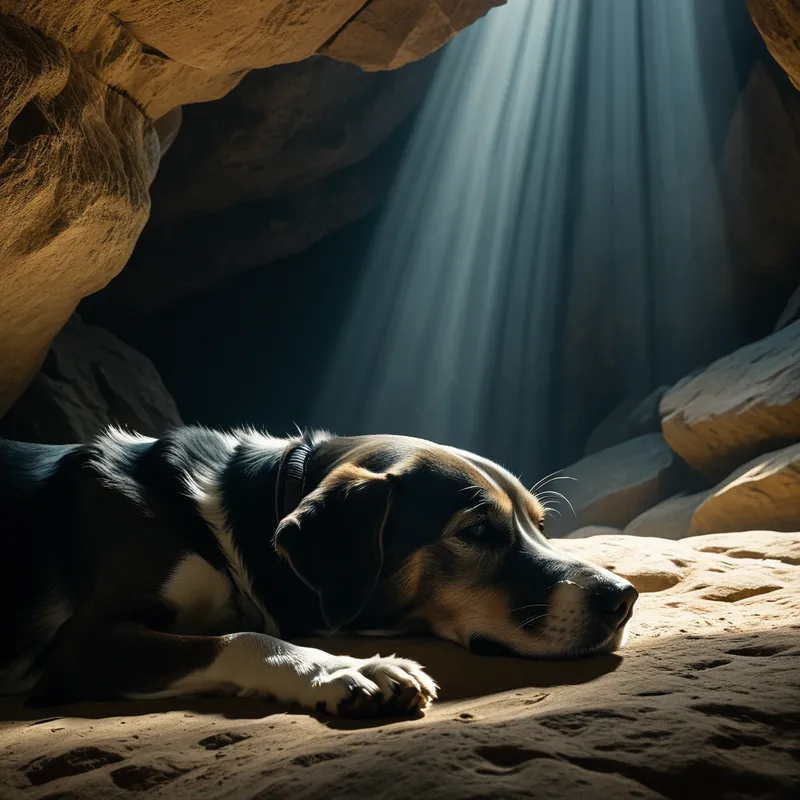
Their flight led them to the breast of a mountain, to the mouth of a cave named al-Raqim. As they entered its cool, dark embrace, a faithful hound, Qitmir, followed and lay down at the threshold. Weary in body but steadfast in spirit, they prayed for mercy. And the Mercy of the Merciful descended upon them. Not death, but a profound, enveloping sleep took them. Their eyes closed, and their bodies settled into the earth as if returning to it.
While they slept, the world turned. The tyrant king passed into dust. New empires rose and fell outside the stone door. Centuries flowed like a river past the cave’s mouth. God, in His wisdom, turned their bodies in their sleep so the earth would not consume them, and He set a seal upon the cave, hiding them from sight.
Then, in the fullness of time, the divine will stirred them. A shepherd, seeking a place to pen his flock, moved the stones at the entrance. The light of a new age pierced the darkness. One among them, Yamlikha, awoke. He rose, stiff with the sleep of ages, and ventured out to buy bread with ancient coins, fearing they had slept but a day. The world he entered was unrecognizable. The crosses above the city gates spoke of a new faith—his faith, now triumphant. When he offered his outdated coin, the people marveled, speaking of a legend of holy youths lost centuries ago.
The truth unfolded like a miracle. The city’s bishop and ruler came to the cave and saw the seven, now awake, their faces radiant with a timeless youth. They had borne witness not through action, but through surrender; not through conquest, but through patient sleep. Having delivered their final testimony to the power of faith over time, they were gathered back into the eternal sleep from which there is no waking, leaving behind a tale that would echo forever. The cave became a sanctuary, and Qitmir, the loyal guardian, was granted a place in the story for all time.
Cultural Origins & Context
This narrative, known widely as the Aṣḥāb al-Kahf, is deeply embedded in the Islamic spiritual and literary tradition. Its most authoritative telling is found within the Qur’an, in Surah al-Kahf. Here, it is not merely a story but a divine sign, a ayah addressing themes of resurrection, divine protection, and the relativity of time. The Qur’anic account is evocative yet elliptical, focusing on the mystery of their state and God’s sovereignty, which sparked extensive exegesis (tafsir) and storytelling.
Pre-Islamic Christian versions from the Syrian tradition likely traveled along trade routes, finding fertile ground in the Arabian Peninsula. In the Islamic context, it was refined and essentialized, becoming a cornerstone parable of unwavering faith (iman) in the face of persecution (shirk). It functioned as societal proof of God’s power to preserve the faithful and as a metaphysical lesson on the nature of time—a day with God being as a thousand years. Told in mosques and recounted in poetry, it served to strengthen the community’s resolve, offering a template of patient endurance (sabr) with the promise of ultimate divine vindication.
Symbolic Architecture
The myth is a profound symbolic vessel for the soul’s journey through cycles of crisis, withdrawal, and transformation.
The cave is not a tomb, but the womb of time where the soul gestates beyond the reach of a hostile world.
The seven youths represent the nascent, vulnerable soul or consciousness that chooses integrity over collective compliance. Their flight is the necessary withdrawal from a dominant, spiritually oppressive order. The cave symbolizes the deep unconscious, a place of protective incubation. Their centuries-long sleep is not inactivity but a profound process of psychic preservation outside of linear time. Qitmir, the loyal dog, embodies instinctual faithfulness and the protective threshold between the inner sanctum and the outer world.
The awakening into a transformed world signifies the soul’s return after a period of introversion, now finding the outer reality has aligned with its inner truth. The core alchemy is one of patient witnessing: by holding true and surrendering to a divine rhythm, the soul becomes a timeless testament, transforming persecution into legacy.
The Dreamer’s Resonance
When this myth stirs in modern dreams, it often signals a profound process of psychic hibernation and impending awakening. To dream of being one of the sleepers, or of discovering such a cave, points to a soul in a necessary state of retreat. The conscious ego may feel stuck, dormant, or isolated—“asleep at the wheel” of life.
Somatically, this can feel like a heavy lethargy, a sense of being out-of-sync with the frantic pace of the world. Psychologically, it is a deep introversion where the psyche is reorganizing itself around a core, authentic truth that the waking life may not yet support. The dream is an affirmation: this withdrawal is not failure, but a sacred process. The anxiety in such dreams often revolves around “waking up too soon” or being discovered before the transformation is complete. It is the psyche’s way of modeling the courage required to remain in the fertile darkness until the time is right for re-emergence.
Alchemical Translation
The myth perfectly models the stage of the individuation process known as the nigirado, or the descent into the unconscious for purification.
The true work is done in the silent cave of the heart, where worldly time dissolves and the soul is re-oriented to its eternal source.
The initial conflict—the tyrannical king’s demand—represents the oppressive power of the persona or collective expectations that threaten the nascent individual spirit. The flight is the conscious decision to abandon this false self, however perilous. Entering the cave is the commitment to the inner journey, to confronting the unconscious. The long sleep is the often-frustrating period of incubation, where the ego feels it is doing nothing, but the Self is orchestrating a fundamental realignment.
The awakening is the culmination of this alchemical process: the opus is complete. The individual re-emerges, not to fight the old king (who is now dust), but to find the outer world has new meaning. The old coins of one’s former identity are obsolete; a new currency of being is required. The process transmutes the base metal of persecuted faith into the gold of timeless witness. One becomes, psychologically, a living bridge between eras—integrating a deep, ancient truth into a contemporary consciousness.
Associated Symbols
Explore related symbols from the CaleaDream lexicon:
- Cave — The primal sanctuary of the unconscious, a place of incubation, protection, and profound transformation where linear time holds no power.
- Sleep — A state of suspended animation and psychic processing, representing necessary withdrawal, preservation, and gestation beyond active striving.
- Door — The threshold between worlds—conscious and unconscious, persecution and sanctuary, one era and the next—guarded by instinct and fate.
- Time — The relativity of temporal experience, symbolizing how soul-work operates on a timescale distinct from the ego’s frantic measurements.
- Stone — The sealing and revealing element of the cave, representing both divine protection that conceals and the earthly reality that endures across ages.
- Light — The divine mercy that induces the sacred sleep and the new dawn of understanding into which the transformed soul awakens.
- Dog — Instinctual loyalty and protection; the faithful companion (Qitmir) who guards the threshold of the soul’s sacred retreat.
- Coin — The obsolete currency of an old identity and era, symbolizing the need to exchange past understandings for new realities upon awakening.
- Mountain — The elevated, enduring place of refuge and trial, representing the spiritual ascent required to reach the place of transformation.
- Faith — The unwavering, inner conviction that motivates the flight and sustains the soul through the long darkness of unknowing.
- Rebirth — The core theme of awakening into a world made new, where the soul is preserved and emerges validated, though physically unchanged.
- Fear — The initial catalyst of persecution that forces the choice between conformity and the perilous journey toward integrity.