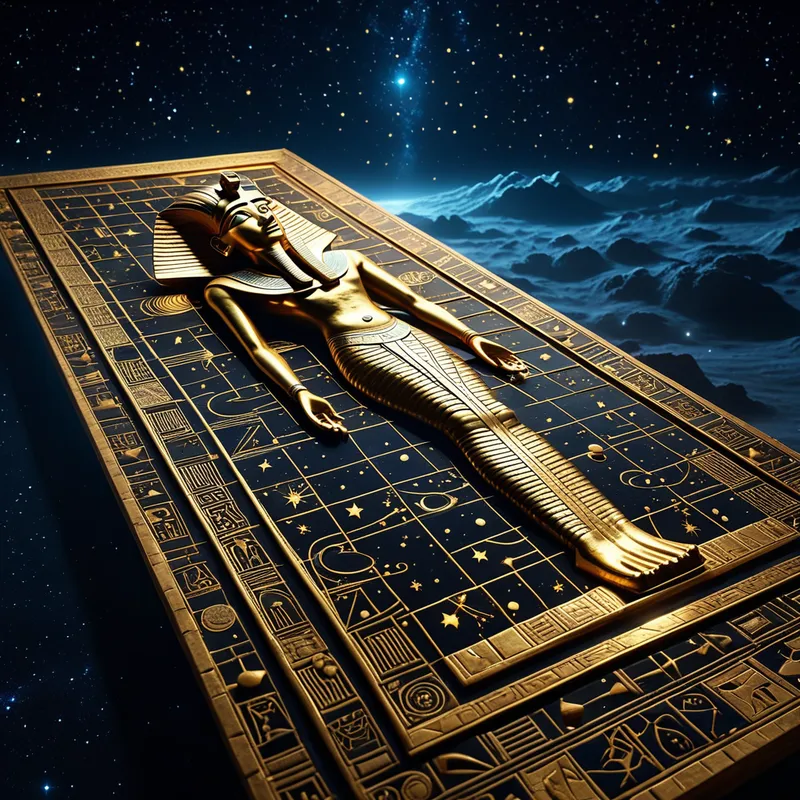
Senet Board Myth Meaning & Symbolism
An ancient board game becomes a sacred map, guiding the soul through the perilous underworld toward rebirth and union with the divine light.
The Tale of the Senet Board
Listen, and hear the rattle of fate in the dark. It is not the sound of bones, but of painted knucklebones tumbling upon a stone table. The air in the chamber is thick with incense and the silence of deep earth. Before the seated figure—a soul stripped of its earthly name, a Ba trembling on the threshold—lies the field of thirty squares. The Senet Board.
This is no pastime. This is the final, solemn play. The opponent is not flesh, but the silent, watching presence of Osiris, Lord of the Perfect Black, whose green-skinned visage adorns the far corner of the board. The goal is not mere victory, but passage. To move from the House of Netherworld Blues, through the chaos of the River of Twisting, past the lurking jaws of the Ammit, and into the House of Re-Atum, the place of becoming One with the Light.
The player’s fingers, spectral and cold, grasp a piece of polished jet. The first cast. The pieces advance, a slow march across a landscape painted in symbols of peril and grace. Here, the square of the Set-animal, a place of storm and confusion where a piece may be thrown back, lost in the howling sandstorm of doubt. There, the square of the Three Truths, a moment of respite, a sip from the waters of memory.
The middle game is a struggle in the dark. Pieces are blocked, sent back to start, as if the very board breathes with malice. The player feels the weight of a lifetime—every false word, every neglected duty—as a tangible resistance. Shadows deepen in the corners of the chamber. Something with crocodile jaws and lioness haunches stirs in the periphery. The House of Waters, a square of beautiful danger, threatens to drown the unwary in the primordial Nun from which all arose and to which all un-purified things return.
But the player remembers the spells from the Book of the Dead. A whisper passes cracked lips, a name of power. The dice obey. A piece slips past a blockade, finding the square of Thoth, the ibis-headed scribe of the gods. A path clears.
The final rows are a race against the dying of the soul’s own light. The last cast must be exact. No more, no less. To overshoot the final square is to fall into oblivion. The player’s entire being focuses into the toss. The knucklebones spin, a tiny universe of chance and destiny. They land. The number is perfect.
The jet piece slides into the final square, the House of Re-Atum. A sound like a shattering crystal fills the silence, yet it is not loud. The board itself begins to glow, the squares dissolving into points of light. The opposing pieces, the shadows of the self, vanish. The player looks up. Before them, no longer a painted image but a living presence, stands Osiris, his crook and flail crossed over his chest. His eyes are stars. He does not speak, but a knowledge floods the chamber: the game is won. The gates of the Aaru swing open on silent hinges. The journey through the Duat is complete. The soul has played itself into eternity.
Cultural Origins & Context
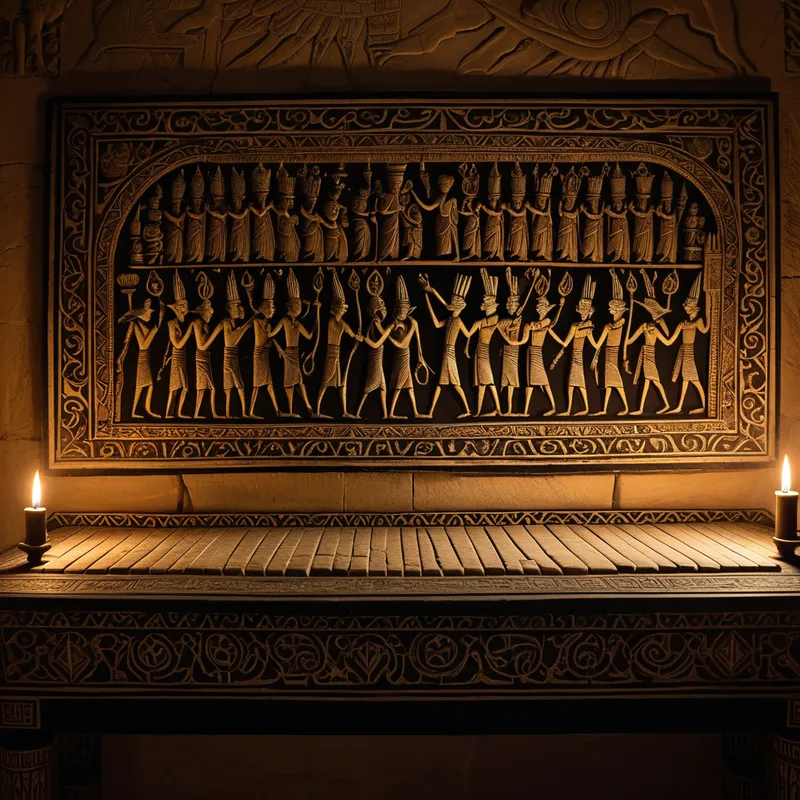
The myth of the Senet Board is unique; it is not a narrative passed down by bards, but a ritual encoded in wood, faience, and ivory. Emerging in the Predynastic Period, Senet began as a common board game. By the time of the New Kingdom (c. 1550–1070 BCE), it had undergone a profound alchemy, transforming from entertainment into a central metaphor for the soul’s perilous journey after death. This transformation was documented in the Coffin Texts and the Book of the Dead, where Chapter 17 explicitly states, "As for him who knows this spell, he will be a worthy spirit in the realm of the dead… his Senet-game will be played in the underworld."
The myth was enacted, not recited. It was performed by the deceased in proxy, through the spells and amulets placed in the tomb, and likely in life by priests and initiates as a meditative practice. The board itself, often placed in the tomb or depicted in tomb paintings, was a functional talisman—a literal map for the Ba to navigate the Duat. Its societal function was twofold: it provided a concrete, interactive schema for understanding the abstract terrors of the afterlife, and it reinforced the core Egyptian doctrine that a righteous life (Maat) was necessary to navigate divine judgment. To play Senet was to rehearse one’s own death and vindication.
Symbolic Architecture
At its heart, the Senet myth is a masterful symbolic system for the individuation process. The board is the mandala of the self, a bounded cosmos where inner conflicts are made objective and played out to resolution.
The thirty squares represent the totality of the psychic life, with its fixed stations of challenge (the House of Netherworld Blues, the square of Set) and grace (the Three Truths, the House of Re-Atum). The player’s pieces are the fragmented aspects of the psyche—the persona, the anima/animus, the shadow—all seeking integration and safe passage. The opposing pieces are not an external enemy, but the personified resistance of the unconscious, the inertia of old patterns, and the weight of unlived life.
The game is not won by defeating an other, but by successfully navigating the self. The opponent is the totality of one's own unseen nature.
The dice, governed by chance, represent the intervention of the transcendent function—the unpredictable, numinous element (fate, destiny, the will of the gods) that disrupts mere logic and demands adaptability. To land on the square of Thoth is to access the reconciling wisdom of the Self. The final, precise throw required for exit symbolizes the critical, non-negotiable moment of surrender and alignment where the ego’s striving must perfectly match the Self’s purpose to achieve transcendence.
The Dreamer's Resonance
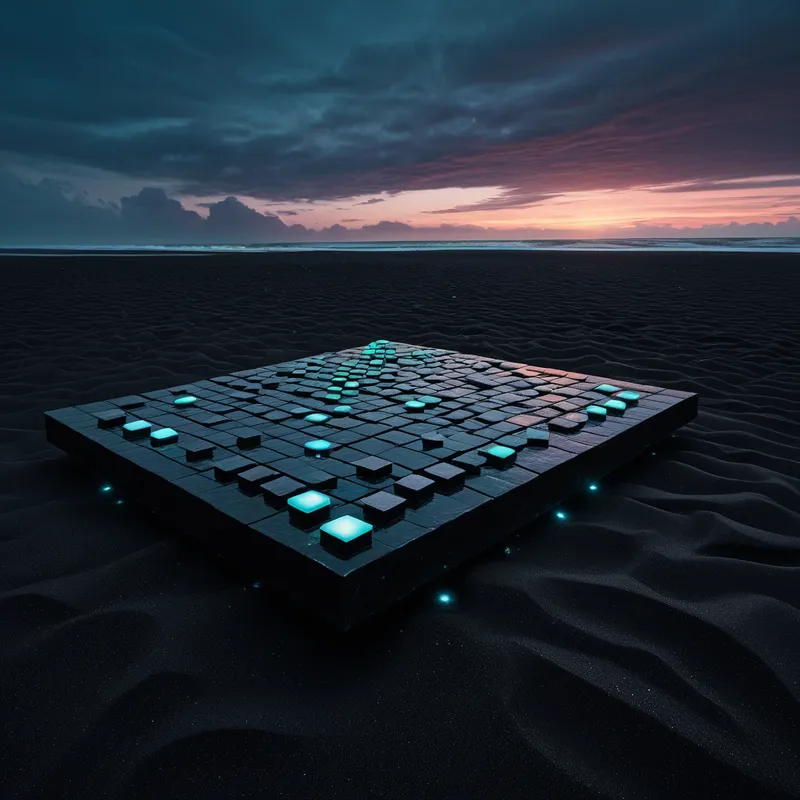
When the Senet Board appears in modern dreams, it rarely manifests as an ancient artifact. It may appear as a labyrinthine office floor plan, a puzzling video game interface, a spreadsheet of life choices, or a mysterious grid etched into the ground. The dreamer is typically faced with the necessity to "make a move" but feels blocked, confused by the rules, or terrified of the consequences of a wrong step.
Somatically, this dream often accompanies periods of intense life transition—career change, the end of a relationship, a spiritual crisis—where the path forward is obscured. The psyche is presenting the ancient map of the Duat because the dreamer is, psychologically, in one. The feeling of being "sent back to start" mirrors the frustrating cycles of repetitive behavior or thought patterns. The lurking "crocodile-lion" figure (Ammit) represents the visceral fear of annihilation, of being consumed by one's own unresolved shadow material if one fails the test. This dream is a signal that the conscious mind is being invited to engage consciously with a profound process of inner navigation and judgment.
Alchemical Translation
The alchemy of the Senet myth models the entire process of psychic transmutation. It begins with the nigredo, the descent into the "House of Netherworld Blues"—the confrontation with the shadow, depression, and the murky contents of the personal unconscious. The squares of chaos and hazard represent the painful but necessary separatio and mortificatio, where old psychic structures are broken down and "sent back."
The middle passage, with its blocks and strategic maneuvers, is the albedo, the whitening. Here, through reflection (the square of the Waters, which can drown or refresh) and the application of conscious insight (the spells, the name of Thoth), order is slowly extracted from chaos. The ego learns to dialogue with the autonomous complexes (the opposing pieces).
The goal is not to remove chance, but to develop the wisdom to play gracefully within its bounds. This is the conjunction of will and fate.
The final rows are the rubedo, the reddening or culmination. The requirement for a perfect final throw is the ultimate act of the transcendent function: the synthesis of conscious intention and unconscious dynamism into a new, whole attitude. Reaching the House of Re-Atum is the individuation achieved—not a static state, but a dynamic union with the source. The player does not destroy the board; they become one with its logic. For the modern individual, this translates to the hard-won ability to see one's life not as a series of random accidents or rigid plans, but as a sacred game. Each challenge, each setback, and each moment of grace is a move on the board of becoming, guiding us not to an external paradise, but to the integrated Self, the inner Aaru where we are, at last, both player and prize.
Associated Symbols
Explore related symbols from the CaleaDream lexicon: