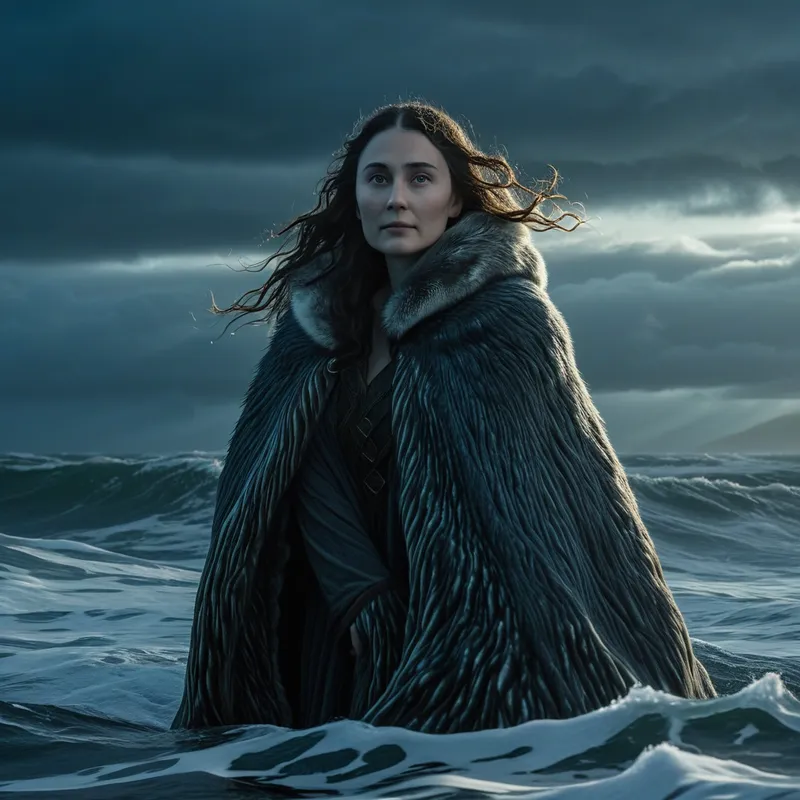
Selkie Kiss Myth Meaning & Symbolism
A seal-woman's skin is stolen, binding her to land and a man, until a kiss of saltwater and memory reveals the path back to her oceanic soul.
The Tale of Selkie Kiss
Listen now, and let the peat-smoke carry you to the edge of [the world](/myths/the-world “Myth from Tarot culture.”/), where the land crumbles into the hungry sea. Here, on the westernmost rocks, where the salt spray tastes of forgotten promises, the selkies dance.
On nights when [the moon](/myths/the-moon “Myth from Tarot culture.”/) is a sliver of polished bone, they shed their heavy pelts and step onto the sand, their human forms luminous and strange. They dance with a grace the land has never known, a memory of the deep currents moving through them. It was on such a night that a fisherman, a man of solitude named Domhnall, hidden among the black rocks, witnessed the impossible. His heart, which knew only the weight of nets and the silence of an empty cottage, was pierced by a beauty so profound it felt like grief. Among the dancers was one whose laughter was the sound of waves breaking in a hidden cove. When the dawn threatened to pinken [the sky](/myths/the-sky “Myth from Persian culture.”/), the others gathered their skins, became seals, and slid into the grey [water](/myths/water “Myth from Chinese culture.”/). But she lingered, and Domhnall saw where she had hidden her skin—a glistening, silver-grey pelt, folded within a cleft of rock as if it were a sleeping shadow.
A desperate, covetous love seized him. He stole the skin, burying it beneath the stone hearth of his home, a secret anchor. When [the selkie](/myths/the-selkie “Myth from Celtic culture.”/) woman could not find her true form, she wept tears that were cold and clear as [the sea](/myths/the-sea “Myth from Greek culture.”/). Domhnall approached, offering shelter, warmth, a mortal life. She looked at him with eyes that held the depth of [the abyss](/myths/the-abyss “Myth from Kabbalistic culture.”/) and, with no ocean to return to, she followed.
For years, she was his wife. She bore him children, whose toes were webbed and who always longed for the shore. She was a good mother, gentle and distant, her songs in a language of waves and whale-call. But her gaze was forever turned to the window, to [the horizon](/myths/the-horizon “Myth from Various culture.”/) line. A profound melancholy hung about her, a silent tide that filled the house. She would often stand at the water’s edge, her feet in the foam, singing a low, haunting tune that drew the seals to bob and watch.
The resolution came not with a storm, but with a whisper. One of her children, a daughter with her mother’s sea-grey eyes, found the hidden pelt while chasing a ball of yarn. Not knowing its power, but feeling its profound pull, she brought it to her mother. The [selkie](/myths/selkie “Myth from Celtic culture.”/) woman did not cry out. She simply took it, her hands trembling not with excitement, but with the solemnity of a fate long delayed. She went to Domhnall, who was mending nets, his hands worn like the driftwood he sat on. She did not speak of betrayal or theft. Instead, she leaned down and kissed him—a kiss that tasted of saltwater, of depths, of a love that was true but could never be owned. It was the [Selkie](/myths/selkie “Myth from Celtic culture.”/) Kiss. In that touch was all the gratitude for the home he gave, and all the sorrow for the home he took.
Then, wrapping the skin around her shoulders, she walked into the surf. The skin fused to her, and she became a seal once more. She looked back once, her dark eyes holding the whole of her human life, before diving beneath a wave and disappearing. Every year thereafter, on that one night, a large seal would be seen near the shore, watching the cottage where her land-children slept, before turning back to the boundless, forgiving sea.

Cultural Origins & Context
The selkie myth is not a singular, codified story but a haunting pattern woven through the oral traditions of coastal communities in Scotland, Ireland, the Faroe Islands, and Iceland—regions deeply influenced by Celtic and Norse seafaring cultures. These are not tales of gods on mountaintops, but of the liminal space where daily life met the immense, unknown sea. They were told by fishermen, crofters, and their families, often by the fireside during long, dark winters.
The societal function was multifaceted. On one level, it was an etiological myth, explaining the uncanny intelligence and seeming empathy of seals, and perhaps the origin of children with an unnatural affinity for water. On a deeper level, it served as a profound cultural narrative about boundaries and belonging. It explored the tension between the safety of the shore (community, marriage, duty) and the call of the unknown (the ocean, freedom, the wild self). The stolen skin symbolized a forced assimilation, a theme painfully resonant in cultures familiar with conquest and displacement. The storyteller, often a woman, might be giving voice to the unspoken longing for a self that existed before domestic bonds, or to the grief of leaving one’s own family for marriage.
Symbolic Architecture
At its core, the Selkie Kiss is a myth of the Self and its essential, immutable [nature](/symbols/nature “Symbol: Nature symbolizes growth, connectivity, and the primal forces of existence.”/). The sealskin is not a [costume](/symbols/costume “Symbol: A costume symbolizes the roles we play in life and the masks we wear, often reflecting personal desires or societal expectations.”/); it is the anam, the very [soul](/symbols/soul “Symbol: The soul represents the essence of a person, encompassing their spirit, identity, and connection to the universe.”/)-stuff of the selkie.
The skin is the contract between one’s spirit and its native element. To lose it is not to change clothes, but to be exiled from the very atmosphere of one’s soul.
The [fisherman](/symbols/fisherman “Symbol: Represents exploration of emotional depths and the pursuit of desires, often reflecting patience and skill.”/) represents the conscious ego that captures and attempts to domesticate a profound, archetypal content from the unconscious (the sea). He believes love is possession, that [beauty](/symbols/beauty “Symbol: This symbol embodies aesthetics, harmony, and the appreciation of life’s finer qualities.”/) can be housed. The [marriage](/symbols/marriage “Symbol: Marriage symbolizes commitment, partnership, and the merging of two identities, often reflecting one’s feelings about relationships and social obligations.”/) is the uneasy [alliance](/symbols/alliance “Symbol: A formal or informal union between individuals or groups for mutual benefit, support, or protection.”/) between the conscious [personality](/symbols/personality “Symbol: Personality in dreams often symbolizes the traits and characteristics of the dreamer, reflecting how they perceive themselves and how they believe they are perceived by others.”/) and this captured, numinous [energy](/symbols/energy “Symbol: Energy symbolizes vitality, motivation, and the drive that fuels actions and ambitions.”/)—it can produce creativity (children), but it is founded on a fundamental dishonesty.
The [melancholy](/symbols/melancholy “Symbol: A deep, lingering sadness often associated with introspection and a sense of loss or longing.”/) of the selkie [wife](/symbols/wife “Symbol: The symbol of a ‘wife’ in a dream often represents commitment, partnership, and personal relationships, reflecting one’s desires for intimacy or connection.”/) is the [symptom](/symbols/symptom “Symbol: A physical or emotional sign indicating an underlying imbalance, distress, or message from the unconscious mind.”/) of the repressed Self. It is the depression, [anxiety](/symbols/anxiety “Symbol: Anxiety in dreams reflects internal conflicts, fears of the unknown, or stress from waking life, often demonstrating the subconscious mind’s struggle for peace.”/), or creative blockage that arises when we live a [life](/symbols/life “Symbol: The symbol of ‘Life’ represents a journey of growth, interconnectedness, and existential meaning, encompassing both the joys and challenges that define human experience.”/) that is not our own, when we betray our deepest nature for [security](/symbols/security “Symbol: Security denotes safety, stability, and protection in one’s personal and emotional life.”/) or approval. The kiss is the pivotal [symbol](/symbols/symbol “Symbol: A symbol can represent an idea, concept, or belief, serving as a powerful tool for communication and understanding.”/) of [integration](/symbols/integration “Symbol: The process of unifying disparate parts of the self or experience into a cohesive whole, often representing psychological wholeness or resolution of internal conflict.”/). It is not an act of vengeance, but of profound recognition and release.
The Selkie Kiss is the moment of conscious, bittersweet truth. It is the acknowledgment of what was, the forgiveness for what could not be, and the absolute commitment to what must be.
The Dreamer’s Resonance
When this myth stirs in the modern [psyche](/myths/psyche “Myth from Greek culture.”/), it often manifests in dreams of searching, of being trapped in pleasant yet suffocating environments, or of encountering water in unexpected places. To dream of a hidden skin, a locked chest, or a forgotten garment is to dream of a disowned part of [the Self](/myths/the-self “Myth from Jungian culture.”/) waiting to be reclaimed.
Somatically, this may feel like a tightness in the chest, a literal “skin” that doesn’t fit, or a chronic longing with no obvious object—what the Portuguese call saudade. Psychologically, the dreamer is navigating the process of differentiating their authentic identity from the identities imposed by family, culture, or career. The “fisherman” in the dream may not be a person, but an internalized voice of duty, pragmatism, or fear that has stolen one’s creative or instinctual vitality. The dream is the psyche’s insistence that the pact with this captor must be renegotiated, that the kiss of truth must be given, even if it means a painful farewell to a familiar shore.

Alchemical Translation
The alchemical journey mirrored in the Selkie Kiss is the opus of individuation. The initial state ([nigredo](/myths/nigredo “Myth from Alchemical culture.”/)) is the selkie’s capture and her ensuing melancholy—[the dark night of the soul](/myths/the-dark-night-of-the-soul “Myth from Christian Mysticism culture.”/) where one feels utterly alien in one’s own life.
The rising action is the long albedo, the years of living the dual life, where consciousness (the fisherman’s world) and the unconscious (the selkie’s nature) coexist in tension. This is a necessary, if painful, stage of incubation. The children represent new psychic structures born from this union—perhaps artistic pursuits, deeper compassion, or spiritual insights that are hybrids of our earthly and soulful natures.
The discovery of the skin is the moment of citrinitas, the first golden light of self-realization. The truth, long buried under [the hearth](/myths/the-hearth “Myth from Norse culture.”/) of daily life, is revealed.
The final transmutation is not in the return to the sea, but in the kiss. This is the rubedo. The conscious ego (the fisherman) does not die; it is acknowledged, thanked, and released from its impossible burden of possession. The soul (the selkie) does not simply flee; it consciously chooses its own nature, integrating the experience of the human world into its eternal being.
For the modern individual, the alchemy is this: we must find what we have hidden away—our wild creativity, our vulnerable sensitivity, our untamed joy—often beneath the very foundations of our constructed lives. We must kiss our old attachments to who we should be with the saltwater of truth, and, with that same bittersweet grace, wrap ourselves in our authentic nature and return to our native depth. We become neither solely seal nor solely human, but the conscious bearer of the kiss that bridges both worlds.
Associated Symbols
Explore related symbols from the CaleaDream lexicon: