Selene Myth Meaning & Symbolism
The story of Selene, the moon goddess, whose eternal love for a mortal shepherd embodies the soul's longing for the unattainable and the rhythm of all cycles.
The Tale of Selene
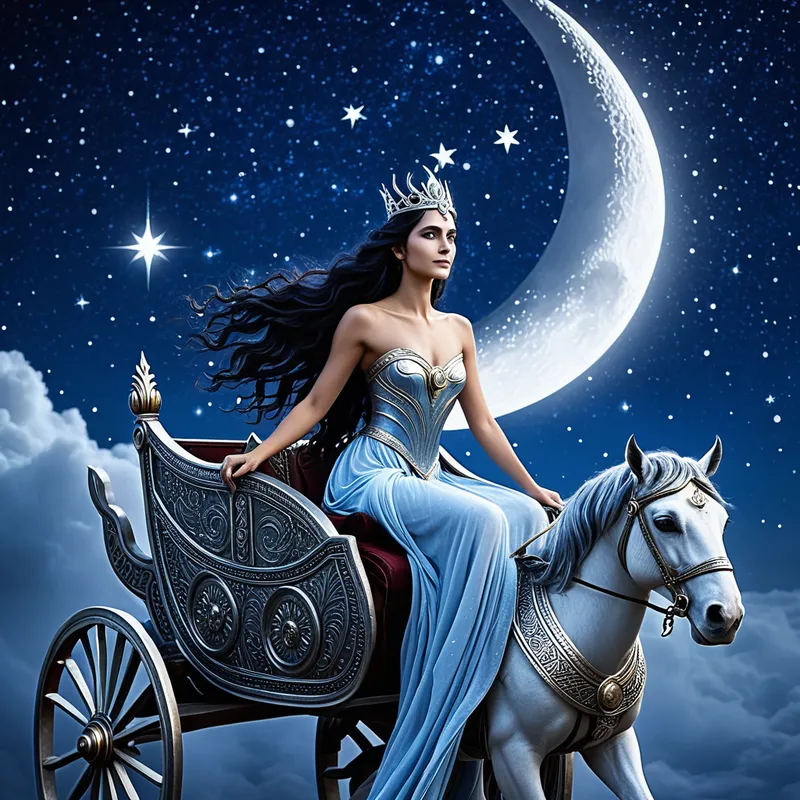
Hear now the tale of the silver-wheeled one, she who rides the velvet cloak of night. Before the clamor of cities, when the world was young and breathed with the gods, the sky was her domain. Each dusk, as her brother Helios sank his fiery chariot into the western sea, Selene would emerge from the eastern mists.
Her chariot was not of fire, but of cool, hammered silver, drawn by two dazzling horses—or sometimes, in whispers told by the oldest shepherds, by a team of powerful, milk-white oxen. Their hooves made no sound upon the air, but where they passed, a trail of dewy, argent light spilled across the land, turning the restless sea to a sheet of shimmering mercury and painting the olive groves in shades of ghostly grey and deepest blue.
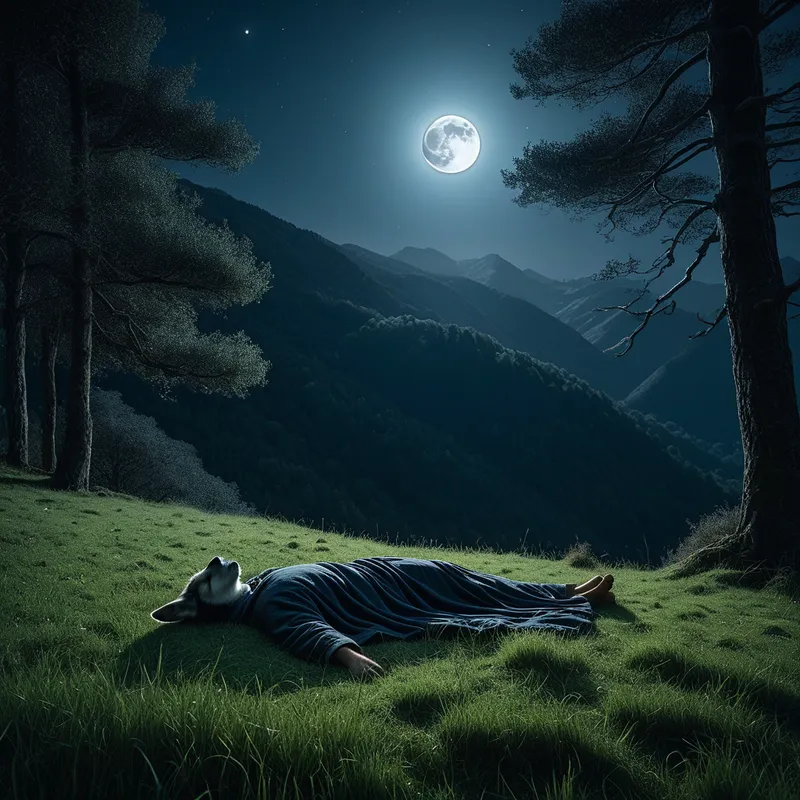
Her light was a balm, a lullaby for the waking earth. But for Selene, it was a lonely vigil. She gazed upon the slumbering world, a queen of a silent, sleeping kingdom, until one night, her light fell upon the slopes of Mount Latmos. There, in a grassy clearing, lay a shepherd. He was Endymion, and his beauty was not of the fierce, sun-baked kind, but of perfect, peaceful repose. The moonlight caressed his face, and in that stillness, Selene’s immortal heart, which had beat only to the rhythm of the cosmos, stumbled.
From that night, her path was fixed. She would guide her chariot with a new urgency, hastening the stars aside to reach her mountain. Descending from her celestial seat, she would shed her divine radiance and sit beside him, watching the gentle rise and fall of his chest, tracing the lines of his face with a light touch that would not wake him. In his eternal sleep—a gift from Zeus, or perhaps a curse—he was forever perfect, forever hers in the silent, secret hours.
Their love was a paradox: a consuming fire that burned with a cold, silver flame; a union that was forever one-sided, yet complete in its longing. She bore him fifty daughters, the Mene, who themselves became measures of time. But the core of the myth remains that single, repeated gesture: the goddess leaving her throne to kneel in the grass, the immortal yearning over the mortal, the luminous embracing the dormant. It is the story of the moon forever seeking her reflection in the still waters of a human soul, and finding, not an answer, but the profound beauty of the question itself.
Cultural Origins & Context
The myth of Selene is a foundational strand in the rich tapestry of Greek mythology, later woven into the broader Hellenistic and Roman world where she was syncretized with Luna. As a Titan, her origins are primal, connecting her to the very architecture of the cosmos. Her story was not the center of a state cult with grand temples, but rather a poetic and pastoral narrative. It was perpetuated by poets like Sappho and later, in more elaborate forms, by nonnus in his Dionysiaca.
This was a myth told under open skies, its primary congregants being shepherds, sailors, and farmers—those whose lives were intimately tied to the rhythms Selene governed. The moon dictated the tides, measured the months for planting and harvest, and provided the only reliable light for night travel. Selene’s story gave a face and a heart to this cosmic clock. It explained the moon’s phases not as mere mechanics, but as the visible expression of a divine emotion: waxing with hope as she approached Endymion, full with the bliss of her vigil, and waning with sorrow as duty pulled her away. Her myth served as a bridge between the cold, predictable cycles of nature and the warm, unpredictable chaos of human feeling.
Symbolic Architecture
At its core, the myth of Selene is an exquisite map of the psyche’s relationship between the eternal and the temporal, consciousness and the unconscious.
The moon does not generate light, but reflects it. In her love for the sleeping Endymion, the soul contemplates its own latent, unconscious beauty, which can only be perceived in a state of receptivity and rest.
Selene represents the aspect of consciousness that illuminates. She is the mindful awareness, the observing ego that casts light on the contents of the inner world. Endymion is the personification of the unconscious self in its pristine, potential state—eternally beautiful, eternally at rest, but inaccessible to ordinary waking life. His perpetual sleep is not a tragedy, but a necessary condition. To “wake” Endymion would be to destroy his perfect form with the demands and compromises of daily, conscious existence. The myth thus sanctifies the value of the unconscious as a sacred, inviolate realm.
Their love affair, conducted only in the silence of night, symbolizes the creative and nourishing dialogue that can occur when the conscious mind (Selene) turns its attentive, loving gaze inward toward the dormant Self (Endymion). The fifty daughters, the Mene, are the fruits of this union: the tangible cycles, ideas, creations, and psychic structures that emerge from this nightly communion.
The Dreamer’s Resonance
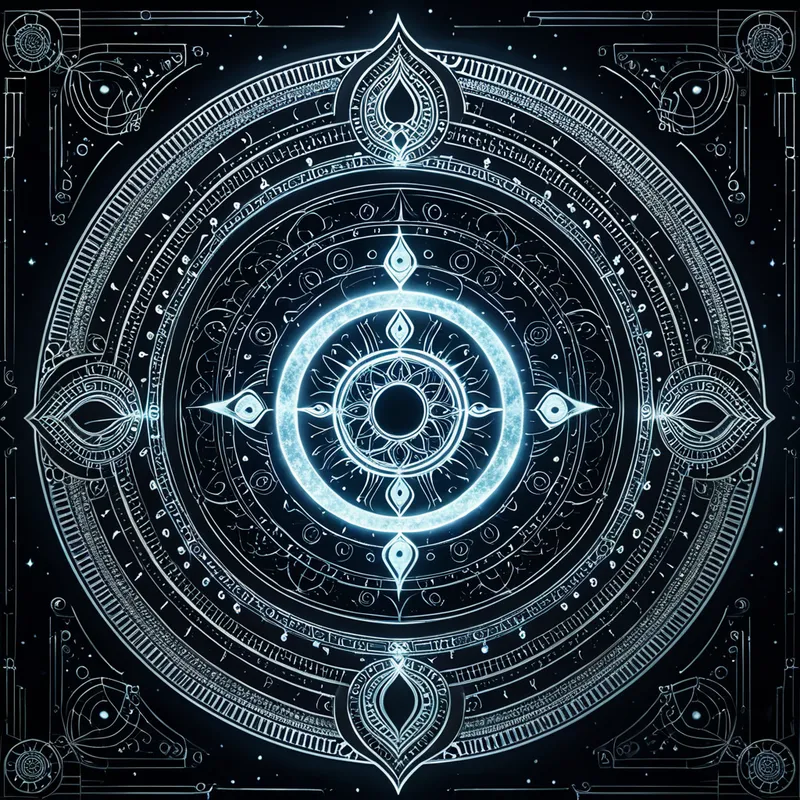
When the pattern of Selene and Endymion stirs in the modern dreamer, it signals a profound somatic and psychological process: the call to sacred observation over frantic action. To dream of bathing in cool, silver light, of watching over a sleeping or tranquil figure, or of feeling a powerful, tender love for something utterly passive and silent, is to touch this archetype.
Psychologically, the dreamer may be in a phase of necessary incubation. Life may demand constant doing, but the soul craves being. This dream imagery is the psyche’s corrective, advocating for a period of receptive witnessing. It suggests that what is needed is not another effort, but a devoted, nightly attendance to what is already present within—a feeling, a memory, a talent, or a wound that has been left dormant. The somatic sensation is often one of cooling, calming, and a slowing of the pulse. It is the body learning the rhythm of the lunar cycle, embracing the wisdom that growth and understanding have their own tides, which cannot be rushed by solar will alone.
Alchemical Translation
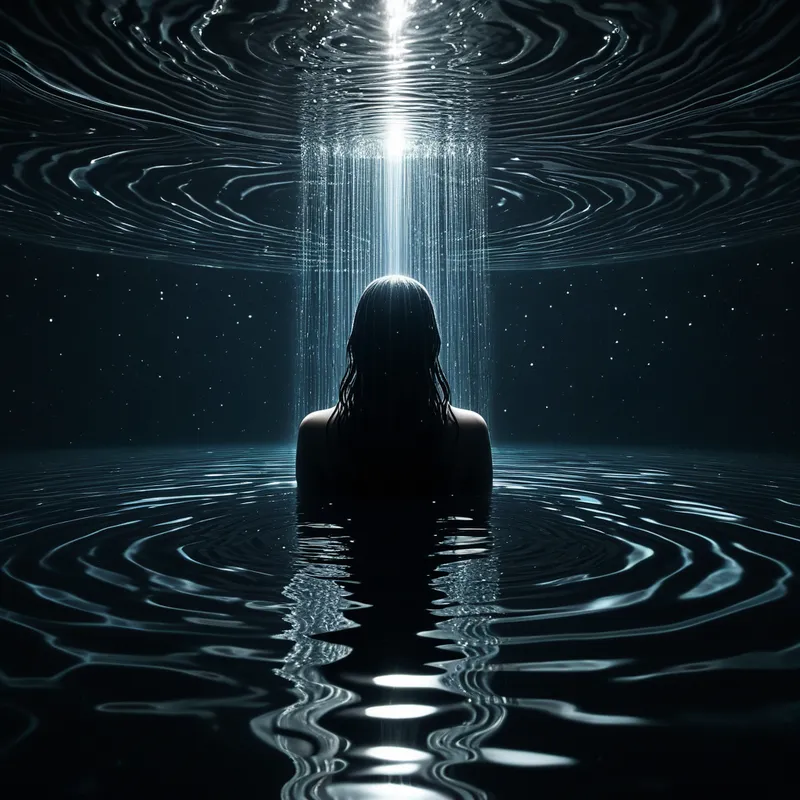
The alchemical journey modeled by Selene’s myth is not one of heroic conquest, but of devoted, cyclic return—the opus of lunaria. It maps the process of psychic transmutation through the stage of albedo, the whitening, where the fiery, chaotic elements of the personality are cooled and purified by the constant, reflective light of awareness.
Individuation is not merely the discovery of the Self, but the nightly, ritualistic courtship of it. The goal is not to possess, but to attend with unwavering fidelity.
For the modern individual, the “Endymion” within is the core of one’s authentic nature, which often feels asleep, remote, or inaccessible amidst the noise of persona and expectation. The “Selene” work is the disciplined, loving practice of introspection. It is the journaling done by moonlight-equivalent calm, the meditation that simply watches the breath, the therapy session that holds space without immediate judgment or solution.
The triumph here is not an awakening, but the establishment of a faithful rhythm. The mortal (the ego) does not become immortal, but through its nightly descent (conscious introspection), it is repeatedly sanctified by contact with the immortal (the Self). The psyche learns to value the full cycle—the light and the dark, the engagement and the retreat, the speaking and the profound listening. One becomes, like the moon itself, a being who is whole precisely because one is comfortable with phases, whose power lies in reflection, and whose love is defined not by possession, but by the grace of its constant, returning gaze.
Associated Symbols
Explore related symbols from the CaleaDream lexicon:
- Moon
- Moonlit Beach
- Moonlit Pier
- Moonlit Night
- Tidal Moon Phases
- Lunar Landscape
- Forgotten Moon
- Moonstone Orb
- Moonstone Drop
- Silvery Moonlight
- Crescent Moonflower
- Moonstone Pendant
- Lunar Crystal
- Moonlit Path
- Moonlit Ritual
- Moonlit Rooftop
- Moonlit Recliner
- Moonlit Surfboard
- Moonlit Bay
- Silvery Moonlit Ocean
- Moonlit Field
- Moonlit Lagoon
- Moonlit Current
- Moon Phase
- Silvery Moon
- Lunar Cycle
- Moonlight
- Moonbeam