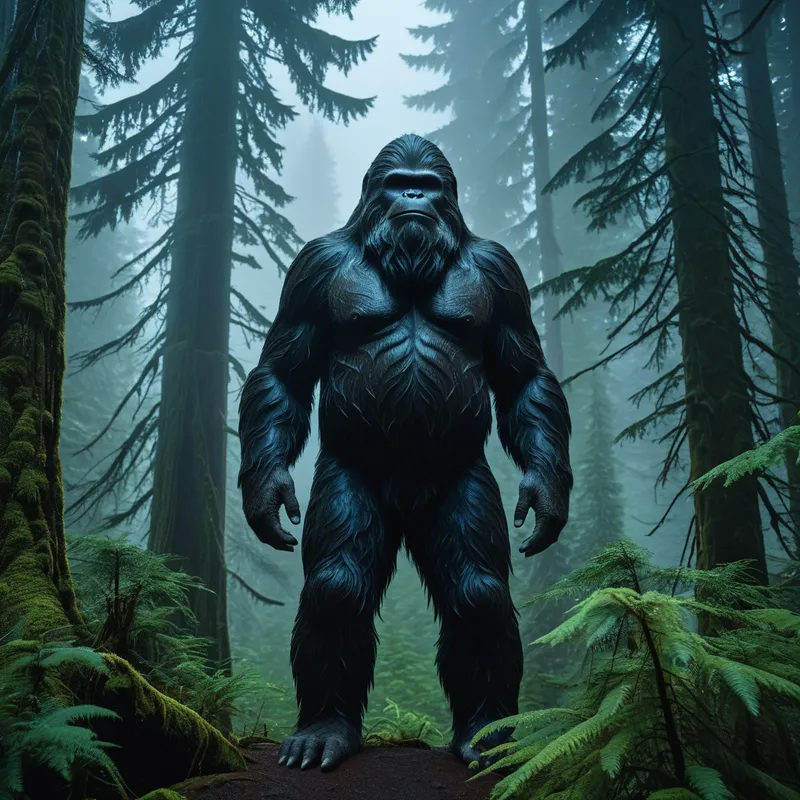
Sasquatch/Bigfoot Myth Meaning & Symbolism
A being of the deep woods, a bridge between worlds, reminding humanity of its place within the living, breathing web of the wild.
The Tale of Sasquatch/Bigfoot
Listen. Before the roads, before the clear-cuts, when the world was a cloak of green and the rivers sang older songs, the people knew they were not alone in the deep woods. In the places where the light fell in shattered pieces through the canopy, where the air grew thick with the scent of damp earth and decaying cedar, He walked.
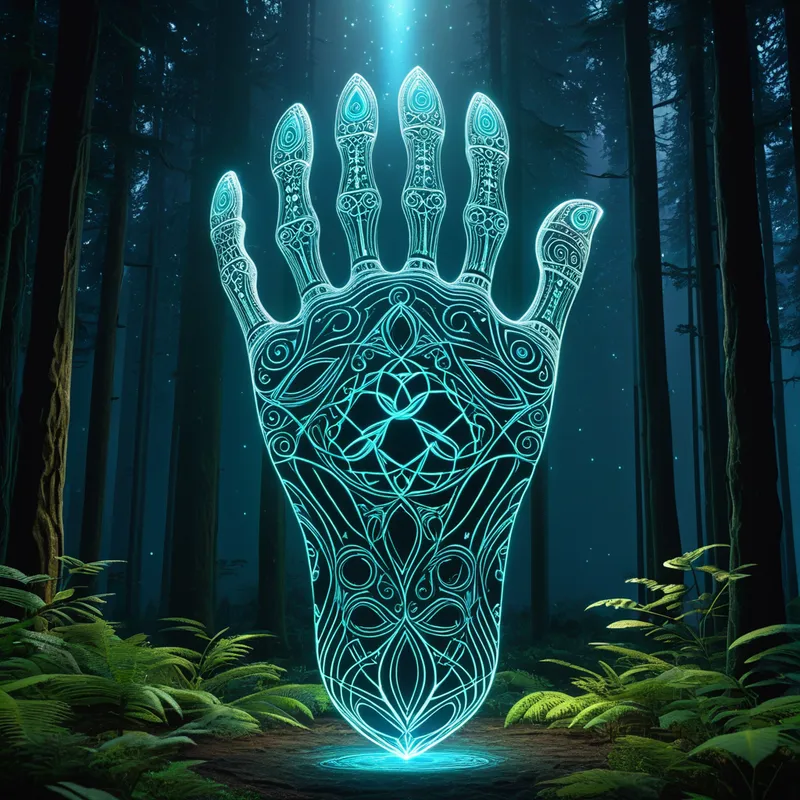
They called him by many names. Sasq’ets. Sé’sxac. The Hairy Man. He was not a beast, nor a man, but something in between—a keeper of the threshold. His breath was the mountain wind, his voice the crack of a falling tree in the distant valley. His feet, wide as a bear’s but shaped like a man’s, pressed into the soft moss, leaving a message for those who could read it: I am here. This place is alive.
The story is not of a hunt, but of an encounter. A hunter, skilled and silent, follows the elk deep into a valley where the shadows linger even at noon. The game leads him on, further than he has ever gone, until the familiar landmarks vanish. The forest grows quiet. The birds cease their chatter. The air turns cold. He feels a gaze upon his back, heavy as stone. He turns.
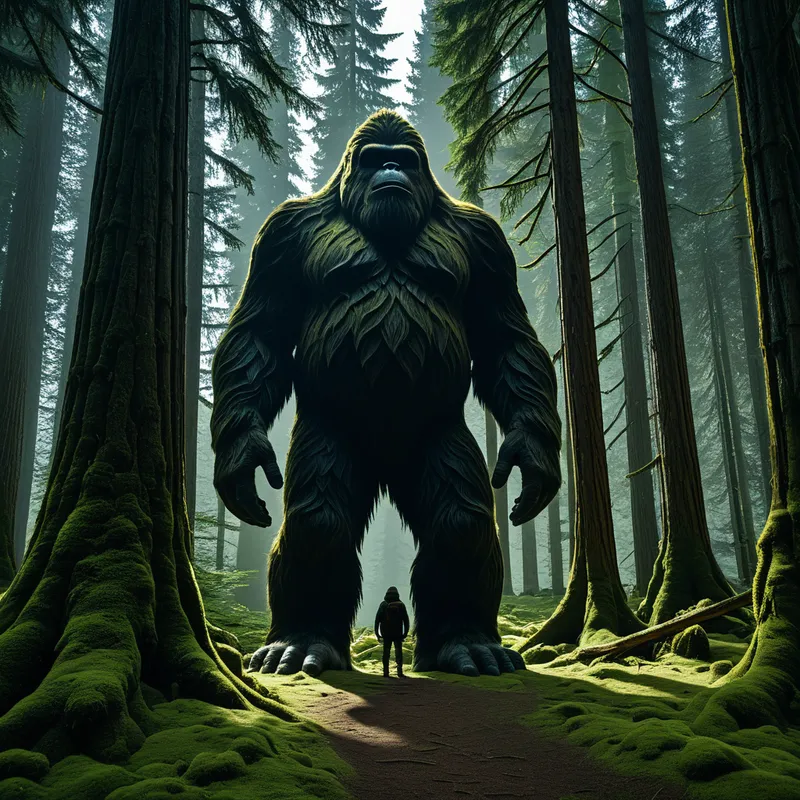
There, between two great cedars, it stands. It is taller than any man, its body powerful, covered in hair dark as wet soil. It does not roar. It does not charge. It simply watches. In its deep-set eyes, the hunter does not see malice, but a profound, alien intelligence—an awareness as old as the glaciers that carved these mountains. It is the forest looking back at him.
A silent exchange passes between them, a conversation without words. The hunter understands a truth that chills his blood more than any threat: he is the visitor here. He is the one who has strayed across a line. The being turns, with a grace that belies its size, and moves into the trees. It does not crash through the underbrush; it is absorbed by it, becoming shadow, becoming silence. All that remains are the impressions in the earth—a line of footprints leading into the heart of the unknown. The hunter returns to his village a different man. He speaks not of a monster, but of a reminder. He carries the silence of that gaze with him forever.
Cultural Origins & Context
The narratives of the Sasquatch are woven into the oral traditions of numerous Coast Salish and interior peoples, from the Sts’ailes to the Lummi. These were not campfire scare stories, but teaching narratives integrated into a complex ecological and spiritual worldview. The stories were told by elders, often in specific contexts—to guide young people about respecting territorial boundaries, both physical and spiritual, or to explain strange sounds in the night.
Its societal function was multifaceted. On a practical level, it served as a natural “keep out” sign for dangerous or spiritually sensitive areas—ravines, remote mountain passes, or berry patches that needed time to regenerate. On a deeper level, the Sasquatch acted as a personification of the wild itself—the autonomous, untamed, and ultimately unknowable aspect of the land that existed beyond the circle of the village fire. It was a constant reminder that humanity lived within nature, not apart from it, and that the forest was a community of which humans were only one part.
Symbolic Architecture
Psychologically, the Sasquatch is a masterful symbol of the shadow and the guardian at the threshold. It embodies all that we have exiled from our modern, sanitized consciousness: the primal, the instinctual, the untamed wilderness within. It is not evil, but it is other—a massive, living representation of the parts of ourselves and our world we have tried to forget or pave over.
The footprint in the moss is not a threat; it is an invitation to remember what we have left behind.
It symbolizes the boundary between the known world (the village, the ego, civilization) and the unknown (the deep forest, the unconscious, the wild). Its appearance in myth always marks a moment of confrontation with that boundary. The being itself is the bridge—hairy like an animal, postured like a human. It is the embodied question: Where does the human end and the wild begin? Its primary message is one of ecological and psychic humility, a check on human arrogance.
The Dreamer’s Resonance
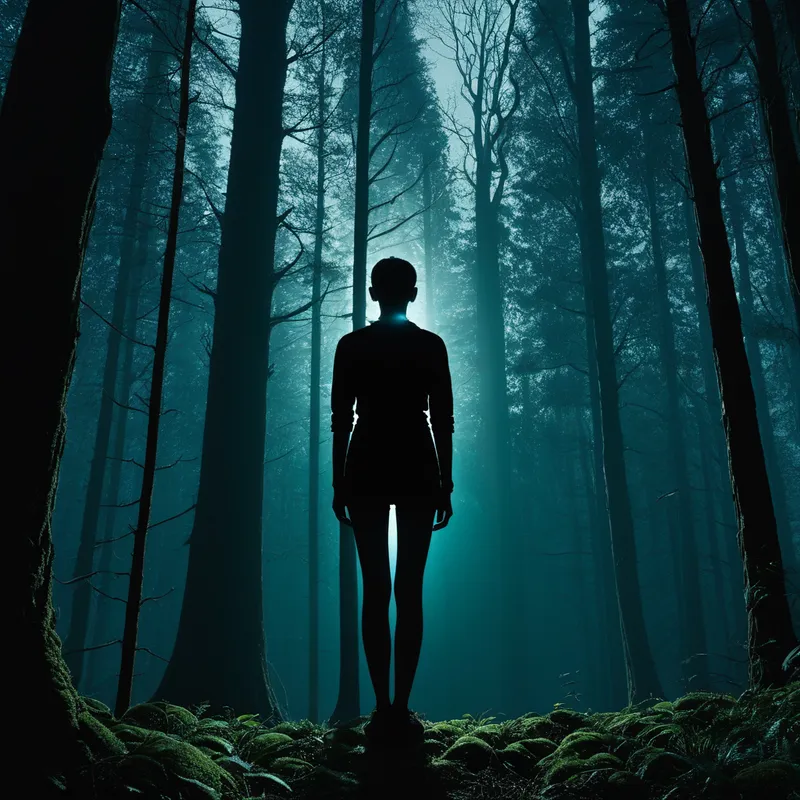
When the Sasquatch pattern emerges in modern dreams, it rarely manifests as a literal monster chase. More often, it is a presence. The dreamer is in a familiar place that has become strangely wild—their backyard has grown into a jungle, or their house has a forgotten, forested room. They feel watched. They catch a glimpse of a large, shadowy figure at the edge of their vision, moving with silent purpose.
Somatically, this dream often accompanies a feeling of being “too big” for one’s current life—of having primal energies, instincts, or creative forces that are shaggy, unkempt, and struggling to fit into a neat, civilized identity. The Sasquatch in the dream is the somatic truth of that suppressed vitality. The psychological process is one of recognition, not integration. The dream ego is not yet ready to speak to this presence; it is only ready to witness it, to acknowledge its existence at the periphery. This is the beginning of shadow-work—the terrifying, awe-inspiring moment when we realize the wilderness within has its own consciousness and will not be ignored.
Alchemical Translation
The alchemical journey modeled by this myth is not one of slaying the beast, but of undergoing a fundamental reorientation of the self in relation to the wild. The initial state is one of assumed sovereignty—the ego as hunter, exploring the territory of the unconscious for its own gain (the elk). The encounter with the Sasquatch is the nigredo, the blackening—the shocking dissolution of that egoic certainty. The hunter is humbled, made aware he is the one being observed and assessed.
The transmutation occurs in the silence after the gaze, when the old identity of conqueror falls away, and a new, more humble consciousness is born.
The individuation process here is the internalization of that gaze. The triumphant resolution is not capturing or understanding the wild, but carrying its memory as a sacred, sobering truth. The modern individual’s “triumph” is to allow the Sasquatch—the symbol of their own untamed psyche and their forgotten kinship with nature—to exist. It is to stop trying to clear-cut the internal forest and instead learn its paths, respect its boundaries, and listen for its movements in the twilight of their awareness. One becomes more whole not by civilizing the wild within, but by acknowledging its rightful, ancient place and learning to live alongside it, in a state of mindful and respectful coexistence. The final gold is a consciousness that is both human and inherently wild, forever marked by the footprint.
Associated Symbols
Explore related symbols from the CaleaDream lexicon: