Sanshin Myth Meaning & Symbolism
The myth of the Sanshin, the ancient Mountain Spirit, embodies the sacred union of wild nature, ancestral memory, and the grounding power of the deep self.
The Tale of Sanshin
Listen. Before the kingdoms, before the first rice paddy was flooded, there was the mountain. It was not a place you went to; it was a presence that watched you. Its peaks were the bones of the earth, thrust skyward, cloaked in forests so deep their green turned to black. In the silence between the wind through the pines, you could hear it breathe.
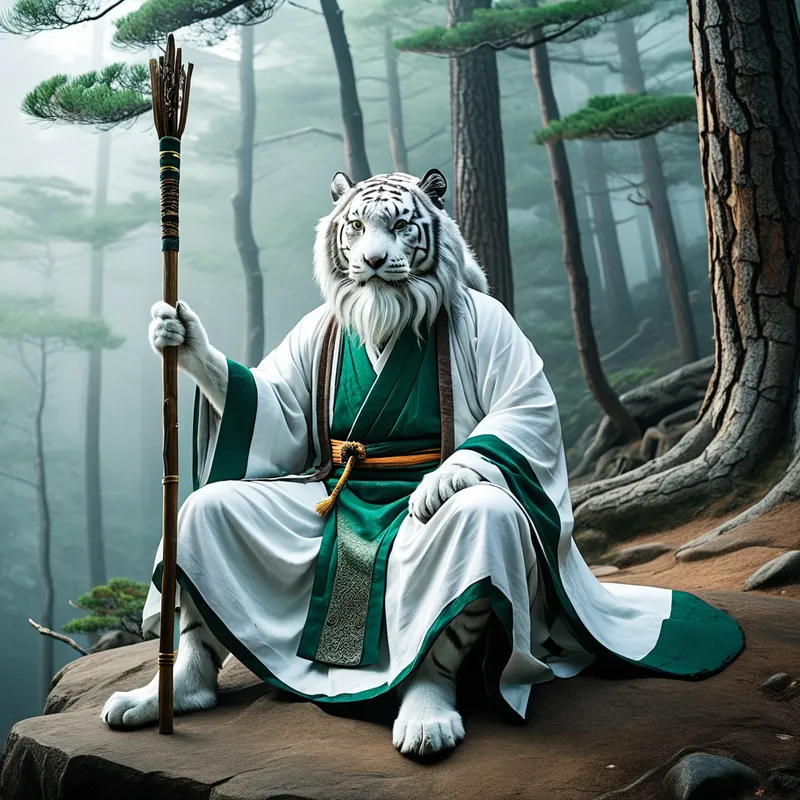
And in the heart of that breathing lived the Sanshin. He was not born; he emerged, as a tree emerges from stone, patient and inevitable. His face was the weathered cliff, his beard the cascading waterfall of snowmelt, his eyes the still, dark pools found in high caves. His robes were the moss and the rock, embroidered with the patterns of bark and lichen. By his side, always, was the Baekho, the white tiger, whose silent tread could shake the valley floor and whose amber eyes held the fire of the sun setting behind the peaks.
The people of the valleys built their homes and planted their fields, but their eyes were always drawn upward. They felt the mountain’s gaze. When the storms raged from its heights, they knew it was the Sanshin’s temper. When the gentle rains came to nourish their crops, they felt it was his blessing. But he was distant, a sovereign of stone and cloud.
Then came a time of great blight. The rivers from the mountain ran thin and bitter. The valley grew silent, the crops withered, and a deep forgetting settled on the people. They worked harder, prayed to the heavens, but the earth itself seemed to have turned away.
A young farmer, his heart as parched as his fields, could bear it no longer. He did not look to the sky. Instead, he looked to the mountain. With no offering but a gourd of pure water from the last clean spring, he began to climb. He did not follow a path, for there was none. He followed the pull in his chest, a longing older than hunger. The climb was a stripping away—of certainty, of time, of his very name. Thorns tore his clothes, rocks bruised his feet, and the thin air whispered that he should turn back.
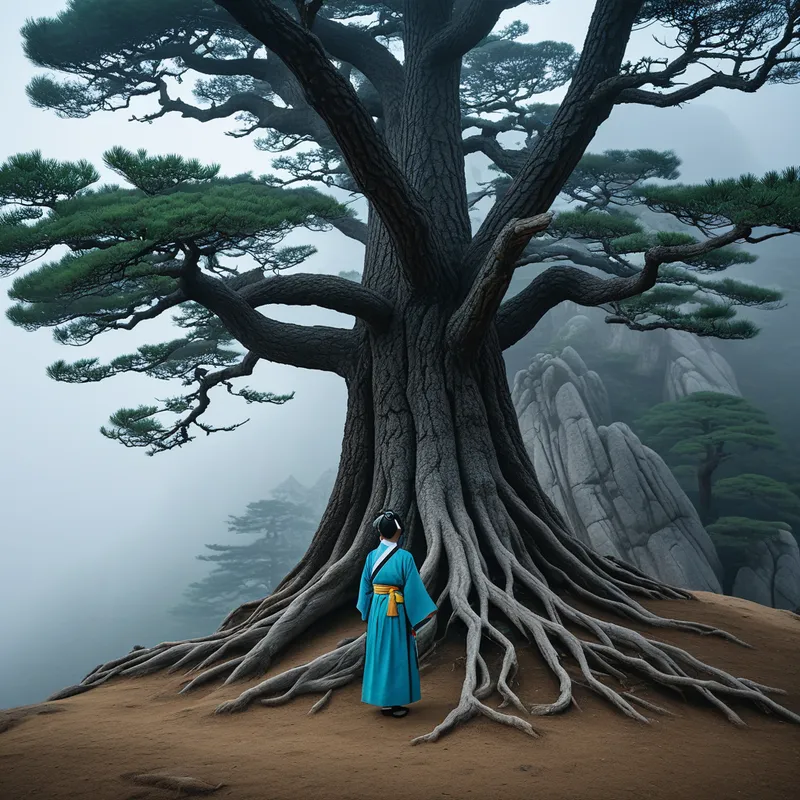
Finally, in a high clearing where ancient pines stood like pillars in a hall of the gods, he found it: a simple stone altar, almost swallowed by the roots of the greatest tree. Exhausted, empty, he placed his gourd upon the stone and bowed, his forehead touching the cool, living earth. He did not ask for rain. He did not speak at all. He simply offered his weariness and his presence.
The wind died. The forest held its breath. And then, a warmth, like the first sun after winter, spread from the ground through his body. He looked up. There, seated on a throne of living rock that had not been there a moment before, was the Sanshin. The spirit’s eyes were not angry, but deep with a timeless knowing. The white tiger lifted its head, but did not snarl. The Sanshin raised a hand, not in threat, but in acknowledgment. He pointed his staff, not at the farmer, but at the mountain spring bubbling suddenly from the roots of the great pine, its water clear and singing.
The farmer understood. He drank, and the water tasted of memory and strength. He descended, not as a supplicant, but as a witness. And where he walked, the people saw that the connection—severed, forgotten—was now restored. The mountain and the valley were not master and servant, but one living body, and the Sanshin was its beating heart.
Cultural Origins & Context
The myth of the Sanshin is not a single story with one author, but a living tradition woven into the very topography of Korea. Its origins are in the ancient Muism (Korean shamanism), where every mountain was understood to possess a sin, or deity, of immense power and personality. These spirits were the original landlords, the primal ancestors of the land itself.
The myth was passed down not by bards in courts, but by Mudang (shamans) in rituals, and by villagers in daily practice. It was told at the base of Jangseung guardian poles, and before the simple stone altars (Doltap) found on mountain paths. Its societal function was profound: to mediate humanity’s relationship with the overwhelming, untamable power of nature. The Sanshin was a bridge. By honoring him, communities sought protection from landslides and storms, blessing for their hunts and foraging, and, most importantly, a sacred contract that legitimized their presence in his domain. This myth ensured that development was always tempered by reverence, embedding an ecological ethic deep within the cultural psyche.
Symbolic Architecture
Psychologically, the Sanshin is the archetype of the Ground of Being. He represents the foundational, often unconscious, layer of the psyche from which all our energy and identity springs. He is not the lofty spirit of the sky (that is another deity), but the spirit of the earth, of roots, of the slow, tectonic movements of the soul.
The mountain does not come to you; you must journey to the mountain. This is the first law of the deep self.
The mountain itself symbolizes the enduring, often daunting structure of the Self—the core identity that persists beneath the changing landscapes of our persona. The white tiger (Baekho) is the instinctual, raw energy that guards this deep Self. It is fierce, untamed libido and vitality that can destroy if approached with arrogance, but becomes a protective companion when approached with humility and respect. The spring that flows from the roots is the life-giving water of the unconscious—the source of creativity, healing, and renewal that only appears when we make contact with this foundational layer.
The farmer’s journey is the ego’s necessary pilgrimage into its own depths. His empty gourd and silent bow symbolize the surrender of the ego’s demands. He does not go to conquer or extract, but to listen and reconnect. The myth’s resolution—the flowing spring—shows that wholeness is not about acquiring something new, but about restoring a connection to what was always, silently, there.
The Dreamer's Resonance
When this myth stirs in the modern dreamer, it often manifests as a profound call for grounding. You may dream of lost in a vast, featureless plain, feeling untethered and anxious, until a mountain appears on the horizon, pulling you toward it. Or you may dream of climbing a seemingly endless staircase or cliff face in a city, a somatic metaphor for the exhausting, often isolating work of building a life without a connection to your inner foundation.
The appearance of a tiger or large feline in a dream, especially one that is calm, watching, or leading you, can signal the awakening of the guarded, instinctual Baekho energy. Dreams of finding a hidden room in your house that leads to a natural cave, or clear water bubbling up through the floorboards, are direct symbols of the Sanshin’s spring—the unconscious wisdom breaking through into conscious life. These dreams indicate a psychological process of descending from the heady anxieties of the persona into the somatic, earthy wisdom of the body and the ancestral soul.
Alchemical Translation
The alchemical process modeled by the Sanshin myth is that of coagulatio—the making solid. In an age of digital ephemera and identity flux, the individuation task is not just to expand, but to condense; not just to fly, but to root.
Individuation is not only a journey upward into consciousness, but a journey downward into the granite of one's own nature.
The first stage is Recognizing the Blight: The dryness in the valley is the modern condition of burnout, meaninglessness, and ecological dissociation. We try everything (the ego’s solutions) but the true source—our connection to the primal, grounding Self—remains blocked.
The second stage is The Ascent of Surrender: This is the conscious decision to turn inward, to engage in the difficult, often painful work of shadow exploration, somatic therapy, or simply deep, unproductive silence. It is the ego shedding its pretensions, represented by the farmer’s torn clothes and empty gourd.
The third stage is The Audience at the Root: This is the moment of profound inner encounter. It is not a vision of light, but of deep, earthy presence. You meet your own foundational truth—your inherited patterns, your core wounds, your innate strengths—personified as the sovereign Sanshin. You do not fight it; you acknowledge it.
The final transmutation is The Spring Returns: The energy that was locked in neurosis or depression (the blocked spring) is liberated. It becomes a steady, renewing flow of vitality. The fierce tiger of your raw instinct now guards your boundaries instead of sabotaging your relationships. You become, like the mountain, both grounded and lofty, a stable presence from which life and creativity can sustainably flow. You realize you are not on the land; you are of the land, and your sovereignty comes from honoring that unbreakable bond.
Associated Symbols
Explore related symbols from the CaleaDream lexicon: