
Samson Myth Meaning & Symbolism
A Nazirite judge of immense strength, bound by sacred vows, is undone by love and betrayal, finding his final purpose in a temple's collapse.
The Tale of Samson
Hear now a tale of a man born under a burning star, a man whose life was a riddle written in flesh and spirit. In the days when the Philistines pressed hard upon the tribes of Israel, a whisper moved through the land of Dan. A whisper of a barren woman visited by a messenger of the Divine, who spoke a command: a son would be born to her, a son set apart from [the womb](/myths/the-womb “Myth from Various culture.”/). He would be a Nazirite, and he would begin to deliver Israel.
And so Samson was born, and the spirit of the Divine began to stir within him. He was a man of paradoxes, a judge who walked alone, his strength a secret coiled in the seven locks of his uncut hair. He tore a young lion apart with his bare hands as if it were a kid goat. He slew thirty men for their garments to pay a riddle’s debt. He caught three hundred foxes, tied torches to their tails, and set the Philistine fields ablaze. With the fresh jawbone of a donkey, he slew a thousand men, his thirst quenched by [water](/myths/water “Myth from Chinese culture.”/) from a hollow place.
But his strength, which could splinter city gates and carry them up a mountain, had a fatal flaw: it was drawn toward the daughters of the Philistines. He loved a woman in Timnah, and later, he loved a woman in the valley of Sorek, whose name was Delilah. The lords of the Philistines came to her, silver in their hands, and whispered, “Entice him, and see wherein his great strength lieth.”
Three times she pressed him, and three times he wove a lie. “Bind me with seven fresh bowstrings,” he said. They did, and he snapped them like flax. “Weave my hair into a web on a loom,” he said. She did, and he pulled up the pin of the loom. But she wore him down with her words day after day, until his soul was vexed unto death. And he told her all his heart: “A razor hath never come upon my head; if I be shaven, then my strength will go from me.”
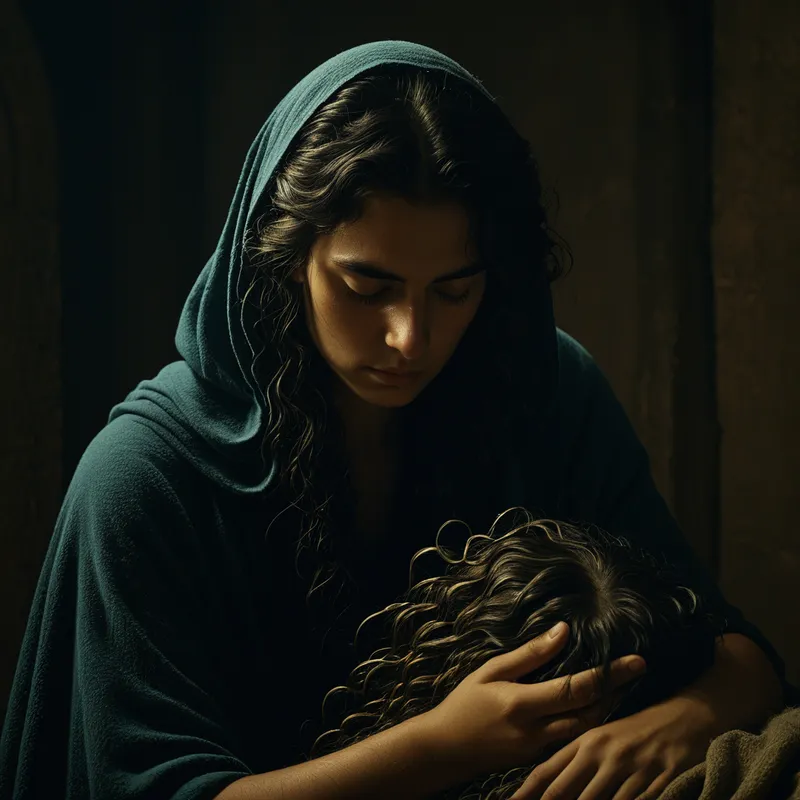
She lulled him to sleep upon her knees, called for a man to shave off the seven locks of his head. And his strength left him. He awoke to her cry, “The Philistines be upon thee, Samson!” He shook himself, but he did not know that the Divine had departed from him. They seized him, put out his eyes, and bound him with fetters of bronze. In the dark prison of Gaza, he ground at the mill, a broken giant.
But his hair began to grow again.
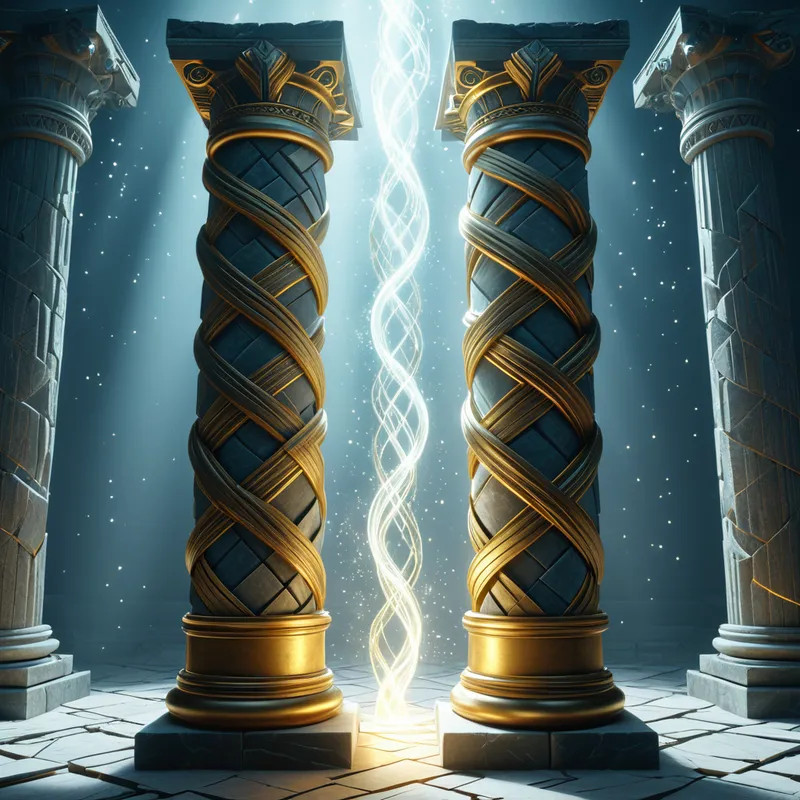
At a great feast to their god Dagon, the Philistine lords called for Samson to make sport. They brought him to [the temple](/myths/the-temple “Myth from Jewish culture.”/), packed with thousands upon the roof and in the court. Leaning on the pillars that held the house, Samson called to the Divine: “O Lord GOD, remember me, I pray thee, and strengthen me, I pray thee, only this once.” Then he bowed himself with all his might. The pillars groaned, the temple shuddered, and with a roar of stone and dying cries, the house fell upon all the lords and upon all the people. So the dead which he slew at his death were more than they which he slew in his life.
Cultural Origins & Context
The story of Samson is found in the Book of Judges (chapters 13-16), a text that chronicles a turbulent, pre-monarchical period in Israelite history characterized by a cyclical pattern of apostasy, oppression, repentance, and deliverance. Unlike other judges who lead armies, Samson operates alone, a folkloric champion whose exploits border on the superhuman. Scholars situate the narrative in the 12th-11th centuries BCE, a time of intense cultural and military pressure from the coastal Philistine confederation.
The tale bears the hallmarks of oral tradition, passed down and refined by storytellers before being codified into the biblical canon. Its function was multifaceted: it served as an etiological tale explaining local landmarks (like “the jawbone place”), as a cautionary narrative about the dangers of breaking sacred vows and mixing with foreign cultures, and ultimately, as a theological statement. It asserts that even a flawed, impulsive, and morally ambiguous vessel can be an instrument of the Divine purpose, and that ultimate strength is not autonomous but contingent upon a sacred relationship. Samson is not a paragon of piety but a paradox—a consecrated man driven by personal passion, whose final act synthesizes his personal vengeance with national deliverance.
Symbolic Architecture
At its core, Samson’s myth is a profound study in the [psychology](/symbols/psychology “Symbol: Psychology in dreams often represents the exploration of the self, the subconscious mind, and emotional conflicts.”/) of power and its [shadow](/symbols/shadow “Symbol: The ‘shadow’ embodies the unconscious, repressed aspects of the self and often represents fears or hidden emotions.”/). His Nazirite [hair](/symbols/hair “Symbol: Hair often symbolizes identity, power, and self-expression, reflecting how we perceive ourselves and how we wish to be perceived by others.”/) is not merely a [source](/symbols/source “Symbol: The origin point of something, often representing beginnings, nourishment, or the fundamental cause behind phenomena.”/) of [strength](/symbols/strength “Symbol: ‘Strength’ symbolizes resilience, courage, and the ability to overcome challenges.”/) but the visible [symbol](/symbols/symbol “Symbol: A symbol can represent an idea, concept, or belief, serving as a powerful tool for communication and understanding.”/) of his [covenant](/symbols/covenant “Symbol: A binding agreement or sacred promise between parties, often carrying deep moral, spiritual, or social obligations and consequences.”/), the tangible link between his personal [life](/symbols/life “Symbol: The symbol of ‘Life’ represents a journey of growth, interconnectedness, and existential meaning, encompassing both the joys and challenges that define human experience.”/) and a transpersonal, numinous force. It represents the conditionality of true power—it is a gift held in trust, not a personal possession.
The secret of great strength is always its corresponding secret weakness. What makes one invulnerable is also the precise locus of one’s potential undoing.
His relationships with Philistine women, particularly Delilah, symbolize the [soul](/symbols/soul “Symbol: The soul represents the essence of a person, encompassing their spirit, identity, and connection to the universe.”/)’s fatal attraction to its own opposite, to that which it is meant to resist or transform. This is not merely about sexual temptation, but about the [psyche](/myths/psyche “Myth from Greek culture.”/)’s entanglement with the very forces that oppose its integrity. Delilah represents the [anima](/symbols/anima “Symbol: The feminine archetype within the male unconscious, representing soul, creativity, and connection to the inner world.”/) figure turned destructive, the captivating inner “other” who, when not integrated consciously, becomes the agent of [betrayal](/symbols/betrayal “Symbol: A profound violation of trust in artistic or musical contexts, often representing broken creative partnerships or artistic integrity compromised.”/) and enervation.
His blinding is the ultimate symbol of [insight](/symbols/insight “Symbol: A sudden, deep understanding of a complex situation or truth, often arriving unexpectedly and illuminating hidden connections.”/) lost. Having “seen” and desired what was forbidden, he is plunged into literal darkness, forced to turn [inward](/symbols/inward “Symbol: A journey toward self-awareness, introspection, and the exploration of one’s inner world, thoughts, and unconscious mind.”/). The [prison](/symbols/prison “Symbol: Prison in dreams typically represents feelings of restriction, confinement, or a lack of freedom in one’s life or mind.”/) mill becomes an [image](/symbols/image “Symbol: An image represents perception, memories, and the visual narratives we create in our minds.”/) of grinding, repetitive, unconscious labor—the [fate](/symbols/fate “Symbol: Fate represents the belief in predetermined outcomes, suggesting that some aspects of life are beyond human control.”/) of a potential that has lost its [connection](/symbols/connection “Symbol: Connection symbolizes relationships, communication, and bonds among individuals.”/) to its source. The regrowth of his hair during this [period](/symbols/period “Symbol: Periods in dreams can symbolize cyclical patterns, renewal, and the associated emotions of loss or change throughout life.”/) is critical: it signifies the slow, often unnoticed process of psychic [regeneration](/symbols/regeneration “Symbol: The process of renewal, restoration, and growth following damage or depletion, often representing emotional healing, transformation, or a fresh start.”/) that occurs in the darkness of failure and humiliation, preparing for one final, integrated act.
The Dreamer’s Resonance
When the pattern of Samson manifests in modern dreams, it speaks to a profound somatic and psychological process. One may dream of possessing immense physical strength that suddenly fails, of having long hair that is cut against one’s will, or of being blinded and imprisoned. These are not literal prophecies but symbolic communications from the deep psyche.
Such dreams often surface when an individual feels they are operating on borrowed or conditional power—perhaps in a career, a relationship, or a creative endeavor where their vitality feels tied to an external agreement, a role, or a [persona](/myths/persona “Myth from Greek culture.”/) they must maintain. The “Delilah” figure in the dream could be a captivating project, a seductive ideology, or a relationship that demands the dreamer compromise a core vow of selfhood. The feeling upon waking is often one of deep vulnerability, shame, or enervation.
The process at work is the confrontation with one’s own conditionality. The dream is forcing an awareness: “Your strength is not your own; it is tied to something you have consecrated yourself to, and you are bartering it away.” It is a call to identify what the “uncut hair” represents in one’s life—the non-negotiable principle, the sacred trust, the authentic source of vitality that must not be sheared for temporary comfort or affection.

Alchemical Translation
The alchemical journey of the Samson myth models a brutal but complete path of psychic transmutation. It begins with the [prima materia](/myths/prima-materia “Myth from Alchemical culture.”/) of raw, unconscious power (the Nazirite vow from birth). This power is then subjected to a series of conjunctios—attempted unions—with its opposite (the Philistine women). These unions are not integrations but entanglements, each one a failed experiment that nonetheless teaches the nature of the substance being worked with.
The climax is the mortificatio or [nigredo](/myths/nigredo “Myth from Alchemical culture.”/): the shearing, the blinding, the imprisonment. This is the essential dark night, the reduction of the heroic ego to a state of absolute helplessness and humiliation. All that was identified with—physical strength, sight, freedom—is stripped away. This is not an error but a necessary stage in [the opus](/myths/the-opus “Myth from Alchemical culture.”/). The conscious personality must be shattered for the deeper, transpersonal will to re-emerge.
The final act is not a return to the old strength, but a sacrifice of the entire structure that contained the self. The temple of the old identity must fall for the new consciousness to be free.
The grinding at the mill is the slow, patient [separatio](/myths/separatio “Myth from Alchemical culture.”/), where the dross of pride and personal vengeance is worn away. The regrowth of the hair is the silent albedo, the whitening, the return of the connection on a new, more conscious level. The final prayer and the pulling down of the temple pillars represent the ultimate coniunctio: the alignment of the individual’s will (even if it is for vengeance) with a transpersonal movement. His death is not a defeat but the final act of the individuation cycle for that incarnation. He becomes, at last, fully the instrument he was meant to be, destroying the oppressive structure (the temple of Dagon) by using its own supports against it. For the modern individual, the myth teaches that our greatest power is inseparable from our deepest vow, and that sometimes, our redemption requires the total collapse of [the world](/myths/the-world “Myth from Tarot culture.”/) we helped to build.
Associated Symbols
Explore related symbols from the CaleaDream lexicon: