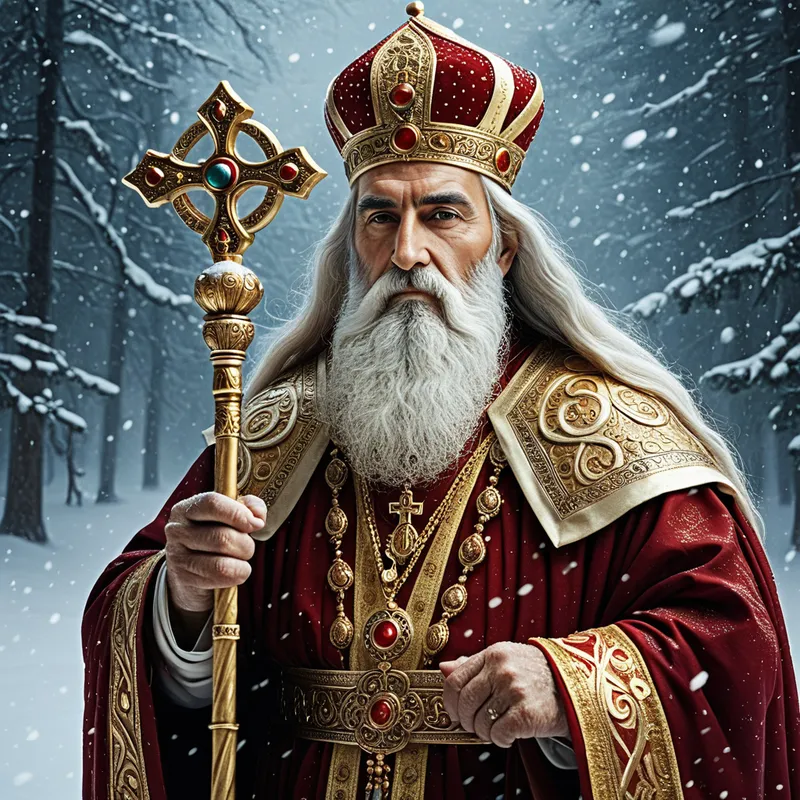
Saint Nicholas/Santa Claus Myth Meaning & Symbolism
A myth of secret generosity, where a saintly bishop transforms into a winter spirit who judges the unseen heart and rewards innocence with gifts.
The Tale of Saint Nicholas/Santa Claus
Listen, and hear the tale of the secret giver, the watcher in the winter dark.
In the deep, dreaming heart of the ancient world, in the port city of Myra, there lived a man whose soul was a furnace of compassion. His name was Nicholas. From a youth cloaked in tragedy and inherited wealth, he chose a different gold—the gold of charity. He became a bishop, his crozier not a rod of rule, but a staff for the stumbling.
But his true work began when the sun fled and the long night claimed the land. It was then he would don his dark cloak, the color of the sky between stars, and move through the sleeping city like a breath of conscience.
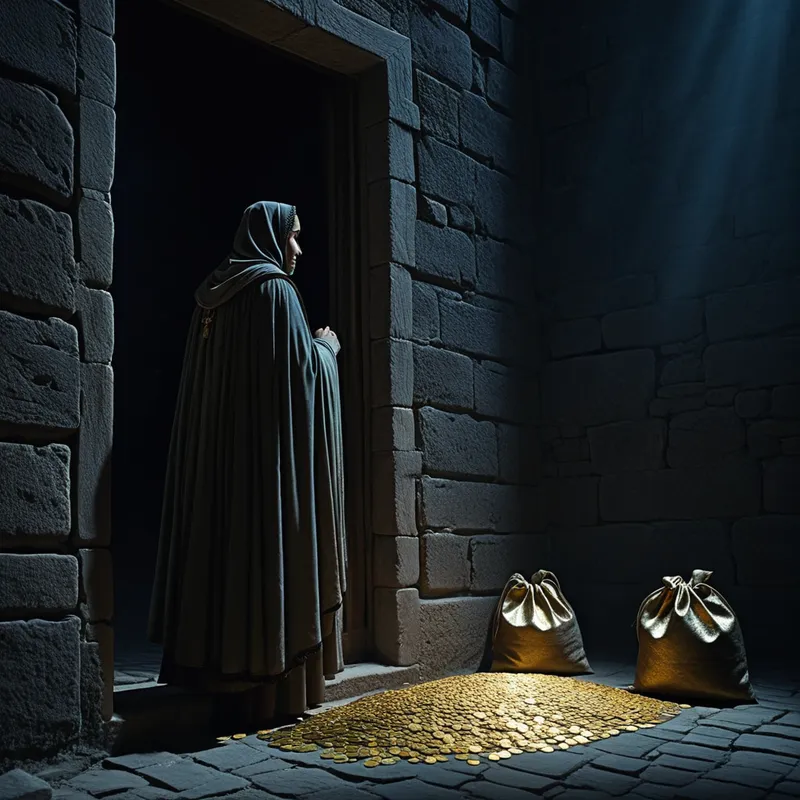
He heard of a ruined nobleman, a father of three daughters whose futures were as bleak as a midwinter dawn. Without dowries, they faced disgrace or worse. On three successive nights, when the moon was a sliver of silver, Nicholas went to their humble dwelling. Not at the door, but to the window. He did not knock. He listened to the wind’s sigh and the family’s soft, desperate prayers from within. Then, through the opening, he cast his salvation—not one, but three small, heavy bags of gold. They thudded softly onto the floor, a sound of impossible hope. On the third night, the father waited, straining to see the face of this phantom benefactor. He saw only the flash of a bishop’s robes, the glimpse of a stern, kind face, before Nicholas vanished back into the myth he was becoming.
This was his way. Coins for the poor, food for the starving, freedom for the unjustly imprisoned—all delivered in shadow, all asking for no thanks. He became a legend whispered by firelight: the saint who came in the night.
And as centuries turned, his story merged with older, colder spirits. From the frost-rimed pines of the North came tales of a Yule Father, a bearded man who knew if you were sleeping or awake, who traveled a sky-road. The bishop’s cloak became fur-trimmed red, his Myra became a palace of ice at the top of the world, his silent nighttime visits became a single, impossible flight. The gold coins became toys, the judgment of his compassionate heart became a list—naughty and nice. But the core remained, shining through the tinsel: a being of profound, secret judgment and even more profound, secret giving, arriving in the deepest dark to leave a spark of light.
Cultural Origins & Context
The figure we know is a palimpsest, a sacred text written over many times. The historical Nicholas was Bishop of Myra in the 4th century, venerated in both Eastern and Western Christianity for his legendary generosity and advocacy. His feast day, December 6th, was marked by gift-giving, often secretly, in his name.
This tradition collided with pre-Christian midwinter festivals across Northern Europe, such as the Germanic Yule. Here, spirits like Jólnir (a name for Odin) were said to lead a wild hunt through the sky, a figure associated with wisdom, the dead, and gift-giving. The Dutch brought their "Sinterklaas" to the New World, where, in the 19th century, authors like Washington Irving and Clement Clarke Moore, and illustrator Thomas Nast, synthesized these strands. They crafted the iconic image: the jolly, rotund, home-invading elf-king in a red suit, powered by reindeer and industrial-era magic (chimney descent, global delivery in one night). The myth was democratized and commercialized, moving from a saint’s day to a central pillar of the family-centric Christmas holiday, serving as a mechanism for social bonding, behavioral conditioning for children, and immense economic activity.
Symbolic Architecture
At its heart, this is a myth of the Caregiver archetype operating in the realm of the unseen. It is a profound drama of witnessed authenticity.
The gift given in secret is a transaction between the soul and the cosmos, bypassing the ego’s ledger of debt and credit.
Santa Claus is the ultimate witness. He "knows when you are sleeping, he knows when you’re awake." This is not surveillance but omniscient compassion. He sees the true self—the private kindness, the hidden struggle, the unspoken regret. The "list" symbolizes the inescapable moral accounting of the psyche, the Superego that judges our actions. The coal and the gift represent the consequences that flow naturally from our inner state, not as punishment or reward from an external god, but as the intrinsic fruit of our character.
The night flight represents the journey of the spirit into the unconscious. The chimney descent is a brilliant symbol of penetration into the hearth—the heart—of the home (the psyche) through a narrow, sooty passage (the birth canal, the process of transformation). He leaves his trace (ashes, gifts) and depairs, his work done in mystery.
The Dreamer's Resonance
To dream of Santa Claus is to encounter the archetype of the Ultimate Witness in one’s own psyche. It often surfaces during times of self-assessment or when one’s private actions feel dissonant with public persona.
Dreaming of receiving a gift from him may signal the unconscious acknowledging a part of the self that has been "good"—aligned, authentic, or nurturing—and is now being integrated. The gift’s nature is crucial: a tool suggests new capability; a toy suggests a return of playfulness or creativity.
Dreaming of being on the "naughty list" or receiving coal is a stark confrontation with the shadow. It is the psyche’s own judgment on behaviors or attitudes the dreamer knows are misaligned, selfish, or "unclean." This is not a condemnation but a call to awareness.
Dreaming of being Santa Claus points to the emergence of the inner Caregiver, the part of the self that wishes to provide for others anonymously, to judge with compassion, and to act from a place of abundant spirit, often suggesting a need to give to parts of oneself that have been neglected.
Alchemical Translation
The alchemical journey modeled by this myth is the transmutation of judgment into gift, and of secret action into spiritual substance.
The North Pole workshop is the vas hermeticum of the soul, where the raw materials of experience (joys, failures, acts of kindness, moments of selfishness) are worked upon by diligent, unseen forces (the elves/instincts) to produce the gold of character.
The modern individual’s "individuation" Santa Claus journey begins with the long night of self-witnessing—the honest, private audit of one’s own "list." This is the nigredo, the blackening, the soot of the chimney. It is uncomfortable, dark work.
The next stage is the secret giving—the albedo, or whitening. This is performing acts of integrity, kindness, or creativity not for recognition, but because they are true. This is Nicholas dropping the gold bags. It is the cultivation of an inner generosity of spirit towards oneself and others, done without an audience.
The culmination is the flight of integration—the rubedo, the reddening. The self, having judged itself with compassion and given from its authentic core, becomes capable of miraculous travel. It can traverse the inner cosmos (the starry sky), descend into the depths of its own and others’ psyches (the chimneys), and leave transformative "gifts"—not material objects, but the presence of understanding, forgiveness, or inspiration. One becomes, in their own sphere, the spirit that works in the dark to bring light, whose true identity is known only by the results left behind at the hearth of the heart.
Associated Symbols
Explore related symbols from the CaleaDream lexicon: