Sacred Smoke Ceremonies Myth Meaning & Symbolism
A myth of sacred smoke as a bridge between worlds, carrying prayers to the sky, cleansing the heart, and weaving the visible with the invisible.
The Tale of Sacred Smoke Ceremonies
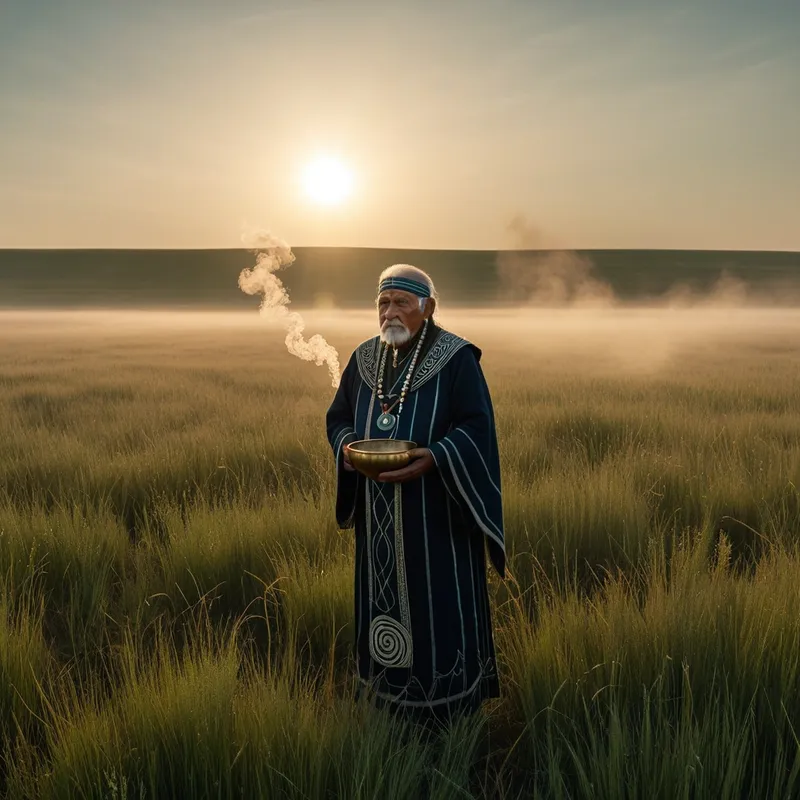
Listen. Before [the world](/myths/the-world “Myth from Tarot culture.”/) was hard with straight lines and loud noises, it was soft with breath and intention. In that time, the people walked with a keen loneliness. They could feel the Wakan Tanka in [the wind](/myths/the-wind “Myth from Various culture.”/)’s whisper and [the river](/myths/the-river “Myth from Buddhist culture.”/)’s song, but they had no voice to answer. Their hearts were full, but their words were earth-bound, falling like stones at their feet. They saw the spirits in the flicker of fire and the flight of the eagle, but a veil hung between the worlds, a silence that ached.
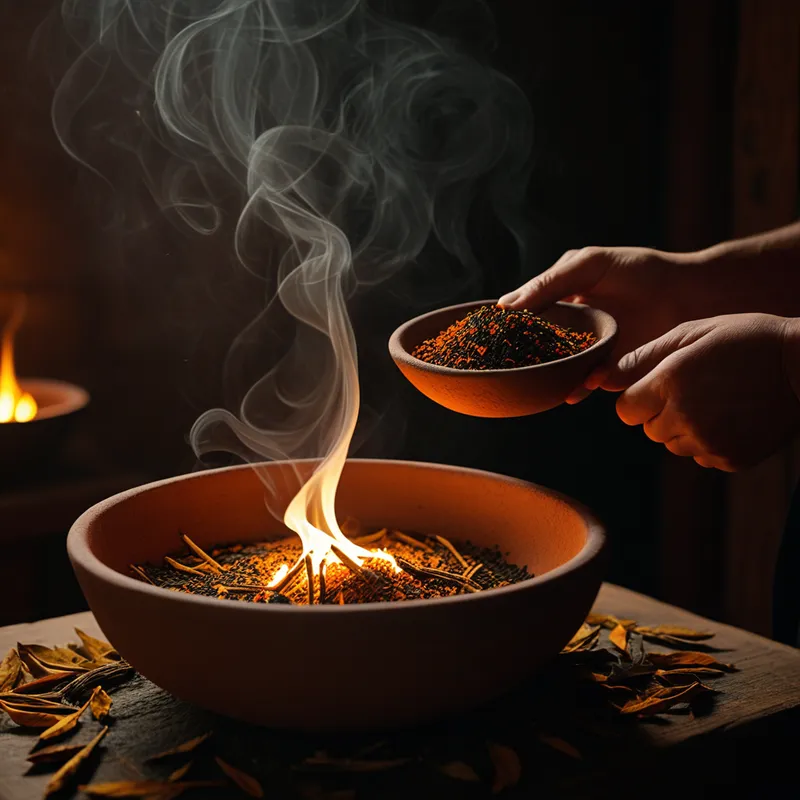
Then, one who walked between, a woman of deep seeing, took her sorrow to a quiet place. She sat with the plants, her tears watering the Wiingashk and the sturdy smudge plant. She gathered their dried gifts, their summer essence captured in leaf and stem. With hands made gentle by despair, she took a coal from the fire—a fragment of the sun’s brother—and placed the herbs upon it.
A miracle of quietness occurred.
Not fire, but breath. Not flame, but a visible sigh. A grey-blue tendril uncurled from the ember, carrying the very scent of the prairie after rain, of sun on cedar, of memory itself. It rose, hesitant at first, then with a purpose. It did not scatter like mist. It climbed, a slender rope, a ladder made of air and prayer. The woman, her heart cracked open, whispered her gratitude to [the earth](/myths/the-earth “Myth from Hindu culture.”/), her hopes for her children, her fears to the wind.
And the smoke carried them. It wove through the still air, up past the lodge poles, through the canopy, and into the vast belly of [the sky](/myths/the-sky “Myth from Persian culture.”/). The spirits of the air, the manitous of the upper world, saw the signal. They leaned down and drew in the fragrant smoke, and with it, they tasted her pure heart. An answer came not in words, but in a feeling: a warmth in the breast, a sudden clarity like a cleared sky, a sense of a presence, vast and attentive.
She returned to the people, her face calm, her eyes holding a new light. “I have found a voice,” she said. “I have found a bridge.” She showed them the humble plants, the humble coal. She taught them that the sacred was not distant, but lay in the relationship between breath, plant, fire, and intent. The people learned. In the morning, smoke carried greetings to the daybreak. In the lodge, before council, smoke cleansed the mind of petty thoughts. For the sick, healing smoke drove out [the shadow](/myths/the-shadow “Myth from Jungian culture.”/) of illness. For the dead, smoke eased their journey to [the star](/myths/the-star “Myth from Tarot culture.”/) road.
[The veil](/myths/the-veil “Myth from Various culture.”/) did not vanish, but it became permeable. The silence was filled with a fragrant, rising conversation. The people were no longer lonely. They were in communion, their every heartfelt word, from joy to grief, turned to sacred smoke and delivered by the invisible hands of the air into the very heart of the Great Mystery.
Cultural Origins & Context
This is not a single myth from a single nation, but a living, breathing practice and its accompanying understanding found across countless Indigenous North American cultures, from the Lakota and Diné (Navajo) to the Coastal Salish and Anishinaabe. The story of its origin is often held within the specific teachings of medicine societies, families, and spiritual leaders, passed down not as a fixed text but as an embodied knowledge.
Its societal function is foundational. It is protocol, medicine, and theology woven into one. The ceremony—whether a simple morning smudge or a complex component of the Sun Dance or Shaking Tent—structures sacred space and time. It marks transitions: between night and day, between profane and sacred activities, between health and sickness, between life and death. The storyteller is often an elder or medicine person, teaching not just the “how” but the “why”—the respect for the plant relatives, the purity of intent, and the understanding that this act sustains the reciprocal relationship between humanity and the rest of creation.
Symbolic Architecture
At its core, the myth presents smoke as the alchemical third, born from the [marriage](/symbols/marriage “Symbol: Marriage symbolizes commitment, partnership, and the merging of two identities, often reflecting one’s feelings about relationships and social obligations.”/) of the earthly (plant) and the celestial (fire). It is matter transformed into [spirit](/symbols/spirit “Symbol: Spirit symbolizes the essence of life, vitality, and the spiritual journey of the individual.”/), the visible made invisible, a perfect [symbol](/symbols/symbol “Symbol: A symbol can represent an idea, concept, or belief, serving as a powerful tool for communication and understanding.”/) for the [movement](/symbols/movement “Symbol: Movement symbolizes change, progress, and the dynamics of personal growth, reflecting an individual’s desire or need to transform their circumstances.”/) of [consciousness](/symbols/consciousness “Symbol: Consciousness represents the state of awareness and perception, encompassing thoughts, feelings, and experiences.”/).
The sacred smoke is the breath of the soul made visible, the intention of the heart given wings.
The [medicine](/symbols/medicine “Symbol: Medicine symbolizes healing, transformation, and the pursuit of knowledge, addressing both physical and spiritual health.”/) plants represent the [body](/symbols/body “Symbol: The body in dreams often symbolizes the dreamer’s self-identity, personal health, and the relationship they have with their physical existence.”/), [memory](/symbols/memory “Symbol: Memory symbolizes the past, lessons learned, and the narratives we construct about our identities.”/), and the specific virtues of the [earth](/symbols/earth “Symbol: The symbol of Earth often represents grounding, stability, and the physical realm, embodying a connection to nature and the innate support it provides.”/). [Cedar](/symbols/cedar “Symbol: Aromatic wood symbolizing purification, protection, and sacred connection, often associated with spiritual cleansing and enduring strength.”/) is protection; sage is cleansing; sweetgrass is kindness and attraction of good spirits; [tobacco](/symbols/tobacco “Symbol: A plant with psychoactive properties, historically used in rituals and social bonding, now associated with addiction and health risks.”/) is pure [prayer](/symbols/prayer “Symbol: Prayer represents communication with the divine or a higher power, often reflecting inner desires and spiritual needs.”/) and contract. The fire represents spirit, will, and transformative power. The smoke itself is the message—the integrated offering of [body](/symbols/body “Symbol: The body in dreams often symbolizes the dreamer’s self-identity, personal health, and the relationship they have with their physical existence.”/) and spirit. Its upward [journey](/symbols/journey “Symbol: A journey in dreams typically signifies adventure, growth, or a significant life transition.”/) maps the [human](/symbols/human “Symbol: The symbol of a human represents individuality, complexity of emotions, and social relationships.”/) desire to transcend limitation, to connect the personal with the transpersonal. The act of fanning the smoke over oneself or a [space](/symbols/space “Symbol: Dreaming of ‘Space’ often symbolizes the vastness of potential, personal freedom, or feelings of isolation and exploration in one’s life.”/) is not merely cleansing; it is a symbolic [baptism](/symbols/baptism “Symbol: A ritual of spiritual cleansing, initiation, and rebirth, symbolizing profound transformation and commitment to a new path.”/) in this integrated spirit, a re-knitting of the individual into the whole.
Psychologically, the central figure—the first person to discover this—represents the emergent ego that realizes its profound interdependence. The “[loneliness](/symbols/loneliness “Symbol: A profound emotional state of perceived isolation, often signaling a need for connection or self-reflection.”/)” is [the ego](/myths/the-ego “Myth from Jungian culture.”/)’s initial state of alienation from the unconscious (the [spirit world](/symbols/spirit-world “Symbol: A realm beyond the physical, inhabited by spirits, ancestors, or supernatural beings, often representing the unconscious, afterlife, or mystical connection.”/)). The [ceremony](/symbols/ceremony “Symbol: Ceremonies in dreams often symbolize transitions, rituals of passage, or significant life events.”/) is the ritualized process by which [the ego](/myths/the-ego “Myth from Jungian culture.”/) consciously offers its contents (thoughts, feelings, prayers) to the larger Self (Wakan Tanka) for [integration](/symbols/integration “Symbol: The process of unifying disparate parts of the self or experience into a cohesive whole, often representing psychological wholeness or resolution of internal conflict.”/) and healing.
The Dreamer’s Resonance
When this myth pattern arises in modern dreams, it often signals a profound somatic and psychological process of purification and seeking connection. To dream of smoke, especially fragrant smoke or smoke that behaves intentionally, points to a deep need to clear away psychic debris—old griefs, stagnant thoughts, inherited patterns that cloud perception.
The dreamer may be undergoing a life transition where an old “self” must be symbolically burned away so its essence can rise. The smoke in the dream is the feeling-tone of that transition: it can be the anxiety (choking smoke) transforming into clarity (fragrant, rising plumes). A dream of being unable to light the herbs may reflect a blockage in connecting to one’s intuitive, spiritual core or a feeling of being “out of relationship” with one’s own body (the earth) or passion (the fire). Conversely, dreaming of smoke gracefully carrying a thought or object upward suggests the unconscious is affirming a process of successful sublimation or prayer—a psychological content is being successfully offered up to a higher level of understanding for integration.

Alchemical Translation
For the modern individual navigating the path of individuation, the myth of the sacred smoke ceremony is a masterful model for psychic transmutation. Our neuroses, complexes, and unresolved emotions are the “raw herbs” of our personal history—potent, often dried and brittle, holding the concentrated essence of past experiences.
Individuation is the sacred fire within; our attention and conscious effort are the coal. Our suffering and our gifts are the herbs. The transformed life is the smoke.
The “alchemical translation” follows the ritual precisely. First, one must gather the material—bring conscious attention to the psychological content (a resentment, a fear, a creative impulse). This requires the respectful “harvest” of self-observation. Then, one applies the heat of consciousness—the honest, non-judgmental scrutiny of the shadow. This is the fire. The conflict, the “burning,” is necessary.
The transmutation occurs not in clinging to the raw herb (repression) nor in letting it be consumed by wild flame (acting out), but in holding it in the transformative container of mindful awareness. The result is “sacred smoke”: the complex is not eliminated, but its energy is transformed and released from its personal, ego-bound form. The hatred becomes understood as wounded love; the fear becomes respect for boundaries; the grief becomes a deepened capacity for compassion. This transformed energy then “rises,” feeding the broader [psyche](/myths/psyche “Myth from Greek culture.”/), connecting the personal ego to the archetypal realm of the Self. We are cleansed, not by removing parts of ourselves, but by changing our relationship to them through [the sacred fire](/myths/the-sacred-fire “Myth from Native American culture.”/) of honest reflection, offering them up to become part of our soul’s fragrant, ascending dialogue with the whole of existence.
Associated Symbols
Explore related symbols from the CaleaDream lexicon: