Ryujin Myth Meaning & Symbolism
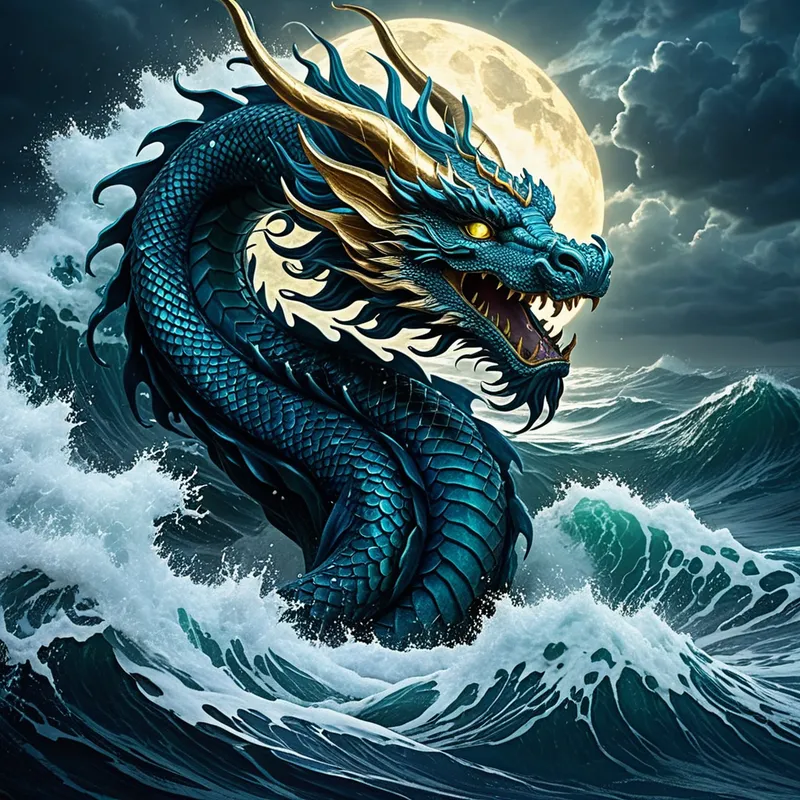
The myth of Ryujin, the Dragon God who rules the sea from his jeweled palace, embodies the power, peril, and profound wisdom of the deep unconscious.
The Tale of Ryujin
Beneath the restless, wine-dark sea, where the light of the sun becomes a memory and the pressure of the deep is a constant prayer, lies a kingdom no mortal eye has truly seen. Its name is Ryugujo, the Dragon Palace, and its ruler is the sovereign of all that is fluid, hidden, and potent: Ryujin.
His form is the ocean’s own breath made flesh—a great, coiling serpent-dragon, scales like polished obsidian and gold, whiskers flowing like the currents he commands. His eyes hold the patience of abyssal trenches and the fury of typhoons. From this jeweled realm of coral spires and gates of tortoiseshell, he governs the tides with a pair of sacred gems: the Kanju and Shiomaneki. To flood the land or to make it dry, to summon a wave or to still it—this is his will.
The tales whisper of a time when a humble fisherman, Urashima Taro, saved a turtle from torment. In gratitude, the turtle, a servant of the palace, bore him on its shell down, down into the crushing, beautiful dark. He was welcomed not as a trespasser, but as an honored guest. In Ryugujo, time flowed like a different current. He feasted, he marveled at the dragon’s daughters dancing like shafts of moonlight through water, and he forgot the world above.
But a whisper of memory, a ghost of a life once lived, stirred in his heart. Wishing to return, he was given a tamatebako, a lacquered box, by Ryujin’s daughter with a solemn warning: never open it. He returned to his village to find centuries had passed in a blink. In his despair and confusion, he broke the taboo. He opened the box. A wisp of white smoke—the captured years of his life—escaped, and he aged instantly into dust, consumed by the time he had evaded in the timeless deep.
In another legend, the tide jewels were the key to a kingdom’s fate. When the prince of Yamato Takeru was trapped by a warlord who set the plains ablaze, he drew the Kusanagi-no-Tsurugi and cut the burning grass, but the true salvation came from the sea. His wife, Otohime, prayed to her father, Ryujin. The Dragon God answered. The tide jewels were used: first the Kanju to draw back the flames with a retreating tide, then the Shiomaneki to summon a great wave that drowned the enemy host. The sea’s fury, directed by divine will, saved the land from fire.
Cultural Origins & Context
The myth of Ryujin is woven from the very fabric of Japan’s relationship with the sea. As an island nation, the ocean was both a bountiful provider and a terrifying, unpredictable force of annihilation. Ryujin, as kami of the sea, embodies this profound ambivalence. These stories were not mere entertainment; they were cosmological maps and social contracts.
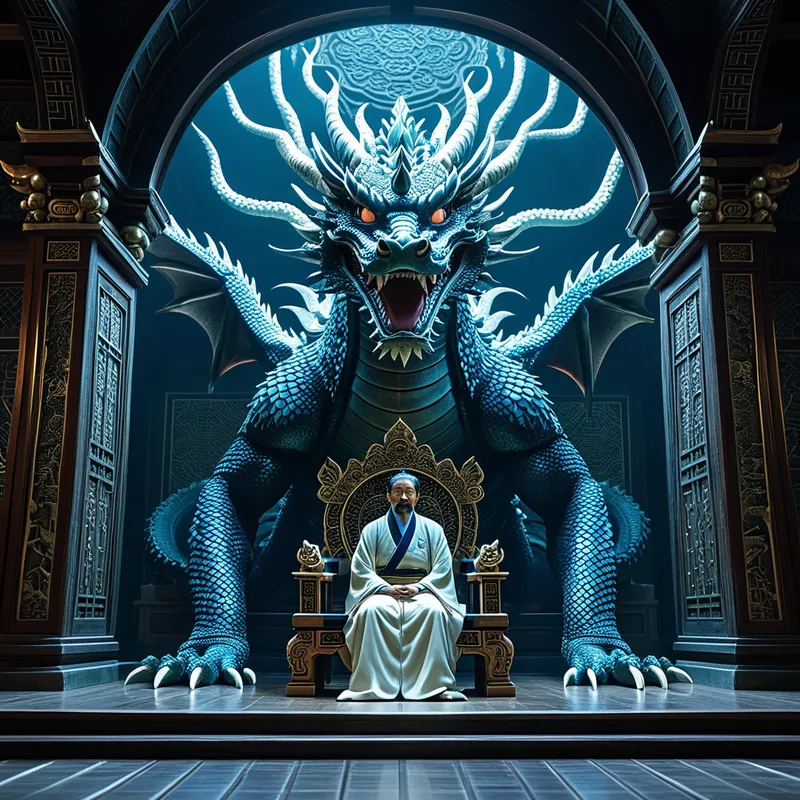
They were passed down through Kodan storytelling, Noh and Bunraku theater, and recorded in ancient texts like the Kojiki and Nihon Shoki. Ryujin’s function was multifaceted: to explain the mysteries of tides and storms, to codify respect for the natural world, and to illustrate the dangers and rewards of engaging with forces greater than oneself. The Dragon Palace served as a mythological counterpart to the Imperial Court, a divine mirror reflecting the structured yet mysterious hierarchy of power.
Symbolic Architecture
Ryujin is the archetypal sovereign of the unconscious. His palace, Ryugujo, is not merely a physical location but a symbol of the psyche’s deepest stratum—the collective unconscious, where primal images, instincts, and ancestral wisdom reside in a state of timeless potential.
The Dragon God does not rule with an iron fist, but with the fluid certainty of the deep current. His sovereignty is the self-regulation of the psyche, where chaos and order are not opposites, but phases of the same eternal motion.
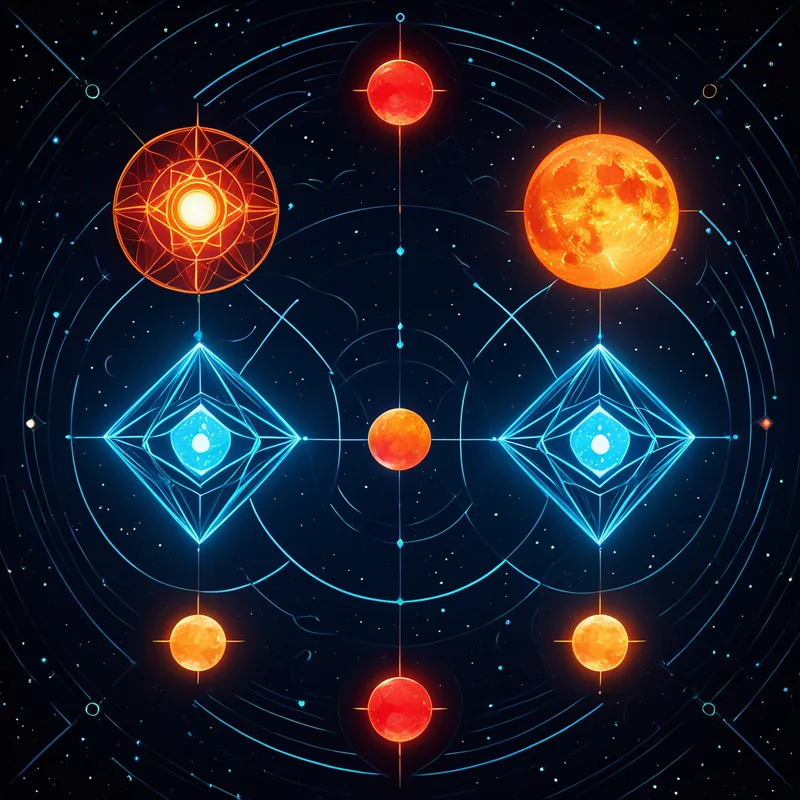
The Tide Jewels are the ultimate symbols of psychic polarity and control. The Kanju (the jewel that floods) represents the inflowing tide of the unconscious—dreams, emotions, intuitions, and creative impulses that can enrich or overwhelm the conscious mind. The Shiomaneki (the jewel that ebbs) represents the capacity for reflection, withdrawal, and conscious analysis that orders and makes sense of that influx. Mastery of life, the myth suggests, is not about suppressing the unconscious sea, but learning to wield these two jewels in harmony.
The tragedy of Urashima Taro is a profound warning about the nature of psychological gifts. The tamatebako is the sealed insight from the deep self. To bring it to the surface world (consciousness) is a great journey. But to prematurely “open” it—to dissect it with literal-mindedness, to demand its meaning before one is prepared—is to lose its magic and be destroyed by the raw, unintegrated power of what it contains (the forgotten/repressed time of one’s own life).
The Dreamer’s Resonance
When the pattern of Ryujin surfaces in modern dreams, it signals a profound engagement with the depths of the Self. It is not a call to action, but to receptivity.
Dreaming of descending into a deep, beautiful, but frightening underwater realm points to a somatic process of diving into repressed emotions or forgotten trauma. The pressure felt in the dream is the weight of this unprocessed material. Encountering a benevolent but awe-inspiring sea dragon or being given a gift by a figure of oceanic authority suggests the dreamer is at the threshold of receiving wisdom from their own depths—perhaps a creative vision, an intuitive solution, or a recognition of a deep-seated pattern.
Conversely, dreams of being chased by tidal waves or drowning speak to a fear of being overwhelmed by the contents of the unconscious—a feeling of emotional flooding where the Kanju runs wild without the balancing Shiomaneki. The psyche is signaling that the conscious ego feels inadequate to contain the rising tide.

Alchemical Translation
The myth of Ryujin models the alchemical process of individuation—the journey toward psychic wholeness—as a maritime expedition. The conscious ego is the fisherman in his small boat on the surface. Individuation begins with the act of “saving the turtle,” an act of compassion toward an instinctual, humble, and often overlooked part of the self (the shadow). This grants passage downward.
The treasure sought in the Dragon Palace is not external gold, but the recognition of one’s own inner sovereignty. To sit before Ryujin is to confront the ultimate authority within one’s own psyche.
The sojourn in the timeless palace represents a necessary incubation period in the unconscious. One must feast on its images and rest in its non-linear logic. The return, with the sealed tamatebako, is critical. This is the transmutation: bringing a nascent, unformed potential from the deep into the light of day. The warning not to open it is the wisdom that integration takes time. The new insight must be allowed to “breathe” and adapt to conscious life slowly, naturally. To force it (opening the box) is to enact a psychic inflation, where the ego is obliterated by a power it cannot yet integrate.
The ultimate alchemical goal is to become, in a sense, the ruler of one’s own Ryugujo. It is to develop a conscious relationship with the deep currents of one’s being, to respectfully wield the Tide Jewels of emotion and reason, and to build a personality that, like the dragon’s palace, is structured yet fluid, majestic yet rooted in the profound, dark, life-giving sea of the Self.
Associated Symbols
Explore related symbols from the CaleaDream lexicon: