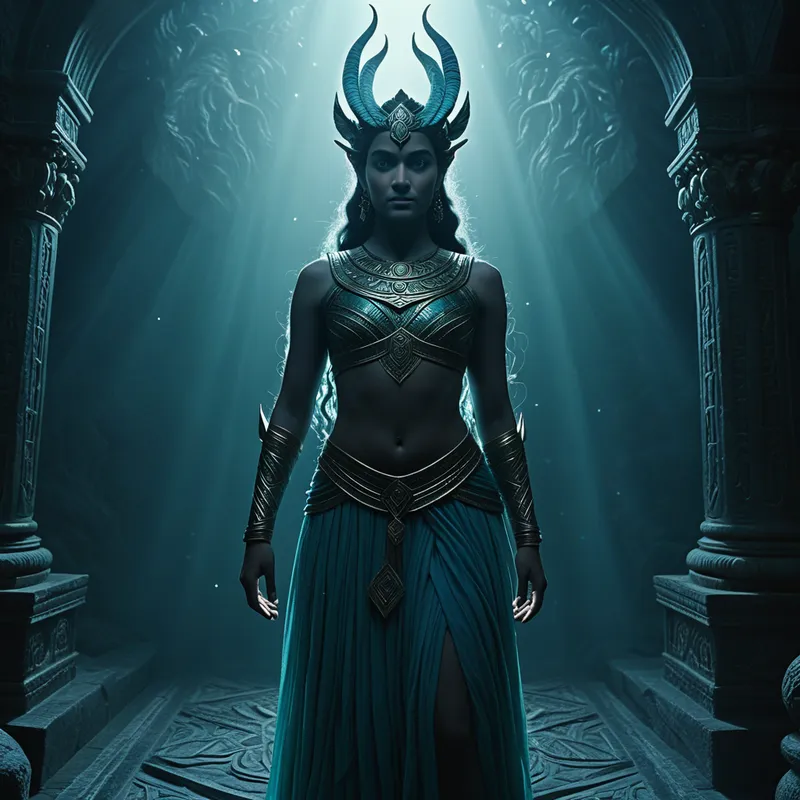
Rumi and Shams of Tabriz
The profound spiritual friendship between Sufi mystic Shams of Tabriz and poet Rumi that ignited Rumi's transformation into one of history's greatest mystical poets.
The Tale of Rumi and Shams of Tabriz
In the city of Konya, in the heart of the Seljuk Sultanate of Rum, lived a respected scholar and jurist named Jalal ad-Din Muhammad Balkhi, known to [the world](/myths/the-world “Myth from Tarot culture.”/) as Rumi. He was a man of profound learning, a teacher with a circle of disciples, a pillar of theological order. His world was one of texts, laws, and reasoned discourse. Yet, beneath the surface of this esteemed life, a divine restlessness simmered—a soul thirsting not for knowledge about God, but for direct, ecstatic union with God.
Into this ordered life, in the year 1244, walked a wild and ragged wanderer. His name was Shams of Tabriz, “the Sun of Tabriz.” He was not a man of books but of blazing, unmediated experience. He wore the guise of a beggar, but his eyes held the fire of [the desert](/myths/the-desert “Myth from Biblical culture.”/) and the depth of the infinite. Their meeting was not polite. It was a collision. Shams, the story goes, confronted the great teacher Rumi by the side of a fountain, pointing to the scholar’s books and asking, “What is this?” Before Rumi could answer, Shams seized the precious volumes—commentaries, philosophy, sacred law—and cast them into the [water](/myths/water “Myth from Chinese culture.”/). “This,” Shams declared, “is what must be done.”
Instead of rage, a miracle occurred. Rumi watched the books sink, and saw not loss, but liberation. He saw the ink of scholarly words dissolve into the living water of direct knowing. From that moment, the scholar died, and the poet-lover was born. Rumi abandoned his lectures, his students, his social standing. He and Shams entered a period of intense, exclusive retreat—sohbet, or spiritual communion. For months, they were sealed in a room, lost in conversation, prayer, and ecstatic dance. To the outside world, it was a scandal. The great teacher had been bewitched by a mad dervish. To Rumi, it was the only reality. Shams had become [the mirror](/myths/the-mirror “Myth from Various culture.”/) in which Rumi saw his own true face, the divine beloved reflected in human form.
This sacred intimacy could not last in the mundane world. The jealousy of Rumi’s disciples and family grew toxic. After a tumultuous period, Shams vanished as suddenly as he had appeared, likely murdered by those who could not bear the light he and Rumi shared. His disappearance plunged Rumi into a grief so vast it became a new ocean of creativity. He wandered the streets of Konya, composing love songs to his absent friend, his absent God. In his anguish, he found the voice that would echo through centuries. He turned, and in turning, began to spin—the origin of the whirling dance of the Mevlevi Sufis. His poetry poured forth, not as crafted verse, but as spontaneous outpourings of a heart torn open by love and loss. Shams was gone, but in his absence, he became even more present. Rumi began to sign his greatest work, the Divan-e Shams-e Tabrizi, not with his own name, but with the name of his beloved. The Sun had set, only to rise eternally within the poet’s soul.
Cultural Origins & Context
This myth arises from the rich soil of Sufism, the mystical heart of Islam. By the 13th [century](/myths/century “Myth from Biblical culture.”/), Sufism had developed sophisticated schools of thought, from the sober introspection of the Baghdad school to the ecstatic, love-intoxicated path of Persian mystics like Attar and Sanai. Rumi was born into this world, but initially inhabited its more scholarly, juridical periphery.
The figure of the Murshid-i Kamil, the perfect spiritual guide, is central to Sufi practice. The guide is not a teacher of doctrine but a physician of the soul, a midwife for the divine birth within the disciple. Shams epitomizes this archetype in its most radical, untamed form. He is the qalandar—the God-intoxicated wanderer who owns nothing and belongs to no institution, whose only authority is the fire of direct gnosis (ma’rifah).
Their story also reflects the tension between the established religious order (sharia) and the transcendent path of mystical truth (haqiqa). Rumi, the professor of law, represented the former; Shams, the wild dervish, embodied the latter. Their union symbolizes the Sufi ideal: that the outer law is not abolished but fulfilled and set aflame by the inner reality of divine love (ishq). The historical context of the Mongol invasions, which shattered the old Islamic political order, forms a silent backdrop—a world in [chaos](/myths/chaos “Myth from Greek culture.”/) where the only true refuge was found in the invisible kingdom of the heart.
Symbolic Architecture
At its core, the myth is an elaborate map of the [soul](/symbols/soul “Symbol: The soul represents the essence of a person, encompassing their spirit, identity, and connection to the universe.”/)’s transformation. Rumi represents the developed intellect, the nafs al-lawwama ([the self](/myths/the-self “Myth from Jungian culture.”/)-reproaching soul) that is ripe for annihilation. Shams is the catalyst, the divine agent of grace, who represents the pull of the nafs al-mutma’innah (the soul at [peace](/symbols/peace “Symbol: Peace represents a state of tranquility and harmony, both internally and externally, often reflecting a desire for resolution and serenity in one’s life.”/)). Their meeting is the spark that ignites the [alchemical process](/symbols/alchemical-process “Symbol: A symbolic transformation of base materials into spiritual gold, representing inner purification, integration, and the journey toward wholeness.”/).
The relationship is not one of master and student in a conventional sense, but of two mirrors facing each other, each polishing the other until nothing remains but the reflected light of the Divine. Shams did not give Rumi something he lacked; he shattered the container so the wine within could flow.
The disappearance and presumed murder of Shams is the crucial [crucible](/symbols/crucible “Symbol: A vessel for intense transformation through heat and pressure, symbolizing spiritual purification, testing, and alchemical change.”/). It transforms [human](/symbols/human “Symbol: The symbol of a human represents individuality, complexity of emotions, and social relationships.”/) attachment (ishq-e majazi) into pure divine love (ishq-e haqiqi). The beloved must be lost in form to be found in essence. Rumi’s [grief](/symbols/grief “Symbol: A profound emotional response to loss, often manifesting as deep sorrow, yearning, and a sense of emptiness.”/) becomes the rotating [axis](/symbols/axis “Symbol: A central line or principle around which things revolve, representing stability, orientation, and the fundamental structure of reality or consciousness.”/) of his whirling poetry and dance—a dynamic, living [symbol](/symbols/symbol “Symbol: A symbol can represent an idea, concept, or belief, serving as a powerful tool for communication and understanding.”/) of orbiting around a central sun that is now invisible, yet felt at the core of being.
The Dreamer’s Resonance
For the modern [psyche](/myths/psyche “Myth from Greek culture.”/), this myth speaks directly to the transformative power of profound encounter. It is the story of the moment our carefully constructed identity—the “respected scholar” of our own lives—is confronted by a wild, authentic, and disruptive truth. This truth often arrives not as a gentle idea, but as a shocking event, a loss, or a person who reflects back to us everything we have suppressed in our pursuit of order and approval.
Shams represents that catalytic friend, therapist, crisis, or inner voice that asks, “What is all this?” and invites us to throw our old scripts into the water. The ensuing “disappearance” of the catalyst is equally psychological. The guide, the therapy, the initial spark must eventually recede for the transformation to become our own. The pain of that separation is not pathology, but the birth pangs of a new consciousness. We are invited, like Rumi, to channel that ache into creative expression, to find the dance within our grief, and to discover that the love we sought in another was always the seed of our own soul’s unfolding.
Alchemical Translation
The myth performs a precise spiritual alchemy. The base metal of scholastic knowledge (ilm) is transmuted into the gold of direct gnosis (irfan). The leaden weight of egoic identity is dissolved in the aqua regia of divine love. Rumi’s poetry itself becomes the philosopher’s stone—a linguistic substance that can turn the reader’s heart.
The whirling dance (sama) is the physical enactment of this alchemy. The dancer sheds the layered garments of social identity as they spin, and with one hand lifted to receive grace and the other turned toward the earth, they become a conduit between heaven and earth, a spinning axis where the human and divine marry.
The ultimate translation is of the self itself. Rumi’s signature on the Divan as “Shams” is the final stage: the complete fana (annihilation) of the separate self in the beloved. The poet disappears into his poetry, the lover into love, the seeker into the sought. What remains is not a void, but a boundless, creative presence.
Associated Symbols
Explore related symbols from the CaleaDream lexicon:
- Sun — The radiant source of illumination and transformative energy, representing both Shams (whose name means Sun) and the divine truth that burns away illusion.
- Water — The fluid medium of dissolution and rebirth, where rigid knowledge is submerged to give way to fluid, intuitive wisdom.
- Mirror — The perfect symbol for their relationship, where each soul polishes the other to reflect only the face of the divine beloved.
- Fire — The consuming, purifying, and ecstatic force of divine love (ishq) that transmutes the soul’s base elements.
- Dance — The embodied expression of cosmic rotation and ecstatic surrender, turning grief into a moving prayer and the body into a axis between worlds.
- Friend — The sacred companion (dost) who is not a mere social contact but a divine mirror and catalyst for the soul’s ultimate journey.
- Cocoon Transformation — The sealed chamber of sohbet where the old identity of the scholar dissolves, allowing the winged poet to emerge.
- Heart — The central organ of Sufi mysticism, the throne of God within the human being, where the divine encounter takes place.
- Ocean — The vast, boundless reality of the divine into which the drop of the individual soul longs to merge, represented by Rumi’s all-consuming grief and love.
- [Death](/myths/death “Myth from Tarot culture.”/) — The necessary annihilation (fana) of [the ego](/myths/the-ego “Myth from Jungian culture.”/) and all worldly attachments, which precedes spiritual rebirth in the divine.
- Wound — The sacred opening created by loss and longing, through which [divine light](/myths/divine-light “Myth from Christian culture.”/) enters and creative expression pours forth.
- Wine — The intoxicating spirit of divine knowledge and ecstasy, contained in the cup of the heart, celebrated in Rumi’s poetry as the true drink of lovers.