Round Table Feasts Myth Meaning & Symbolism
A myth of fellowship where knights gather at a round table, forging a sacred bond of equality and shared purpose under a wounded king's vision.
The Tale of Round Table Feasts
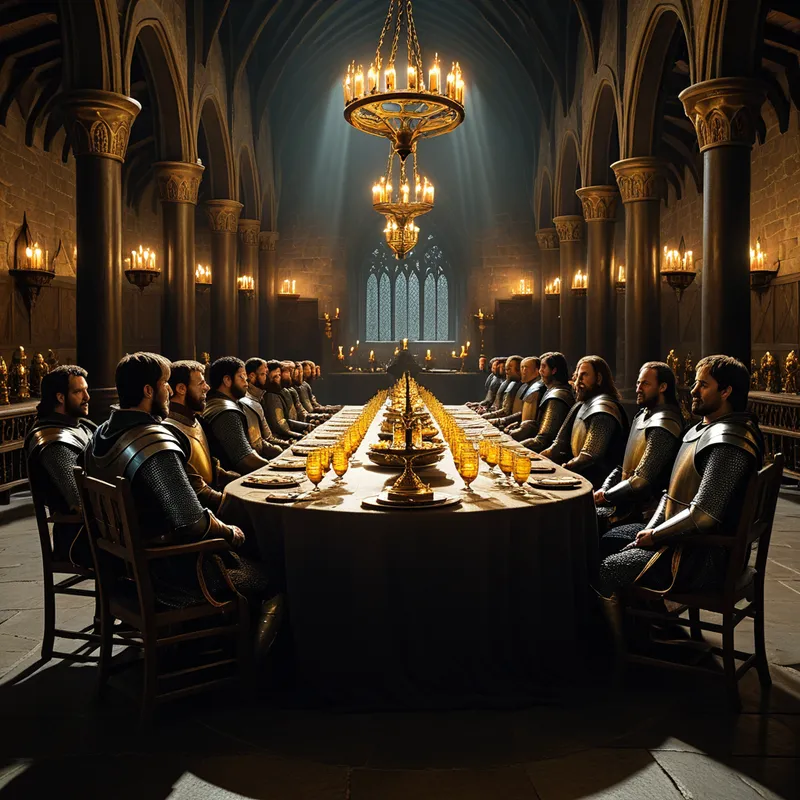
Hear now the tale not of a single quest, but of the hearth from which all quests are born. In the hall of Camelot, where stone held the memory of giants and tapestries whispered of older gods, there stood a table. But this was no ordinary board for meat and mead. It was a circle of dark, ancient oak, a ring of perfection brought by Merlin as a wedding gift, a puzzle with no head and no foot.
Here, in the heart of a kingdom still bleeding from the wounds of usurpation and shattered loyalties, the young king Arthur did not sit above his men. He sat among them. When the great doors groaned shut against the winter’s bite, and the fire roared in the central hearth, they would gather. Not as lord and vassals, but as a fellowship sworn. The air grew thick with the scent of roasting meat, woodsmoke, and the earthy tang of ale. The clatter of plates was punctuated by the low rumble of voices—stories of the day’s patrols, debates on law, laughter that shook the rafters.
Yet, within this warmth lay a cold, silent space. The Siege Perilous, a seat that promised death to any unworthy who dared rest in it, stood empty. Its vacancy was a whisper in the feast’s clamor, a reminder that their circle, though whole in spirit, awaited its final, purest member. The feast was not mere celebration; it was an act of weaving. With each shared cup, each oath sworn over the common board, the disparate threads of their souls—the rage of Lancelot, the piety of Percival, the steadfastness of Gawain—were bound into a single, stronger fabric. The king, his own heart bearing the secret wound of his birth and the heavier wound of a kingdom’s hope, presided not as a master of revels, but as the still center of the turning wheel. In these hours, the kingdom was not a map of borders, but a living body, its pulse the beat of a shared cup upon the unending wood.
Cultural Origins & Context
The myth of the Round Table feasts is a literary and cultural crystallization that emerged in the 12th century, most prominently in the works of the poet Geoffrey of Monmouth and later, the French poet Wace. It is not a relic of Iron Age Britain but a conscious creation of the High Medieval period, reflecting the era’s deep tensions between the ideal of feudal hierarchy and the nascent concept of chivalric brotherhood.
Told in courtly romances and recited by troubadours, the story functioned as a powerful social model. For a nobility often fractured by petty wars and competing loyalties, the Table presented an idealized vision of unity under a just sovereign. It transformed the warrior band into a sacred fellowship, elevating brute martial loyalty into a code of shared purpose. The feast itself mirrored the period’s understanding of the body politic—the king as the head, yes, but here, the head was integrated into the circle of the body, each member essential to the health of the whole. It was a myth for rulers and the ruled, a narrative template for how to build a civilization from the chaos of individual ambition.
Symbolic Architecture
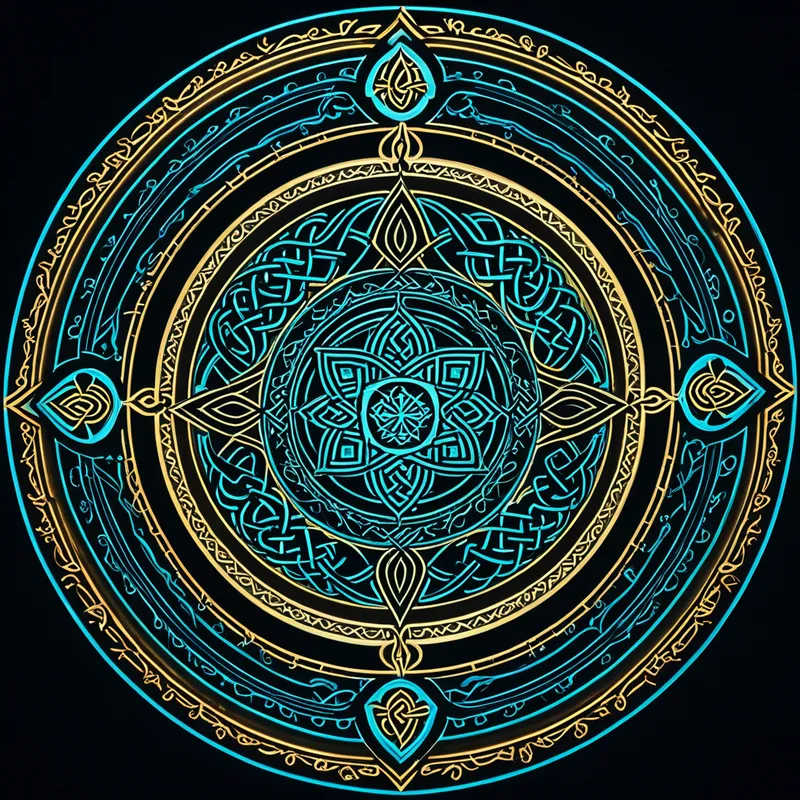
At its core, the Round Table is a symbol of wholeness. Its circular form negates hierarchy, representing the ideal of equality before a shared purpose. It is a mandala, a psychic blueprint for a integrated self and society.
The circle has no beginning and no end; at the Round Table, every knight is both a guardian of the center and a defender of the periphery.
The feast is the active ritual that animates this symbol. Sharing food and drink is a primal act of communion, literally incorporating the group’s identity into the individual body. The empty Siege Perilous represents the transcendent function—the unknown, the future, the aspect of the divine (later embodied by the Grail) that is not yet integrated but whose potential presence completes and sanctifies the circle. King Arthur, as the wounded king presiding, embodies the archetype of the ruler whose authority derives not from domination, but from his capacity to hold the center, to contain the contradictions and conflicts of his knights within the sacred container of the Table.
The Dreamer’s Resonance
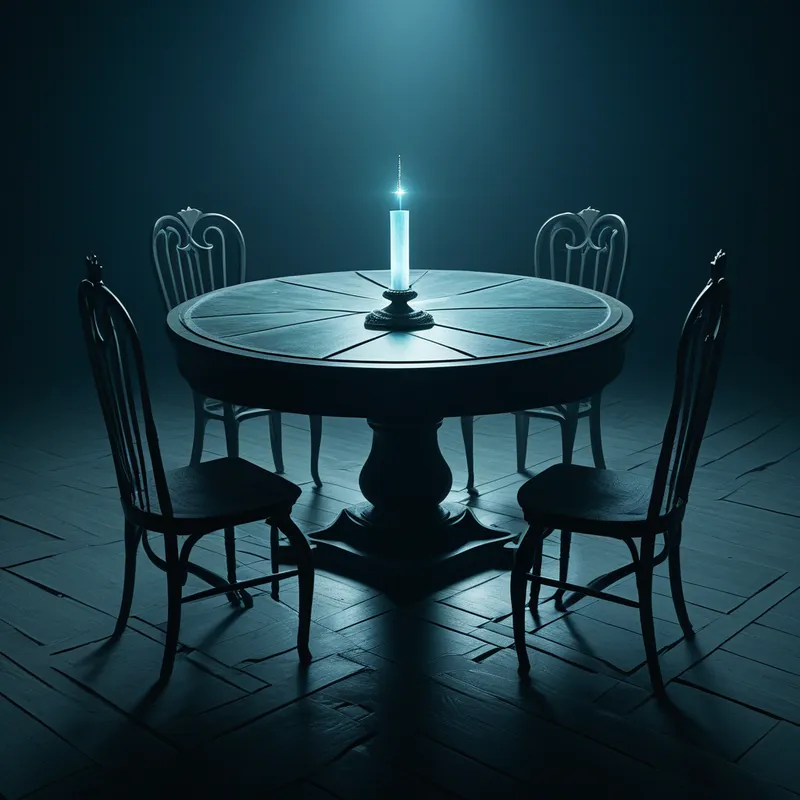
To dream of a Round Table feast is to encounter the psyche’s deep longing for inner council and authentic community. The dream may manifest as finding oneself at a vast table with familiar yet archetypal figures, or conversely, sitting alone at a small, round table in a dim room.
Somatically, this dream often arises during periods of fragmentation or isolated striving, when one’s various “inner knights”—the ambitious achiever, the nurturing caregiver, the righteous moralist—are acting at cross-purposes. The dream-feast signifies the psyche’s attempt to convene these disparate parts. The feeling tone is crucial: a warm, nourishing feast suggests a movement toward inner alignment and self-acceptance. A cold, silent, or conflict-ridden table points to the dreamer’s struggle to integrate competing values or shadow aspects. The empty chair, if present, often points to a missing quality—perhaps intuition, compassion, or courage—that the dreamer knows is essential for their wholeness but has not yet welcomed to their inner table.
Alchemical Translation
The myth models the alchemical process of coniunctio, the sacred marriage of opposites, on a collective scale. The individual knights, each representing a polarized aspect of the human spirit (passion and piety, strength and mercy, justice and compassion), are brought into a vessel—the Table—where their conflicts can be held, not eliminated.
Individuation is not the triumph of one inner voice over others, but the establishment of a round table within, where every aspect of the self has a seat and a voice.
For the modern individual, the “feast” is the conscious, ongoing practice of inner hospitality. It is the work of pausing the relentless questing of the ego to “sit down” with one’s own complexities. To “feast” is to nourish the self with acknowledgment, to listen to the grievances of neglected parts, and to seek a ruling principle (the inner Arthur) that serves the sovereignty of the whole person, not the tyranny of a single drive. The ultimate goal is not a conflict-free psyche, but a sovereign one—a self where the inner knights are aligned under a common purpose, leaving the Siege Perilous not as a threat, but as an invitation to the unknown grace that seeks to complete us.
Associated Symbols
Explore related symbols from the CaleaDream lexicon: