Round Table Myth Meaning & Symbolism
A symbol of perfect fellowship and equal voice, forged to unite disparate knights in a sacred quest for justice and a higher ideal.
The Tale of the Round Table
Hear now, and listen well, to a tale not of a single hero, but of a fellowship forged in the shadow of a broken land. In the days when Arthur Pendragon took up the mantle of a kingdom shattered by war and petty lords, he saw a truth as sharp as Excalibur's edge: a king alone is but a man with a crown. His dream was a kingdom not ruled by fear, but guided by a common, sacred purpose.
The land groaned under the memory of blood-feuds and the clamor of arrogant barons, each demanding the seat of honor at a lord's long table, where position meant power and whispers of envy poisoned the wine. Arthur, in his court at Camelot, felt this discord like a chill wind. Then came the gift, or perhaps the destiny: a great table, round as the wheel of the year, round as the shield-wall of an ideal. Some say it was a wedding gift from his queen's father; others whisper it was fashioned by the enchanter Merlin himself, who saw in its geometry a spell for unity.
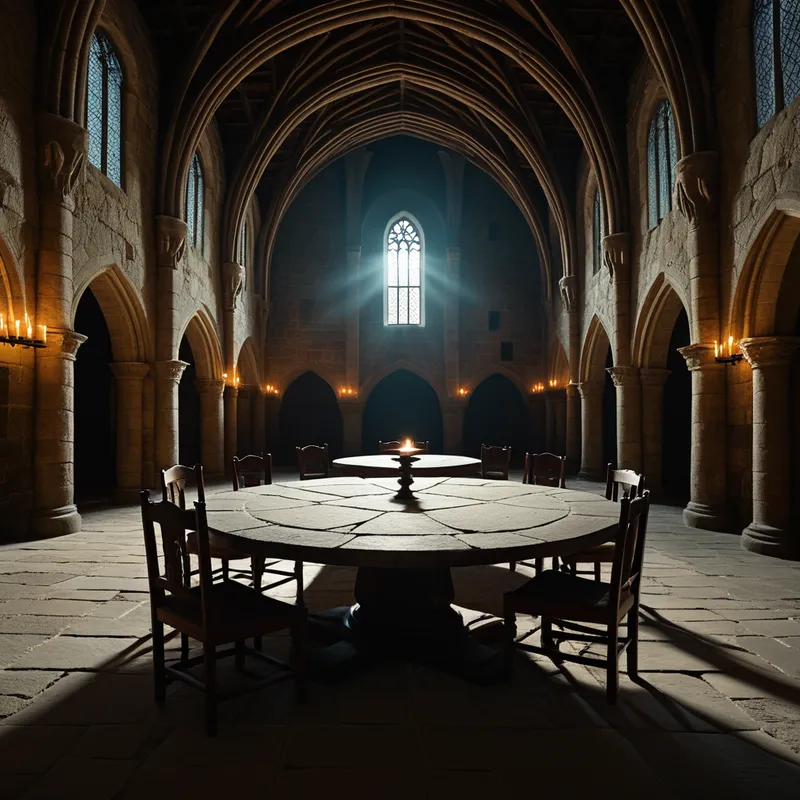
Arthur commanded the table be placed in the heart of his hall. He summoned his champions—the fierce Lancelot, the noble Galahad, the loyal Kay, and all the valorous company. "Behold," said the King, his voice echoing off the stone. "Here is no head, no foot. Here, no man may claim precedence over another. The only elevation here is the elevation of our shared oath."
And so they sat, a brotherhood in steel and spirit. The table was not merely wood; it became a vessel. Upon it, they swore oaths that vibrated in the very grain. They laid their plans to drive back the encroaching dark, to succor the weak, and to pursue the most sacred and perilous of quests: the search for the Holy Grail. The table witnessed their triumphs and their heated debates; it held their feasts and felt the weight of their solemn silences. It was the still point around which the chaos of the world turned, a physical promise of a perfect, equitable order. For a time, under the shadow of its circumference, the dream was made manifest.
Cultural Origins & Context
The symbol of the Round Table emerges not from a single ancient text, but evolves through the rich tapestry of medieval romance, primarily in the 12th century and beyond. While the core Arthurian legends have roots in earlier Welsh and Breton folklore, the Table itself is a brilliant literary and political invention of the Anglo-Norman poet Wace and, most famously, elaborated by Chrétien de Troyes. It was later cemented in the collective imagination by Sir Thomas Malory's Le Morte d'Arthur.
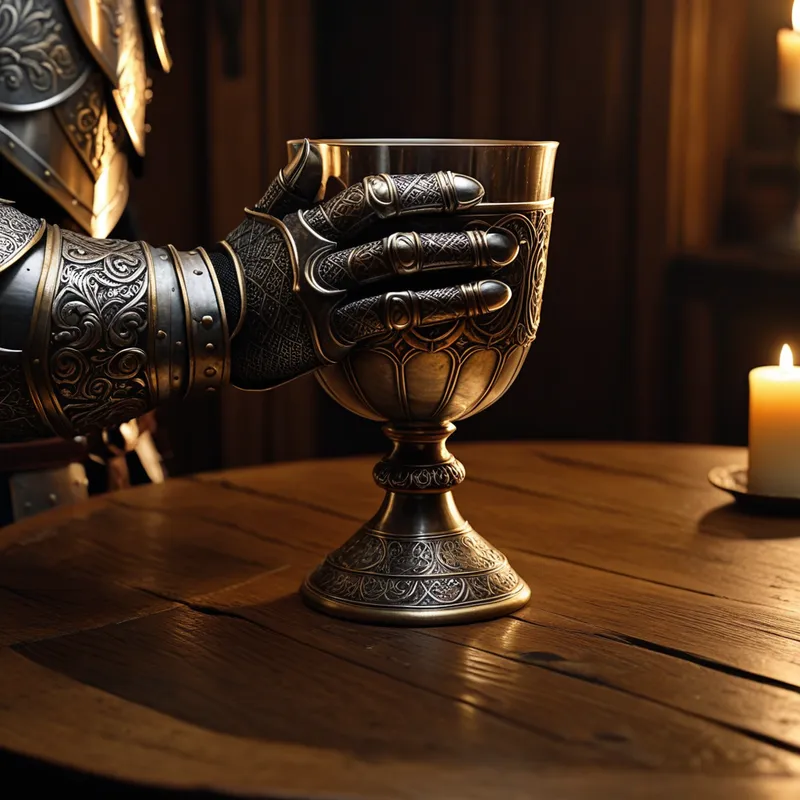
Its societal function was multifaceted. For the feudal audiences of courtly romance, it presented an idealized model of chivalric society—a mitigation of the harsh, rigid hierarchy they knew. It offered a vision where merit and virtue, rather than solely birthright, determined one's place in the fellowship. The Table also served a potent nationalistic purpose for the Plantagenet kings of England, who used the Arthurian mythos to legitimize their rule and inspire crusading zeal, framing their courts as the inheritors of Camelot's glory. It was a story told by bards and clerks to inspire nobility toward a higher code, a narrative container for the aspirations of an era yearning for order, purpose, and divine favor.
Symbolic Architecture
The Round Table is an archetypal symbol of wholeness and the sacred circle. Its primary power lies in its negation of the linear hierarchy.
The circle abolishes the chain of command. In its perfect geometry, every point on the circumference is equidistant from the center—and the center is not a person, but an ideal.
The Table represents the concept of the polity itself. Arthur, as the Ruler, does not sit above it but as part of it; his authority is derived from his embodiment of the central ideal (Justice, Logos), not from a physical position of dominance. Each knight embodies a facet of the whole—courage, piety, loyalty, passion—and the Table contains them all, requiring their integration for the kingdom to function.
Psychologically, it symbolizes the ego's attempt to create order within the psyche. The individual knights can be seen as competing complexes, drives, and talents. The ego (Arthur) must not repress or exile these forces, but must give them a "seat at the table," organizing them around a central, unifying life principle or goal. The quest for the Grail, launched from this table, represents the Self's call to transcend even this admirable social order in pursuit of direct, individual spiritual experience.
The Dreamer's Resonance
To dream of a Round Table is to dream of integration and the longing for equitable community. The somatic feeling is often one of relief—a release from the tension of "above" and "below," of constant comparison and jostling for status. The dreamer may find themselves sitting at such a table among strangers or colleagues, feeling an unspoken bond and a clear, shared purpose.
Conversely, dreaming of a broken Round Table, or one where the seats are violently contested, speaks to a profound inner or outer conflict. It indicates that the dreamer's internal "knights"—their values, ambitions, and responsibilities—are at war, or that their social world feels treacherously hierarchical and unjust. The table in dreams can also appear empty, a haunting symbol of potential unfulfilled, of a fellowship desired but not yet realized. It asks the dreamer: What is the central, ordering principle of your life? And who, or what, within you deserves a seat?
Alchemical Translation
The alchemical process modeled by the Round Table is coagulatio—the bringing together of disparate elements into a solid, enduring form. The base materials are the raw, unrefined warriors and barons of a fractured kingdom (the fragmented psyche, ruled by shadowy complexes and primal instincts). The prima materia is the chaos of ambition and envy.
The King, as the conscious ego, does not conquer these elements but provides the vas or vessel—the Round Table—and the sacred law. The heat of conflict is transformed into the warmth of fellowship through the container of a shared oath.
The alchemical gold produced is not personal glory, but Civilization—the inner civilization of the Self. It is the creation of a functioning, just order within one's own soul, where all aspects of the personality are acknowledged and given voice in service to the totality. The ultimate test, however, is that this beautiful, balanced creation (the lapis) is not the end. The Grail Quest that shatters the fellowship reveals a deeper truth: the psychic order we build, however noble, must eventually be transcended for direct encounter with the divine. The Table prepares the soul for community, but the soul must ultimately leave the table to find its own, solitary Grail. Thus, the myth charts the journey from chaotic individuality, to ordered community, and finally to the call of the transcendent Self.
Associated Symbols
Explore related symbols from the CaleaDream lexicon: