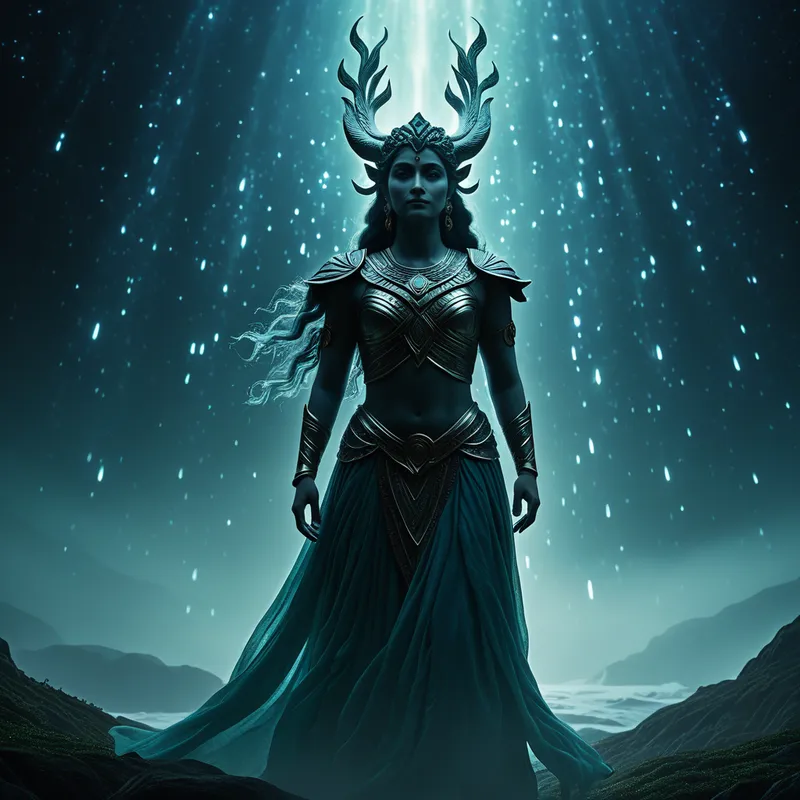
Rostam and the Seven Labors
The legendary Persian hero Rostam undertakes seven perilous trials, battling mythical beasts and supernatural foes to prove his valor and fulfill his destiny.
The Tale of Rostam and the Seven Labors
The tale begins not with a roar, but with a silence—the silence of the great hero Rostam, son of Zal, in deep, enchanted sleep. His legendary steed, Rakhsh, had vanished, stolen away in the night from the meadows of Zabul. To retrieve his other half, his martial soul, Rostam must journey into the lion-haunted, demon-breathing land of Mazandaran. This journey, a gauntlet of seven impossible trials, is less a quest he chooses than a fate that chooses him, an initiation carved by destiny into the bedrock of his being.
His first labor is a confrontation not with a beast, but with his own path. A lion, the archetype of raw, kingly power, attacks Rakhsh. Rostam slays it, but the true test is one of vigilance; the hero must remain awake, mastering the lure of unconsciousness. Next, he crosses a desert of such blistering heat that it seems the sun itself has fallen to earth. Parched and dying, he is saved by a divine ram, a guide sent from the unseen world, showing that even [the self](/myths/the-self “Myth from Jungian culture.”/)-made hero is not abandoned by fate.
The third trial brings [water](/myths/water “Myth from Chinese culture.”/), but water that kills. A [dragon](/myths/dragon “Myth from Chinese culture.”/), a Azhdaha, guards a precious spring. Their battle is titanic, a primal clash of order and [chaos](/myths/chaos “Myth from Greek culture.”/), with Rakhsh himself aiding to crush the serpent’s skull. In the fourth, the peril shifts to enchantment. A sorceress, beautiful and duplicitous, offers Rostam a feast. Seeing through her false semblance, he seizes and slays her, resisting the temptation of comfort and deceit.
The fifth labor is an encounter with a power greater than his own. Olad, the lord of Mazandaran, captures Rostam through guile. Bound and imprisoned, the hero faces the ultimate humiliation. Yet here, his father Zal’s wisdom intervenes; the [simurgh](/myths/simurgh “Myth from Persian culture.”/) feather, a token of ancestral blessing, is burned, and the mythical bird appears, freeing Rostam and healing his wounds with its feather. This trial teaches dependence, the humility to receive aid from a source beyond the warrior’s arm.
Sixth, he meets a peer: the champion of Mazandaran, a demon-warrior. Their combat is the purest expression of heroic contest, a clash of equals where Rostam’s superior might and fortitude finally prevail. The seventh and final labor is the culmination: the confrontation with the White Demon, the sovereign of that dark realm. This is no mere monster, but a king of shadows. Their battle is fought in a cave, [the womb](/myths/the-womb “Myth from Various culture.”/) of [the underworld](/myths/the-underworld “Myth from Greek culture.”/) itself. Rostam prevails, plunging his dagger into the demon’s heart, and in doing so, he anoints his own eyes with the demon’s blood, granting him the farsightedness of a seer. With Rakhsh recovered and the demon-king slain, the labors are complete. He returns not just with his horse, but with a kingslayer’s insight, his destiny irrevocably forged in the seven fires of ordeal.
Cultural Origins & Context
The labors of Rostam are the fiery core of the Shahnameh (The Book of Kings), the epic masterpiece composed by the poet Ferdowsi in the 10th [century](/myths/century “Myth from Biblical culture.”/) CE. This monumental work is not mere entertainment; it is [the vessel](/myths/the-vessel “Myth from Alchemical culture.”/) of Persian identity, language, and farr (the divine royal glory) crafted in the wake of Arab conquest. Rostam, the champion of the Kayanian dynasty, embodies the idealized Iranian pahlavan—a knight who blends immense physical prowess with unwavering loyalty, rustic nobility, and a tragic adherence to a personal code of honor.
The structure of the seven labors is a distinctly Persian contribution to the global [monomyth](/myths/monomyth “Myth from Universal culture.”/) of the hero’s journey. Unlike [the Twelve Labors of Hercules](/myths/the-twelve-labors-of-hercules “Myth from Greek culture.”/), which are often framed as penance or royal command, Rostam’s trials are intrinsically linked to a single, urgent, personal mission: the recovery of Rakhsh. This focus creates a narrative that is both linear and profoundly symbolic, each obstacle representing a specific dimension of [the world](/myths/the-world “Myth from Tarot culture.”/)’s malevolence and the inner faculties required to overcome it. The trials defend the cosmological order of Aša (Truth, Order) against the forces of Druj (The Lie, Chaos), often embodied by the divs (demons) of Mazandaran. Rostam’s journey is thus a microcosm of the Persian king’s—and by extension, Persia’s—eternal struggle to cultivate civilization from [the wilderness](/myths/the-wilderness “Myth from Biblical culture.”/) and uphold light against the encircling dark.
Symbolic Architecture
The seven labors are not a random [sequence](/symbols/sequence “Symbol: The symbol of ‘sequence’ often signifies the order of events and the progression towards a desired outcome or goal.”/) but a carefully orchestrated [ascent](/symbols/ascent “Symbol: Symbolizes upward movement, progress, spiritual elevation, or striving toward higher goals, often representing personal growth or transcendence.”/) through the layers of existence. They move from the elemental ([the desert](/myths/the-desert “Myth from Biblical culture.”/)’s fire, the [dragon](/symbols/dragon “Symbol: Dragons are potent symbols of power, wisdom, and transformation, often embodying the duality of creation and destruction.”/)’s spring) to the psychological (the sorceress’s deception, the captivity of [despair](/symbols/despair “Symbol: A profound emotional state of hopelessness and loss, often signaling a need for transformation or surrender to deeper truths.”/)), culminating in the metaphysical battle with the [demon](/symbols/demon “Symbol: Demons often symbolize inner fears, repressed emotions, or negative aspects of oneself that the dreamer is struggling to confront.”/)-[king](/symbols/king “Symbol: A symbol of ultimate authority, leadership, and societal order, often representing the dreamer’s inner power or external control figures.”/). Each victory is a [piece](/symbols/piece “Symbol: A ‘piece’ in dreams often symbolizes a fragment of the self or a situation that requires integration, reflection, or understanding.”/) of the [hero](/symbols/hero “Symbol: A hero embodies strength, courage, and the ability to overcome significant challenges.”/)’s [soul](/symbols/soul “Symbol: The soul represents the essence of a person, encompassing their spirit, identity, and connection to the universe.”/) reclaimed and tempered.
The lion is the untamed nafs (the lower self or egoic passion) that must be mastered before the greater journey can begin. Its defeat is the hero’s first act of true self-ownership.
The cave of the White Demon is the inner sanctum of the shadow. To enter is to descend into the collective nightmare; to slay its ruler is not to eradicate darkness, but to wrest its sovereignty and claim its insight—the blood-anointed eyes.
Rakhsh, more than a mount, is the hero’s instinctual, vital [energy](/symbols/energy “Symbol: Energy symbolizes vitality, motivation, and the drive that fuels actions and ambitions.”/)—his xvarenah or divine [fortune](/symbols/fortune “Symbol: Fortune symbolizes luck, wealth, and opportunities that may be present or sought in one’s life.”/) made flesh. To lose Rakhsh is to be severed from one’s own [life](/symbols/life “Symbol: The symbol of ‘Life’ represents a journey of growth, interconnectedness, and existential meaning, encompassing both the joys and challenges that define human experience.”/) force; the entire [quest](/symbols/quest “Symbol: A quest symbolizes a journey or search for purpose, fulfillment, or knowledge, often representing life’s challenges and adventures.”/) is therefore an [odyssey](/symbols/odyssey “Symbol: A long, adventurous journey filled with trials, transformations, and eventual homecoming, symbolizing life’s quest for meaning and self-discovery.”/) of soul-retrieval. The simurgh’s intervention represents the grace of ancestry and the support of the transcendent Self, which arrives only when [the ego](/myths/the-ego “Myth from Jungian culture.”/) has been sufficiently humbled (in the [prison](/symbols/prison “Symbol: Prison in dreams typically represents feelings of restriction, confinement, or a lack of freedom in one’s life or mind.”/) of Olad).
The Dreamer’s Resonance
To dream of Rostam’s labors is to feel the call of one’s own impossible task. Psychologically, the seven trials map onto the non-negotiable challenges of individuation. The desert thirst speaks to spiritual aridity; [the dragon](/myths/the-dragon “Myth from Chinese culture.”/) guards the waters of the unconscious, which we must confront to survive. The enchanting sorceress is the allure of complexes that promise solace but lead to captivity. Imprisonment by Olad is that moment of profound depression or stagnation where all self-driven effort fails, forcing an appeal to a higher power—the simurgh of the inner guide.
The dreamer recognizes in Rostam the part of the [psyche](/myths/psyche “Myth from Greek culture.”/) that must, despite fear or weariness, engage these trials. The labors are not about the glorification of violence, but about the necessary violation of stasis. Each beast slain is a limitation overcome; each deception seen through is a [projection](/myths/projection “Myth from Alchemical culture.”/) withdrawn. The ultimate foe, the White Demon, waits in the deepest cave of the [psyche](/myths/psyche “Myth from Greek culture.”/), representing the core complex or primal wound that holds sovereignty over one’s inner world. To face it is the work of a lifetime.
Alchemical Translation
The labors are a perfect allegory for the alchemical [magnum opus](/myths/magnum-opus “Myth from Alchemical culture.”/). Rostam is the [prima materia](/myths/prima-materia “Myth from Alchemical culture.”/), the raw, sleeping potential. The loss of Rakhsh initiates the [nigredo](/myths/nigredo “Myth from Alchemical culture.”/), the blackening, the descent into the chaotic land of Mazandaran (the unconscious). Each labor is a stage of purification and alteration:
The desert and the dragon represent the [calcinatio](/myths/calcinatio “Myth from Alchemical culture.”/) and [solutio](/myths/solutio “Myth from Alchemical culture.”/)—the burning away of dross and the dissolution in the waters of the unconscious. The sorceress is the false conjunctio, the tempting but impure union that must be refused. Captivity is the mortificatio, the [death](/myths/death “Myth from Tarot culture.”/) of the ego’s presumption.
The simurgh’s feather, when burned, is the ignis innaturalis—the divine, non-ordinary fire that arrives from beyond to facilitate transformation. Its healing is the albedo, the whitening, granting clarity and purification.
The final battle in [the cave](/myths/the-cave “Myth from Platonic culture.”/) is the [coagulatio](/myths/coagulatio “Myth from Alchemical culture.”/) and [rubedo](/myths/rubedo “Myth from Alchemical culture.”/): the reddening, where the spirit is solidified into a new, indelible form. Rostam emerges with blood-anointed eyes—the creation of the [lapis philosophorum](/myths/lapis-philosophorum “Myth from Alchemical culture.”/), the philosopher’s stone, which here is the fully realized, insight-bearing Self. He has not simply completed tasks; he has undergone a transmutation of his entire being from a mighty man into a vessel of fated wisdom.
Associated Symbols
Explore related symbols from the CaleaDream lexicon:
- Hero — The archetypal figure who ventures beyond the known world into the realm of supernatural wonder, confronts and overcomes formidable forces, and returns with the power to bestow boons upon his community.
- Destiny — The pre-ordained course of events, often perceived as an inescapable power that shapes the journey of the hero and the fate of nations, demanding both submission and immense personal action.
- Horse — A symbol of vital instinct, untamed power, and the vehicle of the soul; the loss and recovery of which can frame an entire epic of transformation and self-reclamation.
- Cave — The womb of [the earth](/myths/the-earth “Myth from Hindu culture.”/) and the unconscious mind, a place of descent, confrontation with primal truths, and potential rebirth after a battle with [the shadow](/myths/the-shadow “Myth from Jungian culture.”/).
- Dragon — The guardian of treasure or sacred knowledge, representing the chaotic, primal force of the unconscious that must be confronted and integrated to access deeper life or wisdom.
- Journey — The fundamental process of movement from a state of lack or call through perilous trials toward a goal, representing the outer and inner pilgrimage of consciousness.
- Trial — An orchestrated test of character, strength, or virtue, often sent by fate or the gods, which serves to refine, prove, and define the one who undergoes it.
- Shadow — The hidden, rejected, or unconscious aspects of the self, often personified as a monstrous foe; integration of which is essential for wholeness.
- Blood — The vital essence and carrier of lineage; its shedding can signify sacrifice, guilt, or, as an anointing agent, the transmission of power or hidden sight.
- Fire — The element of transformation, purification, and divine energy; it can both destroy the old and illuminate the path forward in the hero’s ordeal.
- [Labors of Hercules](/myths/labors-of-hercules “Myth from Greek culture.”/) — The classic Western archetype of the hero’s set trials, serving as a comparative framework for understanding Rostam’s tasks as a distinct cultural expression of the same profound pattern.
- Spear of Destiny — An object representing the inescapable, weaponized point of fate that pierces through circumstance, driving the hero toward a pre-ordained climax or purpose.