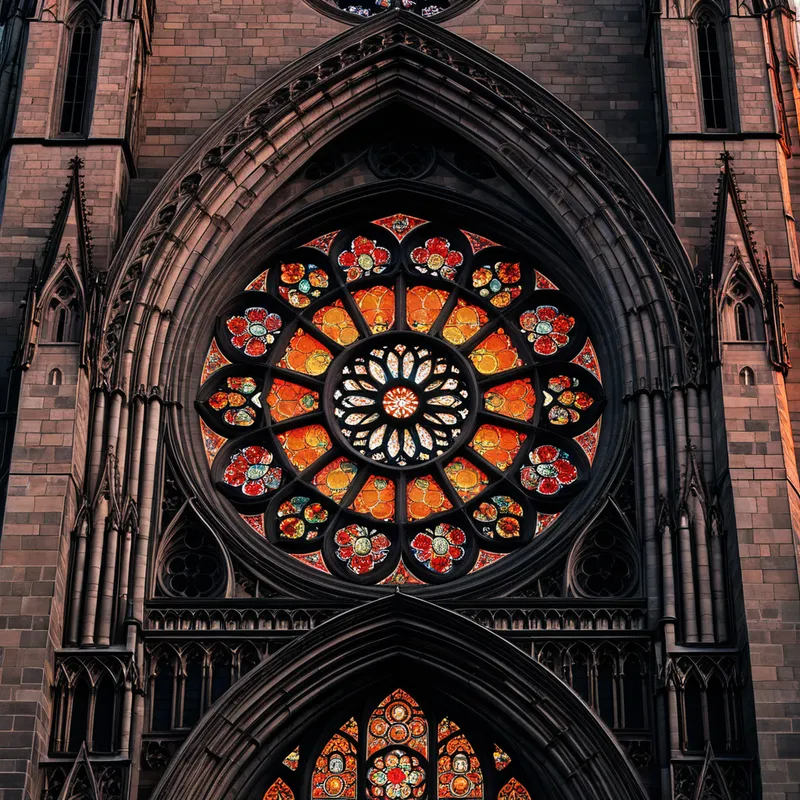
Rose Window Myth Meaning & Symbolism
A master artisan's quest to capture divine light in stone and glass, creating a celestial eye that unites heaven and earth within the cathedral's heart.
The Tale of Rose Window
Listen, and hear the tale not of a man, but of a prayer made manifest in stone and light. In the age when faith built mountains to touch [the sky](/myths/the-sky “Myth from Persian culture.”/), there lived a master of the craft, a man whose soul was a compass for the divine. His name is lost to the dust of the scaffolds, but his longing remains. He was tasked not with a window, but with a paradox: to trap a sunbeam, to weave the very breath of heaven into a still and silent circle.
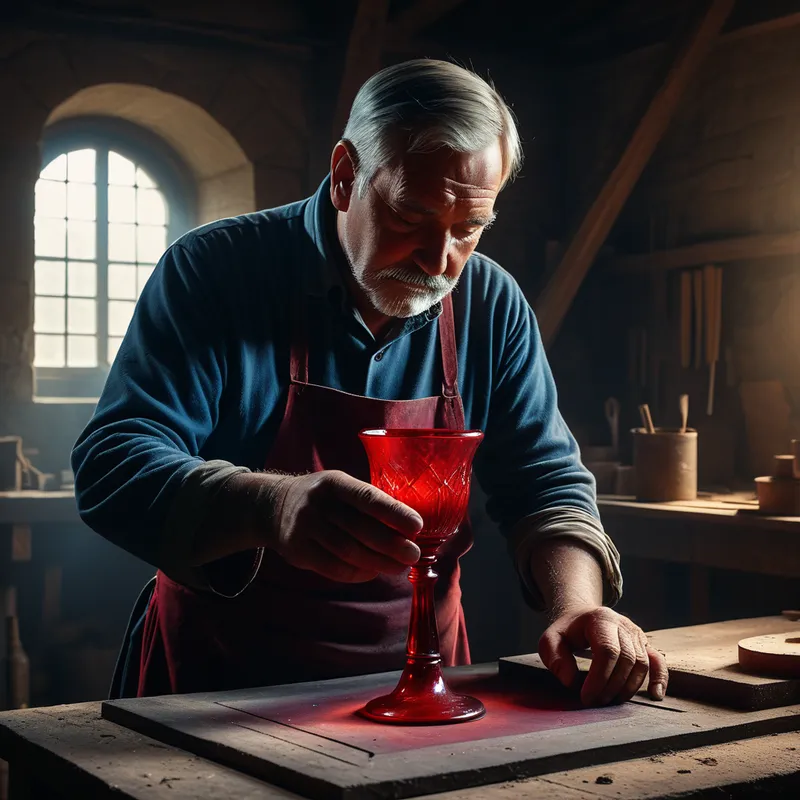
For years, he labored in [the shadow](/myths/the-shadow “Myth from Jungian culture.”/) of the soaring vaults. The quarry yielded its grey bones, and from them he coaxed the delicate ribs of stone, the tracery, as fine as a [spider](/myths/spider “Myth from Native American culture.”/)’s web yet strong enough to bear the weight of a vision. But stone was mere skeleton. The flesh of his dream was light itself. He sought glass—not mere colored panes, but fragments of solidified sky. Cobalt for the depth of midnight, vermilion for the martyr’s fire, emerald for the everlasting field. Each piece he cut was a word in a silent hymn.
Yet, a great shadow lay upon his heart. The window was vast, a gaping maw in the western wall. He had the frame, he had the jewels of glass, but the design… it eluded him. It was all fragments, beautiful chaos. He dreamed of geometric phantoms—circles within circles, petals radiating from a hidden heart. He awoke with the scent of roses in his nostrils, though no flower bloomed in his cell.
One evening, in despair, he climbed the unfinished tower. The sun was dying in the west, a furnace of gold and crimson. As he watched, its light did not simply fade; it performed a final, sacred geometry. Beams pierced the low cloud, not as rays, but as ordered pathways, converging, dividing, creating a vast, ephemeral wheel in the sky centered on the sinking sun. In that moment, he did not see light. He saw structure. He saw the hidden order behind the blaze, the Cosmos made visible.
He descended in a fever. The fragments in his mind—the stone ribs, the colored glass, the scent of roses, the wheel of light—slammed together like a [thunderclap](/myths/thunderclap “Myth from Various culture.”/) of understanding. The window was not a picture. It was a map. The central circle, the Oculus Dei, was the still point, the unmoved mover, the Sun of Righteousness. The radiating petals were the unfolding of creation, the days of the week, the gifts of the spirit, the path of the soul outward into [the world](/myths/the-world “Myth from Tarot culture.”/) and back to its source. The outer circles were [the celestial spheres](/myths/the-celestial-spheres “Myth from Medieval Christian culture.”/), [the wheel of the year](/myths/the-wheel-of-the-year “Myth from Celtic culture.”/), the eternal cycle.
With hands that trembled not from fatigue but from awe, he laid the final design. The glaziers worked as if possessed, fitting the thousand fragments into his leaden lines. And on the day of its unveiling, as the morning sun rose in the east, its light traveled through the long nave and struck the western wall. What had been a dark, complex puzzle of stone and paint erupted into being. A rose of fire bloomed on the interior wall. Light, once formless, was now parsed into theology; color, once mere pigment, now told the stories of prophets and [saints](/myths/saints “Myth from Christian culture.”/). The common folk who entered fell silent, then wept. They did not see a window. They saw a hole punched through to paradise, a Mystical Rose in full, eternal bloom. The master artisan looked upon his work, saw the light he had labored a lifetime to court now dancing in a geometry of its own making, and knew his quest was complete. He had built a lens for the soul.
Cultural Origins & Context
[The Rose](/myths/the-rose “Myth from Persian culture.”/) Window is not a singular myth from a sacred text, but a living, architectural myth that blossomed in the high medieval period, particularly within the Gothic tradition of the 12th to 15th centuries. Its “storytellers” were the anonymous collectives of master masons, theologians, and guild craftsmen. The myth was passed down not through scrolls, but through the lodge, through the secret language of the compass and [the square](/myths/the-square “Myth from Platonic culture.”/), and through the awe-struck gaze of the illiterate faithful who “read” the cathedral as their Bible.
Its societal function was multifaceted. For the Church, it was a potent tool of catechesis, a complex visual sermon illustrating divine order, the hierarchy of heaven, and the centrality of Christ (or the Virgin) in the cosmos. For the burgeoning urban centers, the rose window in the cathedral facade was a statement of civic pride and spiritual ambition, a “crown” for their city, competing with the heavens themselves. Most profoundly, it served a mystical function. In an era where light was synonymous with divinity, the window transformed the physical sun into the Sol Justitiae, mediating the presence of God into the communal space of the nave, making the intangible tangible.
Symbolic Architecture
At its core, the [Rose](/symbols/rose “Symbol: A rose often symbolizes love, beauty, and passion, embodying both the joys and sorrows of romantic relationships.”/) [Window](/symbols/window “Symbol: Windows in dreams symbolize opportunities for insight, clarity, and a desire to connect with the outside world or one’s inner self.”/) is a [mandala](/symbols/mandala “Symbol: A sacred geometric circle representing wholeness, the cosmos, and the journey toward spiritual integration.”/)—a [symbol](/symbols/symbol “Symbol: A symbol can represent an idea, concept, or belief, serving as a powerful tool for communication and understanding.”/) of wholeness, centeredness, and the [integration](/symbols/integration “Symbol: The process of unifying disparate parts of the self or experience into a cohesive whole, often representing psychological wholeness or resolution of internal conflict.”/) of opposites. It is a map of the [psyche](/myths/psyche “Myth from Greek culture.”/) as much as it is a map of the medieval [universe](/symbols/universe “Symbol: The universe symbolizes vastness, interconnectedness, and the mysteries of existence beyond the individual self.”/).
The center is the Self, the divine spark within, the unmoving origin from which all complexity unfolds and to which it must return.
The radiating petals or spokes represent the dynamic processes of the psyche: the thoughts, emotions, and experiences that flow from the core. The intricate tracery is the necessary [structure](/symbols/structure “Symbol: Structure in dreams often symbolizes stability, organization, and the framework of one’s life, reflecting how one perceives their environment and personal life.”/) of [consciousness](/symbols/consciousness “Symbol: Consciousness represents the state of awareness and perception, encompassing thoughts, feelings, and experiences.”/)—the laws, principles, and boundaries that give form to the luminous [chaos](/symbols/chaos “Symbol: In Arts & Music, chaos represents raw creative potential, uncontrolled expression, and the breakdown of order to forge new artistic forms.”/) of inner [life](/symbols/life “Symbol: The symbol of ‘Life’ represents a journey of growth, interconnectedness, and existential meaning, encompassing both the joys and challenges that define human experience.”/). Without this [structure](/symbols/structure “Symbol: Structure in dreams often symbolizes stability, organization, and the framework of one’s life, reflecting how one perceives their environment and personal life.”/), the light is blinding and formless; without the light, the structure is a dead cage.
The [stained glass](/symbols/stained-glass “Symbol: Stained glass represents the interplay of light and color, often symbolizing divine beauty and transcendent experiences.”/) represents the contents of the personal and [collective unconscious](/symbols/collective-unconscious “Symbol: The Collective Unconscious refers to the part of the unconscious mind shared among beings of the same species, embodying universal experiences and archetypes.”/)—the archetypes, memories, and passions. Each is a unique color, a distinct “[piece](/symbols/piece “Symbol: A ‘piece’ in dreams often symbolizes a fragment of the self or a situation that requires integration, reflection, or understanding.”/)” of experience. In their raw state, they are fragmented and opaque. But when organized by the conscious structure (the lead) and illuminated by the light of [awareness](/symbols/awareness “Symbol: Conscious perception of self, surroundings, or internal states. Often signifies awakening, insight, or heightened sensitivity.”/) (the sun/Self), they coalesce into a transcendent, meaningful [image](/symbols/image “Symbol: An image represents perception, memories, and the visual narratives we create in our minds.”/). The window thus symbolizes the ultimate goal: to become a [vessel](/symbols/vessel “Symbol: A container or structure that holds, transports, or protects something essential, representing the self, emotions, or life journey.”/) through which divine light passes, not to erase the individual colors of our experience, but to arrange them into a holy [pattern](/symbols/pattern “Symbol: A ‘Pattern’ in dreams often signifies the underlying structure of experiences and thoughts, representing both order and the repetitiveness of life’s situations.”/).
The Dreamer’s Resonance
To dream of a rose window, especially one that is broken, forming, or overwhelmingly luminous, signals a profound process of psychic reorganization. It is the psyche attempting to create order from chaos, to find a central, organizing principle amidst life’s fragments.
A dream of painting or repairing a rose window suggests active individuation. The dreamer is consciously working to integrate disparate parts of their personality, seeking the “design” that makes sense of their history and aspirations. The somatic feeling is often one of focused, meticulous effort—a deep, almost cellular knitting-together.
A dream of standing before a blindingly bright, complete rose window can indicate a moment of numinous insight, a sudden experience of wholeness (synchronicity) where everything “makes sense.” This may be accompanied by feelings of awe, peace, or even holy terror.
Conversely, a dream of a shattered or dark rose window speaks to a crisis of meaning, a feeling that one’s inner world has lost its center or that one’s life structure has failed to contain its experiences. The process here is one of necessary deconstruction before a new, more authentic order can be built. The somatic resonance is often fragmentation, dizziness, or a cold absence of light.
Alchemical Translation
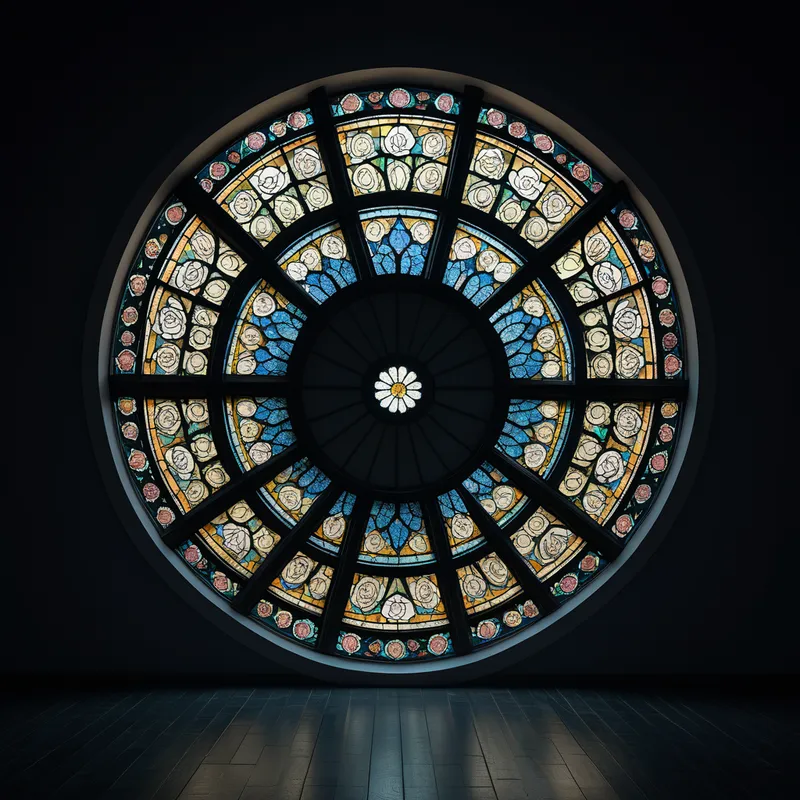
The myth of the Rose Window is a perfect allegory for the alchemical Opus, [the great work](/myths/the-great-work “Myth from Alchemical culture.”/) of psychic transmutation. The base material is the [prima materia](/myths/prima-materia “Myth from Alchemical culture.”/) of the soul: our raw, unrefined experiences, emotions, and inherited patterns (the rough stones and sands of glass).
The first stage, Nigredo (blackening), is the master’s despair, the formless chaos before the vision. It is the necessary confrontation with the shadow, the recognition that one’s current “design” is insufficient.
The Albedo (whitening) is the moment of revelation on [the tower](/myths/the-tower “Myth from Tarot culture.”/)—the flash of pure, structuring insight from [the Self](/myths/the-self “Myth from Jungian culture.”/). This is the arrival of the transcendent function, the symbol that can unite the opposites. The geometric design is this crystallizing symbol.
The Citrinitas (yellowing) and [Rubedo](/myths/rubedo “Myth from Alchemical culture.”/) (reddening) are the laborious process of construction and glazing. This is the hard, conscious work of analysis, therapy, creative expression, and discipline—applying the lead of consciousness to the colored fragments of the complex. It is the slow building of [the vessel](/myths/the-vessel “Myth from Alchemical culture.”/).
The final result is the [Lapis Philosophorum](/myths/lapis-philosophorum “Myth from Alchemical culture.”/), the Philosopher’s Stone: not the window itself, but the transformed psyche capable of creating it. The completed window, radiating light, symbolizes the individuated Self. The individual becomes a stable, centered structure through which the transpersonal light of meaning and purpose can flow into the world, transforming personal suffering (the dark, heavy glass) into a necessary part of a breathtaking, holy pattern. The quest is not to become the light, but to become the perfect lens for it.
Associated Symbols
Explore related symbols from the CaleaDream lexicon: