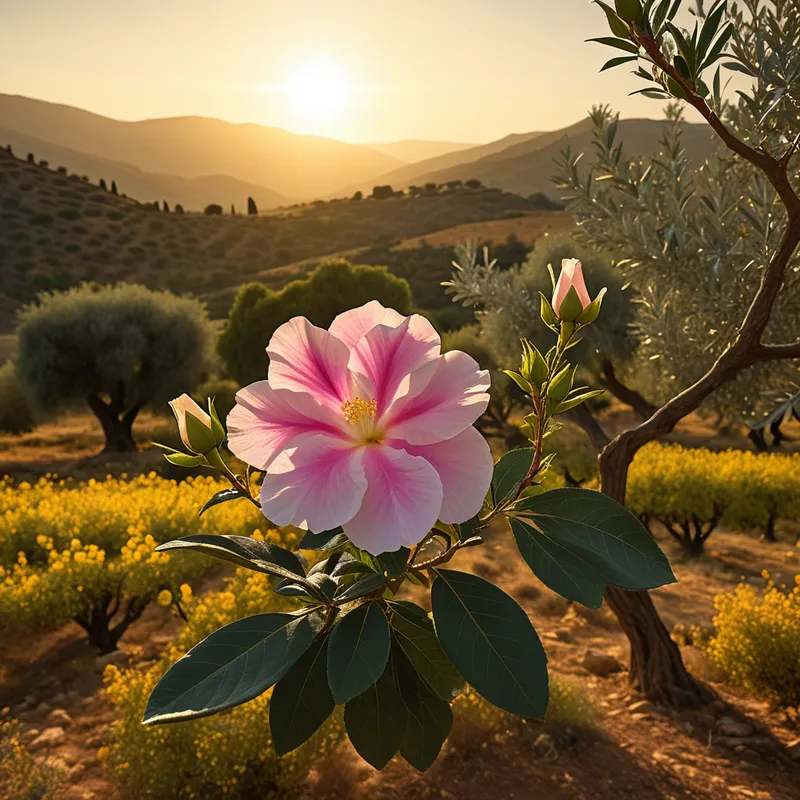
Rose of Sharon Myth Meaning & Symbolism
A poetic biblical symbol of divine love and the soul's sacred union, representing Christ's sacrifice and the beloved's transcendent beauty.
The Tale of Rose of Sharon
Listen. In a land of sun-baked hills and valleys thick with the scent of myrrh, there was a song. It was not a song of trumpets or of war, but a whisper carried on the evening wind, a fragrance more than a sound. It came from the Sharon, a place where [the earth](/myths/the-earth “Myth from Hindu culture.”/) itself seemed to sigh with abundance, where common lilies dressed in splendor that outshone a king’s robes.
But among the common beauty, there was one who was not common. She was the Rose of Sharon, and her presence was a mystery. She did not proclaim herself from the mountain tops; she was found in the quiet places, by the shepherd who wandered the valleys with a heart both full and aching. He sought her, and in seeking, he sang. His voice was raw with longing, a thirst in a dry land. “I am [the rose](/myths/the-rose “Myth from Persian culture.”/) of Sharon,” she would say, a statement not of pride, but of being—a simple, devastating truth of identity amidst the field.
Their story was written in glances and absences, in the terror of night searches through the city streets and the ecstasy of reunion at dawn. He would knock at her door, but she was slow to rise, and by the time she arrived, he had turned away—a gap of moments that felt like an eternity of loss. She wandered the streets, asking the watchmen, “Have you seen the one my soul loves?” Her cheeks were stained with the dust of the road and the salt of her tears.
Yet, in the deepest night of separation, her essence could not be hidden. Even in absence, her fragrance lingered. It was the promise that drew him back, that guided her search. The conflict was not against dragons or armies, but against the walls of [the self](/myths/the-self “Myth from Jungian culture.”/), the slumber of the spirit, and the vast, aching distance that can lie between two hearts, even when they are destined to be one.
The resolution came not with a fanfare, but with a whisper. “My beloved is mine, and I am his.” It was an utterance that collapsed distance, that turned the seeking into finding, the longing into belonging. He would lead her to the banquet hall, and his banner over her was love. In that mutual possession—a surrender that was also a claiming—the rose and the shepherd, the lover and the beloved, were no longer two stories, but one single, breathing hymn.
Cultural Origins & Context
This is not a myth of temples and priests, but of tents and vineyards. Its home is the Song of Songs, a unique and audacious text nestled within the wisdom literature of the Hebrew Bible. Its voice is passionately human, a duet of yearning between a maiden and her beloved, rich with the sensory world of ancient Israel—spices, gardens, vineyards, and the watchful eyes of brothers.
For centuries, Jewish and later Christian scholars grappled with its overtly erotic poetry. The prevailing solution, which allowed its sacred inclusion, was allegory. The Rabbis heard in it the love song between Yahweh and Israel. The Church Fathers heard the love between Christ and his Church, or Christ and the individual soul. Thus, the “Rose of Sharon” transformed from a poetic self-description of a young woman into a title for the divine beloved. It was passed down not as a straightforward narrative, but as a layered text—a surface of human love concealing (or revealing) a bottomless depth of divine romance. Its societal function was dual: it sanctified human love as a mirror of the sacred, and it provided a mystical language for the soul’s most intimate relationship with the divine.
Symbolic Architecture
At its core, the [Rose](/symbols/rose “Symbol: A rose often symbolizes love, beauty, and passion, embodying both the joys and sorrows of romantic relationships.”/) of Sharon is a [symbol](/symbols/symbol “Symbol: A symbol can represent an idea, concept, or belief, serving as a powerful tool for communication and understanding.”/) of unique [identity](/symbols/identity “Symbol: Identity represents the sense of self, encompassing personal beliefs, cultural background, and social roles.”/) within commonality. The Sharon was known for its wildflowers, yet one is singled out. This speaks to the [soul](/symbols/soul “Symbol: The soul represents the essence of a person, encompassing their spirit, identity, and connection to the universe.”/)’s [paradox](/symbols/paradox “Symbol: A contradictory yet true concept that challenges logic and perception, often representing unresolved tensions or profound truths.”/): it is part of the collective field of humanity, yet it carries a singular, irreplaceable essence that calls to the divine.
The beloved is not loved for being a flower, but for being this specific flower in this specific field. The sacred sees you not as a category, but as a name.
The rose symbolizes radiant, vulnerable [beauty](/symbols/beauty “Symbol: This symbol embodies aesthetics, harmony, and the appreciation of life’s finer qualities.”/) that exists for [relationship](/symbols/relationship “Symbol: A representation of connections we have with others in our lives, often reflecting our emotional state.”/). Its thorns speak of the protection and the painful cost of such [vulnerability](/symbols/vulnerability “Symbol: A state of emotional or physical exposure, often involving risk of harm, that reveals authentic self beneath protective layers.”/). The [shepherd](/symbols/shepherd “Symbol: A shepherd symbolizes guidance, protection, and the nurturing aspects of leadership, often reflecting the dreamer’s desire for direction or support.”/)—the [seeker](/symbols/seeker “Symbol: A person actively searching for meaning, truth, or a higher purpose, often representing the dreamer’s own quest for identity or fulfillment.”/)—represents the active, pursuing [aspect](/symbols/aspect “Symbol: A distinct feature, quality, or perspective of something, often representing a partial view of a larger whole.”/) of the divine, as well as the soul’s own deepest desire moving towards its [source](/symbols/source “Symbol: The origin point of something, often representing beginnings, nourishment, or the fundamental cause behind phenomena.”/). Their cycle of [presence](/symbols/presence “Symbol: Presence in dreams often signifies awareness or acknowledgment of something significant in one’s life.”/), [absence](/symbols/absence “Symbol: The state of something missing, void, or not present. Often signifies loss, potential, or existential questioning.”/), search, and [reunion](/symbols/reunion “Symbol: A reunion symbolizes reconnection, healing, and the revival of past relationships and experiences.”/) models the fundamental [rhythm](/symbols/rhythm “Symbol: A fundamental pattern of movement or sound in time, representing life’s cycles, emotional flow, and universal order.”/) of the spiritual [life](/symbols/life “Symbol: The symbol of ‘Life’ represents a journey of growth, interconnectedness, and existential meaning, encompassing both the joys and challenges that define human experience.”/): ecstatic union, the “dark [night](/symbols/night “Symbol: Night often symbolizes the unconscious, mystery, and the unknown, representing the realm of dreams and intuition.”/) of the soul,” the desperate search, and the grace of return.
Psychologically, the Rose represents the Self—the complete, flowering potential of the individual. The shepherd is [the ego](/myths/the-ego “Myth from Jungian culture.”/)’s [journey](/symbols/journey “Symbol: A journey in dreams typically signifies adventure, growth, or a significant life transition.”/) toward [integration](/symbols/integration “Symbol: The process of unifying disparate parts of the self or experience into a cohesive whole, often representing psychological wholeness or resolution of internal conflict.”/) with that Self. The [wall](/symbols/wall “Symbol: Walls in dreams often symbolize boundaries, protection, or obstacles in one’s life, reflecting the dreamer’s feelings of confinement or security.”/) she hesitates behind is [the ego](/myths/the-ego “Myth from Jungian culture.”/)’s defenses; the [city](/symbols/city “Symbol: A city often symbolizes community, social connection, and the complexities of modern life, reflecting the dreamer’s relationships and societal integration.”/) streets are the complex, often alienating structures of the conscious mind where the Self can feel lost.
The Dreamer’s Resonance
When this myth stirs in the modern unconscious, it often surfaces in dreams of profound longing or sacred encounter. You may dream of a flower of impossible beauty in an ordinary place—a [lotus](/myths/lotus “Myth from Hindu culture.”/) in a parking lot, a luminous rose in your childhood backyard. This is the Self announcing its presence in the field of your everyday [psyche](/myths/psyche “Myth from Greek culture.”/).
Conversely, you may dream of searching desperately for a person or a place you cannot name, guided only by a faint, familiar scent. This somatic experience of guided longing is the psyche enacting the search for the beloved. The tears in the dream are not merely sadness; they are the irrigation of a parched inner landscape, the necessary dissolution that makes reunion possible. Dreams of doors, of knocking and waiting, speak directly to [the threshold](/myths/the-threshold “Myth from Folklore culture.”/) moments in life where we are called to open to a deeper love—of self, other, or life itself—and our hesitation or readiness defines the next phase of our journey.
Alchemical Translation
The alchemy here is the transmutation of seeking into being, of longing into embodiment. The initial state is the separated soul (the rose unaware of its seeker, the shepherd aching in his search). The [nigredo](/myths/nigredo “Myth from Alchemical culture.”/), or blackening, is the painful gap, the night of separation, the feeling of having missed the moment. This despair is not failure, but the necessary fermentation of desire.
The crucible of longing heats not to destroy the soul, but to distill its essential oil—its unique and fragrant identity.
The albedo, or whitening, is the moment of recognition: “I am the rose.” This is not an egoic claim, but a humble acceptance of one’s own sacred core. The final [rubedo](/myths/rubedo “Myth from Alchemical culture.”/), or reddening, is the declaration, “My beloved is mine, and I am his.” This is [the sacred marriage](/myths/the-sacred-marriage “Myth from Various culture.”/), the coniunctio oppositorum, where the soul (Rose) and the guiding spirit/divine (Shepherd) are united. The individual is no longer seeking wholeness from outside; they have become [the vessel](/myths/the-vessel “Myth from Alchemical culture.”/) in which the union resides. The “Rose of Sharon” is thus the alchemical lapis, the Philosopher’s Stone—the ordinary human soul, having undergone the fire of longing and the [water](/myths/water “Myth from Chinese culture.”/) of tears, revealed as the singular, beloved, and eternal vessel of a divine love affair.
Associated Symbols
Explore related symbols from the CaleaDream lexicon: