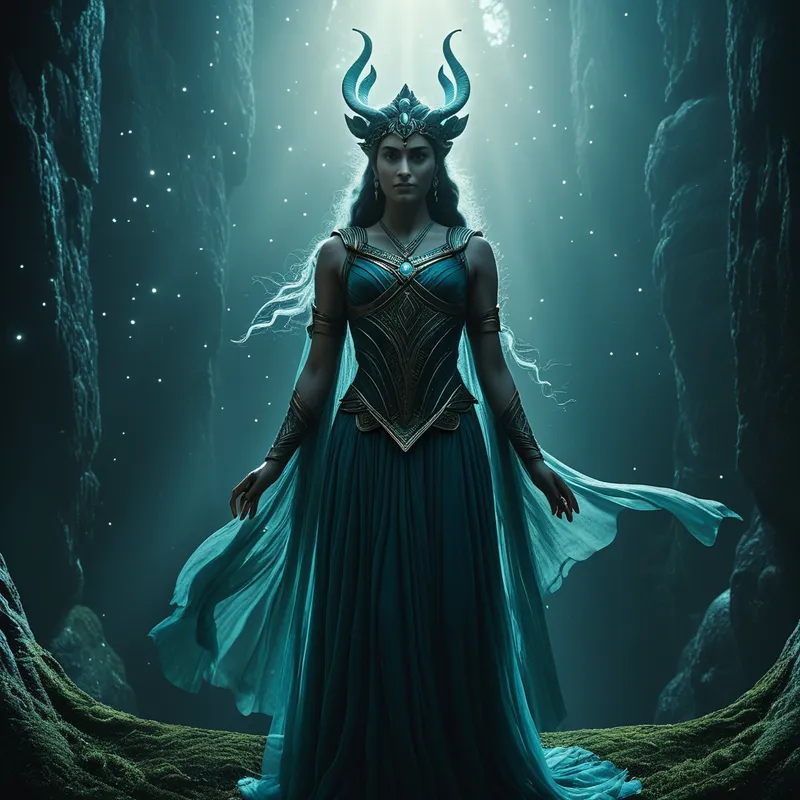
Roro Anteng and Joko Seger
A tragic Javanese legend of star-crossed lovers whose forbidden union challenged divine authority and left a lasting cultural legacy.
The Tale of Roro Anteng and Joko Seger
In the high, mist-wreathed caldera of Mount Bromo, where the earth still speaks in plumes of smoke and the sky feels close enough to touch, a story of impossible longing was born. Roro Anteng, whose name whispers of grace and beauty, was a princess of the Dewi lineage, a daughter of the gods. Her spirit was woven from mountain air and the first light of dawn, and her destiny seemed written in the stars—a celestial one, far removed from the mortal realm. Yet, her heart, that most human of compasses, yearned for the earthly. It yearned for Joko Seger.
Joko Seger, whose name resonates with vitality and prosperity, was a man of the soil and the people. He was not of divine blood but of human strength and earnest spirit, a commoner whose soul was as solid and enduring as the volcanic stone. When their eyes met, it was not a meeting of two people, but of two worlds: the transcendent and the immanent, the eternal and the temporal. Their love was an immediate, undeniable truth, a force of nature as potent as the volcano beneath their feet. But it was a truth that defied the cosmic order. A goddess, even a semi-divine one, was forbidden from binding her fate to a mortal man. Their union was a transgression against divine law, a challenge to the very architecture of the heavens.
Driven by a love that would not be denied, they fled. They sought refuge in the Tengger highlands, a place of stark beauty and solitude, where the clouds were their curtains and the stars their only witnesses. There, they built a life and a kingdom, the Kingdom of Tengger, a name born from the fusion of their own: Teng from Anteng, Ger from Seger. Their love became the foundation of a people, a culture sprung from sacred disobedience. For years, they ruled in harmony, their union blessed with many children, their love seemingly having carved out a sanctuary beyond the reach of divine wrath.
But the cosmos demands balance, and a debt incurred by defying destiny must one day be settled. The peace of their mountain sanctuary was shattered when the kingdom was struck by a terrible drought and famine. The earth cracked, the crops failed, and despair took root. In their desperation, Roro Anteng and Joko Seger sought answers through meditation and prayer. The response from the spiritual realm was a terrible ultimatum. Their prosperity, their very lineage, had been built on forbidden ground. To save their people and ensure the continuation of the Tengger, they were required to make the ultimate sacrifice: to return their youngest child, Kesuma, to the cosmos. He was to be offered to the crater of Mount Bromo.
The agony of this decree is the heart of the tragedy. Their love, which had defied heaven to create life, was now forced to consent to the destruction of its most precious creation. In a scene of unimaginable sorrow, Kesuma, understanding his fate with a wisdom beyond his years, accepted his role. He was consumed by the volcano. From this act of supreme sacrifice, the rains returned, the land grew fertile, and the kingdom was saved. The love of Roro Anteng and Joko Seger, which began in defiance, culminated in a willing surrender to a higher, crueler necessity. They gained the legacy of a people but forever bore the wound of a lost child, their personal joy forever intertwined with communal sorrow.
Cultural Origins & Context
The legend is rooted in the oral traditions of the Tenggerese people, an indigenous Hindu community inhabiting the highlands around Mount Bromo in East Java. Unlike the predominantly Islamic Javanese lowlands, the Tenggerese maintain ancient pre-Islamic Hindu-Buddhist beliefs and rituals. The myth of Roro Anteng and Joko Seger is not merely a romantic tale; it is an etiological narrative, a sacred story explaining the origins of the Tenggerese people, their unique customs, and their profound spiritual connection to the volcanic landscape.
The annual Yadnya Kasada festival is the living embodiment of this myth. During the ceremony, Tenggerese pilgrims journey to the edge of Mount Bromo’s crater to make offerings of fruit, vegetables, livestock, and sometimes even currency, throwing them into the volcanic abyss. This ritual is a direct re-enactment and remembrance of the sacrifice of Kesuma. It is an act of gratitude to the mountain gods (often associated with Brahma, from which "Bromo" is derived) and a plea for continued protection, fertility, and forgiveness. The myth thus functions as the foundational charter for Tenggerese identity, binding the community to its ancestors, its land, and its gods through a covenant of remembered sacrifice.
Symbolic Architecture
The myth constructs a world of profound symbolic tensions. The central axis is the conflict between dharma (cosmic law and duty) and kama (human desire and love). Roro Anteng and Joko Seger’s initial union is an act of kama that disrupts dharma. The resulting kingdom exists in a precarious, liminal state—a human society founded on a divine transgression. The resolution does not come through the triumph of one over the other, but through a terrifying synthesis: love (kama) must express itself through the ultimate act of duty and sacrifice (dharma), thereby restoring a new, more painful order.
The mountain is both womb and tomb, a symbol of the Great Mother who gives life (the fertile kingdom) only through a process of terrifying consumption. The sacrifice is not a punishment, but a horrific necessity of creation itself.
The characters are archetypal vectors. Roro Anteng represents the anima, the soul-force descending from spirit into matter, longing for incarnation and earthly connection. Joko Seger is the grounded animus, the human spirit aspiring toward meaning and legacy. Their child, Kesuma (meaning "flower" or "essence"), symbolizes the beautiful, fragile fruit of that union—the individual self, the unique consciousness, which must ultimately be surrendered for the greater whole to endure.
The Dreamer's Resonance
For the individual psyche, this myth speaks to the inevitable sacrifices demanded by love and commitment. Every deep union, whether romantic, creative, or communal, begins with a kind of forbidden act—the choice to prioritize a personal truth over external expectations or previous identities. The "kingdom" we build—a family, a career, an art—is our Tengger, a sanctuary carved out by our devotion.
Yet, the dream whispers a harder truth: to sustain what we love, we must be prepared to offer back a part of it. The sacrifice of the "youngest child" can be interpreted as the sacrifice of our own innocence, our purest joy, or a cherished aspect of our personal freedom for the health of the relationship or community. It is the psychological moment when romantic love matures into responsible love, when passion is tempered by duty. The myth validates the grief of this loss, acknowledging that true love’s legacy is always tinged with the sorrow of what was given up. It asks the dreamer: What is your Kesuma? What part of your joy must you consent to release to water the fields of your life?

Alchemical Translation
In the alchemical vessel of the soul, this myth describes the process of solve et coagula—dissolve and coagulate. The initial, fiery passion of the lovers (the nigredo, the blackening) dissolves their old, separate selves. From this union, a new identity coagulates: the Kingdom of Tengger, the albedo or whitening, a state of reflected cultural and personal purity.
The final sacrifice is the rubedo, the reddening. It is the stage of supreme suffering and transformation, where the most precious product of the work—the filius philosophorum (the philosophical child)—is surrendered. Only through this "death" is the lapis philosophorum, the stone of lasting value (the enduring culture, the matured love), truly achieved.
The volcano, Bromo, is the alchemical furnace itself. It is the transformative fire that does not merely destroy but radically transmutes. The offering thrown into the crater is the prima materia thrown into the fire, and the resulting fertility of the land is the elixir of life produced. The myth teaches that the highest value is not created through blissful union alone, but through the conscious, agonizing sacrifice of that union’s most perfect fruit to a purpose greater than itself.
Associated Symbols
Explore related symbols from the CaleaDream lexicon:
- Mountain — The sacred, liminal space where heaven and earth meet, representing both divine aspiration and the crushing weight of destiny.
- Sacrifice — The voluntary surrender of something precious to appease a higher power or ensure a greater good, the core of the covenant between humanity and the divine.
- Forbidden Fruit — The love between divine and mortal, a knowledge and union that transgresses established law and brings both profound joy and inevitable consequence.
- Child — The innocent and beautiful creation of a union, representing future hope, vulnerability, and the ultimate price that may be demanded.
- Fire — The consuming, transformative element of the volcano, symbolizing both divine wrath and the purifying, sacrificial flame that renews life.
- Destiny's Call — The inescapable summons of cosmic law, which cannot be outrun and must ultimately be answered, often at great personal cost.
- Love — The primordial force that defies order and reason, compelling union and creation, yet demanding the deepest forms of responsibility and loss.
- Cup — The vessel of life, legacy, and community that must be filled, often only through the pouring out of one’s most cherished contents.
- Wound — The eternal, psychic injury borne by the lovers, the scar tissue that remains as the testament to their love and their loss.
- Rain — The blessing and fertility that follows sacrifice, the divine grace or emotional release that comes after a period of terrible aridity and despair.
- Silhouette of a Lover — The haunting, eternal form of the beloved, a memory that persists beyond loss, defining a life and a landscape.