Romulus and Remus Myth Meaning & Symbolism
Twin brothers, suckled by a wolf, found a city. Fratricide on the Palatine Hill births Rome, a civilization forged from wilderness and blood.
The Tale of Romulus and Remus
Listen, and hear the tale written in river mud and royal blood. It begins not with glory, but with a crime in the house of kings. In Alba Longa, a usurper, Amulius, seizes the throne from his brother, Numitor. To secure his stolen power, he murders Numitor’s son and condemns his daughter, Rhea Silvia, to the eternal chastity of the Vestals. But the gods have other designs. The war god Mars finds her in the sacred grove, and from their union, twin boys are born.
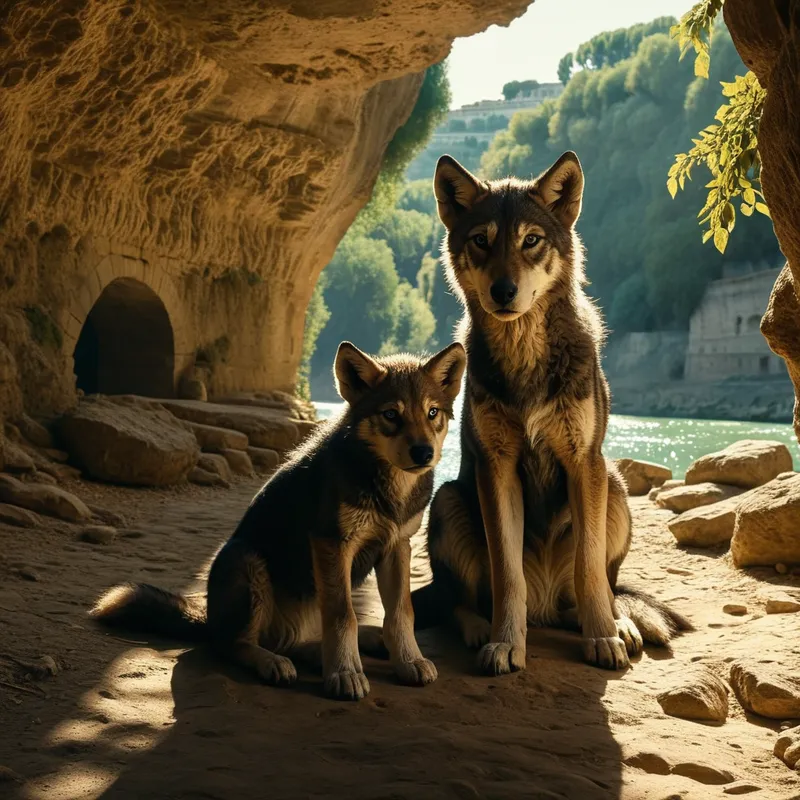
Fury fills Amulius. He orders the infants drowned in the swelling Tiber. The servant tasked with the deed cannot bear it; he places the basket in the shallows, where the river, refusing the command, gently carries it to the base of the Palatine Hill. The waters recede, leaving the twins crying in the mud. Their wails reach the ears of a she-wolf, Lupa, fresh from her hunt. Drawn not by hunger but by a deeper instinct, she licks them clean, offers her teats, and guards them in her den. A woodpecker, sacred to Mars, brings them morsels of food. The wild itself becomes their nurse.
They are found by Faustulus, a herdsman of the king. He and his wife, Acca Larentia, raise the boys as their own, naming them Romulus and Remus. They grow strong among shepherds and outlaws, natural leaders with a royal bearing they cannot explain. The truth emerges in a clash over stolen cattle; captured and brought before Numitor, their grandfather, their lineage is revealed by their bearing and the testimony of Faustulus. Rage kindled, the brothers rally their band, overthrow the tyrant Amulius, and restore Numitor to his throne.
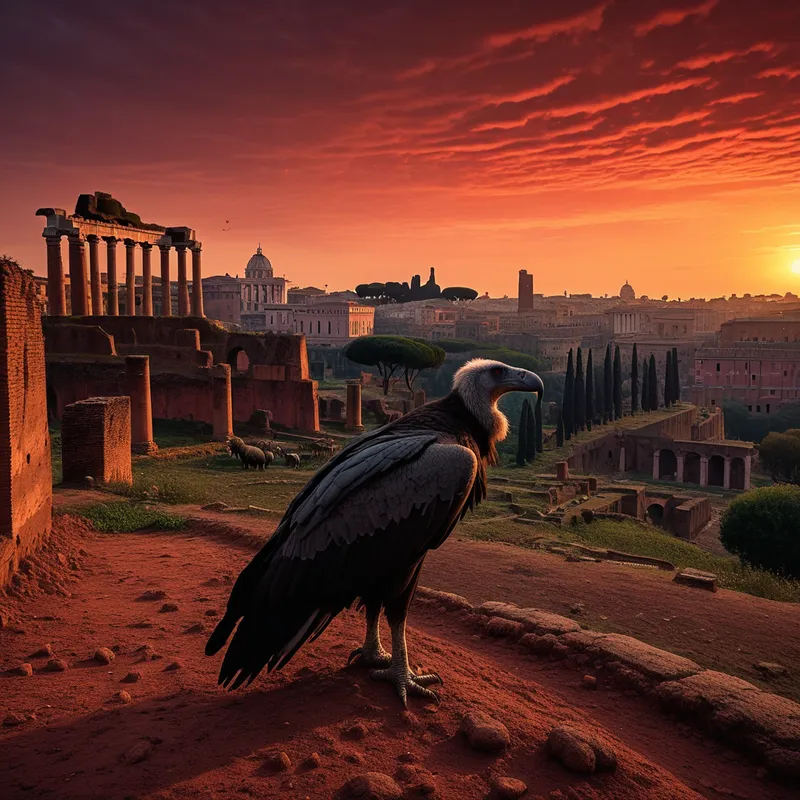
But their destiny lies not in Alba Longa. Driven by the blood of Mars, they seek to found a city of their own at the place where the river saved them. Here, the harmony of twins shatters. Both seek augury from the gods to decide who should rule and name the city. Remus, on the Aventine Hill, sees six vultures, a sign of favor. But Romulus, on the Palatine, sees twelve. Their followers erupt into dispute: does priority or number hold greater weight? As Romulus begins to plow the sacred boundary, the pomerium, Remus in contempt leaps over the nascent furrow and the low wall. “So shall perish any who cross my walls,” Romulus cries, and in a flash of fratricidal fury, strikes his brother down. The first citizen of the new city, Rome, is a murderer; its first law, written in his brother’s blood.
Cultural Origins & Context
This foundational narrative is not a single, fossilized tale but a living tradition that evolved alongside Rome itself. The earliest versions are lost to time, likely circulating as oral folktales among Italic tribes. By the time it was committed to writing by historians like Livy and the poet Vergil, it had been polished into an official state myth, serving crucial societal functions. It provided a divine and heroic origin that rivaled the epic Greek past, connecting Rome to the Trojan hero Aeneas through their mother, Rhea Silvia. More practically, it explained the “Roman character”—martial, pious, fiercely devoted to law and boundary, even at a horrific cost. The myth was performed, celebrated in the Lupercalia festival, and embedded in the very topography of the city, rooting Roman identity in the specific hills and river of the tale.
Symbolic Architecture
The myth is a profound drama of emergence, where civilization is not a gentle birth but a violent separation from a prior state of unity. The twins represent a primal duality: two halves of a single potential. Remus often embodies the older, more numinous right of first sight and connection to the wild (the Aventine was associated with outcasts and plebeians). Romulus embodies the later, more potent claim of quantity, order, and the ruthless pragmatism required for foundation (the Palatine became the seat of imperial power).
The founding act is not construction, but division. The plow that cuts the furrow of the pomerium severs the chaotic unity of the wilderness to create the sacred space of culture. To cross that line is to threaten the very principle of order.
The she-wolf, Lupa, is the ultimate symbol of this ambiguous threshold. She is the ferocious wild that paradoxically nourishes and protects the seeds of civilization. She represents the instinctual, pre-cultural foundation upon which all law and society are built—a foundation that must be acknowledged but ultimately transcended, and often, betrayed. The fratricide is the tragic, perhaps inevitable, cost of choosing one path, one identity, one ruling principle over its twin. The murdered brother becomes the eternal shadow, the sacrificed possibility that haunts all absolute order.

The Dreamer’s Resonance
When this myth stirs in the modern psyche, it often manifests in dreams of profound inner conflict between two seemingly equal parts of the self. One may dream of a sibling rivalry of cosmic proportions, of being twins, or of a vital partnership fracturing over a point of principle or a competition for a “foundation.” The somatic feeling is often one of tearing, of being ripped in two directions. The dreamer might be trying to build something (a career, a relationship, a sense of self) but is sabotaged by an inner “Remus”—a part that mocks the boundaries, leaps over the carefully laid plans, and forces a confrontation.
This is the psyche’s enactment of a critical developmental juncture: the point where undifferentiated potential must give way to committed form. The anguish of the dream mirrors the anguish of choice, the mourning for the “other life” not lived, the path not taken. The she-wolf may appear as a powerful, instinctual guide or a terrifying feral presence, indicating the dreamer’s relationship to the raw, nourishing, but unregulated energies of their own nature that precede conscious identity.
Alchemical Translation
The alchemical process modeled here is the separatio, followed by the fixatio. The primal massa confusa is the twin-brother unity, the wilderness, the unlimited possibilities of youth and unconsciousness. The plow of discernment performs the cruel but necessary separation. One element (Romulus, order, the ruling archetype) is fixed and elevated to govern the new psychic city—the conscious ego and its structured life.
Individuation is not merely self-discovery, but self-creation through a sacred, solemn, and often violent act of choice. The brother must fall for the city to rise.
The ongoing work for the modern individual is not to undo the fratricide, but to integrate its meaning. This involves building the “city” of the conscious self with full acknowledgment of the sacrifice it required. It means honoring the shadow-Remus not as a rival, but as a sacred ancestor, the price paid for form. The healthy psyche visits the tomb of Remus, makes offerings, and understands that its strength and order are built upon a foundational loss. The ultimate goal is not a return to the wolf’s den, but to build a Rome so secure, so just, and so whole that it can finally make peace with the ghost at its gates. In this reconciliation, the ruler archetype matures from a fratricidal founder into a wise guardian of the complex, haunted, glorious city of the self.
Associated Symbols
Explore related symbols from the CaleaDream lexicon: