
Ritual Bells Myth Meaning & Symbolism
A myth of a shaman who journeys to the spirit world to retrieve the stolen sound of creation, forging the first ritual bells to mend the world.
The Tale of Ritual Bells
In the First Days, when the world was still soft and the sky close enough to touch, there was not only light and dark, but also Sound and Silence. They were lovers, dancing at the edge of creation. From their dance came the Wind’s sigh, the River’s song, the crackle of the First Fire, and the heartbeat of the First Drum. This was the Song of Becoming.
But a spirit of greed, He-Who-Swallows-Echoes, grew jealous of this harmony. He did not understand the dance; he only desired to possess. One night, as Sound slept curled within Silence, he crept to the World Navel and, with a net woven from forgotten fears, he captured the Song of Becoming. He swallowed it whole. The world did not end, but it fell terribly ill.
The Wind moved, but made no whisper. The River flowed, but gave no murmur. The fire burned in perfect, dreadful quiet. The people’s voices became thin, rasping things, unable to carry meaning. Laughter died before it left the lips. Prayers could not rise. The world was being unmade, not by chaos, but by an ever-deepening void.
From the people, one was called. Not the strongest warrior, nor the cleverest hunter, but the one who listened to the spaces between things: the Shaman. In the suffocating silence, they heard a faint, desperate pulse—the trapped Song, beating within the belly of He-Who-Swallows-Echoes. The journey would not be one of miles, but of layers. The Shaman donned a cloak of owl feathers for seeing in spiritual darkness, smudged their face with ash from the silent fire, and began to beat a drum whose skin was now mute.
The rhythm was not in the air, but in the blood. With each heartbeat-drumbeat, the Shaman’s spirit slipped from the body, descending through the roots of the World Tree into the Under-Forest. It was a place of inverted echoes, where every stolen sound was a twisted, thorny vine. There, bloated and slumbering on a mound of gray moss, was the spirit-thief.
The Shaman could not fight him; force would only shatter the fragile Song. Instead, they began to dance. A slow, deliberate dance of remembering—the curve of a riverbank, the flutter of a leaf, the spark of flint on stone. They danced the memory of the world before. The thief stirred, disturbed by this silent, persistent pattern. As he opened his maw to consume this new annoyance, the Shaman saw it: a single, shimmering thread of the original Song, caught in his teeth.
In a move of pure, desperate grace, the Shaman reached not into the mouth, but with the dance, weaving their own spirit-fingers around that glimmering thread. They pulled, not with muscle, but with longing. The thread resisted, then snapped free with a vibration that shook the Under-Forest. The stolen Song began to unravel from the thief’s gut, but it was wild, discordant, a storm of raw frequency that threatened to tear the Shaman’s spirit apart.
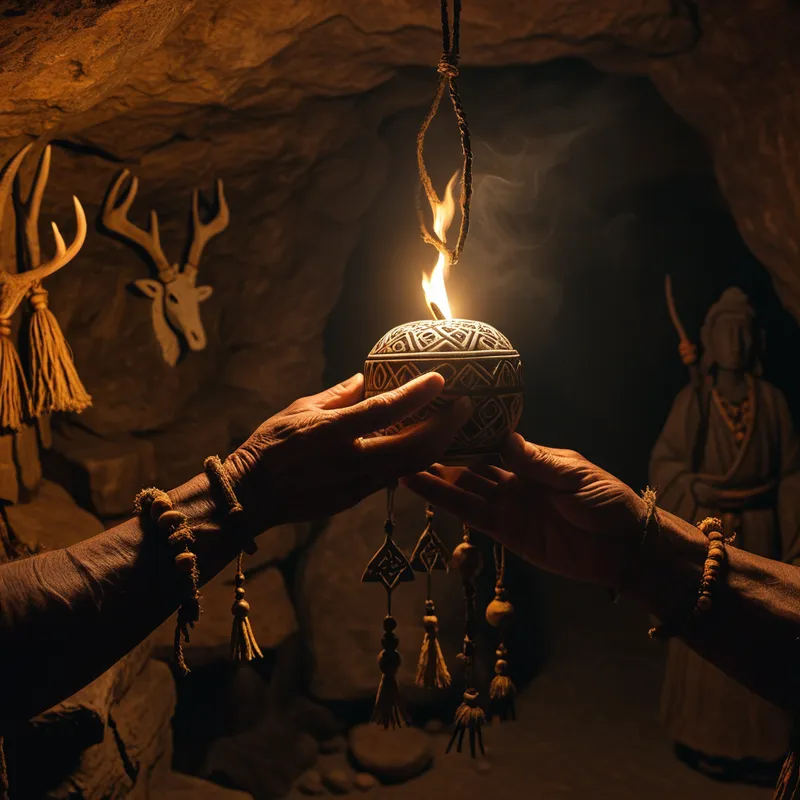
They could not carry it back as it was. As they ascended the World Navel, the Shaman gathered the fragments—the chirp of a cricket, the babble of a spring, the sigh of a lover. At the threshold of the waking world, with their physical hands, they took clay, and copper, and the hollow bones of a crane. Into each vessel, they breathed a captured fragment of the Song, and sealed it with a clapper of heart-wood. They forged not one thing, but many: the first Ritual Bells.
The Shaman rang the first bell. A clear, high tone pierced the silence. It was the sound of a single star. They rang the second, a lower, warmer tone—the sound of stone remembering it was mountain. One by one, the bells rang out, each a note of the restored symphony. The Wind found its voice. The River remembered its melody. Sound and Silence resumed their eternal dance, closer now, wiser for the rupture. The bells were not the Song itself, but its vessels—a bridge forever after, held in human hands.
Cultural Origins & Context
This myth finds its roots not in a single tribe, but in the shared phenomenological bedrock of circumpolar and Siberian shamanic traditions. It is a story of the regalia, explaining the sacred tools of the practice. It was never a fixed, canonical text, but a living narrative performed during initiations and healing ceremonies. The elder shaman, often with bell-adorned garb, would tell it to an apprentice, not as history, but as a map of the non-ordinary reality they were learning to navigate.
Its societal function was multifaceted. Primarily, it established the shaman’s role as the community’s “psychopomp” of sound—the one who could navigate between coherence and chaos to retrieve what was lost. It sacralized the tools of the trade, transforming craft into cosmology. The bells were not mere instruments; they were fragments of the world’s soul, and their use in ritual was a participatory act of cosmic maintenance. The myth also served as a therapeutic metaphor for a community experiencing rupture—famine, conflict, or plague—framing their distress as a “stolen song” and the ritual as its restoration.
Symbolic Architecture
At its core, the myth is a profound allegory for the integrity of the psychic ecosystem. The Song of Becoming represents the innate, flowing wholeness of the psyche—what Jung might call the Self in its unmanifest state. It is the background harmony of being.
The theft of the song is not an attack from without, but the psychic entropy that follows when a complex—here, He-Who-Swallows-Echoes—consumes life energy. It is depression, dissociation, the loss of meaning where actions continue but their soul-note is absent.
The shaman’s journey is the ego’s descent into the unconscious (the Under-Forest) to confront this devouring complex. Crucially, the victory is not through battle but through re-membering—dancing the pattern of wholeness. This is the therapeutic act of recalling one’s authentic narrative, piece by piece, from the grip of a negative complex.
The forging of the bells is the critical symbol of translation. The raw, overwhelming totality of the Self (the recovered Song) cannot be integrated directly; it would shatter the conscious mind.
The ritual bell is the symbol of the tertium non datur—the third thing. It is the crafted form, the conscious symbol (like a dream image, a work of art, or a personal ritual) that can hold and transmit a fragment of the numinous without destroying the vessel.
The Dreamer's Resonance
When this myth activates in the modern dreamer, it often manifests as dreams of profound silence or muffled sound: trying to scream but no voice emerges, phones that transmit only static, or living in a world where everyone speaks a language you cannot hear. Somatically, this can feel like a constriction in the throat chakra, a sense of being “unheard” at a fundamental level, or chronic fatigue where one’s actions feel meaningless and hollow.
The appearance of a bell in such dreams is a pivotal moment of potential healing. It may be rusted and silent, requiring polishing (conscious attention). It may be ringing in the distance, guiding the dreamer through a fog (the call to a new attitude). To dream of finding or forging a bell signals the psyche’s nascent attempt to create a new symbolic vessel—a personal ritual, a creative outlet, or a mode of expression—to carry a lost part of the self back into the world of relationship and meaning. The dream is an invitation to listen for what specific “note” that bell represents.

Alchemical Translation
The alchemical process mirrored here is solve et coagula: dissolve and coagulate. First, the cohesive world-sound is dissolved (stolen), plunging the system into the nigredo, the blackening, the silent despair. The shaman’s journey is the mortificatio, a symbolic death in the underworld. The retrieval is the beginning of the albedo, the whitening, but the raw material is volatile.
The forging of the bells is the coagulatio—the spirit made matter, the insight given form. It is the embodiment of the transcendent function.
For the individual, the myth models the path of individuation through the restoration of inner dialogue. The “stolen song” is often one’s unique vocation or authentic voice, swallowed by the complex of the persona or the demands of the collective. The descent is the necessary withdrawal from external noise to confront the inner “swallower” (shadow, addiction, toxic pattern).
The triumph is not in obliterating this complex, but in reclaiming specific contents from it. One does not recover “everything” at once. You recover the note of your creativity, the tone of your boundary, the chime of your grief. Each is forged into a personal “ritual bell”—a daily practice, a committed art form, a truthful way of speaking. Each time you engage this practice, you are not just performing a task; you are ringing a fragment of the primordial harmony back into your world, restoring the dance between your own Sound and Silence.
The ultimate teaching of the Ritual Bells is that wholeness is not a static state to be regained, but a symphony to be continually performed through the humble, persistent ringing of the fragments we have rescued and dared to give form.
Associated Symbols
Explore related symbols from the CaleaDream lexicon: