Raven the Trickster Myth Meaning & Symbolism
A shape-shifting deity steals light from a cosmic chief, bringing illumination to a dark world through cunning, sacrifice, and transformative trickery.
The Tale of Raven the Trickster
In the beginning, the world was a womb of shadow. Not a gentle twilight, but a profound, swallowing dark where water and land were one, and all creatures moved blind and formless through the gloom. In this primordial soup, there was a great house, a lodge of cosmic proportions, where the Chief Who Owned the Light lived. He kept the sun, the moon, and the stars locked away in a nested series of beautifully carved boxes, hoarding their brilliance for himself and his daughter. The people outside groped in the perpetual dusk, their world a half-born thing.
Into this scene of stagnant darkness came a creature of pure potential: Raven. He was not yet the glossy black bird we know. He was a shape-shifter, a being of endless appetite and cunning curiosity. He saw the people’s plight, but more immediately, he heard a rumor of the Chief’s great treasure. Raven’s desire was not born of pure altruism, but of a hungry, creative impulse that could not abide such a hoarded thing.
He transformed himself. Shrinking, shifting, he became a single, insignificant pine needle. He drifted on a breath of wind until he fell into a stream where the Chief’s daughter came to drink. She swallowed him. Inside her, he became a child, and in time, he was born as her son—a strange, dark-eyed boy who cried and cried for the boxes that held the light. The doting grandfather, the Chief, could deny his “grandson” nothing. One by one, the boxes were brought to the child to play with. He cooed at the outer boxes, but his cries only ceased when he held the innermost one, the one that pulsed with a warm, golden glow.
The moment he was alone, the child-Raven resumed his true form. With a sharp beak, he tore open the final box. Light, raw and blinding, erupted into the dark lodge. Chaos ensued. In the confusion, Raven snatched up the glowing orb of the sun in his beak and burst through the smoke hole of the house, fleeing into the vast, waiting darkness.
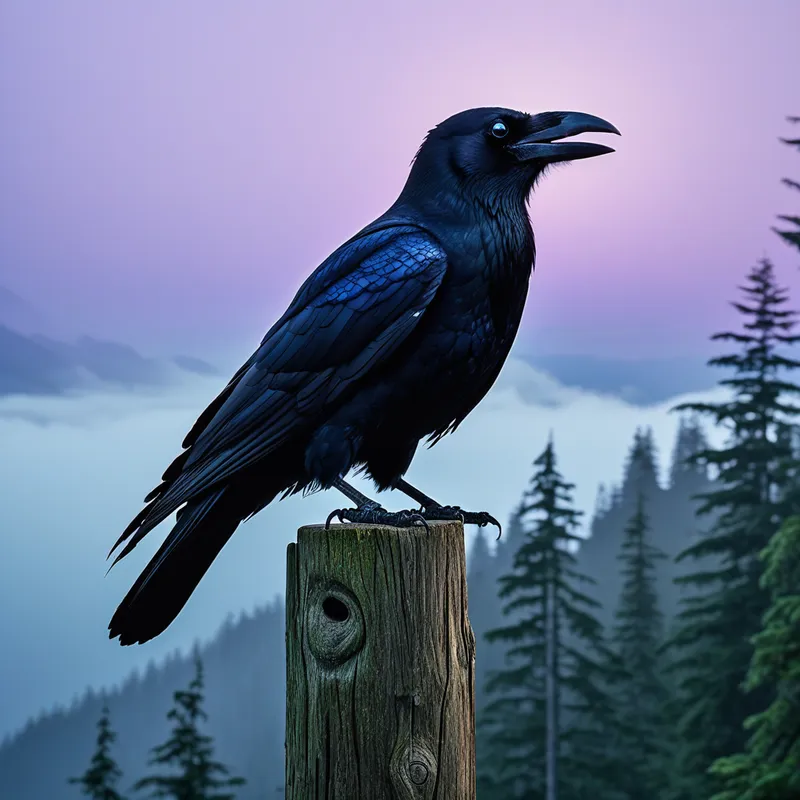
The flight that followed was an act of cosmic theft and desperate creation. The Chief and his people gave chase. Raven flew, the sun burning his beak, his feathers scorched by its radiance. He flew until his wings ached and his breath was fire. To escape, he was forced to release the light. But he did not drop it. He threw it—up, up, into the dome of the sky, where it stuck and began to journey, bringing dawn, day, and the cycle of time to a world that had known only night. The people below saw their world for the first time: the green of the forests, the blue of the rivers, the shapes of one another’s faces. Raven, exhausted and forever blackened by the sun’s touch, watched from a high branch, his raucous laugh the first sound of a world made whole and strange.
Cultural Origins & Context
The Raven cycle is a cornerstone of the oral traditions among many Coastal First Nations, including the Tlingit, Haida, Tsimshian, and Kwakwaka'wakw peoples. This is not a single, monolithic story, but a vast, living tapestry of tales where Raven is the constant, chaotic thread. He is Transformer, Culture Hero, and supreme Trickster.
These stories were not mere entertainment; they were the foundational texts of a people. Told by elders and storytellers during the long winter months in great cedar plank houses, the tales served as cosmology, history, moral instruction, and social satire. Raven’s adventures explained the origins of geographical features, the behaviors of animals, and the quirks of human nature. His amoral, often selfish actions provided a safe vessel to explore taboo subjects, critique authority (like the hoarding Chief), and illustrate that the world’s order is not born from perfect virtue, but often from messy, desirous, and cunning intervention.
Symbolic Architecture
Raven is the embodiment of the primordial, creative chaos that precedes and necessitates order. He is not evil, nor purely good. He is the necessary force of disruption that breaks a stagnant system.
The Trickster does not build from a plan, but from appetite. His creativity is a byproduct of his hunger.
The darkness of the beginning world symbolizes undifferentiated consciousness, a state of potential with no form. The Chief Who Owns the Light represents the ego’s tendency to hoard psychic energy, to keep consciousness small, controlled, and selfish. The light is illumination itself—awareness, consciousness, the ability to see things as they are.
Raven’s method is critical. He does not wage a heroic war. He transforms—becoming a pine needle, then a child. This symbolizes the psychic ability to approach a defended complex (the hoarded light/consciousness) not through direct confrontation, but through subtlety, infiltration, and leveraging relationships (the daughter’s love, the grandfather’s doting). The theft is a necessary crime against the old, selfish order.
His flight, his scorched feathers, and the final release of the light model the cost of bringing consciousness into being. The transformation is permanent; Raven is blackened by it. The world, and the bringer of the world, are forever changed.
The gift of consciousness burns the one who steals it from the gods. Enlightenment is not a gentle acquisition, but a transformative theft that leaves its mark.
The Dreamer's Resonance
When the pattern of Raven the Trickster stirs in the modern unconscious, it often manifests in dreams of cunning escapes, of stealing something precious from a powerful or oppressive figure, or of shape-shifting to achieve a goal. You might dream of finding a hidden key, of being a spy in your own life, or of a black bird delivering a crucial message.
Somatically, this can feel like a restless, itching energy—a creative frustration with a situation that feels “dark” or stuck. It is the psyche’s intelligence signaling that a direct, “heroic” approach to a problem (a stagnant job, a blocked creative project, a repressed aspect of the self) is doomed. The Raven process is underway, suggesting that the solution lies in cunning, in a change of form (perspective), in appealing to an unexpected ally, or in being willing to be the “trickster” who breaks unspoken rules for a greater gain. The anxiety in the dream is the heat of the stolen sun in the beak—the fear and exhilaration of holding a new, brilliant, and potentially dangerous awareness.
Alchemical Translation
The Raven myth is a perfect map for the individuation process, specifically the stage where one must confront and integrate the shadow and retrieve a hoarded treasure from the unconscious.
We all live initially in a kind of personal “darkness,” where our fullest potential, our inner light, is locked away by an inner “Chief”—our rigid ego, our adherence to family or cultural expectations, our fears. The ego hoards safety and control, keeping our broader consciousness small.
The Raven within is the shadow itself—the cunning, amoral, hungry, and creative force we often deny. Individuation requires not destroying this Raven, but allowing it to act. We must let ourselves be “impregnated” by a pine needle of inspiration, to change form, to become the child who can ask for what the adult cannot. It requires the trickster’s courage to infiltrate our own defenses, to “steal” the insight, the talent, the self-knowledge that our egoistic Chief has locked away.
The flight is the difficult integration. Holding this new consciousness is painful; it burns. It changes us, blackening our old identity. We are chased by the parts of ourselves that want things to remain dark and familiar. The final, triumphant act is not to consume the light for ourselves, but to release it to the sky—to structure it into the ongoing cycle of our lived experience, where it can illuminate our whole world. The result is not a saintly hero, but a transformed, slightly scorched, and cackling being who has, through chaotic and desirous means, participated in the ongoing creation of a more conscious world.
The alchemy of the self is not a purification, but a theft. We do not earn our wholeness; we cunningly liberate it from the tyranny of the small self, and are forever marked by the glorious crime.
Associated Symbols
Explore related symbols from the CaleaDream lexicon: