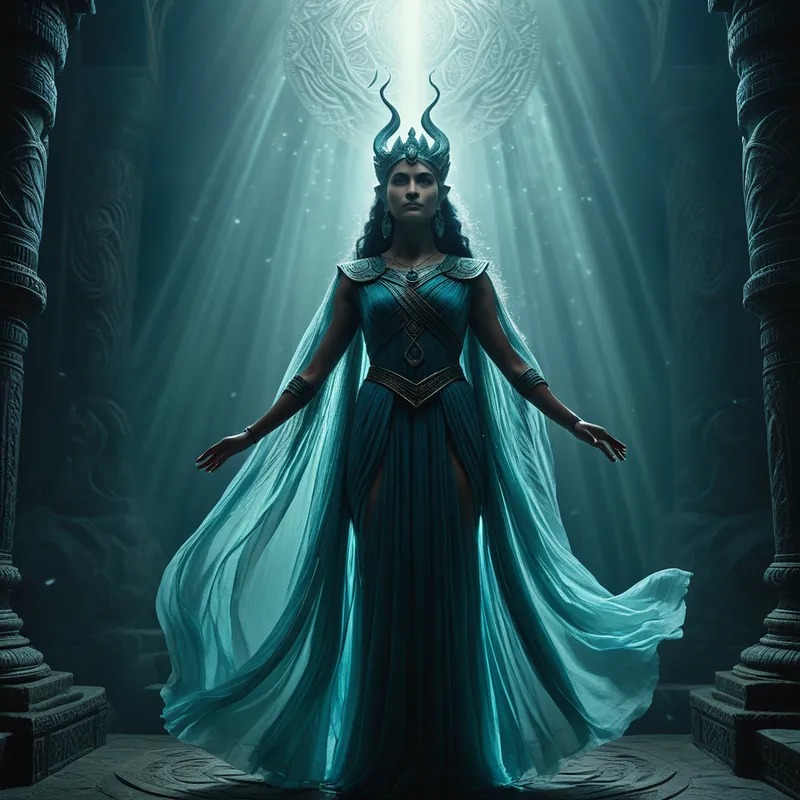
Quetzalcoatl Feathered Serpent
The benevolent creator god of Aztec mythology, Quetzalcoatl brought knowledge and civilization but clashed with darker forces, embodying the tension between creation and sacrifice.
The Tale of Quetzalcoatl Feathered Serpent
In the time before time, when [the world](/myths/the-world “Myth from Tarot culture.”/) was formless and dark, the dual-natured god stirred in the primordial sea. He was [Quetzalcoatl](/myths/quetzalcoatl “Myth from Aztec culture.”/), the Feathered Serpent, a being woven from the green iridescence of the quetzal bird and the coiled, earth-bound power of the serpent. From this union of sky and soil, he rose to become the great civilizer, the breath of order in the [chaos](/myths/chaos “Myth from Greek culture.”/).
His story is one of creation and profound loss. After the Fourth Sun was destroyed by a [great flood](/myths/great-flood “Myth from Mesopotamian culture.”/), the gods gathered at Teotihuacan to create a new age. To bring forth [the Fifth Sun](/myths/the-fifth-sun “Myth from Aztec culture.”/), the era of movement, a sacrifice was required. The proud and wealthy god Tecuciztecatl hesitated before [the sacred fire](/myths/the-sacred-fire “Myth from Native American culture.”/). But the humble, pustule-covered god Nanahuatzin, filled with devotion, leapt into the flames without a second thought, transforming into the brilliant sun. Yet a sun that does not move is a dead sun. It was Quetzalcoatl, in an act of fierce, life-giving violence, who then slew the other gods, offering their sacred energy as tonalli—the animating force—to hurl the new sun into motion across [the sky](/myths/the-sky “Myth from Persian culture.”/). Thus, creation was born from sacrifice, a paradox that would define his essence.
As the White [Tezcatlipoca](/myths/tezcatlipoca “Myth from Mesoamerican culture.”/), the god of light, wind, and wisdom, Quetzalcoatl descended to the earthly plane. He did not come with thunder, but with a breath of life. He taught humanity the sacred arts: the cultivation of maize, the shaping of stone, the measurement of time by the stars, the craft of the scribe, and the reverence for beauty through jade and quetzal feathers. He forbade the offering of human hearts, advocating instead sacrifices of flowers, snakes, and butterflies. His city, Tollan, became a paradise of harmony, where corn grew in colors never seen before and birds sang with jeweled voices.
Yet his nature held a fatal duality, a tension that his darker brother, the Tezcatlipoca, knew how to exploit. Tezcatlipoca, the lord of discord, came to Tollan disguised as an old man. He showed Quetzalcoatl his own reflection in a mirror—not as the radiant god, but as a mortal man, aged and frail. Stricken by this vision of his earthly limitations, Quetzalcoatl’s spirit broke. In his despair, Tezcatlipopa offered him the fermented juice of the maguey, the pulque. The god of wisdom became intoxicated, and in his shameful stupor, he broke his own celibate vows with the priestess Quetzalpetlatl.
Awakening to his disgrace, the Feathered Serpent knew his time in Tollan was over. He burned his palaces of coral and silver, buried his treasures, and transformed the cacao trees into thorny mezquites. Then, dressed in his quetzal feather regalia, he journeyed to the coast. There, upon the eastern sea, he built a pyre of serpents and immolated himself. As his body burned, his heart ascended to become [the Morning Star](/myths/the-morning-star “Myth from Astrological culture.”/), the planet [Venus](/myths/venus “Myth from Alchemical culture.”/), the celestial [herald](/myths/herald “Myth from Greek culture.”/) caught between the sun and [the underworld](/myths/the-underworld “Myth from Greek culture.”/). But the promise lingered on [the wind](/myths/the-wind “Myth from Various culture.”/): he would one day return from the east, across the waters, to reclaim his rightful place.
Cultural Origins & Context
Quetzalcoatl’s roots sink deep into the Mesoamerican world, far predating the Aztec (Mexica) empire that venerated him. His figure coalesced from ancient Olmec and Maya conceptions of a feathered serpent deity associated with wind, rain, and royal authority. For the Aztecs, who saw themselves as inheritors of the legendary Tollan’s glory, Quetzalcoatl became a complex symbol of their own historical and spiritual anxieties.
He was not merely a “benevolent” god in a [pantheon](/myths/pantheon “Myth from Roman culture.”/) of fearsome deities; he was the embodiment of the Toltecayotl, the idealized civilization of the past. His myth served as a foundational narrative explaining the necessity of ritual sacrifice (nextlahualli, “the debt payment”) while simultaneously mourning its human cost. The Aztec state, built on militaristic expansion and mass sacrifice to sustain the cosmos, held Quetzalcoatl in tension. He was the patron of priests (tlamacazqui) and the calmecac schools for the nobility, representing the intellectual and spiritual path that stood in contrast to the warrior’s path of [Huitzilopochtli](/myths/huitzilopochtli “Myth from Aztec culture.”/).
His promised return was not just a religious trope; it was a historical specter that haunted the Aztec worldview. When the Spanish conquistador Hernán Cortés arrived from the east in 1519, the year One Reed (Ce Acatl)—a year sacred to Quetzalcoatl—Emperor Moctezuma II was paralyzed by the possibility that this might be the god-king’s return. This cultural context reveals Quetzalcoatl not as a static figure, but as a living, evolving archetype through which a civilization understood its origins, its moral conflicts, and its ultimate destiny.
Symbolic Architecture
Quetzalcoatl’s very form is a sacred equation. The [serpent](/symbols/serpent “Symbol: A powerful symbol of transformation, wisdom, and primal energy, often representing hidden knowledge, healing, or temptation.”/) (coatl) represents the terrestrial: the chthonic powers, the flowing [river](/symbols/river “Symbol: A river often symbolizes the flow of emotions, the passage of time, and life’s journey, reflecting transitions and movement in one’s life.”/), the undulating [landscape](/symbols/landscape “Symbol: Landscapes in dreams are powerful symbols representing the dreamer’s emotional state, personal journey, and the broader context of life situations.”/), the cycle of shedding and renewal. The quetzal feathers (quetzalli) signify the celestial: the [spirit](/symbols/spirit “Symbol: Spirit symbolizes the essence of life, vitality, and the spiritual journey of the individual.”/), the [breath](/symbols/breath “Symbol: Breath symbolizes life, vitality, and the connection between the physical and spiritual realms.”/) ([ehecatl](/myths/ehecatl “Myth from Mesoamerican culture.”/)), the highest aspirations, [beauty](/symbols/beauty “Symbol: This symbol embodies aesthetics, harmony, and the appreciation of life’s finer qualities.”/), and the green vitality of [life](/symbols/life “Symbol: The symbol of ‘Life’ represents a journey of growth, interconnectedness, and existential meaning, encompassing both the joys and challenges that define human experience.”/). He is the embodied bridge between matter and spirit, [earth](/symbols/earth “Symbol: The symbol of Earth often represents grounding, stability, and the physical realm, embodying a connection to nature and the innate support it provides.”/) and sky, instinct and [consciousness](/symbols/consciousness “Symbol: Consciousness represents the state of awareness and perception, encompassing thoughts, feelings, and experiences.”/).
He is the dynamic synthesis of opposites, a living mandala where the horizontal plane of earthly existence is pierced and uplifted by the vertical axis of spiritual aspiration. His being resolves, but never dissolves, the tension between the two.
His [narrative arc](/symbols/narrative-arc “Symbol: A narrative arc represents the structured path that a story follows from introduction to resolution, reflecting growth and transformation.”/) maps the [journey](/symbols/journey “Symbol: A journey in dreams typically signifies adventure, growth, or a significant life transition.”/) of consciousness itself. He creates order from [chaos](/symbols/chaos “Symbol: In Arts & Music, chaos represents raw creative potential, uncontrolled expression, and the breakdown of order to forge new artistic forms.”/), imposes culture on [nature](/symbols/nature “Symbol: Nature symbolizes growth, connectivity, and the primal forces of existence.”/), yet is ultimately brought low by his own [reflection](/symbols/reflection “Symbol: Reflection signifies self-examination, awareness, and the search for truth within oneself.”/)—his [shadow](/symbols/shadow “Symbol: The ‘shadow’ embodies the unconscious, repressed aspects of the self and often represents fears or hidden emotions.”/). [The mirror](/myths/the-mirror “Myth from Various culture.”/) Tezcatlipoca holds is the mirror of self-[awareness](/symbols/awareness “Symbol: Conscious perception of self, surroundings, or internal states. Often signifies awakening, insight, or heightened sensitivity.”/), where the god confronts his mortal [vessel](/symbols/vessel “Symbol: A container or structure that holds, transports, or protects something essential, representing the self, emotions, or life journey.”/), his [capacity](/symbols/capacity “Symbol: A measure of one’s potential, limits, or ability to contain, process, or achieve something, often reflecting self-assessment or external demands.”/) for weakness and [shame](/symbols/shame “Symbol: A painful emotion arising from perceived failure or violation of social norms, often involving exposure of vulnerability or wrongdoing.”/). His downfall is not from an external [enemy](/symbols/enemy “Symbol: An enemy in dreams often symbolizes an internal conflict, self-doubt, or an aspect of oneself that one struggles to accept.”/), but from the [eruption](/symbols/eruption “Symbol: A sudden, violent release of pent-up energy or emotion from beneath the surface, often representing transformation or crisis.”/) of the denied [human](/symbols/human “Symbol: The symbol of a human represents individuality, complexity of emotions, and social relationships.”/) within the divine.
His transformation into the Morning Star is the final, perfect [symbol](/symbols/symbol “Symbol: A symbol can represent an idea, concept, or belief, serving as a powerful tool for communication and understanding.”/). Venus as the Morning Star (Quetzalcoatl) and the Evening Star (his twin [Xolotl](/myths/xolotl “Myth from Aztec culture.”/), the dog-headed god of monsters and the setting sun) embodies the eternal cycle of descent and [ascent](/symbols/ascent “Symbol: Symbolizes upward movement, progress, spiritual elevation, or striving toward higher goals, often representing personal growth or transcendence.”/), [death](/symbols/death “Symbol: Symbolizes transformation, endings, and new beginnings; often associated with fear of the unknown.”/) and [rebirth](/symbols/rebirth “Symbol: A profound transformation where old aspects of self or life die, making way for new beginnings, growth, and renewal.”/). He becomes the light that emerges from the sacrificial fire, the promise that wisdom, though it may be exiled and shamed, will always return.
The Dreamer’s Resonance
To encounter Quetzalcoatl in the inner landscape is to meet the part of the [psyche](/myths/psyche “Myth from Greek culture.”/) that seeks to build, to civilize the raw wilderness of our instincts. He is the dreamer who architects a life of meaning, who cultivates the gardens of talent and knowledge, and who strives for a personal “Tollan”—a state of integrated harmony. He represents the creative impulse in its purest form: the act of bringing spirit into form.
Yet his myth warns us of the perils of this archetype when it is not in dialogue with its shadow. The Quetzalcoatl complex can manifest as a spiritual pride, an identification with the “light” so complete that it denies the darker, more instinctual, and embodied aspects of [the self](/myths/the-self “Myth from Jungian culture.”/). The intoxicating pulque offered by Tezcatlipoca is not merely alcohol; it is the unconscious itself, rising up to shatter a one-sided consciousness that has become too rigid, too perfect, too removed from the fertile mud of human experience.
His exile is the necessary depression, the “[dark night of the soul](/myths/dark-night-of-the-soul “Myth from Christian culture.”/)” that follows a fall from grace. It is the period when our idealized self-image is shattered by a mirror we cannot avoid—a failure, a betrayal, a surge of “unacceptable” emotion. The dreamer’s task, guided by this myth, is not to avoid [the fall](/myths/the-fall “Myth from Biblical culture.”/), but to undergo it, to be immolated in the fires of shame, so that the essential heart, stripped of its regalia, can ascend as a guiding light. Quetzalcoatl teaches that true wisdom is born not from pristine perfection, but from the integration of the broken pieces.
Alchemical Translation
In the alchemical vessel of the soul, Quetzalcoatl represents the [coniunctio oppositorum](/myths/coniunctio-oppositorum “Myth from Alchemical culture.”/)—[the sacred marriage](/myths/the-sacred-marriage “Myth from Various culture.”/) of opposites. The serpent is the [prima materia](/myths/prima-materia “Myth from Alchemical culture.”/), the base matter, the mercurial and transformative energy. The feathers are the [spiritus](/myths/spiritus “Myth from Alchemical culture.”/), the volatile and ascending essence. Their union is the creation of the philosopher’s stone, the integrated Self.
The myth is an alchemical recipe: take the lead of earthly existence (the serpent), combine it with the gold of spiritual aspiration (the feathers), and subject it to the fire of sacrifice and the mirror of self-reflection. The result is not a static perfection, but a luminous, cycling star—the cauda pavonis or peacock’s tail, displaying all colors, all aspects of experience.
His journey from creator to outcast to celestial herald mirrors the alchemical stages: the [nigredo](/myths/nigredo “Myth from Alchemical culture.”/) (the blackening, the destruction of Tollan and his self-immolation), the [albedo](/myths/albedo “Myth from Alchemical culture.”/) (the whitening, his purification as the Morning Star), and the hinted [rubedo](/myths/rubedo “Myth from Alchemical culture.”/) (the reddening, his promised return). He is the agent of transformation who himself must be transformed. The sacrifice he once demanded of the gods becomes the sacrifice he ultimately makes of himself, moving from an externalized ritual to an internalized, psychic process where [the ego](/myths/the-ego “Myth from Jungian culture.”/) is offered up for the sake of a greater consciousness.
Associated Symbols
Explore related symbols from the CaleaDream lexicon:
- Feathered Serpent — The ultimate glyph of synthesized duality, representing the marriage of earthly wisdom and celestial aspiration, the binding of instinct to spirit.
- Sacrifice — The foundational, paradoxical act where life is given to sustain life, representing the necessary surrender of one state of being to birth another.
- Mirror — The instrument of self-revelation and shadow confrontation, showing not what we wish to see, but the raw, often unsettling truth of our embodied existence.
- Morning Star — The light that emerges from the darkness of sacrifice, symbolizing hope, cyclical return, and wisdom born from the ordeal of descent.
- Trickster — The destabilizing force, embodied by Tezcatlipoca, that shatters rigid perfection to force growth, integration, and a more complete consciousness.
- Wind — The invisible breath of Quetzalcoatl as Ehecatl, representing spirit, inspiration, change, and the intangible force that shapes both world and mind.
- Duality Mask — The face that contains two natures in one form, speaking to the inherent tension and potential unity within opposing forces of the self.
- Serpent Coil — The grounded, cyclical, and regenerative power of [the earth](/myths/the-earth “Myth from Hindu culture.”/) and the unconscious, the necessary counterpart to ascending flight.
- Fires of Creation — The transformative blaze from which new worlds and new consciousness are forged, requiring a profound offering to ignite.
- Exile — The state of banishment from one’s own center, a necessary wilderness journey where the soul is stripped bare to discover its essential core.
- Quetzal Feather — The emblem of rare beauty, truth, and the highest spiritual value, often representing the hard-won prize of an inner journey.
- [Rainbow Serpent](/myths/rainbow-serpent “Myth from Australian Aboriginal culture.”/) — A related Mesoamerican motif emphasizing the serpent’s connection to [water](/myths/water “Myth from Chinese culture.”/), fertility, and the bridge between heaven and earth after the storm.