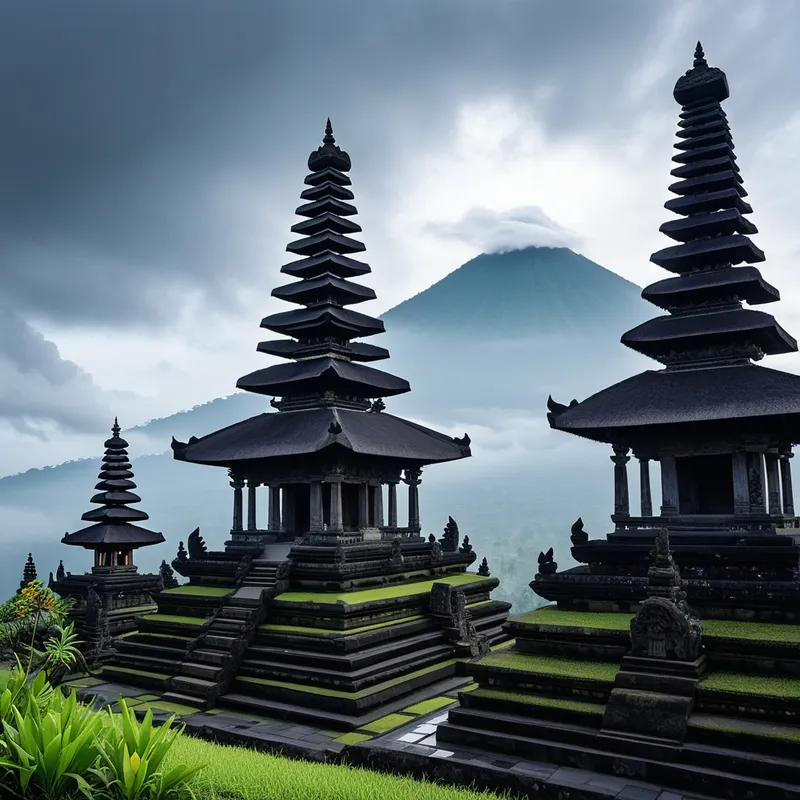
Pura Besakih Mother Temple Myth Meaning & Symbolism
The myth of a sacred mountain where the gods descended to establish cosmic order, creating a temple that is a living axis between heaven and earth.
The Tale of Pura Besakih Mother Temple
Listen, and let the mists of Mount Agung part. In the time before time, when the world was still soft and the seas restless, the great mountain was not a place of stone and fire, but a throne of pure intention. The heavens gazed down upon the island of Bali, a jewel adrift in the turquoise sea, and saw it was beautiful, but formless. It lacked a heart, a fixed point around which the dance of life could turn.
From the highest realm, Sang Hyang Widhi Wasa sent forth a pulse of divine will. It descended not as a single being, but as a triad of radiant essences, the Trimurti. They did not walk upon the earth, but became the earth. Their presence infused the very bones of the island. Yet, a center was needed—a sanctuary where the shimmering veil between the realms of gods (Swah Loka), humans (Bhur Loka), and demons (Bhur Loka) would be thin as a lotus petal.
The gods chose the southwestern slope of mighty Agung. But this was no empty hillside. It was watched over by a primordial spirit, a fierce and ancient guardian of the wild places. Some say it was a great Naga, its coils deep in the mountain’s roots. Others whisper of a being older than names. The divine essences did not conquer this guardian; they performed a sacred alchemy. Through a ritual of cosmic balance, they invited the guardian’s power into the new order, transforming raw, chthonic force into protective, foundational energy. The ground was hallowed, not cleared.
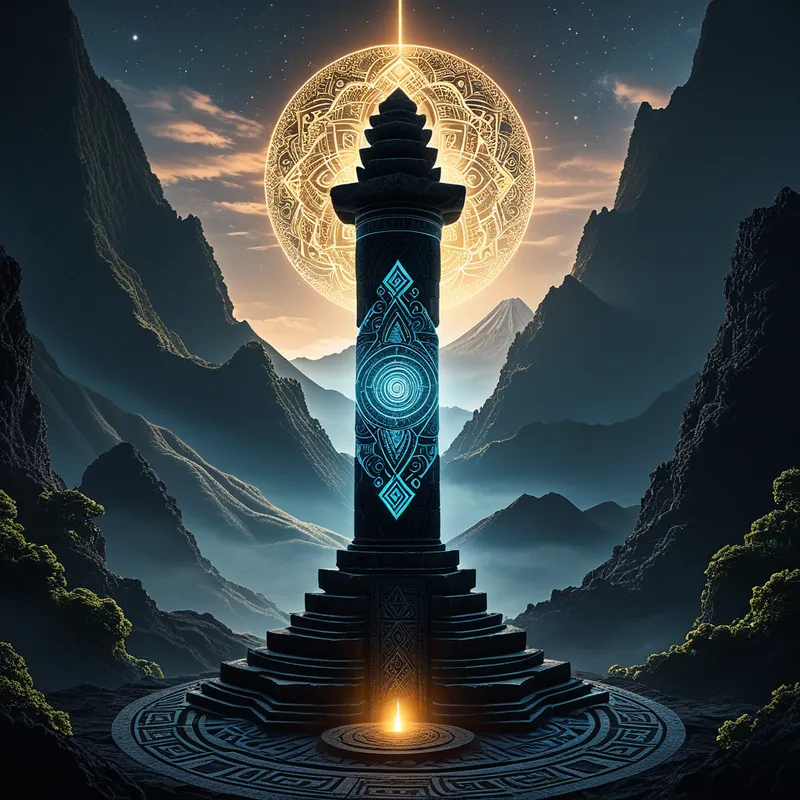
Then, from the heavens, a beam of solidified light—a celestial foundation stone—pierced the mist and settled upon the mountainside. Around it, the first priests, guided by vision and trance, began to place stones. They built not a single shrine, but a cascade of them, tier upon tier, mirroring the mountain’s own ascent. They erected Meru towers, their thatched roofs reaching like steps to the sky. They carved gates, Candi Bentar, that were not barriers but invitations to cross a threshold. Water, channeled from sacred springs, was made to flow through the complex, singing of purification. Fire, in perpetual lamps, was kindled, speaking of consciousness.
Thus, Pura Besakih was born—not as a monument completed, but as a living process, a breathing axis where the divine descent met the human aspiration to ascend. It became the navel of Bali, the fixed point from which all spiritual order (dharma) radiates and to which it returns. The mountain, the temple, and the island became one body, with Besakih as its steadfast, nurturing heart.
Cultural Origins & Context
The myth of Pura Besakih is not a fossilized story from a distant past, but the living breath of Balinese Agama Hindu Dharma. Its origins are woven into the very settlement of the island, with inscriptions suggesting sacred use of the site as early as the 11th century. The myth is not contained in a single epic text; it is held in the collective memory of the banjar, recited by pedanda during intricate rituals, and animated in the movements of sacred legong dances.
It functions as Bali’s foundational charter. The tale explains why Besakih is the “Mother Temple” (Pura Besakih): it is the primal source from which all other temples on the island derive their sanctity, much as a mother is the source of a lineage. The myth establishes the core Balinese worldview of sekala and niskala (the seen and unseen), and the constant, active work needed to maintain balance between them. The temple is the primary tool for this work. The story is told to remind every Balinese that their identity, their safety from chaos, and their connection to the divine are rooted in this sacred covenant between the mountain, the gods, and the people, maintained through unbroken ritual.
Symbolic Architecture
At its core, the myth of Pura Besakih is a [blueprint](/symbols/blueprint “Symbol: A blueprint represents the foundational plan or design for something, often symbolizing potential, structure, and the mapping of one’s inner self or future.”/) for the psyche’s own [structure](/symbols/structure “Symbol: Structure in dreams often symbolizes stability, organization, and the framework of one’s life, reflecting how one perceives their environment and personal life.”/). The [temple](/symbols/temple “Symbol: A temple often symbolizes spirituality, sanctuary, and a deep connection to the sacred aspects of life.”/) complex is a grand [mandala](/symbols/mandala “Symbol: A sacred geometric circle representing wholeness, the cosmos, and the journey toward spiritual integration.”/) of [integration](/symbols/integration “Symbol: The process of unifying disparate parts of the self or experience into a cohesive whole, often representing psychological wholeness or resolution of internal conflict.”/).
The mountain is the enduring Self, the temple is the conscious ego-structure built in its service, and the rituals are the daily acts of attention that maintain the connection.
The initial conflict with the primordial [guardian](/symbols/guardian “Symbol: A protector figure representing safety, authority, and guidance, often embodying parental, societal, or spiritual oversight.”/) represents the necessary encounter with the psychic bedrock—the instinctual, perhaps fearsome, aspects of our own [nature](/symbols/nature “Symbol: Nature symbolizes growth, connectivity, and the primal forces of existence.”/) (the [shadow](/symbols/shadow “Symbol: The ‘shadow’ embodies the unconscious, repressed aspects of the self and often represents fears or hidden emotions.”/), the chthonic). Enlightenment or wholeness is not achieved by slaying this [guardian](/symbols/guardian “Symbol: A protector figure representing safety, authority, and guidance, often embodying parental, societal, or spiritual oversight.”/), but by acknowledging its power and integrating its [energy](/symbols/energy “Symbol: Energy symbolizes vitality, motivation, and the drive that fuels actions and ambitions.”/) into the [foundation](/symbols/foundation “Symbol: A foundation symbolizes the underlying support systems, values, and beliefs that shape one’s life, serving as the bedrock for growth and development.”/) of the self. The Meru towers symbolize the aspiration toward higher [consciousness](/symbols/consciousness “Symbol: Consciousness represents the state of awareness and perception, encompassing thoughts, feelings, and experiences.”/), a stepwise [ascent](/symbols/ascent “Symbol: Symbolizes upward movement, progress, spiritual elevation, or striving toward higher goals, often representing personal growth or transcendence.”/). The flowing [water](/symbols/water “Symbol: Water symbolizes the subconscious mind, emotions, and the flow of life, representing both cleansing and creation.”/) and eternal fire within the temple walls represent the union of opposites—[emotion](/symbols/emotion “Symbol: Emotion symbolizes our inner feelings and responses to experiences, often guiding our actions and choices.”/) and [spirit](/symbols/spirit “Symbol: Spirit symbolizes the essence of life, vitality, and the spiritual journey of the individual.”/), the fluid and the fixed, the cleansing and the illuminating—contained within the sacred precinct of a balanced psyche.
The Dreamer’s Resonance
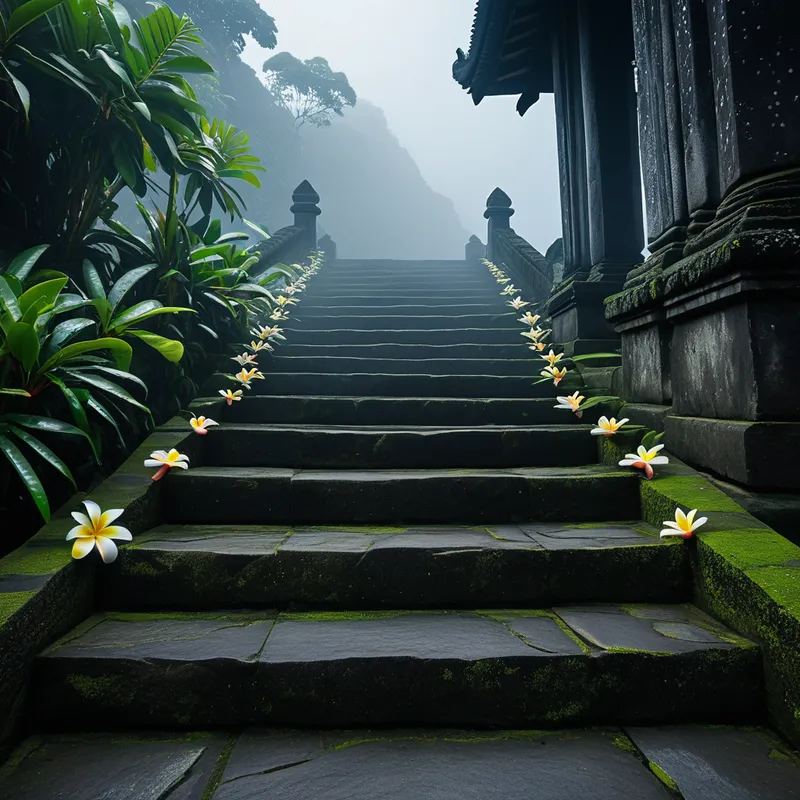
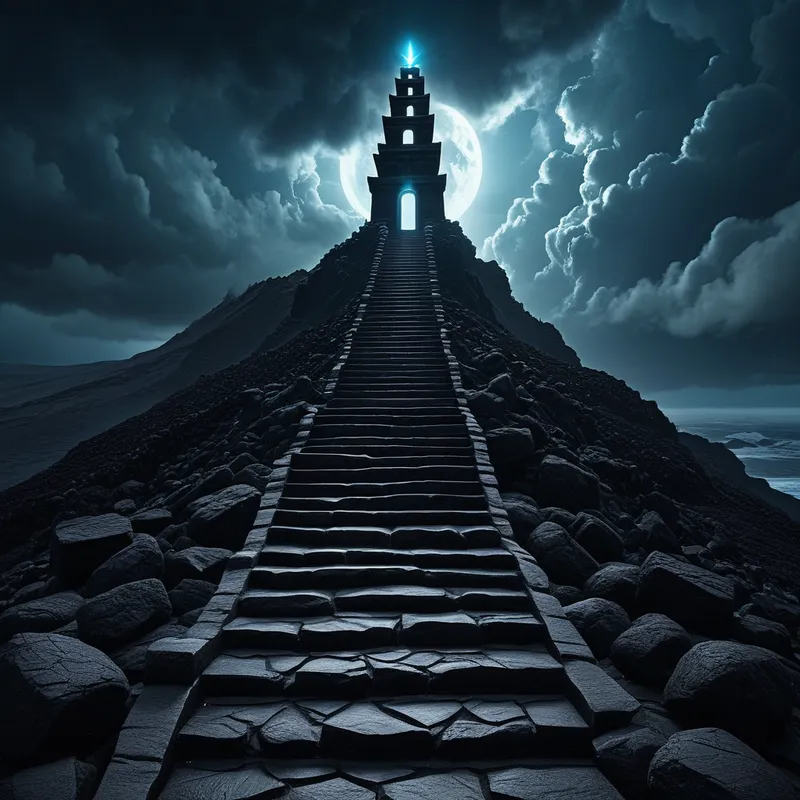
When this myth stirs in the modern dreamer, it often manifests as dreams of discovering or ascending a vast, intricate structure on a mountainside. One might dream of finding a hidden staircase on a familiar hill, leading to an unknown sanctuary. There is a somatic sense of ascent—a lifting, sometimes an arduous climb. Alternatively, one might dream of performing a meticulous, unfamiliar ritual in such a place, feeling a profound sense of responsibility and rightness.
Psychologically, this signals a process of foundational work. The psyche is seeking to establish or repair its own inner axis mundi. The dreamer may be navigating a life transition that requires a new internal structure—a new “temple” of values, beliefs, or identity. The climb reflects the effort of consciousness-raising. The ritual actions point toward the need for disciplined, regular practices (mindfulness, reflection, creative work) to maintain inner order and connection to one’s deeper Self (the mountain). It is the psyche’s blueprint for building resilience and sacred center amidst life’s chaos.
Alchemical Translation
The individuation journey modeled by Besakih is one of grounded transcendence. It begins with the descent of “divine” awareness (an intuition, a calling, a moment of clarity) into the messy, “earthy” reality of one’s life. The first alchemical operation is conjunction: not rejecting the wild, “demonic” or shadowy parts of oneself (the guardian), but engaging with them to establish a firm, inclusive foundation.
The temple is not built on cleared land, but on hallowed ground—a pact with all that you are.
The construction of the multi-tiered complex represents the patient, layer-by-layer development of the personality. Each courtyard, each shrine, is a new complex of attitudes, talents, and understandings integrated into a coherent whole. The central act of psychic transmutation is the maintenance of the inner sanctuary through ritual—which, psychologically, translates to consistent self-reflection, ethical action, and creative expression. The goal is not to escape to the mountain peak (dissociation), but to build a stable, beautiful structure upon it, from which one can survey one’s entire inner landscape with compassion and order, fully embodied yet connected to the transcendent. One becomes, like Besakih, a living axis where heaven and earth meet.
Associated Symbols
Explore related symbols from the CaleaDream lexicon:
- Mountain — The enduring, foundational Self; the ultimate aspiration and the immutable ground of being upon which the temple of the personality is built.
- Temple — The consciously constructed structure of the psyche, a sacred space where order is maintained and communion with the deeper Self occurs.
- Mother — The source of all subsequent spiritual life and structure; the nurturing, foundational principle that gives birth to and sustains inner order.
- Stone — The primordial, enduring material of foundation; the hardened essence of the earth used to create a permanent sanctuary for the spirit.
- Ritual — The conscious, repeated actions necessary to maintain the connection between the different levels of the self and preserve inner cosmic balance.
- Gate — The threshold between states of consciousness; the decision point to move from the profane world of distraction into the sacred space of self-awareness.
- Water — The fluid, cleansing, emotional, and life-giving forces that must flow through the psychic structure to prevent stagnation and purify intention.
- Fire — The light of consciousness, the transformative energy, and the eternal spark of spirit that is kept alive at the heart of the sacred complex.
- Axis Mundi — The central pillar of the world; the internal spine of alignment that connects one’s deepest instincts (earth) with one’s highest ideals (sky).
- Order — The cosmic principle of dharma; the harmonious structure that emerges when all elements of the self are in right relationship, preventing psychic chaos.
- Ascent — The spiritual and psychological journey upward toward greater awareness, clarity, and integration, often experienced as a stepwise climb.
- Foundation — The non-negotiable, often shadow-integrated base upon which a stable and authentic identity and spiritual life must be constructed.