Poseidon Myth Meaning & Symbolism
The myth of Poseidon, god of the churning sea and shifting earth, embodies the untamed, foundational forces of the psyche and the sovereignty of the emotional realm.
The Tale of Poseidon
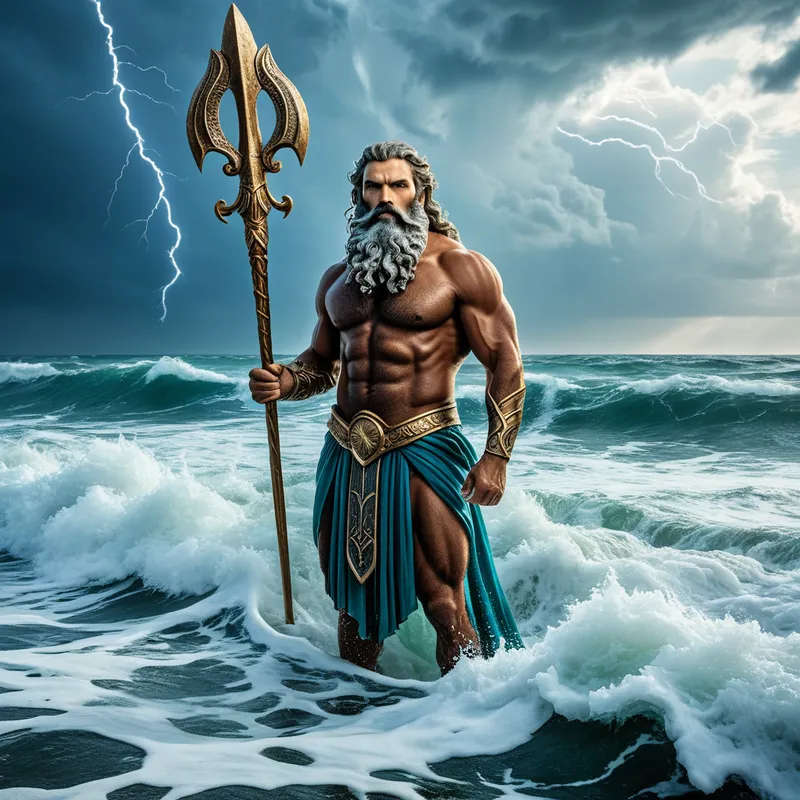
Hear now the tale of [the Earth](/myths/the-earth “Myth from Hindu culture.”/)-Shaker, the Lord of the Deep, he whose name is whispered by the tides. Before the age of men, when the cosmos was a raw and screaming [thing](/myths/thing “Myth from Norse culture.”/), the three sons of [Kronos](/myths/kronos “Myth from Greek culture.”/) drew lots for the dominion of [the world](/myths/the-world “Myth from Tarot culture.”/). The thunder and the bright air fell to Zeus. The sunless gloom beneath the roots of [the world](/myths/the-world “Myth from Tarot culture.”/) fell to [Hades](/myths/hades “Myth from Greek culture.”/). And the third brother, broad-shouldered and fierce-eyed, thrust his hand into the urn and drew forth [the sea](/myths/the-sea “Myth from Greek culture.”/).
This was his portion: the endless, salt-veined deep, the abyssal trenches where light fears to tread, and all the restless, foaming plains between. He named himself Poseidon. With a roar that shook the pillars of the deep, he claimed his throne in a palace of coral and [pearl](/myths/pearl “Myth from Chinese culture.”/), built in the sunless glimmer of Aegae. His chariot was harnessed not to horses of flesh, but to creatures born of his own stormy imagination: the hippocampi, with the foreparts of steeds and the coiling tails of serpents of the deep.
But the sea is never content. Its lord’s heart, too, was a roiling thing of pride and hunger. He looked upon the dry land, upon the cities of men springing up like mushrooms, and desired their worship, their foundations. He would stride from the surf, his trident in hand—a three-pronged spear forged by the Cyclopes in the volcanic dark. Where he struck the earth, salt springs would burst forth, or the very bones of the world would crack and groan. He contested with the grey-eyed Athena for the soul of a city yet unnamed. He struck [the Acropolis](/myths/the-acropolis “Myth from Greek culture.”/) rock, and a magnificent, salt-[water](/myths/water “Myth from Chinese culture.”/) spring erupted. Athena offered the olive tree, deep-rooted and life-giving. The city chose her gift, and in his wrath, Poseidon sent a flood to drown the plain. His love was as perilous as his hate; he pursued the [nymphs](/myths/nymphs “Myth from Greek culture.”/) and mortal women, and from these unions sprang heroes as wild and unpredictable as the sea itself—like [Theseus](/myths/theseus “Myth from Greek culture.”/), his son.
He was a god of profound contradictions: the creator of the first horse, a gift of nobility and speed, born from a stroke of his trident upon a cliffside; and the bringer of the tsunami, the earthquake that swallows palaces whole. Sailors prayed to him for fair passage, offering horses drowned in his surf, their voices trembling with both hope and terror. For they knew the truth: the same god who calmed the waves with a glance could, in a fit of pique, summon a storm to splinter their ships into driftwood. His was [the law](/myths/the-law “Myth from Biblical culture.”/) of the deep: vast, ancient, impersonal, and utterly sovereign.
Cultural Origins & Context
The myth of Poseidon is not a single story but a seismic pressure felt throughout the entire body of Greek culture. His worship was as old as the Mycenaeans, whose Linear B tablets name him Po-se-da-o, a powerful chthonic deity possibly linked to earthquakes and freshwater. For a civilization born on rocky peninsulas and scattered islands, the sea was not a metaphor; it was the source of life, the highway of commerce, and the ever-present face of death. To understand Poseidon is to understand the Greek relationship with this elemental force.
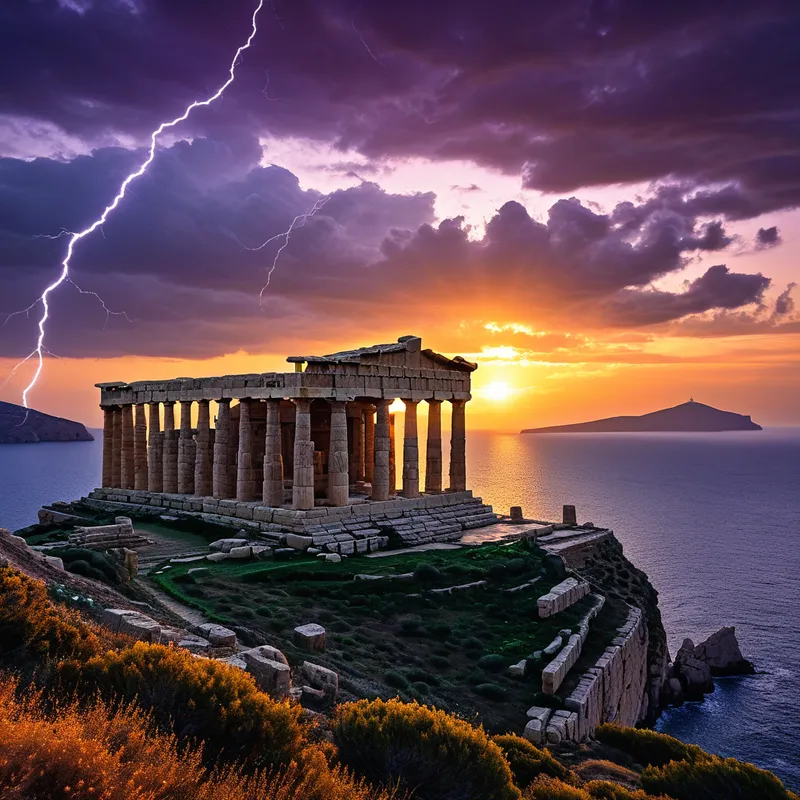
His myths were woven into the epic poetry of [Homer](/myths/homer “Myth from Greek culture.”/) and Hesiod, performed at festivals and in royal halls. But his cult was local and visceral. Coastal cities and island communities built his temples on perilous headlands, like the magnificent sanctuary at Sounion, where sailors would watch its columns fade from view and pray for his mercy. The great Panhellenic games at Olympia began with sacrifices to him. He was the “Savior of Ships” and the “Earth-Embracer,” a duality reflecting the Greek awareness that the ground beneath their feet and the sea at their doorstep were facets of the same unstable, divine power.
Symbolic Architecture
Poseidon symbolizes the foundational, emotional, and instinctual strata of the [psyche](/myths/psyche “Myth from Greek culture.”/). He is not the [lightning](/symbols/lightning “Symbol: Lightning symbolizes sudden insights or revelations, often accompanied by powerful emotions or disruptive change.”/)-flash of [insight](/symbols/insight “Symbol: A sudden, deep understanding of a complex situation or truth, often arriving unexpectedly and illuminating hidden connections.”/) (Zeus) nor the crafted [strategy](/symbols/strategy “Symbol: A plan of action designed to achieve a long-term or overall aim, often involving competition, resource management, and foresight.”/) of mind (Athena). He is the ground of being itself—often unstable, always potent.
The sea is the image of the collective unconscious, its depths holding both the treasures of life and the monsters of the repressed.
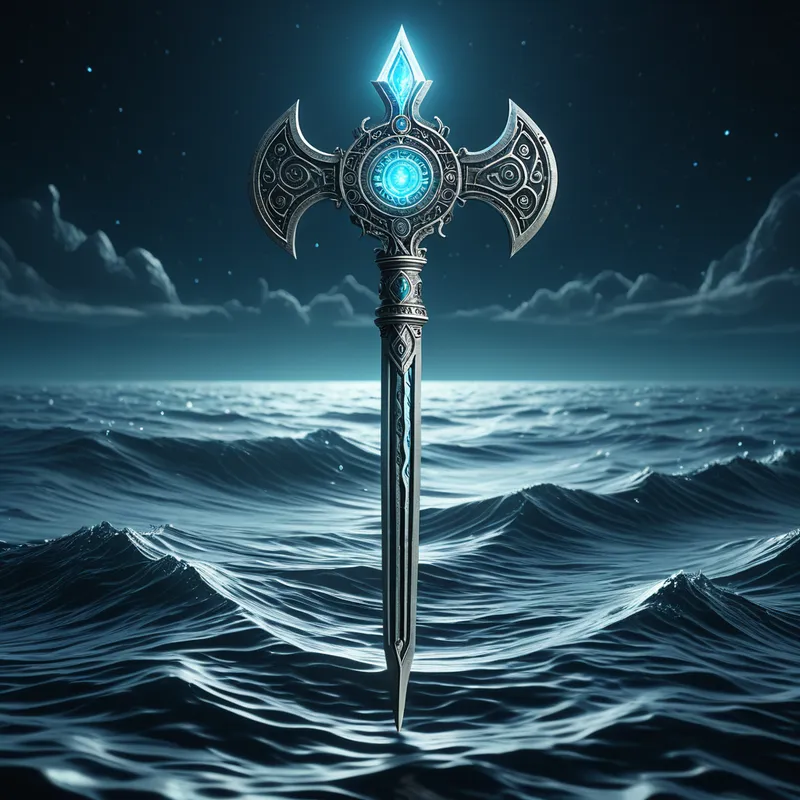
His domain is the unconscious emotional [body](/symbols/body “Symbol: The body in dreams often symbolizes the dreamer’s self-identity, personal health, and the relationship they have with their physical existence.”/). The [salt](/symbols/salt “Symbol: Salt represents purification, preservation, and the essence of life. It is often tied to the balance of emotions and spiritual cleansing.”/) of his springs represents the primal fluid of [life](/symbols/life “Symbol: The symbol of ‘Life’ represents a journey of growth, interconnectedness, and existential meaning, encompassing both the joys and challenges that define human experience.”/), tears, and the sea from which all biological life emerged. His earthquakes symbolize the psychic tremors that occur when deeply buried complexes—resentments, traumas, instinctual drives—shift and demand recognition. The trident is his master [symbol](/symbols/symbol “Symbol: A symbol can represent an idea, concept, or belief, serving as a powerful tool for communication and understanding.”/): a triple scepter representing his rule over sea, [earth](/symbols/earth “Symbol: The symbol of Earth often represents grounding, stability, and the physical realm, embodying a connection to nature and the innate support it provides.”/) (earthquakes), and freshwater (springs). Psychologically, it can be seen as an [instrument](/symbols/instrument “Symbol: An instrument symbolizes creativity, communication, and the means by which one expresses oneself or influences the world.”/) that divides and penetrates the unified surface of [consciousness](/symbols/consciousness “Symbol: Consciousness represents the state of awareness and perception, encompassing thoughts, feelings, and experiences.”/) to release the powerful, often chaotic, energies hidden beneath.
His constant rivalry with other gods, particularly Athena, embodies the eternal [tension](/symbols/tension “Symbol: A state of mental or emotional strain, often manifesting physically as tightness, pressure, or unease, signaling unresolved conflict or anticipation.”/) between raw, instinctual power (Poseidon) and civilized, intellectual order (Athena). His creation of the horse, an animal of sublime [beauty](/symbols/beauty “Symbol: This symbol embodies aesthetics, harmony, and the appreciation of life’s finer qualities.”/) and terrifying power, perfectly captures his essence: the harnessing of primal, chaotic [energy](/symbols/energy “Symbol: Energy symbolizes vitality, motivation, and the drive that fuels actions and ambitions.”/) into a form of majestic potency and [locomotion](/symbols/locomotion “Symbol: The act of moving from one place to another, symbolizing life’s journey, personal progress, or the drive to change one’s circumstances.”/). He is the archetypal Ruler of this deep, [interior](/symbols/interior “Symbol: The interior symbolizes one’s inner self, thoughts, and emotions, often reflecting personal growth, vulnerabilities, and secrets.”/) [kingdom](/symbols/kingdom “Symbol: A kingdom symbolizes authority, belonging, and a sense of identity within a larger context or community.”/), whose [authority](/symbols/authority “Symbol: A symbol representing power structures, rules, and control, often reflecting one’s relationship with societal or personal governance.”/) is absolute but whose moods are volatile.
The Dreamer’s Resonance
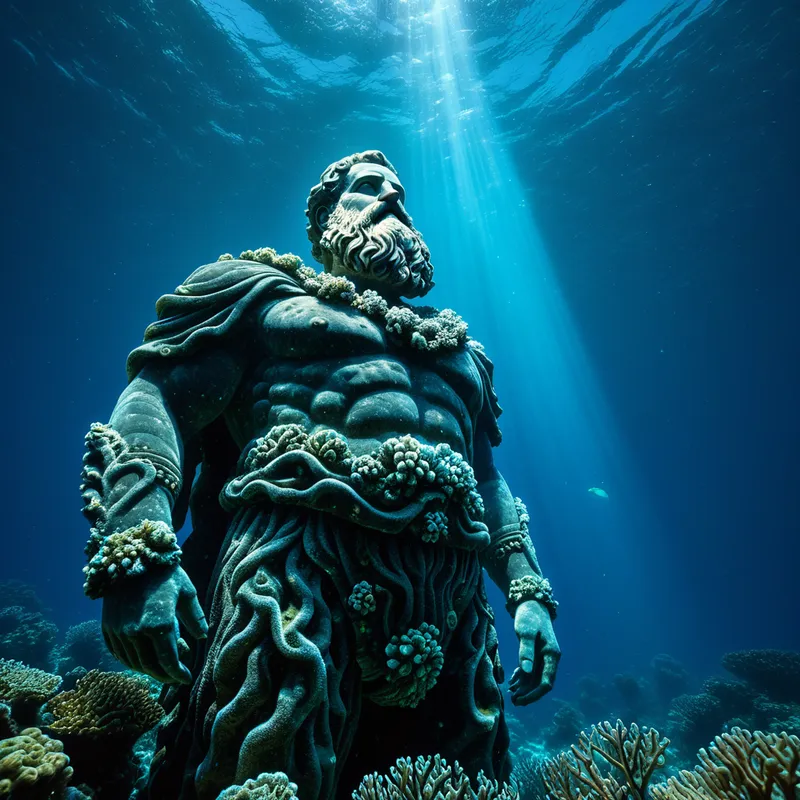
To dream of Poseidon’s realm is to dream of the psyche’s foundational waters. Common motifs include: being overwhelmed by a colossal wave; discovering a vast, hidden ocean within a familiar house; navigating a small boat on a suddenly stormy sea; or encountering immense, ancient sea creatures in the deep.
Such dreams often surface during periods of profound emotional upheaval, life transitions, or when long-suppressed feelings are beginning to erupt. The somatic experience can be one of pressure, churning in the gut, or a feeling of being emotionally “unmoored.” The dream is not merely depicting chaos; it is presenting the sovereignty of the emotional world. The dream-ego’s task is not to conquer this sea, but to learn its laws, to respect its power, and to navigate its currents. A dream of calming the waves may indicate a nascent integration of these forces, while a dream of being swallowed by [the abyss](/myths/the-abyss “Myth from Kabbalistic culture.”/) suggests a feeling of being possessed by them.
Alchemical Translation
The individuation process modeled by Poseidon is the transmutation of blind force into grounded sovereignty. It is the hero’s journey not outward, but downward, into the foundations of [the self](/myths/the-self “Myth from Jungian culture.”/).
The alchemical work is to take the trident in hand—to consciously engage the tools that can stir the depths—not to cause destruction, but to release the life-giving springs.
Initially, the Poseidon force in the psyche may manifest as ungovernable moods, seismic anger, or a tidal pull of depression—raw power without a throne. The first step is recognition: acknowledging this immense, non-rational power as a legitimate part of the self, not as a flaw to be eradicated. This is like building a temple on the headland, a conscious space from which to observe the sea.
The next phase is differentiation. The trident helps here. We learn to distinguish the different prongs of this power: the salt of grief (sea), the tremors of foundational change (earthquake), and the nourishing, creative wellsprings (freshwater). We see that [the force](/myths/the-force “Myth from Science Fiction culture.”/) that can shatter can also create the horse—a symbol of vital energy directed with grace and purpose.
Finally, the work is integration as sovereignty. One does not become Poseidon, but one learns to rule one’s own interior kingdom with his kind of authority—an authority that accepts the tempests as part of the realm. [The ego](/myths/the-ego “Myth from Jungian culture.”/) ceases to be a tiny boat at the mercy of the waves and becomes the steward of the shore, the navigator who knows the depths. The foundational instability becomes a source of strength, the emotional power becomes a well of creativity and resilience. The Earth-Shaker within is not silenced; he is given his proper domain, and in doing so, the entire psyche becomes more solid, more vast, and authentically powerful.
Associated Symbols
Explore related symbols from the CaleaDream lexicon:
- Earthquake
- Hurricane
- Daring Tarpon
- Riding Waves
- Tidal Wave
- El Niño
- Aquamarine Stone
- Tempest Seas
- Ocean Waves Crashing
- Turbulent Storm at Sea
- Surfing Waves
- Horse Racing Track
- Scuba Diving Equipment
- Fishing Pier
- Rolling Waves
- Churning Seas
- Choppy Waves
- Muddy Riverbanks
- Trident
- Fisherman’s Catch
- Tremors of Earthquake
- Amplitude
- Shake
- Saltiness
- Briny