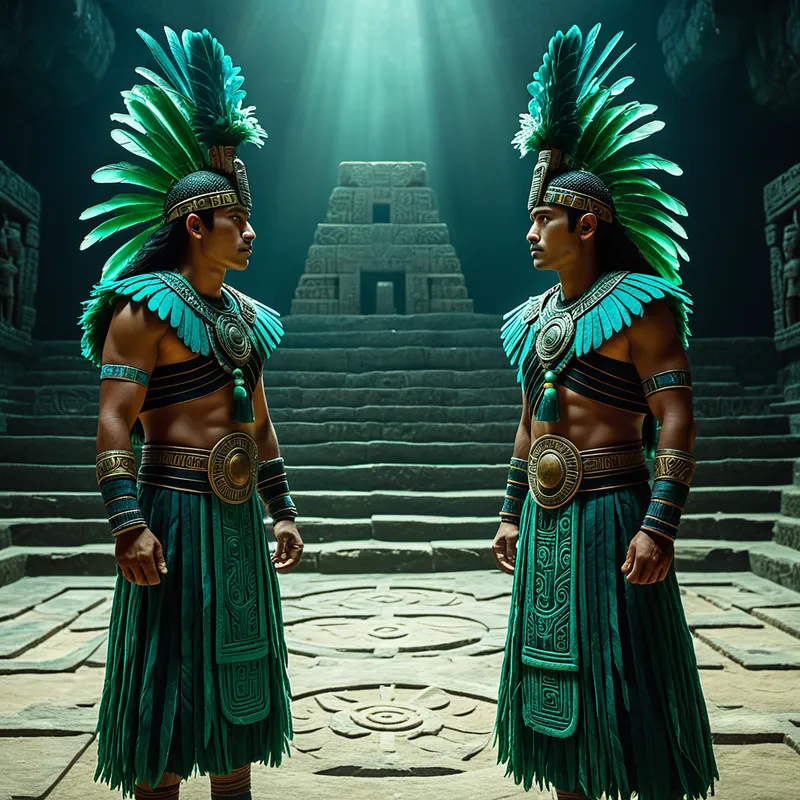
Popol Vuh Creation Myth Meaning & Symbolism
The sacred K'iche' Maya story of the gods' repeated attempts to create beings who could remember and honor them, culminating in the birth of humanity from maize.
The Tale of Popol Vuh Creation
In the beginning, there was only the silent sea of the sky and the calm sea of the earth. There was nothing that stood, nothing that stirred, nothing that made a sound. There was only the vast, pregnant stillness, and within it, the Heart of Sky—Hurakan, the one-legged lightning—and the Plumed Serpent.
They spoke together in the darkness. Their word brought forth the land from the waters. They commanded “Earth!” and the mountains rose. They commanded “Green!” and the forests clothed the world. But the world was empty. There were no voices to speak their names, no hands to lift in praise. So the makers began their great work.
First, they shaped the animals—the deer, the birds, the jaguars, the snakes. “Speak our names! Praise us!” they commanded. But the animals could only chatter, howl, and hiss. They could not remember. They were scattered to the forests and told to serve the ones who would come.
So the gods tried again. This time, they took mud and fashioned a being. It was soft, it melted, it could not stand. It had no mind, no soul. It dissolved back into the earth. A failure.
They consulted the ancient ones, the diviners. “Try wood,” was the counsel. And so they carved beings of wood. They walked, they talked, they multiplied. But they had no hearts, no memory. Their faces were dry and blank. They forgot the gods who made them. In their emptiness, they turned on each other, on the animals, on the world. The gods sent a great resinous rain to wash them away. The survivors became the monkeys who chatter in the trees, a reminder of the hollow creation.
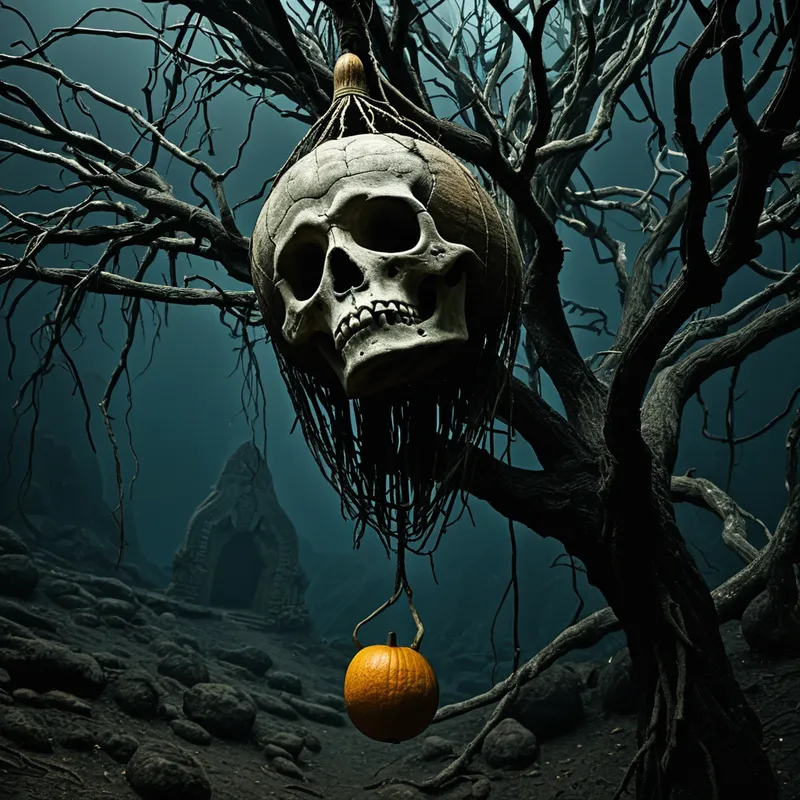
Then came the whisper of destiny. In the days before the wooden people, two brothers, One Hunahpu and Seven Hunahpu, were great ballplayers. Their pounding game angered the lords of Xibalba, the Place of Fright. The lords summoned them to the underworld for a ballgame, but it was a trick. The brothers failed the dark tests of the Xibalbans and were sacrificed. The head of One Hunahpu was placed in a barren tree, which then miraculously bore fruit.
A daughter of a Xibalban lord, drawn by the strange tree, was spoken to by the skull. It spat in her hand, and she conceived. She fled to the surface world and gave birth to the new Hero Twins: Hunahpu and Xbalanque.
These twins were clever and powerful. They avenged their father and uncle by descending into Xibalba themselves. They did not fear the tests. When challenged to a night in the House of Gloom, they lit a torch disguised as a cigar. When thrown into the House of Cold, they huddled together for warmth. When forced into the House of Jaguars, they threw bones to the beasts. And in the deadly House of Bats, Hunahpu lost his head. But through cunning and magic, Xbalanque restored him.
Their final triumph was the ballgame. They allowed themselves to be defeated, sacrificed, and ground into bone dust, only to be reborn as miraculous dancers who could kill and restore life. In their final performance for the Xibalban lords, they sacrificed a dog and brought it back, then sacrificed each other and returned. Blinded by desire for this power, the lords demanded, “Do it to us!” The twins obliged, but left the lords of death dead, their power broken.
With the underworld subdued, the twins ascended to become the sun and the moon, bringing order to the sky.
Now the gods could try once more. They sent the animals to a distant mountain to find the substance of creation. The fox, coyote, parrot, and crow failed. But the yellow and white animals burrowed and found perfect, ripe maize. The gods took this yellow and white corn, ground it into meal, and from this sacred dough, mixed with water, they fashioned the first true people. These beings had sight, they had understanding, they had memory. They could speak and give thanks. “You are our sustenance, our providers,” they said to the gods. And the gods, at last, were satisfied.
Cultural Origins & Context
The Popol Vuh is not merely a story; it is the “Book of the Community,” the sacred narrative of the K’iche’ Maya people of the Guatemalan highlands. Its survival is a testament to cultural resilience. After the Spanish conquest, a K’iche’ nobleman, likely in the mid-16th century, transcribed the oral history into Latin script, preserving the cosmology, genealogy, and history of his people. This manuscript was later translated by Friar Francisco Ximénez in the early 18th century.
It functioned as a foundational charter, explaining the origin of the world, the gods, and the K’iche’ people themselves, legitimizing their social order and royal lineages. It was a guide to living in a cosmos where the divine, the natural, and the human were intimately intertwined. The myth was not just told; it was performed, its patterns echoed in rituals, ballgames, and the very agricultural cycle of planting (descent) and harvest (ascent).
Symbolic Architecture
The myth’s power lies in its layered [symbolism](/symbols/symbolism “Symbol: The use of symbols to represent ideas or qualities, often conveying deeper meanings beyond literal interpretation. In dreams, it’s the language of the unconscious.”/). It is not a [linear](/symbols/linear “Symbol: Represents order, predictability, and a direct, step-by-step progression. It symbolizes a clear path from cause to effect.”/) triumph but a cyclical process of failure, sacrifice, and refinement.
Creation is not a singular act of will, but a patient dialogue with failure. Each flawed being—mud, wood, monkey—is a necessary draft in the composition of a soul that can remember.
The initial failures represent the raw materials of [consciousness](/symbols/consciousness “Symbol: Consciousness represents the state of awareness and perception, encompassing thoughts, feelings, and experiences.”/): [earth](/symbols/earth “Symbol: The symbol of Earth often represents grounding, stability, and the physical realm, embodying a connection to nature and the innate support it provides.”/) (the physical [body](/symbols/body “Symbol: The body in dreams often symbolizes the dreamer’s self-identity, personal health, and the relationship they have with their physical existence.”/)), [wood](/symbols/wood “Symbol: Wood symbolizes strength, growth, and the connection to nature and the environment.”/) (instinctual [life](/symbols/life “Symbol: The symbol of ‘Life’ represents a journey of growth, interconnectedness, and existential meaning, encompassing both the joys and challenges that define human experience.”/) without [spirit](/symbols/spirit “Symbol: Spirit symbolizes the essence of life, vitality, and the spiritual journey of the individual.”/)). True humanity emerges only from sacred sustenance—maize—symbolizing that we are literally and spiritually fashioned from what we consume, both physically and culturally. The ballgame is the central [metaphor](/symbols/metaphor “Symbol: A figure of speech where one thing represents another, often revealing hidden connections and deeper truths through symbolic comparison.”/) for the cosmic struggle between order and [chaos](/symbols/chaos “Symbol: In Arts & Music, chaos represents raw creative potential, uncontrolled expression, and the breakdown of order to forge new artistic forms.”/), [life](/symbols/life “Symbol: The symbol of ‘Life’ represents a journey of growth, interconnectedness, and existential meaning, encompassing both the joys and challenges that define human experience.”/) and [death](/symbols/death “Symbol: Symbolizes transformation, endings, and new beginnings; often associated with fear of the unknown.”/), the surface and the [underworld](/symbols/underworld “Symbol: A symbolic journey into the unconscious, representing exploration of hidden aspects of self, transformation, or confronting repressed material.”/).
The [journey](/symbols/journey “Symbol: A journey in dreams typically signifies adventure, growth, or a significant life transition.”/) of the [Hero](/symbols/hero “Symbol: A hero embodies strength, courage, and the ability to overcome significant challenges.”/) Twins into Xibalba is the archetypal descent. They do not conquer through brute force but through intelligence, trickery, and the ultimate [alchemy](/symbols/alchemy “Symbol: A transformative process of purification and creation, often symbolizing personal or spiritual evolution through difficult stages.”/): the willingness to undergo sacrifice and [disintegration](/symbols/disintegration “Symbol: A symbol of breakdown, loss of form, or fragmentation, often reflecting anxiety about personal identity, control, or stability.”/) to achieve a higher, transformative state. Their victory establishes the [pattern](/symbols/pattern “Symbol: A ‘Pattern’ in dreams often signifies the underlying structure of experiences and thoughts, representing both order and the repetitiveness of life’s situations.”/): life emerges from death, order from chaos, [dawn](/symbols/dawn “Symbol: The first light of day, symbolizing new beginnings, hope, and the transition from darkness to illumination.”/) from the darkest [night](/symbols/night “Symbol: Night often symbolizes the unconscious, mystery, and the unknown, representing the realm of dreams and intuition.”/).
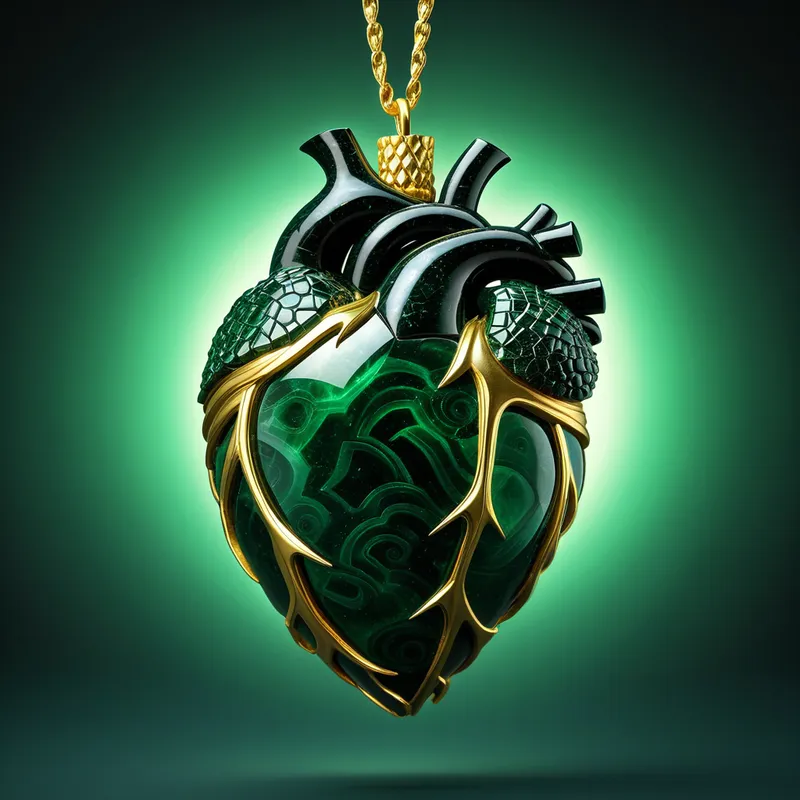
The Dreamer’s Resonance
When this myth stirs in the modern psyche, it often manifests in dreams of repeated, frustrating attempts at a task—building a structure that collapses, writing words that fade, trying to speak but having no voice. This is the somatic echo of the mud and wood people, the feeling of being an inadequate vessel.
Dreams of being tested in a labyrinthine, institutional building (the Houses of Xibalba) point to an encounter with the personal or collective underworld: depression, systemic oppression, or a profound crisis of meaning. The dream-ego, like the twins, must navigate these tests not with heroic aggression, but with cleverness, patience, and the aid of allies (the animal helpers).
A dream of being ground to dust or dismembered, followed by a feeling of reconstitution, signals a profound psychic death-and-rebirth process. The dreamer is in the alchemical nigredo, the blackening, being reduced to essential matter—the bone dust—from which a new, more authentic self can be formed.
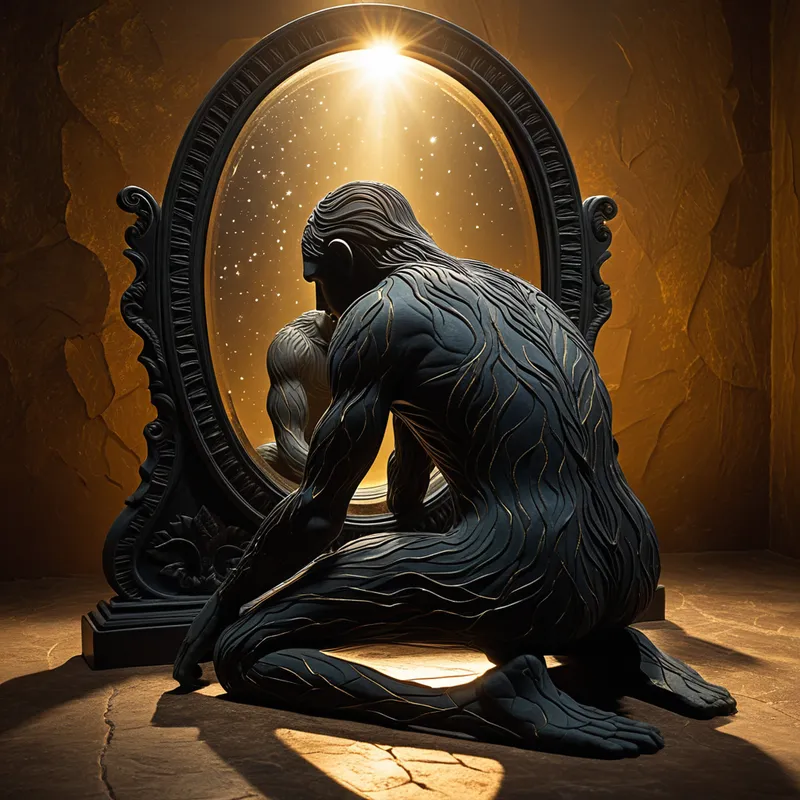
Alchemical Translation
The Popol Vuh is a master blueprint for the individuation process. It models the painful but necessary iterations of the self.
The first creations—mud and wood—represent the early, unconscious identifications of the ego: the fragile persona (mud) and the hollow, adapted self that goes through motions without heart (wood). Their dissolution is a brutal but essential crisis, the collapse of inauthentic life structures.
The underworld is not a place of punishment, but the crucible of consciousness. We do not find our true face in the light of day, but by confronting what hangs in the dark tree of the forgotten self.
The descent of the Hero Twins is the ego’s journey into the unconscious (Xibalba) to confront the “lords of death”—our complexes, traumas, and shadow aspects that trick and sabotage us. Victory requires integrating the Trickster energy, using the cunning of the unconscious against itself.
The final creation from maize is the achievement of the Self. The ego, having undergone the trials, is no longer fashioned from base earth or dead wood, but from the sacred, cultivated substance of life—the integrated wisdom and nourishment harvested from the entire psychic journey. We become beings who can truly “see” and “give thanks,” acknowledging the divine within the cyclical process of our own becoming.
Associated Symbols
Explore related symbols from the CaleaDream lexicon:
- Maize — The sacred substance of the final, true humanity, representing that we are formed from what sustains us, both physically and spiritually, and that true being requires cultivation.
- Ballgame — The ritual contest between life and death, order and chaos, symbolizing the cosmic struggle and the player’s role in maintaining balance through skill and sacrifice.
- Underworld — The realm of Xibalba, representing the unconscious, the place of fear, testing, and necessary descent where the old self is dismantled so the new can be born.
- Sacrifice — The central transformative act; not merely loss, but the essential offering that enables rebirth, as seen in the deaths of the twins and the lords of Xibalba.
- Trickster — Embodied by the Hero Twins’ cunning strategies in Xibalba, representing the intelligence needed to navigate the unconscious and transform rigid patterns through cleverness.
- Tree — The barren calabash tree that holds the severed head of One Hunahpu and bears fruit, symbolizing life emerging from death, and the potential for wisdom in unexpected places.
- Blood — The life-force offered in sacrifice, connecting the generations (from the father’s sacrifice to the sons’ vengeance) and serving as a potent offering to the gods and the earth.
- Mirror — Implicit in the gods’ desire for beings who could “see” and reflect their glory, representing self-awareness, memory, and the capacity for true recognition.
- Dawn — The triumph of the twins who become the sun and moon, representing order established over chaos, consciousness emerging from the darkness of the unconscious.
- Hero — The dual archetype of the Hero Twins, who undertake the perilous journey, face death, and transform it for the benefit of the whole world.
- Seed — The maize kernel and the divine spit that impregnates the maiden, representing latent potential, the origin point of life, and the promise within dissolution.
- Rebirth — The core cycle of the myth, from the failed creations to the twins’ resurrection and the final emergence of humanity, symbolizing the psyche’s endless capacity for renewal.