
Poludnitsa Myth Meaning & Symbolism
A tale of the Noon Witch, a field spirit who tests those who work at midday, teaching respect for liminal times and the hidden forces of nature.
The Tale of Poludnitsa
Hear now the tale whispered by the wind through the bending rye, a story not of night, but of the day’s most potent hour. When the [Perun](/myths/perun “Myth from Slavic culture.”/)’s sun climbs to its zenith and hangs, a molten coin in a bleached-blue sky, the world holds its breath. This is the hour of stillness, of dangerous beauty. This is the hour of Poludnitsa.
In a sea of gold, where the rye whispers secrets to the earth, a man toils. His name is lost, for he is every man who has ever pushed against the sun. The air shimmers, thick as honey, and the cicadas’ song is a single, piercing note that drills into the skull. He feels the weight of the light, a physical pressure on his neck and shoulders. His scythe moves, a slow silver arc, but his thoughts are slow, thick with the heat. A foolish thought takes root: Just a little more. I can defy the stillness.
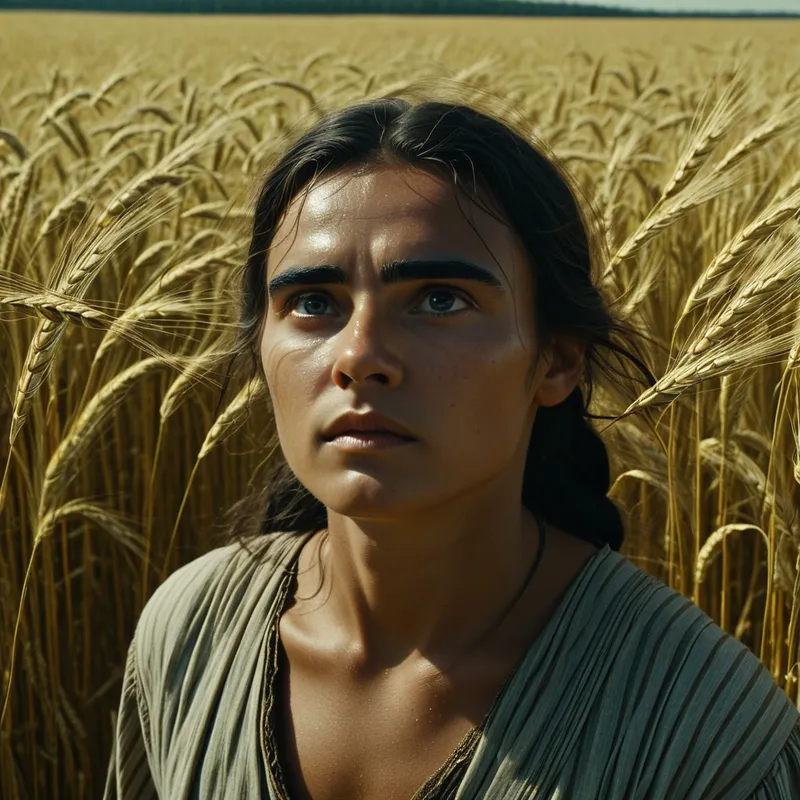
Then, the quality of the light changes. It thickens, coalesces. From the heart of the heat-haze, she steps forth. Poludnitsa. She is tall, impossibly so, and clad in white that glows with its own captured sunlight. Her hair is the colour of ripe wheat, or perhaps of bone, flowing like a pale river down her back. In her hand, she carries a scythe—not a tool, but an extension of her will, its edge sharper than any frost. Her face is beautiful, but it is a beauty without mercy, like the heart of a flame.
She does not speak. She simply appears before him, blocking the sun, casting a cold shadow in the blistering heat. Her eyes, the colour of a midsummer sky, hold no warmth, only a vast, inquiring emptiness. She circles him, a silent predator. She asks him a riddle, her voice the sound of dry stalks rubbing together. Or perhaps she asks him about his work—why he does not rest? Why he insults the sacred hour with his striving?
Fear, colder than the winter river, washes over him. His tongue sticks to the roof of his mouth. If he answers with pride, with defiance, if he shows no respect, her smile will be the last thing he sees. Her scythe will flash, not to cut rye, but to bring a sleep from which there is no waking, or to bring a madness that makes the sane world fade. But if he shows humility? If he acknowledges her power, the sacredness of the boundary he has crossed?
He drops his own scythe. The clatter is loud in the silent field. He bows his head, not in defeat, but in recognition. “Lady of the Midday,” he whispers, his voice cracking. “I have erred. I seek the shade.”
For a long moment, she is still. Then, as silently as she came, she begins to fade. The oppressive weight lifts. The world’s sounds return—a distant bird, the rustle of the rye. The man stumbles to the edge of the field, to the cool darkness beneath the trees, and does not look back. He has met the keeper of the threshold and lived by remembering his place.
Cultural Origins & Context
The myth of Poludnitsa is not a story of grand cosmology, but a Beregina tale born from the intimate, daily relationship between the Slavic peasant and the land. She is a Demon of place, specifically of the cultivated field at its most potent and vulnerable moment. This lore was passed down not in royal courts but in peasant huts and during communal work, a practical, oral tradition meant to govern behaviour.
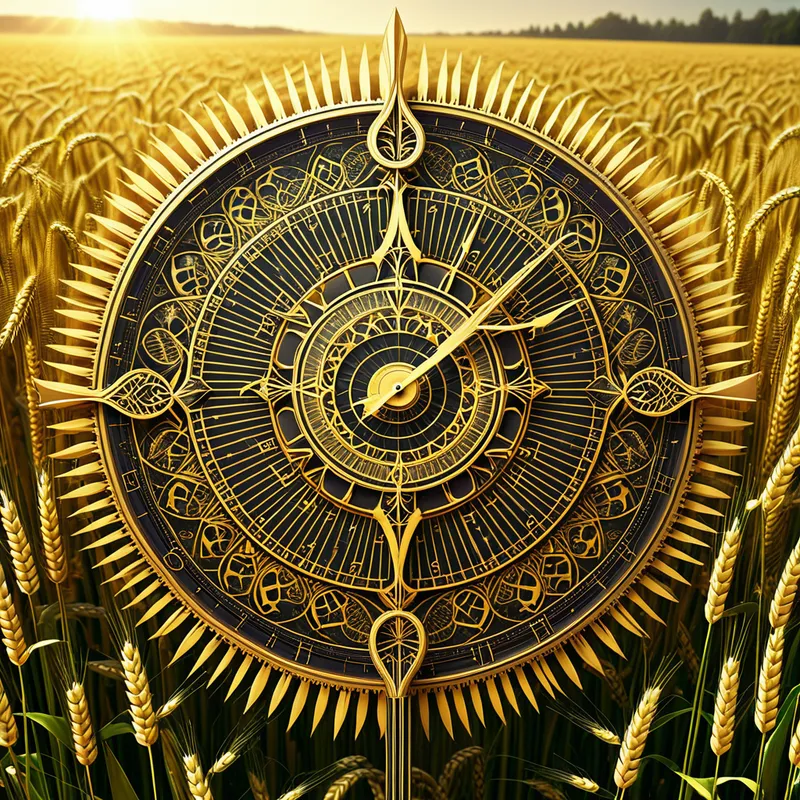
Her primary function was pedagogical and protective. She enforced the sacred rhythm of agricultural life. Noon was a liminal time, a dangerous pivot between the morning’s labour and the afternoon’s toil. It was a time for rest, for retreating from the sun’s full force. Poludnitsa policed this boundary. Her appearance was a natural explanation for sunstroke, heat exhaustion, or the sudden, disorienting madness that could strike in the open field. By giving this danger a form and a rule—rest at noon, or face her—the myth provided a structure that protected the community’s health and reinforced respect for the natural order. She was a necessary shadow, a personification of the land’s own demanding consciousness.
Symbolic Architecture
Poludnitsa is the archetypal [guardian](/symbols/guardian “Symbol: A protector figure representing safety, authority, and guidance, often embodying parental, societal, or spiritual oversight.”/) of a liminal zone. She does not inhabit the [night](/symbols/night “Symbol: Night often symbolizes the unconscious, mystery, and the unknown, representing the realm of dreams and intuition.”/), the domain of absolute [shadow](/symbols/shadow “Symbol: The ‘shadow’ embodies the unconscious, repressed aspects of the self and often represents fears or hidden emotions.”/), nor the cool rationality of morning. She is the [spirit](/symbols/spirit “Symbol: Spirit symbolizes the essence of life, vitality, and the spiritual journey of the individual.”/) of the peak, the [moment](/symbols/moment “Symbol: The symbol of a ‘moment’ embodies the significance of transient experiences that encapsulate emotional depth or pivotal transformations in life.”/) of maximum intensity and exposure. Psychologically, she represents the point where any sustained [effort](/symbols/effort “Symbol: Effort signifies the physical, mental, and emotional energy invested toward achieving goals and personal growth.”/), any focused [consciousness](/symbols/consciousness “Symbol: Consciousness represents the state of awareness and perception, encompassing thoughts, feelings, and experiences.”/), risks tipping into mania, burnout, or [inflation](/symbols/inflation “Symbol: A dream symbol representing feelings of diminishing value, loss of control, or expansion beyond sustainable limits in one’s life or psyche.”/).
She is the embodiment of the law of necessary retreat, the truth that every peak contains the seed of its own descent.
Her white dress symbolizes not purity, but the blinding, all-consuming [nature](/symbols/nature “Symbol: Nature symbolizes growth, connectivity, and the primal forces of existence.”/) of unmoderated consciousness—the light that, when stared into directly, obliterates all shadow and thus all [depth](/symbols/depth “Symbol: Represents profound layers of consciousness, hidden truths, or the unknown aspects of existence, often symbolizing introspection and existential exploration.”/). Her [scythe](/symbols/scythe “Symbol: The scythe symbolizes the dual nature of life and death, often representing transition, the harvest of one’s experiences, and the inevitability of endings.”/) is dual: it is the tool of the harvest (the [culmination](/symbols/culmination “Symbol: A point of completion or climax in a process, often marking the end of a cycle and the achievement of a goal.”/) of work) turned into a [weapon](/symbols/weapon “Symbol: A weapon in dreams often symbolizes power, aggression, and the need for protection or defense.”/) against the [worker](/symbols/worker “Symbol: The symbol ‘Worker’ represents effort, productivity, and the role of individuals within a broader societal framework.”/) who cannot stop. She is the [boundary](/symbols/boundary “Symbol: A conceptual or physical limit defining separation, protection, or identity between entities, spaces, or states of being.”/) made sentient. To encounter her is to encounter the Self’s [enforcement](/symbols/enforcement “Symbol: The imposition of rules, laws, or authority, often representing external control, societal order, or internalized discipline.”/) of its own limits. The confrontation is not about good versus evil, but about balance versus hubris, about the ego’s need to acknowledge a power greater than its own will.
The Dreamer’s Resonance
When Poludnitsa glides into modern dreams, she rarely appears in a rye field. Her landscape has transmuted. She is the feeling of oppressive, buzzing anxiety in a silent, sunlit office at the peak of a deadline. She is the figure who appears when you are pushing relentlessly on a project, a relationship, or a self-improvement goal, refusing all pauses. She is the chilling presence in a dream of being trapped in a mall, a gym, or any space of endless, glaring consumption at the height of the day.
Somatically, the dream may be accompanied by sensations of overheating, paralysis, or a frantic heart rate against a backdrop of eerie stillness. Psychologically, this is the psyche’s alarm system. The dreamer is at their own “noon”—a point of maximum output or stress—and the unconscious is personifying the impending crash. Poludnitsa in a dream is a direct manifestation of the shadow of one’s own ambition or diligence. She asks the dreamer the same riddle: Why do you not rest? What sacred law of your own being are you violating with this endless striving?

Alchemical Translation
The alchemical journey modeled by the Poludnitsa myth is not the grand individuation of slaying dragons, but the crucial, recurring stage of nigredo within the light. It is the recognition that the path to the Self requires not only battling darkness but also surrendering to the blinding light of one’s own potential at its most intense. The ego, identified with its labour and its progress, is the peasant in the field.
The transmutation occurs not in the fighting, but in the bowing. The act of laying down the scythe—the tool of conscious will—is the sacrificium intellectus, the sacrifice of the intellect’s pride.
By acknowledging Poludnitsa, the ego acknowledges a natural law superior to its own agenda: the law of rhythm, of yin and yang, of effort and rest. This submission is not a defeat but an integration. The “shade” the hero seeks is not just physical shadow, but the neglected, cooling, feminine aspects of the psyche—introversion, receptivity, patience. In surviving the encounter through humility, the conscious mind is forcibly aligned with a deeper, more organic timing. The psyche’s Self uses this terrifying noon-daimon to prune inflationary growth, ensuring the harvest of consciousness is sustainable and rooted, not burned away by its own sun.
Associated Symbols
Explore related symbols from the CaleaDream lexicon:
- Sun — The source of life and growth, but in its zenith state, it becomes the oppressive, glaring force that summons Poludnitsa, representing consciousness at its most intense and dangerous.
- Shadow — Poludnitsa is the shadow cast by the sun itself, the dark aspect of clarity and effort, manifesting to enforce the balance the conscious mind ignores.
- Scythe — The dual symbol of harvest and severance; it is the tool of cultivation turned into the weapon of enforcement, cutting down what overreaches.
- Field — The cultivated space of conscious effort and work, the ego’s domain which becomes the stage for the encounter with the transpersonal boundary-keeper.
- Time — The myth is fundamentally about chronos, the measured time of work, violated by ignoring its sacred pivot point at noon.
- Boundary — Poludnitsa is the living embodiment of a liminal boundary, the strict line between appropriate effort and hubristic overextension.
- Rage — The silent, cold fury of Poludnitsa is the psyche’s rage against the ego’s self-exploitation, a destructive force meant to preserve the whole.
- Rest — The implied, sacred counter-force to the sun’s work; the blessing granted to those who heed the warning and retreat from the peak.
- Heat — The somatic and atmospheric symbol of pressure, intensity, and the slow cooking of the psyche that precedes a crisis or breakthrough.
- Silence — The oppressive, buzzing silence of the midday field is the sound of the unconscious preparing to speak through a terrifying form.