Pitys Myth Meaning & Symbolism
A nymph pursued by Pan transforms into a pine tree, her story a timeless allegory of desire, violation, and the soul's rooted resilience.
The Tale of Pitys
Hear now the rustling tale of Pitys, a whisper carried not on the wind, but as the wind. In the wild, untamed places where the mountain’s breath grows cold and the scent of earth is sharp, there lived a nymph of the high places. Pitys was of the nymphai, her laughter the sound of water over stone, her form as supple as a young sapling bending in the breeze. She belonged to the lonely cliffs and the sun-dappled clearings where few mortals dared to tread.
Her beauty was a quiet, steadfast thing, noticed by the wildest heart of all: Pan. From his caverns, he watched her, and in him, a rough desire stirred—not the polished longing of Apollo, but a raw, consuming hunger that matched the bellow of the storm. He pursued her. His pursuit was not a courtship but a claiming, the thunder of goat-hooves on rock, the invasive skirl of his pipes shattering the mountain’s silence. Pitys fled. Her feet, once so sure on the steep paths, now scrambled in terror. The air, once her companion, grew thick with the heat of his breath.
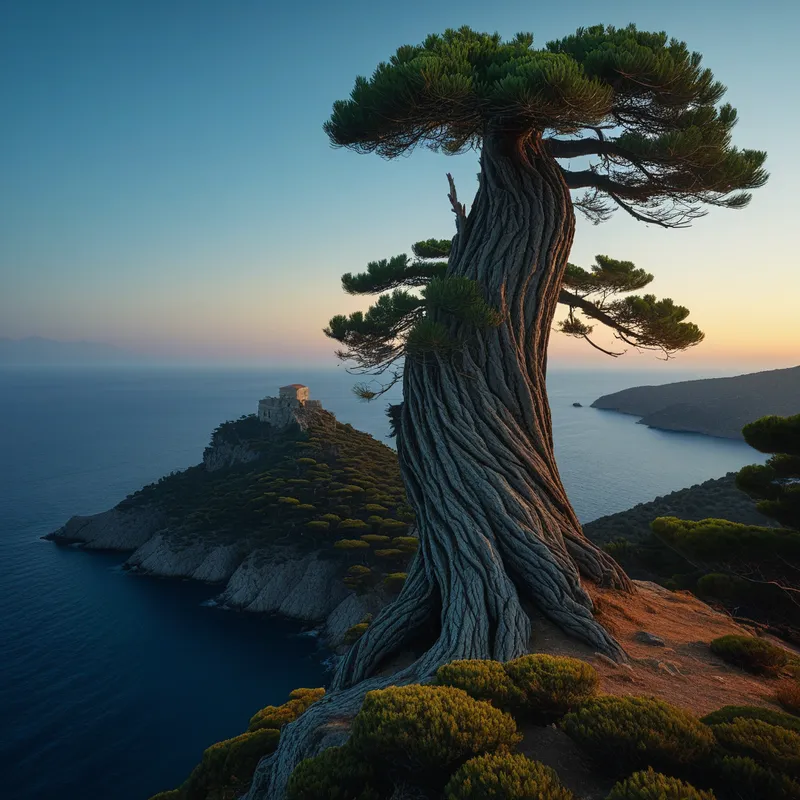
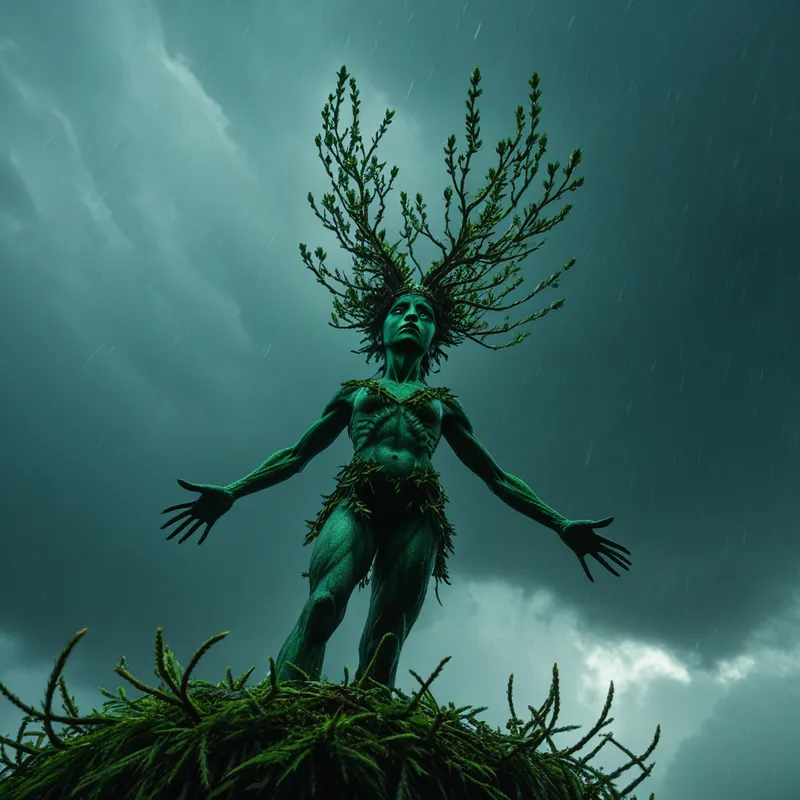
She ran until the world fell away, until she stood at the very lip of a precipice, the sea churning far below. Before her was the abyss. Behind her, the crashing presence of the god. There was no choice, only a final, desperate prayer to the earth that bore her. As Pan’s shadow fell upon her, her arms, outstretched in fear or perhaps in a last embrace of her freedom, stiffened. Her skin roughened and cracked into bark. Her flowing hair stiffened into clusters of dark, evergreen needles. Her feet drove deep, deep into the cliffside, anchoring her in an instant. Where the nymph had stood, a pine tree now grew, slender and resilient, its branches sighing a new, eternal song.
And it is said that Pan, in his grief or perhaps his twisted homage, took the pine for his sacred tree. He would wear a wreath of its needles, and the wind through its boughs became the companion to his lonely music—a perpetual reminder of the one who escaped him by becoming something else entirely.
Cultural Origins & Context
The story of Pitys is a fragment, a piece of the vast mosaic of Greek local and mythic lore. It survives not in grand epics but in the allusive verses of poets like Nonnus and the scholarly compilations of later mythographers. This places it within the rich tradition of metamorphosis myths, where the boundaries between human, divine, and natural worlds are fluid and permeable.
Such tales were the connective tissue between the people and their landscape. A traveler seeing a pine tree clinging tenaciously to a windswept cliff did not just see a tree; they saw Pitys. The myth animated the natural world, giving it a biography and a sacred history. It explained a feature of the landscape (why pines grow in such places) and a cultural practice (why Pan is associated with the pine). Functionally, it served as a aition, a foundational story for a specific element of the natural and religious order. It was likely told in pastoral settings, a cautionary and awe-inspiring tale about the power of the wild (Pan) and the ultimate, transformative sanctuary found in nature itself.
Symbolic Architecture
At its core, the myth of Pitys is a profound drama of autonomy versus possession. Pitys represents the soul’s pure, autonomous existence, its right simply to be in its chosen solitude. Pan embodies the undifferentiated, compulsive force of instinctual desire—not love, but a will to consume and possess that recognizes no other.
The transformation into the tree is not a defeat, but a radical act of self-preservation. It is the soul choosing a different form of existence rather than surrendering its essence.
The pine tree is the perfect symbol for this resolution. Evergreen, it represents endurance, resilience, and life that persists through the harsh seasons (Pan’s relentless pursuit). Its resin is fragrant and protective; its roots clutch the rock with fierce determination. Pitys does not die; she grounds herself. She exchanges a vulnerable, mobile form for one of immense, rooted strength. Her sigh in the wind is the voice of this resilience—a lament that has become a song of survival. Psychologically, she represents the ego’s retreat into a deeper, more authentic layer of the Self when faced with overwhelming psychic pressure.
The Dreamer's Resonance
When this myth stirs in the modern dreamer’s psyche, it often manifests as dreams of being chased or cornered, where escape seems impossible. The pursuer may be a vague, menacing presence, a specific person, or even a wave of one’s own overwhelming emotion or obligation. The critical moment in the dream—the Pitys moment—is not the capture, but the sudden, instinctual shift.
The dreamer might find themselves merging with a wall, sinking into the earth, or feeling their body become heavy, solid, and immovable. They may dream of becoming a tree, a stone, or a mountain. Somaticly, this can correlate with a felt sense of "rooting down" or "becoming solid" upon waking—a deep, often unconscious process of establishing boundaries. Psychologically, this dream pattern signals a psyche under siege, choosing introversion and containment over engagement. It is the Self initiating a protective metamorphosis, forcing a confrontation with the question: "What must I become, what form must I take, to preserve my core when flight is no longer an option?"
Alchemical Translation
The alchemical journey mirrored in Pitys’s story is that of transmutation through fixation. In the alchemical opus, the initial, volatile matter must be "fixed" or made stable to endure the coming trials. Pitys’s flight is the nigredo, the chaotic, darkening crisis. The cliff’s edge is the moment of maximum despair and tension, where all previous forms of being are annihilated.
Her prayer to Gaia (Earth) is the invocation of the vas, the sacred vessel. Her transformation is the albedo—not into white, but into enduring green—the fixation of her spirit into a new, incorruptible form. She becomes her own container.
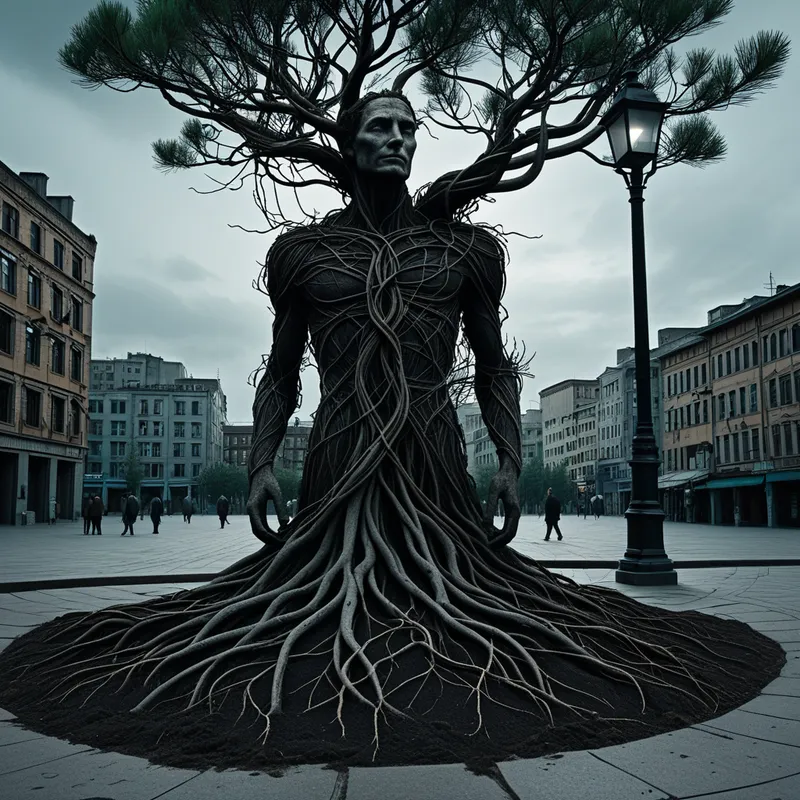
For the modern individual, the myth models the individuation process of turning a psychic invasion (a demand, a trauma, a consuming complex) into the very substance of one’s character.
The process is not about defeating Pan, but about using the energy of his pursuit to catalyze an unimaginable change. The individual learns that when the world (or the inner tyrant) demands a possession they cannot grant, the soul has the archetypal recourse to deepen, to root, to transform vulnerability into unshakable presence. The goal is not to escape life on the cliff, but to discover how to live there, authentically and resiliently, in a new and eternal shape. The sigh in the branches is the sound of the integrated Self, a consciousness that has made its peace with the very winds that once sought to destroy it.
Associated Symbols
Explore related symbols from the CaleaDream lexicon: