Pillars of Hercules Myth Meaning & Symbolism
Hercules, to atone for a crime, performs a labor that creates the ultimate boundary between the known world and the terrifying unknown.
The Tale of Pillars of Hercules
Hear now, a story not of a single deed, but of a scar upon [the world](/myths/the-world “Myth from Tarot culture.”/). It begins not with glory, but with a madness sent by the gods—a crimson fog that descended upon the mind of [Hercules](/myths/hercules “Myth from Greek culture.”/), son of Zeus. In that divine fury, he saw not his beloved wife and children, but phantoms of his enemies. When the fog lifted, the horror of his own hands remained.
To purify this stain of kin-blood, the oracle spoke: he must bind himself to Eurystheus, a lesser man, and perform ten labors. But two would be denied, forging the final count to twelve—a number for the ages. The tenth labor was a theft from the edge of creation: to fetch the cattle of Geryon, a monster who dwelled in the far west, where the sun plunged into the ocean of night.
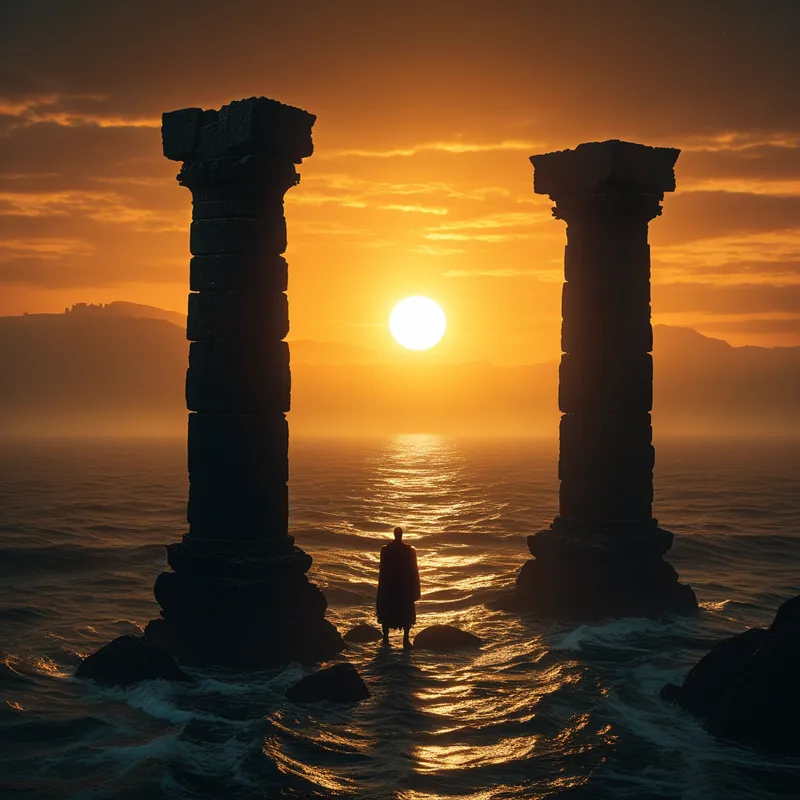
Hercules journeyed to the end of the known earth. The air grew thick with the salt of endless sea, and the light took on a weary, golden hue. Before him lay the narrow passage that was the final gate of the Mediterranean world. To the north stood the mountain of Calpe; to the south, the mountain of Abila. They were not pillars then, but a single, unbroken wall of stone—a natural bulwark holding back the terrifying, formless expanse of the [Oceanus](/myths/oceanus “Myth from Greek culture.”/).
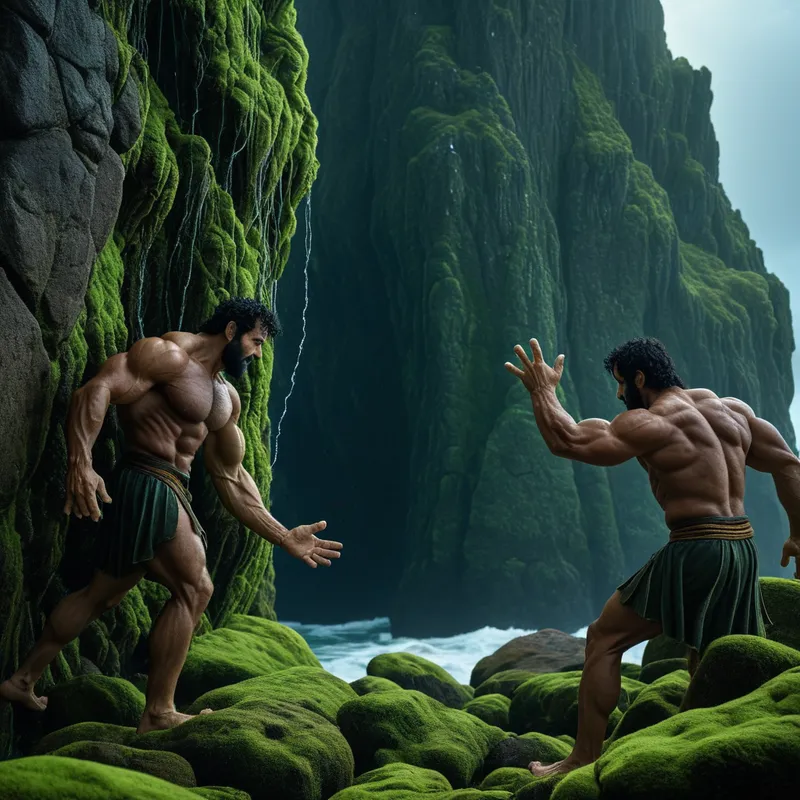
The hero could not sail around. The wall was complete. So, calling upon the strength born of his divine father and his mortal agony, he set his shoulders against the rock. [The earth](/myths/the-earth “Myth from Hindu culture.”/) trembled. Stone groaned like a living beast. With a roar that echoed the fury of his past and the desperation of his atonement, he pushed. The continent itself resisted, then yielded with a cataclysmic sigh. The wall split, and the waters of the inner sea rushed out to meet the outer abyss.
He passed through the gap he had made, a man walking from the world of order into the realm of primal chaos. He completed his labor, battling Geryon under that alien sky, and returned with the cattle. But the passage remained. The two mountains, now separate, stood as eternal sentinels. Upon them, so the later poets would sing, he inscribed a warning: Non Plus Ultra—“Nothing Further Beyond.” They became the Pillars of Hercules, the ultimate boundary, a monument not just to strength, but to the moment a man reshaped the very map of the possible.
Cultural Origins & Context
The myth of the Pillars is not a single, frozen story, but a fluid concept that evolved with Greek geographical understanding and colonial ambition. Its earliest threads are woven by the epic poet [Homer](/myths/homer “Myth from Greek culture.”/), who speaks of the “Pillars of [Heracles](/myths/heracles “Myth from Greek culture.”/)” as a distant, nebulous point in the west. For the ancient Greeks, the Mediterranean was the center of the civilized world (oikoumene). Beyond the Strait of Gibraltar lay the Ocean River—a realm of monsters, perpetual darkness, and the unknown.
The myth served a vital societal function: it defined a cosmological and psychological limit. It marked the edge of safe navigation, the boundary between the familiar cosmos (kosmos, meaning “order”) and the terrifying chaos (khaos) of the unformed deep. Storytellers and sailors used it as a narrative anchor, a point beyond which only the divinely favored or the utterly mad would venture. Later, as Phoenician and Greek colonists established trading posts beyond the Strait, the Pillars transformed from a literal barrier into a symbol of transition and gateway. The warning Non Plus Ultra was not just a deterrent; for the ambitious, it became a dare.
Symbolic Architecture
At its core, the myth of the Pillars is an archetypal [drama](/symbols/drama “Symbol: Drama signifies narratives, emotional expression, and the exploration of human experiences.”/) of the [boundary](/symbols/boundary “Symbol: A conceptual or physical limit defining separation, protection, or identity between entities, spaces, or states of being.”/). It is not merely about creating a [passage](/symbols/passage “Symbol: A passage symbolizes transition, movement from one phase of life to another, or a journey towards personal growth.”/), but about defining [the self](/myths/the-self “Myth from Jungian culture.”/) in relation to the other.
The Pillars are the ultimate liminal space: they are the threshold where the known self ends and the shadow of the unknown begins.
Hercules, in his labors, is the embodiment of [the ego](/myths/the-ego “Myth from Jungian culture.”/) forced into a transformative ordeal. The madness and murder that precede the labors represent the unconscious [shadow](/symbols/shadow “Symbol: The ‘shadow’ embodies the unconscious, repressed aspects of the self and often represents fears or hidden emotions.”/) erupting into conscious [life](/symbols/life “Symbol: The symbol of ‘Life’ represents a journey of growth, interconnectedness, and existential meaning, encompassing both the joys and challenges that define human experience.”/), shattering the old [identity](/symbols/identity “Symbol: Identity represents the sense of self, encompassing personal beliefs, cultural background, and social roles.”/). The labor at the world’s end is the [psyche](/myths/psyche “Myth from Greek culture.”/)‘s [journey](/symbols/journey “Symbol: A journey in dreams typically signifies adventure, growth, or a significant life transition.”/) to its own farthest frontier. The unbroken [mountain](/symbols/mountain “Symbol: Mountains often symbolize challenges, aspirations, and the journey toward self-discovery and enlightenment.”/) [wall](/symbols/wall “Symbol: Walls in dreams often symbolize boundaries, protection, or obstacles in one’s life, reflecting the dreamer’s feelings of confinement or security.”/) symbolizes a psychological impasse—a fixed belief, a [trauma](/symbols/trauma “Symbol: A deeply distressing or disturbing experience that overwhelms the psyche, often manifesting in dreams as unresolved emotional wounds or psychological injury.”/), a perceived limit of one’s own [nature](/symbols/nature “Symbol: Nature symbolizes growth, connectivity, and the primal forces of existence.”/) that seems insurmountable.
The act of cleaving the pillars is the heroic, yet terrifying, act of [differentiation](/symbols/differentiation “Symbol: The process of distinguishing or separating parts of the self, emotions, or identity from a whole, often marking a developmental or psychological milestone.”/). It is the [moment](/symbols/moment “Symbol: The symbol of a ‘moment’ embodies the significance of transient experiences that encapsulate emotional depth or pivotal transformations in life.”/) one consciously separates from a fused state (the single landmass of the known) to create a [space](/symbols/space “Symbol: Dreaming of ‘Space’ often symbolizes the vastness of potential, personal freedom, or feelings of isolation and exploration in one’s life.”/) for something new (the passage). This is not a destruction, but a structuring. The resulting pillars create a sacred [gateway](/symbols/gateway “Symbol: A threshold between states, representing transition, opportunity, or initiation into new phases of life or consciousness.”/), a [temenos](/myths/temenos “Myth from Greek culture.”/), which both protects the inner world and provides a controlled [aperture](/symbols/aperture “Symbol: An opening or hole in a structure, often representing thresholds, opportunities, or portals between states of being.”/) to the outer.
The Dreamer’s Resonance
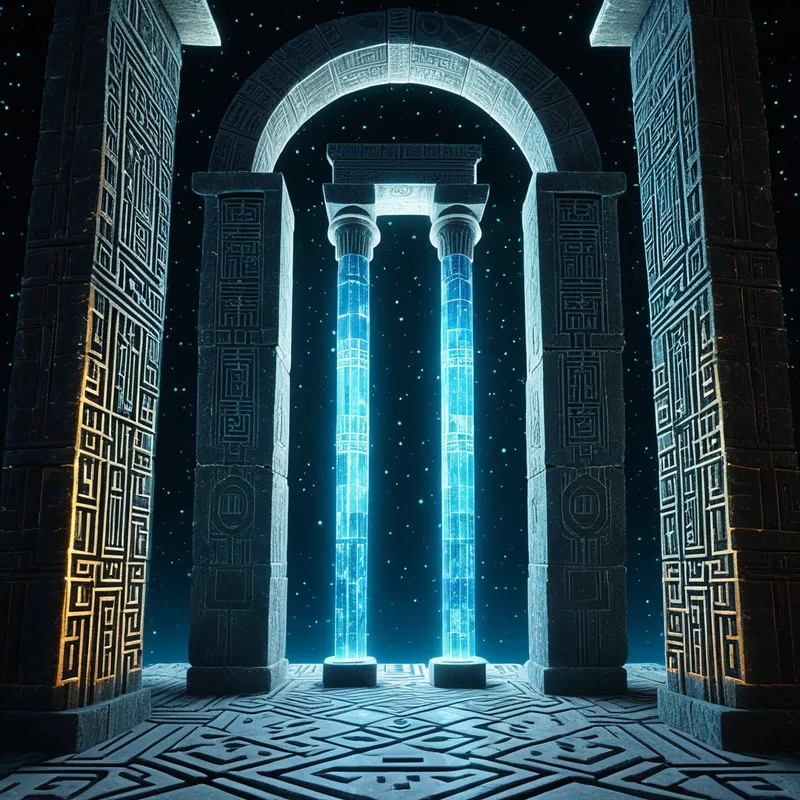
When this myth stirs in the modern unconscious, it often manifests in dreams of profound thresholds. One might dream of standing before two immense doors, a narrow canyon, a pair of towering gates, or a bridge between two cliffs. The emotional tone is key: it is rarely excitement, but more often awe, dread, or solemn determination.
The somatic experience is one of liminal tension—a feeling of being “in-between.” The dreamer may feel the solid ground of their old identity (the known continent) behind them, and the vast, dark ocean of potential (or dissolution) ahead. This is the psyche working through a critical transition: the end of a life chapter, the approach of a major decision, or the confrontation with a repressed aspect of the self (the “Geryon” within). The dream asks: What monolithic structure in your life needs to be split apart to allow passage? What warning have you inscribed on your own limits, and is it time to sail beyond it?

Alchemical Translation
In the alchemical process of individuation—the journey toward psychic wholeness—[the Pillars of Hercules](/myths/the-pillars-of-hercules “Myth from Greek culture.”/) model the opus of separation ([separatio](/myths/separatio “Myth from Alchemical culture.”/)) and the creation of [the vessel](/myths/the-vessel “Myth from Alchemical culture.”/) (vas).
The initial, fused mountain represents the massa confusa, the undifferentiated state of the psyche where opposites are locked together. Hercules’s labor is the application of conscious effort and suffering (the [nigredo](/myths/nigredo “Myth from Alchemical culture.”/)) to this mass. His strength is the focused will of the ego, aligned with the Self’s deeper intent for growth.
The strait he creates is the vas or temenos—the sacred, bounded space where the transformative journey can safely occur. It is the analyzed life, the therapeutic container, the disciplined practice.
Passing through the strait to retrieve the cattle symbolizes venturing into the unconscious (the land beyond the pillars) to retrieve vital, instinctual energy (the cattle) that has been monstrously projected (onto Geryon). The return is the integration of this energy back into the known world. The final, enduring pillars represent the stable, enduring structures of the personality that are formed through such an ordeal—the core values, insights, and boundaries that remain after a great transformation. They no longer say only “Nothing Further Beyond,” but also, for the one who has passed through and returned, “Here Begins the Journey.”
Associated Symbols
Explore related symbols from the CaleaDream lexicon: