Philemon and Baucis Myth Meaning & Symbolism
An elderly couple's humble hospitality to disguised gods transforms them into intertwined trees, a timeless symbol of sacred connection and enduring grace.
The Tale of Philemon and Baucis
The world had grown hard and cold. In the hills of Phrygia, where the air once carried the scent of thyme and the laughter of nymphs, there now hung a miasma of human pride. The gods, it was said, had turned their faces away. But the Olympian father, Zeus, wished to see for himself. With his swift messenger, Hermes, he descended from the high places, cloaking his thunderous majesty in the weary forms of mortal travelers.
They walked a stony road, dust on their sandals, and knocked on a hundred doors. At each threshold, they asked for water, for a crust of bread, for a moment’s rest from the sun. And at each threshold, they were met with scowls, with doors slammed, with curses hurled at beggars. The villages, rich with harvest, had grown poor in spirit. The sacred law of Xenia was broken, its altar forgotten.
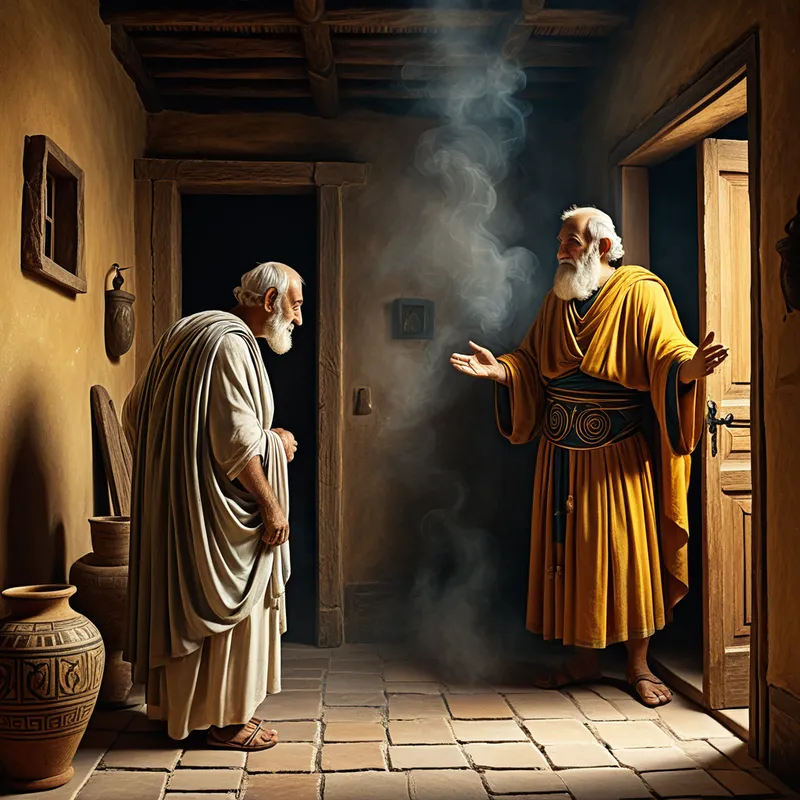
As dusk bled into violet night, they came to the poorest dwelling of all—a humble cottage of wattle and daub, its roof thatched with reeds from the marsh. Here lived Philemon and Baucis, two souls worn thin by years but not by kindness. Their wealth was a garden, a goose, and each other. Hearing the knock, Baucis hurried to the door. She saw not beggars, but guests. “Come,” she said, her voice a crackle of warm hearth-fire. “Our house is poor, but our welcome is true.”
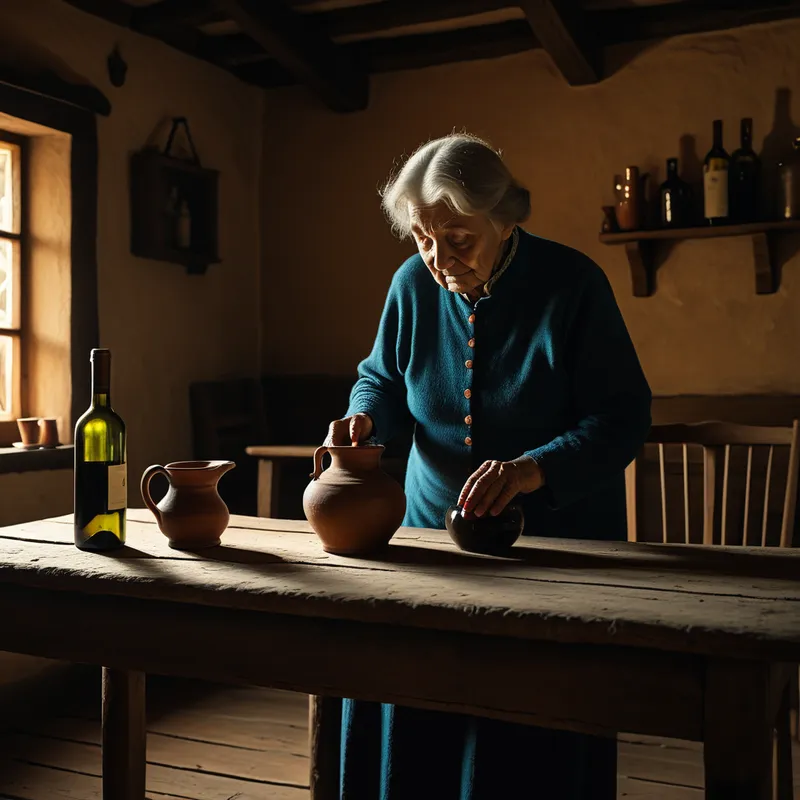
They ushered the strangers in. Philemon stirred the embers, Baucis laid their one good cloth upon a wobbly table. They brought what little they had: olives, endive, radishes, cheese, and eggs. They warmed water for their feet. And then, a wonder: the earthenware pitcher of wine, nearly drained, began to fill itself anew, the dark liquid rising as if from an invisible spring. The air grew still. The old couple looked at each other, then at their guests, and understood. They were in the presence of the divine.
Trembling, they fell to their knees. “Forgive us, great ones,” Philemon whispered, “for our meager fare.” But Zeus raised them up, his form now shimmering with a terrible, gentle light. “You alone in all this land have kept the faith,” his voice was like distant thunder. “Come. Follow us.”
He led them up the highest hill. Below, where the scornful villages lay, a great flood was rising, swallowing homes and fields. Only their tiny cottage remained untouched, and as they watched, it began to transform. The reeds became a golden roof, the mud walls polished marble, the humble door a gate of bronze. “Ask of us any boon,” said Zeus.
The old couple conferred, their hands clasped. Then Philemon spoke for them both. “To be your priests, to guard this new temple. And… let neither of us see the other’s tomb. Let us leave this life together.”
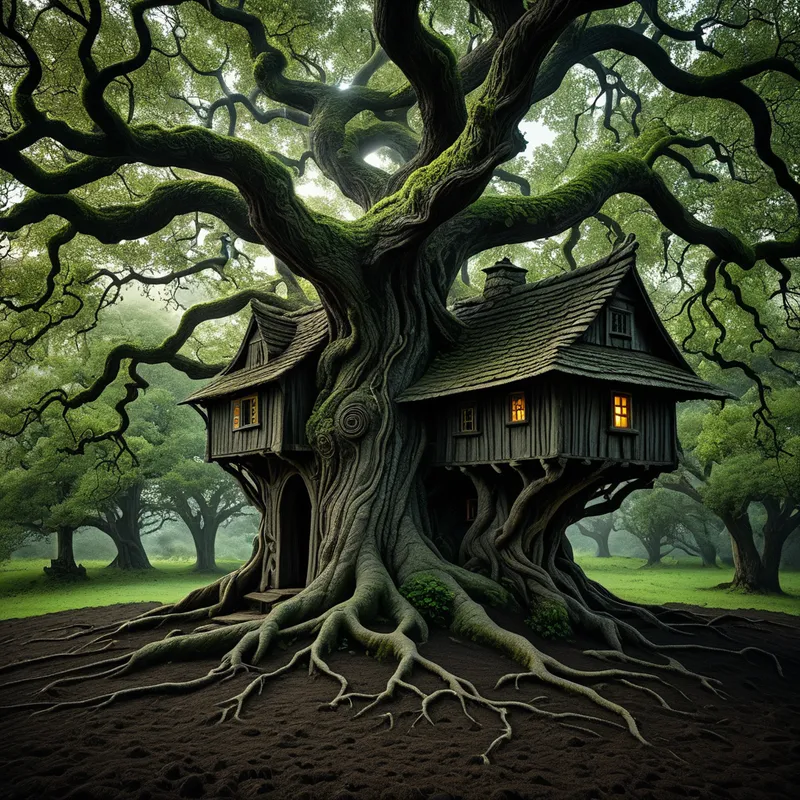
The gods consented. For years beyond count, they served in the glorious temple that was once their home. And when extreme old age came upon them, standing before the sacred steps, they felt a deep peace. Bark crept over Philemon’s skin, leaves sprouted from Baucis’s hair. Where two old people stood, now grew two magnificent, intertwined trees—an oak and a linden, their branches embracing for eternity, whispering the last sacred law of a forgotten world: Here, hospitality was not lost.
Cultural Origins & Context
This poignant tale reaches us primarily through the Roman poet Ovid, in his epic Metamorphoses. While Ovid’s lens is Roman, the myth’s heart is deeply Greek, rooted in the fundamental social and religious code of Xenia. This was not mere politeness but a sacred, reciprocal bond between host and guest, enforced by Zeus Xenios. The myth functioned as a powerful etiological narrative, explaining the origin of a specific temple (likely in Phrygia) and its peculiar sacred trees. More importantly, it served as a moral exemplar. Told in symposia and by traveling storytellers, it reinforced core societal values: piety (eusebeia), humility, and the idea that the divine tests mortals not in grand arenas, but at their own thresholds. It warned that civilization’s fabric unravels not through war, but through the failure of simple, compassionate duty.
Symbolic Architecture
At its core, the myth is an alchemy of the humble into the eternal. The cottage—the vessel of the soul’s simple virtues—becomes a temple. The aged, mortal body becomes an immortal, natural form. This is not a reward for ambition, but for being: for maintaining one’s essential humanity when all others have forsaken it.
The true miracle is not the refilling pitcher, but the heart that chooses to offer its last drop.
The disguised gods represent the numen, the divine spark, hidden within the stranger, the outsider, the part of reality we are tempted to reject. Philemon and Baucis succeed because they see the sacred in the seemingly insignificant. Their transformation into intertwined trees is the ultimate symbol of symbiotic devotion—a love and partnership so complete it transcends human form to become a permanent feature of the living world. The flood that destroys the inhospitable villages is the necessary dissolution of a psychic or social order that has become corrupt, making way for a new foundation built on the surviving seed of virtue.
The Dreamer’s Resonance
When this myth pattern stirs in the modern unconscious, it often surfaces in dreams of humble shelters, unexpected guests, or miraculous replenishment. To dream of desperately offering meager food, or of a simple cup that never empties, signals a psyche at a crossroads of generosity. The dreamer may be feeling spiritually or emotionally impoverished, yet is being called to give from that very scarcity. The guest at the door often represents an unloved aspect of the self—a vulnerability, a need, a forgotten talent—seeking sanctuary. The dream is a somatic nudge towards self-hospitability. The terrifying flood in the background mirrors the anxiety that by tending to this “guest,” one’s familiar world (of pride, self-sufficiency, or isolation) will be washed away. The myth in dream form asks: What small, sacred duty is your soul refusing? What humble part of your life, if honored, could become your temple?
Alchemical Translation
The journey of Philemon and Baucis is a perfect map for the individuation process—the psychic transmutation of the base lead of the ego into the gold of the Self. It begins with the descent of the gods, symbolizing the arrival of a compelling content from the collective unconscious, often in a form the conscious mind deems unimportant (a mood, a synchronicity, a nagging thought). The ego’s typical reaction is the slammed door of repression or neglect.
Individuation is not about building a grand palace for the ego, but about recognizing the temple already latent within the humble cottage of one’s present being.
The alchemical work is embodied by the old couple: the conscious attitude (Philemon) and the animating, relational principle (Baucis) must collaborate to welcome this strange content. The “miraculous replenishment” is the experience of psychic energy (libido) flowing anew once one engages sincerely with the unconscious. The ensuing flood is the inevitable, often painful, deconstruction of old, rigid attitudes (the inhospitable village of the persona) that block wholeness.
The final transmutation into intertwined trees is the goal. The oak represents steadfastness, endurance, and connection to the masculine principle of structure and spirit. The linden symbolizes sweetness, healing, and the feminine principle of connection and heart. Their union signifies the achieved conjunctio—the marriage of conscious and unconscious, spirit and soul, resulting in a new, rooted, and living existence that is both individual and part of the greater cosmic order. One does not become a god; one becomes fully, authentically, a natural part of the divine landscape.
Associated Symbols
Explore related symbols from the CaleaDream lexicon: