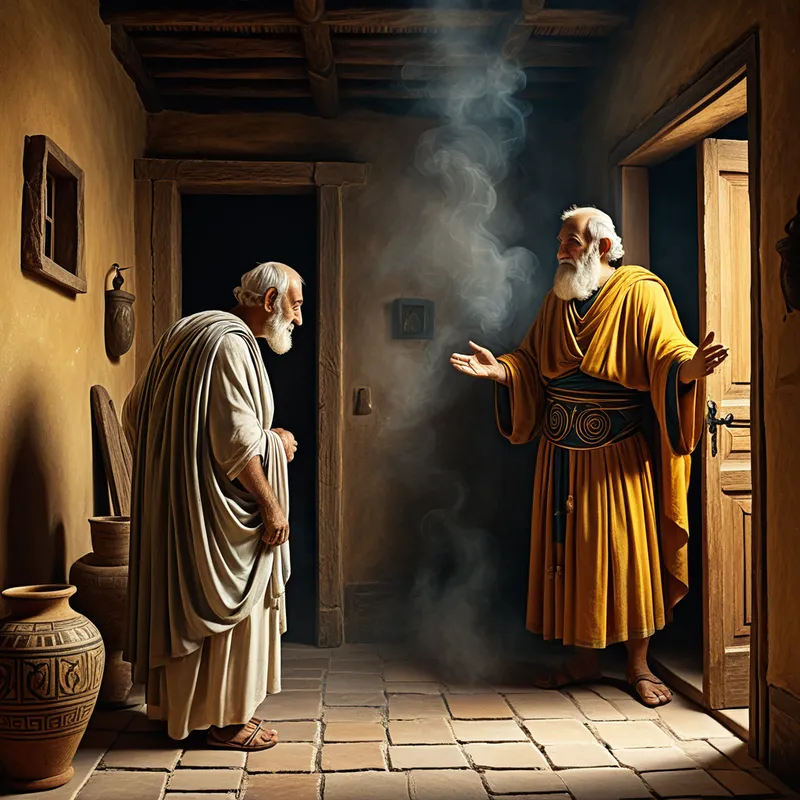
The Dream of Piety: A Call to the Inner Altar
The dream of piety arrives not as a sermon, but as a pressure. It is a weight in the chest, a solemn gravity that pulls the solar plexus taut. Before images form, there is a feeling of being watched by an invisible jury, a silent expectation that hangs in the air of the sleeping body like incense. The breath becomes shallow, measured, as if moving through a prescribed ritual. This is the somatic echo: a deep, structural tension between the spine’s desire to bow and the heart’s silent rebellion to stand. It is the ache of a loyalty that has outgrown its source, a devotion that has become a cage of beautiful, gilded bars.
The Dreamer's Log
The dreamer stands in a vast, humming server room, its cold blue light sterile and eternal. In the center, on a rough-hewn stone altar that feels impossibly ancient, a single holographic flame flickers. A voice, synthesized and omnipresent, intones: "Maintain the sacred fire." The dreamer’s task is clear, yet their hands feel like stone, unable to tend to this ghostly light they do not understand.
Here, the alchemy is clear: the soul is tasked with tending a flame of meaning in a context that has lost its warmth, demanding a transmutation of empty ritual into personal covenant.

The False Lead
This is not a dream about being more devout, nor is it a punishment for a lack of faith. To mistake it for a call to simply redouble external observance is to miss its revolutionary core. The tension you feel is not a deficit of piety, but a signal that your current structure of devotion—whether to a family creed, a cultural script, or an internalized critic—has become a false idol. The dream does not condemn the altar; it questions who built it, and in whose name you kneel.
Psychological Architecture
The work here is the most delicate of dissections: separating the gold of genuine reverence from the lead of imposed obligation. In the language of internal family systems, it is the moment the loyal "Manager" part, who has diligently enforced the rules of a borrowed religion, confronts the exiled "Firekeeper" – the part that knows the true source of the sacred flame is internal. This is shadow work of the highest order, for the shadow of piety is not blasphemy, but autonomy. The terror is not of divine wrath, but of the terrifying freedom and responsibility that comes when you become the author of your own sacred texts. The individuation process demands you depose the inner high priest who speaks in borrowed verses, so the mystic within can finally whisper in the language of direct experience.
Mythic Resonance
We see this eternal drama in the story of Abraham. Commanded by a divine voice to sacrifice his son Isaac, Abraham embodies ultimate pious surrender to external authority. The myth, in its brutal clarity, shows the zenith of this archetype: the readiness to annihilate one’s deepest future (Isaac, the child of promise) on the altar of a received command. The alchemical moment—the stay of the hand, the substitution of the ram—is often glossed over. It is the pivotal turn from blind obedience to a more profound, relational covenant. The dream of piety places you at that cliffside, knife in hand, asking not if you will obey, but if you will dare to re-negotiate the terms of the sacred.
Symbolic Nodes
- Empty Altars or Shrines: Signaling a ritual devoid of personal meaning.
- Broken Relics or Icons: The fracturing of inherited belief systems.
- Silent Bells or Unmoving Prayer Beads: Stagnant practice, disconnected from feeling.
- Being Watched While Praying: The pressure of perceived judgment, internal or external.
- A Sacred Text with Blank Pages: The invitation to inscribe your own revelation.
- Kneeling on Stone: The self-imposed hardship of an outdated devotion.
Archetypal Resonance
The core energy here is that of The Ruler Archetype, specifically its shadow aspect. The dream of piety confronts us with the Shadow Ruler—the inner Tyrant who conflates control with order, and dogma with law. This archetype’s somatic echo is the stiff neck, the rigid spine of enforced discipline, and the heavy crown of a duty you did not choose. Its alchemical potential lies in its transformation into the true Sovereign. The true Ruler does not obey external codes; they generate an internal governance rooted in authentic values and compassionate authority. The heat of this dream is meant to melt the tyrannical crown of "should" so you may forge the sovereign circlet of "is."
The Alchemical Process
The transmutation of piety is an operation of sacred treason. The prima materia is the dense, leaden weight of inherited obligation. The furnace is lit by the friction between your soul’s truth and the family’s, culture’s, or ego’s doctrine. This is the nigredo: the dark night where all former gods seem to fail, where rituals feel hollow, and a profound spiritual loneliness sets in. The pressure is the unbearable tension of holding a form of faith that no longer contains your spirit. The alchemical fire is the courage to commit the act of holy rebellion: to politely step away from the pew, to close the inherited book, and to sit in the silent void of your own authority. From this dissolution (solutio) arises the albedo—a moon-cool clarity. You begin to distinguish the universal sacred from its local costume. Finally, in rubedo, you don the red robe of the sovereign mystic, building your inner temple stone by stone from lived experience, your devotion no longer a performance for a projected audience, but a private, unshakeable conversation with the numinous.

The Integration Protocol
Question 1: Where in my life does my "devotion" feel more like a heavy garment I must wear, rather than a skin I naturally inhabit?
Question 2: What ancient, unexamined rule—spoken or unspoken—am I still sacrificing my authenticity on the altar of?
Question 3: If my sense of the sacred were no longer defined by any external tradition, what simple action or private moment would genuinely feel like prayer to me?
Action 1 (The Silent Audit): For one week, perform a mundane ritual (like making morning coffee) with the same intentional focus you might bring to a religious rite. Observe, without judgment, where your mind wanders to—to obligation, to memory, to presence. This grounds the theme in the body’s daily rhythm.
Action 2 (The Heretical Journal): In an unstructured, private writing session, complete this sentence: "The God/Spirit/Force I was taught to believe in would command me to… But the Sacred I actually sense in my bones whispers that I should…" Let the dialogue flow without censorship. This is the creative, expressive core of the transmutation.
Action 3 (The Personal Relic): Find or create a small object that holds zero inherited meaning—a unique stone, a scrap of metal, a drawn symbol. Consecrate it not with traditional prayer, but by placing it somewhere meaningful to you and imbuing it with a silent promise you make only to yourself. This externalizes the new, internal covenant.
Final Validation
The disorientation you feel is not a failure of spirit, but its first true awakening. It is terrifying to dismantle the only chapel you’ve ever known, to stand in the rubble and feel both the desolation of loss and the vast, open sky of possibility. This is the necessary wilderness. From here, you are not building a new religion to live by, but becoming the living scripture. Your authority is no longer borrowed; it is breathed. Your piety is no longer performed; it is pulsed. The altar was always within you. The dream simply asked you to turn around and see it.