Peter's Denial Myth Meaning & Symbolism
The story of the apostle Peter, who denies knowing his teacher three times in a moment of fear, only to be later restored through love.
The Tale of Peter's Denial
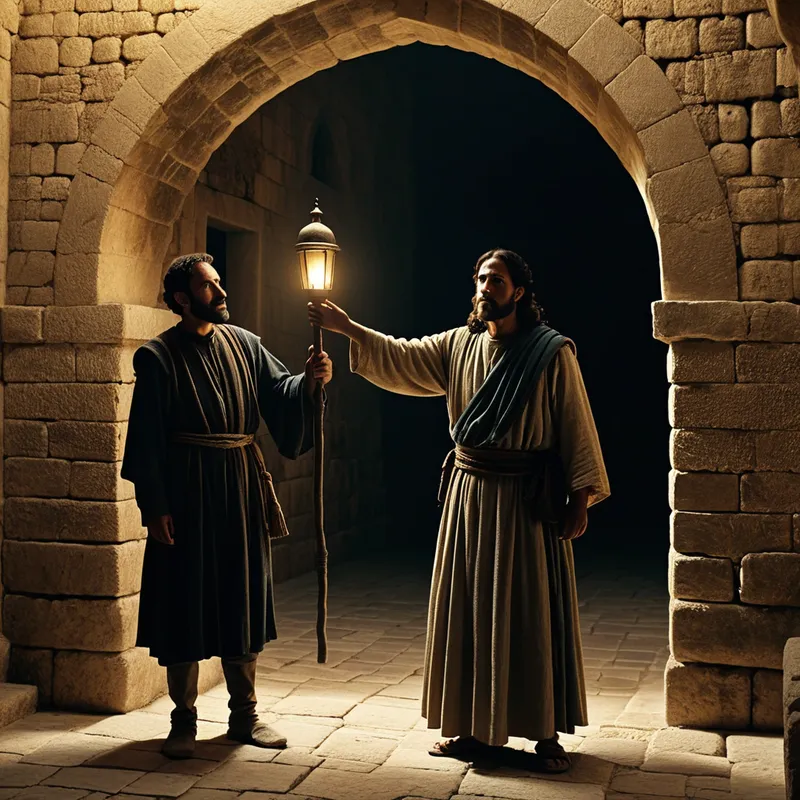
The night was a cold cup, bitter to the dregs. In the Garden of Gethsemane, the scent of crushed olives and fear hung heavy. The one they called Jesus had been taken, bound by shadows and soldiers. And Simon, whom he named Peter, followed—a rock rolling helplessly down a slope of dread, drawn by a loyalty he could no longer feel in his bones. He followed at a distance, a ghost of his former boastful self, into the high priest’s courtyard.
There, a servant girl’s eyes found him in the firelight. The charcoal glowed, a pit of orange eyes in the dark. “You also were with the Nazarene,” she said, not with malice, but with the simple clarity of recognition. The words were a hook in his heart. “I do not know or understand what you mean,” he stammered, retreating into the gateway, the cold stone at his back. The lie was a stone in his own throat.
But the night was not done with him. The girl pointed again, telling the bystanders, “This man is one of them.” Again, Peter denied it. “I am not.” His voice, once so sure on the sea, was thin, a frayed rope.
Then they came—the bystanders, their faces carved by flickering torchlight. “Certainly you are one of them, for you are a Galilean.” Your speech betrays you.” Fear, cold and final, closed around him like a vise. He began to invoke a curse, to swear an oath: “I do not know this man of whom you speak!”
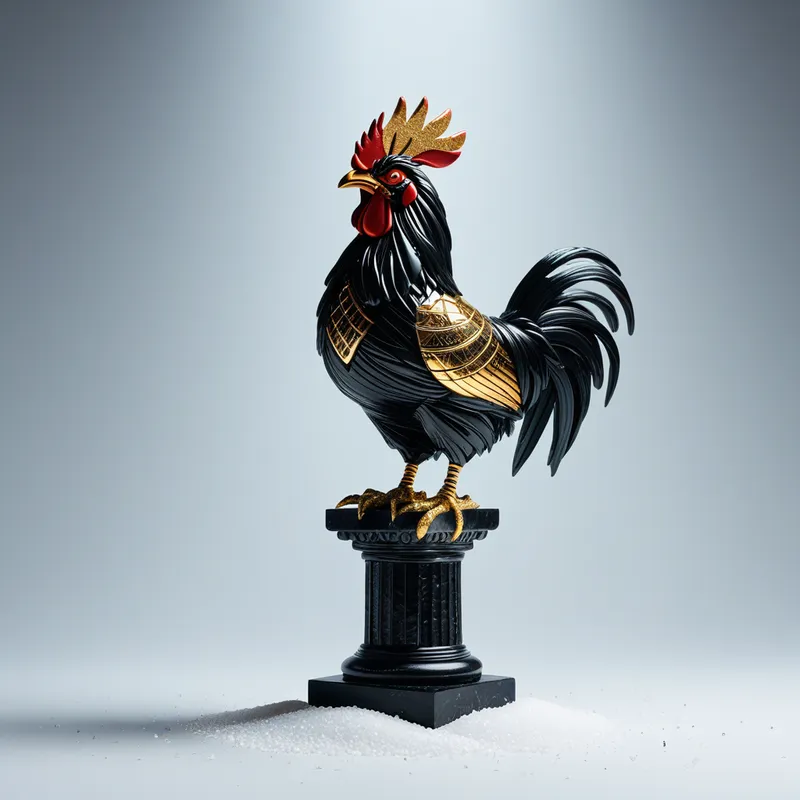
And in that moment, as the final oath left his lips, a sound pierced the predawn gloom. The crow of a rooster, sharp as a shard of glass. And he remembered. He remembered the words spoken just hours before, in the warmth of a shared meal: “Before the rooster crows twice, you will deny me three times.”
He turned. And through the chaos of the courtyard, his eyes met the eyes of his Lord, being led across the way. In that look was no accusation, no fury—only a knowing, a sorrow as deep as the world. And the rock, Peter, broke. He went out and wept, and his tears were the first waters of a new, desolate sea.

Cultural Origins & Context
This story is embedded in all four canonical Gospels, a rare narrative unanimity that underscores its foundational weight. It was not a tale of triumphalism, but one of profound, uncomfortable memory, preserved and told within the early Christian communities. These were communities often facing persecution, where the temptation to deny affiliation for safety was a lived, daily reality. Peter’s story functioned as a brutal mirror.
It served a dual purpose. For the failing, it was a story of identification and hope—if the chief apostle, the “rock” upon which the community was to be built, could fall so spectacularly and yet be restored, then so too could any believer. For the community, it was a sobering check against spiritual arrogance, a narrative inoculation against the pride that claims, “I would never betray.” The story was passed down not to shame Peter, but to sanctify the reality of human frailty within the sacred story itself.
Symbolic Architecture
At its core, this is the myth of the fractured self. Peter represents the conscious ego, the part of us that builds identity on promises, ideals, and proclaimed loyalty. The courtyard is the liminal space where this constructed self meets the raw, undiluted pressure of the world—the fear of social rejection, the threat of pain, the instinct for self-preservation.
The denial is not of another, but of the deepest, most demanding part of one's own soul.
The threefold structure is crucial. It is not a mistake, but a ritual of unraveling. The first denial is to a servant girl—perhaps a dismissal of the “lesser” or intuitive part of ourselves. The second is to the group, a capitulation to collective pressure. The third, with oaths and curses, is the full, violent repudiation of the core Self to save the skin-encapsulated ego. The rooster is the herald of consciousness, its crow the shocking return of awareness, the moment the ego sees the catastrophic gap between its ideal and its action.
The meeting of gazes is the pivotal symbol. It is the confrontation with the Self, here embodied in the figure of Jesus. This look carries no vengeance, only the unbearable weight of truth. It is this truth, not punishment, that causes the “rock” to shatter into the liberating tears of the shadow acknowledged.
The Dreamer's Resonance
When this myth stirs in the modern dreamer, it signals a profound somatic and psychological confrontation with the shadow. One may dream of vehemently denying a close friend or a cherished value in a public setting. Or the dream may feature a simple, repeated question—“Do you know him?” “Is this you?”—posed by an unthreatening figure, which nonetheless triggers overwhelming panic and dissociative lies.
Somatically, this can manifest as a tightening in the throat (the stifled truth), a sinking in the gut (the “pit” of the courtyard), or an actual sense of fragmentation. The psychological process is one of unconscious betrayal. The dream-ego is betraying a deeper, essential aspect of the personality to maintain a fragile, socially-approved identity. The weeping in the dream, as in the myth, is not a failure but the beginning of the cure—the ego’s rigid defense cracking to allow the flood of authentic, if painful, feeling.
Alchemical Translation
The alchemy modeled here is the Nigredo made sacred. It is the necessary dark night, the dissolution of the persona. Peter’s journey from the confident fisherman to the weeping wreck in the dawn is the archetypal path of individuation through failure.
The rock must be shattered before the cornerstone can be laid.
The first stage is the projection of strength (“I will never deny you!”). The second is the descent into the courtyard of fear and peer pressure, where the shadow takes the reins. The third is the catastrophic rupture, heralded by the rooster’s crow—the conscious realization of one’s own capacity for betrayal. This is the alchemical mortification.
But the process does not end in ash. The tears are the aqua permanens, the permanent water that begins the cleansing. The subsequent restoration of Peter, told in another dawn scene by a lakeside, completes the cycle. The one who denied is asked three times, “Do you love me?” and is charged to “feed my sheep.” The denied identity is not erased but is reclaimed at a deeper, more humble, and infinitely more resilient level. The ego, having faced its own shadow and survived the gaze of the Self, is no longer a brittle rock of boasts, but becomes a vessel capable of holding a genuine, tested love. The myth thus maps the transformation from the Orphan (betrayed and betraying) to the Caregiver, but only by passing through the fire of its own denied truth.
Associated Symbols
Explore related symbols from the CaleaDream lexicon: