
Peter the Rock Myth Meaning & Symbolism
A story of a flawed man named Simon, renamed Peter, who becomes the foundational rock of a new spiritual reality through faith and failure.
The Tale of Peter the Rock
Listen. [The wind](/myths/the-wind “Myth from Various culture.”/) off the Sea of Galilee carries the scent of fish and damp nets. In the town of Capernaum, a man named Simon labors. He is a man of [water](/myths/water “Myth from Chinese culture.”/) and weather, his soul as changeable as the lake’s surface—one moment calm and generous, the next stormy with impulsive passion. His world is the boat, the net, the catch, the wage.
Then, a voice cuts through the morning mist, not from the water, but from the shore. “Follow me,” it says, “and I will make you [fishers of men](/myths/fishers-of-men “Myth from Biblical culture.”/).” The speaker is a rabbi from Nazareth. Something in that voice, a gravity deeper than [the sea](/myths/the-sea “Myth from Greek culture.”/), pulls at Simon’s core. He leaves his nets, a tangible world, for a promise intangible as the wind.
For three years, Simon walks dusty roads beside this man. He witnesses wonders that defy the order of things: storms stilled with a word, thousands fed from a boy’s lunch, even the dead walking. Simon’s faith swells like a sail in a gale. In a moment of blazing insight, he declares, “You are the Messiah, the Son of the living God!”
The rabbi’s eyes hold him. “Blessed are you, Simon son of [Jonah](/myths/jonah “Myth from Christian culture.”/). For flesh and blood has not revealed this to you, but my Father in heaven. And I tell you, you are [Peter](/myths/peter “Myth from Biblical culture.”/), and on this rock I will build my ekklesia, and the gates of [Hades](/myths/hades “Myth from Greek culture.”/) will not overcome it. I will give you the keys of the kingdom of heaven.”
Simon becomes Peter—the Rock. The name is a prophecy, a mantle heavier than any net. Yet the man beneath remains shifting sand. That very night, when the rabbi speaks of suffering and death, Peter rebukes him. The rock becomes a stumbling block. “Get behind me, Satan!” comes the devastating reply.
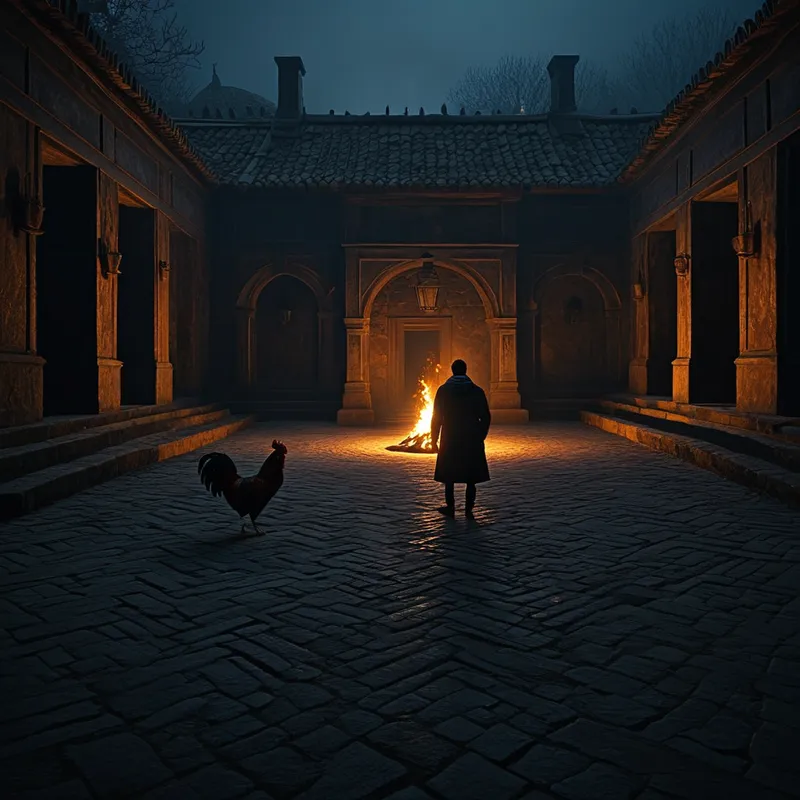
The crisis deepens in [the shadow](/myths/the-shadow “Myth from Jungian culture.”/) of the Praetorium. As the rabbi is arrested, Peter follows at a distance, drawn by love and fear. In a courtyard, by the accusing light of a charcoal fire, a servant girl recognizes him. “You were with him,” she says. Panic, cold and swift, floods him. “Woman, I do not know him.” He denies it again. And a third time, with curses. As the words leave his lips, a rooster crows. The rabbi, being led across the courtyard, turns and looks at Peter. Not with anger, but with a knowing sorrow that shatters the rock into dust. Peter stumbles into the night and weeps bitterly.
But the tale does not end in ash and tears. After the unthinkable—the rabbi’s execution and rumored resurrection—Peter returns to the only [thing](/myths/thing “Myth from Norse culture.”/) he knows: the boat, the nets. At dawn, a figure stands on the familiar shore. “Children, have you any fish?” They do not. “Cast the net on the right side of the boat.” The net fills until it strains. John whispers, “It is the Lord.” Peter, naked in his work, throws on his tunic and plunges into the sea, swimming desperately to shore.
By another charcoal fire, this one cooking fish, the resurrected rabbi asks Peter three times, “Do you love me?” Three affirmations to heal three denials. “Feed my lambs. Tend my sheep. Feed my sheep.” The commission is renewed. The rock, fractured and reconstituted by the fire of failure, is made solid. The fisherman, who sank in doubt and swam in desperate love, is given the keys. He becomes [the foundation stone](/myths/the-foundation-stone “Myth from Mesopotamian culture.”/) of a story that will outlast empires.
Cultural Origins & Context
This narrative is embedded in the Christian Biblical tradition, primarily within the Gospel accounts of Matthew, Mark, Luke, and John, and the Acts of the Apostles. It is a foundational “myth” not in the sense of fiction, but in the deeper sense of a sacred, identity-forming story for a community. It originated within the first-century Jewish-Christian movement, a culture steeped in Tanakh prophecy, Pharisaic debate, and apocalyptic expectation.
The story was transmitted orally by early communities before being codified in Greek texts. Its societal function was multifaceted: to explain the paradoxical authority of a flawed leader (Peter), to model the possibility of redemption after catastrophic failure, and to establish the theological legitimacy of the emerging Church as being built upon a divinely appointed, yet fully human, foundation. It served as both an origin story for ecclesiastical authority and a profound pastoral comfort for every believer who had ever failed in their faith.
Symbolic Architecture
At its [heart](/symbols/heart “Symbol: The heart symbolizes love, emotion, and the core of one’s existence, representing deep connections with others and self.”/), the myth is an [alchemy](/symbols/alchemy “Symbol: A transformative process of purification and creation, often symbolizing personal or spiritual evolution through difficult stages.”/) of [identity](/symbols/identity “Symbol: Identity represents the sense of self, encompassing personal beliefs, cultural background, and social roles.”/). “Simon” represents the natural man, [the ego](/myths/the-ego “Myth from Jungian culture.”/)-[personality](/symbols/personality “Symbol: Personality in dreams often symbolizes the traits and characteristics of the dreamer, reflecting how they perceive themselves and how they believe they are perceived by others.”/) with all its gifts and flaws—impulsive, passionate, loyal, and fragile. “Peter” is the bestowed name, the Self [archetype](/symbols/archetype “Symbol: A universal, primordial pattern or prototype in the collective unconscious that shapes human experience, behavior, and creative expression.”/) calling [the ego](/myths/the-ego “Myth from Jungian culture.”/) into a [destiny](/symbols/destiny “Symbol: A predetermined course of events or ultimate purpose, often linked to spiritual forces or cosmic order, representing life’s inherent direction.”/) far greater than itself. The rock is not a [symbol](/symbols/symbol “Symbol: A symbol can represent an idea, concept, or belief, serving as a powerful tool for communication and understanding.”/) of innate, unyielding [strength](/symbols/strength “Symbol: ‘Strength’ symbolizes resilience, courage, and the ability to overcome challenges.”/), but of become strength. It is [stability](/symbols/stability “Symbol: A state of firmness, balance, and resistance to change, often represented by solid objects, foundations, or steady tools.”/) forged through the shattering experience of one’s own inadequacy.
The true foundation is not laid upon perfection, but upon the fault line of acknowledged failure, sealed by grace.
The keys symbolize conscious [authority](/symbols/authority “Symbol: A symbol representing power structures, rules, and control, often reflecting one’s relationship with societal or personal governance.”/) and the power of discernment—the [ability](/symbols/ability “Symbol: In dreams, ‘ability’ often denotes a recognition of skills or potential that one possesses, whether acknowledged or suppressed.”/) to “bind and loose,” to make ethical and spiritual distinctions. They are not given to the perfect sage, but to the redeemed [fool](/symbols/fool “Symbol: Represents innocence, risk-taking, and new beginnings. Often symbolizes a leap into the unknown or naive trust.”/). The twin [charcoal](/symbols/charcoal “Symbol: Charcoal represents purification, transformation, and grounding. It symbolizes the residue of fire, moving from raw material to refined essence.”/) fires are brilliant psychological symbols: the first illuminates the [shadow](/symbols/shadow “Symbol: The ‘shadow’ embodies the unconscious, repressed aspects of the self and often represents fears or hidden emotions.”/) of [betrayal](/symbols/betrayal “Symbol: A profound violation of trust in artistic or musical contexts, often representing broken creative partnerships or artistic integrity compromised.”/) (the denied Self), the second provides the [crucible](/symbols/crucible “Symbol: A vessel for intense transformation through heat and pressure, symbolizing spiritual purification, testing, and alchemical change.”/) for its [integration](/symbols/integration “Symbol: The process of unifying disparate parts of the self or experience into a cohesive whole, often representing psychological wholeness or resolution of internal conflict.”/) and healing. The threefold questioning is a [ritual](/symbols/ritual “Symbol: Rituals signify structured, meaningful actions carried out regularly, reflecting cultural beliefs and emotional needs.”/) of psychic recalibration, aligning the conscious will (“Do you love me?”) with the destined function (“Feed my [sheep](/symbols/sheep “Symbol: Sheep often symbolize innocence, vulnerability, and the idea of conforming to societal norms.”/)”).
The Dreamer’s Resonance
When this myth pattern stirs in the modern dreamer, it often signals a critical juncture in the process of psychological foundation-building. To dream of being given a great responsibility or a new name points to the ego’s encounter with the calling of [the Self](/myths/the-self “Myth from Jungian culture.”/). It is a moment of both empowerment and terror.
Dreams of crumbling rocks, sinking into sand, or being unable to hold a heavy, symbolic object (like a key or cornerstone) may reflect the “Peter-before-the-fire” experience: the fear that one’s perceived strength is an illusion, that one is not equal to life’s task. Conversely, dreams of rebuilding from rubble, finding a solid stone in a swamp, or finally turning a key in a long-locked door speak to the integration phase. The somatic sensation is often a shift from a tight chest and shallow breath (the panic of denial) to a feeling of grounded solidity in the legs and core, even amidst emotional turbulence (the steadfastness born of redemption).
Alchemical Translation
The individuation journey modeled here is not one of ascending a ladder of flawless virtue, but of a descent into the truth of one’s own nature to find the bedrock beneath the personality. The [prima materia](/myths/prima-materia “Myth from Alchemical culture.”/) is the raw, unrefined Simon—the complex of talents and liabilities we are born with. The [nigredo](/myths/nigredo “Myth from Alchemical culture.”/), the blackening, occurs in the courtyard of failure, where the ego’s grand self-image is incinerated in the fire of its own betrayal. This is a necessary death; the rock must be cracked to be reconstituted.
The alchemical stone is not found; it is made in the furnace of our most humiliating moments.
The albedo, the whitening or purification, is the weeping—the conscious, agonizing acceptance of the shadow. The [rubedo](/myths/rubedo “Myth from Alchemical culture.”/), the reddening or culmination, is the dawn encounter by the sea. It is the return to the simple, embodied life (fishing) where the Self unexpectedly appears. The threefold question is the final coagulation: love (the heart) is explicitly linked to service (the hands). The [psyche](/myths/psyche “Myth from Greek culture.”/) is no longer a loose collection of impulses and fears, but an integrated entity with a conscious, loving purpose. The fisherman becomes the foundation. The one who sank becomes the rock. This is the alchemy of the soul: our greatest weaknesses, when confronted and redeemed, become the very site upon which our unshakable strength is built.
Associated Symbols
Explore related symbols from the CaleaDream lexicon: