
Peter the Fisher of Men Myth Meaning & Symbolism
A fisherman's soul is caught by a divine call, transforming him from a man of nets into a fisher of souls, through failure, betrayal, and ultimate redemption.
The Tale of Peter the Fisher of Men
Listen. The story begins not in a temple, but in the smell of salt, sweat, and fish. [The Sea](/myths/the-sea “Myth from Greek culture.”/) of Galilee is a capricious god, giving and taking with the same indifferent wave. Its servant is a man named Simon, son of [Jonah](/myths/jonah “Myth from Christian culture.”/), whose world is measured in the weight of a net and the depth of a callus. His life is a rhythm of toil: the groan of wood against the dock, the slap of wet rope, the sigh of an empty net hauled into the grey dawn.
One morning, after a night of catching nothing but weariness, a stranger stands on the shore. He is not a fisherman. He tells Simon to cast his net into the deep. It is a foolish request—the wrong time, the wrong place. But something in [the stranger](/myths/the-stranger “Myth from Biblical culture.”/)’s gaze, a quiet authority that stills the very wind, compels him. The net goes down, and the sea erupts. A silver chaos of life strains the ropes, threatening to tear the very fabric of his world apart. Simon falls to his knees in the sloshing bilge, not in [triumph](/myths/triumph “Myth from Roman culture.”/), but in terror. “Depart from me,” he gashes to the stranger, “for I am a sinful man.” He has not caught fish; he has been caught.
The stranger, whose name is Yeshua, smiles. “Do not be afraid. From now on, you will be catching people.” In that moment, Simon the fisherman dies. He is given a new name: Petros, the Rock. He leaves his nets, his boat, the only identity he has ever known, to follow a man who walks on the very [water](/myths/water “Myth from Chinese culture.”/) that once ruled him.
He walks on that water himself, for a few glorious, impossible steps, before doubt—the old gravity of [the world](/myths/the-world “Myth from Tarot culture.”/)—pulls him under. He is the first to proclaim his master’s divine nature, and moments later, the first to be called “Satan” for refusing the path of suffering. He swears a mighty oath: “Even if all fall away, I will not. I will die with you.” The night the soldiers come, his courage flares and fails; he draws a sword, then flees into the shadows.
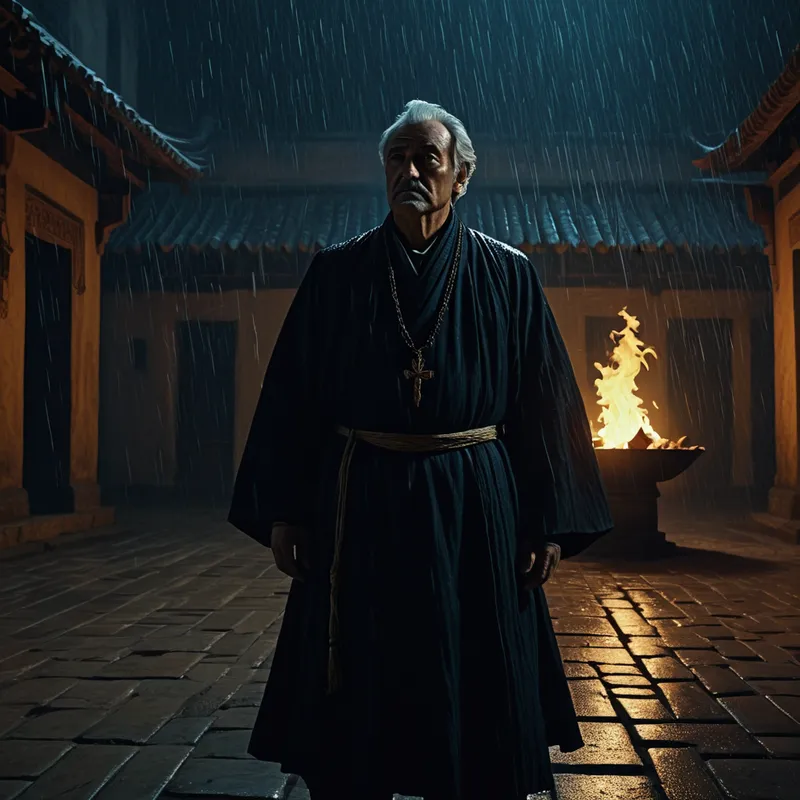
In the cold dark of a servant’s courtyard, huddled by a fire for warmth, the prophecy spoken hours before unfolds. Three times, a voice in the gloom accuses him of being one of the followers. Three times, with rising desperation, he denies it. “I do not know the man!” And as the third denial tears from his throat, a rooster crows, slicing the night like a blade. The sound is not just a bird’s call; it is the shattering of his own soul. He meets the eyes of his master, being led across the courtyard. And he goes out and weeps bitterly.
But the story does not end in the ashes of that fire. After the unthinkable death and rumored resurrection, a figure again stands on a familiar shore at dawn. “Children,” he calls to the disciples fishing, “you have no fish, have you?” They do not. The instruction comes again: cast the net. The miracle repeats, a silver bounty from the deep. And on the beach, by a charcoal fire—a mirror of the fire of denial—the risen Yeshua asks [Peter](/myths/peter “Myth from Biblical culture.”/) three times: “Do you love me?” Three affirmations to heal three denials. The call is reinstated, not to a conquering king, but to a shepherd who will one day stretch out his hands and be led where he does not wish to go. The fisherman, who became the rock, who became broken shale, is made whole again. He is given a new catch: not to rule, but to feed, to tend, to love.
Cultural Origins & Context
This myth originates in the 1st-century Levant, within the nascent Jewish sect that would become Christianity. It is not a single, polished epic but a collection of oral traditions and memories, woven into the narrative fabric of the Gospels. The primary tellers were the early Christian communities themselves, for whom Peter was a foundational pillar—the chief apostle, the witness to key events, and a leader in the early church in [Jerusalem](/myths/jerusalem “Myth from Biblical culture.”/) and Rome.
Societally, the myth functioned on multiple levels. For a persecuted minority, it offered a story of flawed leadership and radical grace, assuring believers that failure was not final. It established apostolic authority through a direct, personal commissioning by [Jesus](/myths/jesus “Myth from Christian culture.”/). Furthermore, it served as an etiological myth for the Christian mission: explaining how the message moved from a small Jewish teacher to the wider world. The “[fisher of men](/myths/fisher-of-men “Myth from Christian culture.”/)” metaphor perfectly captured the early church’s self-understanding as gathering people into a new community, a net cast across the sea of nations. Peter’s journey from impulsive fisherman to steady shepherd modeled the transformation expected of every believer and leader.
Symbolic Architecture
At its core, this is a myth of profound [identity](/symbols/identity “Symbol: Identity represents the sense of self, encompassing personal beliefs, cultural background, and social roles.”/) [death](/symbols/death “Symbol: Symbolizes transformation, endings, and new beginnings; often associated with fear of the unknown.”/) and [rebirth](/symbols/rebirth “Symbol: A profound transformation where old aspects of self or life die, making way for new beginnings, growth, and renewal.”/). The central [symbol](/symbols/symbol “Symbol: A symbol can represent an idea, concept, or belief, serving as a powerful tool for communication and understanding.”/) is the Net. In the beginning, it is a tool for securing biological [life](/symbols/life “Symbol: The symbol of ‘Life’ represents a journey of growth, interconnectedness, and existential meaning, encompassing both the joys and challenges that define human experience.”/) (fish). After the encounter with the divine, it is transposed into a tool for securing spiritual life (“catching people”). The net represents the [structure](/symbols/structure “Symbol: Structure in dreams often symbolizes stability, organization, and the framework of one’s life, reflecting how one perceives their environment and personal life.”/) of the [psyche](/myths/psyche “Myth from Greek culture.”/) itself—it must be cast into the deep, the unconscious, to bring up a bounty of latent potential and [connection](/symbols/connection “Symbol: Connection symbolizes relationships, communication, and bonds among individuals.”/). An empty net signifies a [life](/symbols/life “Symbol: The symbol of ‘Life’ represents a journey of growth, interconnectedness, and existential meaning, encompassing both the joys and challenges that define human experience.”/) lived on the surface, yielding nothing but toil.
The call to individuation often feels, at first, like a command to do the impossible in the wrong place at the wrong time.
Peter’s Name Change from Simon (meaning “he has heard”) to Peter/Petros (“rock”) signifies the [assignment](/symbols/assignment “Symbol: An assignment signifies tasks, responsibilities, or challenges that need to be addressed in one’s waking life, often representing personal growth.”/) of a [destiny](/symbols/destiny “Symbol: A predetermined course of events or ultimate purpose, often linked to spiritual forces or cosmic order, representing life’s inherent direction.”/) that contradicts his current, fluid [nature](/symbols/nature “Symbol: Nature symbolizes growth, connectivity, and the primal forces of existence.”/). He is called a rock while still being a man of [water](/symbols/water “Symbol: Water symbolizes the subconscious mind, emotions, and the flow of life, representing both cleansing and creation.”/) and [impulse](/symbols/impulse “Symbol: A sudden, powerful urge or drive that arises without conscious deliberation, often linked to primal instincts or emotional surges.”/). The myth beautifully charts the agonizing process of becoming one’s symbolic name. He must be fractured by failure (the denial) before the true, steadfast [foundation](/symbols/foundation “Symbol: A foundation symbolizes the underlying support systems, values, and beliefs that shape one’s life, serving as the bedrock for growth and development.”/) within him can be laid.
The Rooster’s Crow is the sound of [the Self](/myths/the-self “Myth from Jungian culture.”/)’s ruthless objectivity. It is the [moment](/symbols/moment “Symbol: The symbol of a ‘moment’ embodies the significance of transient experiences that encapsulate emotional depth or pivotal transformations in life.”/) [the ego](/myths/the-ego “Myth from Jungian culture.”/)’s grand self-[image](/symbols/image “Symbol: An image represents perception, memories, and the visual narratives we create in our minds.”/)—the brave, loyal [hero](/symbols/hero “Symbol: A hero embodies strength, courage, and the ability to overcome significant challenges.”/)—is confronted with its [shadow](/symbols/shadow “Symbol: The ‘shadow’ embodies the unconscious, repressed aspects of the self and often represents fears or hidden emotions.”/): the terrified, self-preserving denier. This is not condemnation, but the necessary [dawn](/symbols/dawn “Symbol: The first light of day, symbolizing new beginnings, hope, and the transition from darkness to illumination.”/) of self-[awareness](/symbols/awareness “Symbol: Conscious perception of self, surroundings, or internal states. Often signifies awakening, insight, or heightened sensitivity.”/). The bitter weeping is the alchemical [solutio](/myths/solutio “Myth from Alchemical culture.”/), the dissolving of the old [persona](/symbols/persona “Symbol: The social mask or outward identity one presents to the world, often concealing the true self.”/) in the waters of [truth](/symbols/truth “Symbol: Truth represents authenticity, honesty, and the quest for knowledge beyond mere appearances.”/).
Finally, the Threefold Restoration by the [charcoal](/symbols/charcoal “Symbol: Charcoal represents purification, transformation, and grounding. It symbolizes the residue of fire, moving from raw material to refined essence.”/) fire is the myth’s masterstroke of psychological repair. The [trauma](/symbols/trauma “Symbol: A deeply distressing or disturbing experience that overwhelms the psyche, often manifesting in dreams as unresolved emotional wounds or psychological injury.”/) (the three denials) is not erased but revisited and redeemed in an act of conscious, loving repetition. The call is not taken away but deepened: from the exciting, miraculous “catch” to the humble, enduring “feed.”
The Dreamer’s Resonance
When this myth stirs in the modern psyche, it often manifests in dreams of failed tests, broken oaths, or public exposure. The dreamer may find themselves in a courtyard, unable to speak, or denying something they hold dear. This is not merely anxiety; it is the psyche presenting its own “rooster’s crow”—a confrontation with the gap between one’s professed identity and one’s shadowy, enacted reality.
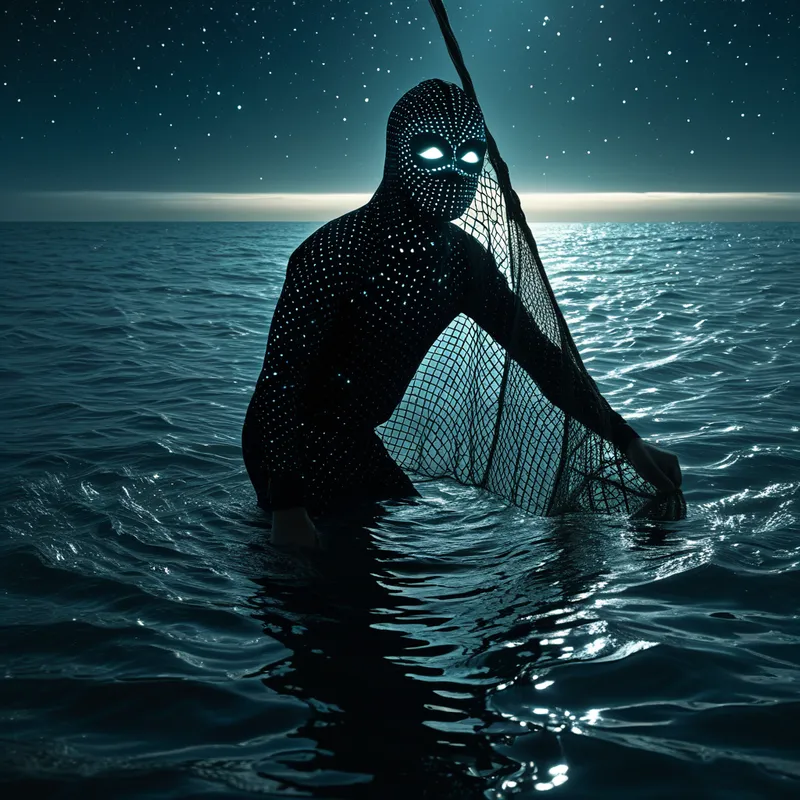
Somatically, this process can feel like a sinking sensation, a literal “going under” as Peter did on the water. It is the gravity of a truth one has been avoiding. Alternatively, dreams of casting nets into strange waters or hauling in unexpected, luminous catches signal the active phase of the “fisher” archetype: the soul is engaged in the meaningful work of gathering disparate parts of the self or forging new, profound connections in the world. The key is the feeling of being commissioned, called to a task that feels both destined and dauntingly beyond one’s current capacity.
Alchemical Translation
The myth of Peter is a precise map of the individuation process. It begins with the [Nigredo](/myths/nigredo “Myth from Alchemical culture.”/), the blackening: the futile, night-long toil (the empty net) representing the ego’s exhausted efforts at a life that no longer yields meaning. The divine call is the albedo, the whitening: a shocking, illuminating insight that reveals a new potential identity.
The rock is not given, but forged in the furnace of one’s own betrayal and the subsequent grace that does not discard the broken pieces.
Peter’s subsequent journey—his bold declarations, his walking on water, his violent defense, and his catastrophic denial—constitutes the chaotic citrinitas, the yellowing. Here, the new identity is tested, inflated, and shattered. The ego tries to enact the symbol (“the Rock”) through willpower and fails spectacularly. This failure is essential. It destroys the ego’s identification with the archetype, creating the fertile humilitas (humility) necessary for true transformation.
The final stage, the [rubedo](/myths/rubedo “Myth from Alchemical culture.”/) or reddening, is the integration. It occurs not in triumph, but at a humble breakfast on the beach. The restored call—“Feed my sheep”—is no longer about the hero’s glory but about service from a place of wholeness. The healed wound becomes the source of compassion. The modern individual undergoing this alchemy moves from a life of catching what the world defines as success (fish), to being caught by a deeper purpose, through the necessary crucible of failing one’s own ideals, to finally becoming a grounded, compassionate presence who nurtures growth in others and in the world. The fisherman becomes the rock by first being dissolved in the sea of his own tears.
Associated Symbols
Explore related symbols from the CaleaDream lexicon: