Perseus's Shield Myth Meaning & Symbolism
The hero Perseus defeats the Gorgon Medusa not by direct confrontation, but by using his polished shield as a mirror to avoid her petrifying gaze.
The Tale of Perseus’s Shield
Hear now a tale not of brute force, but of cunning reflection. It begins in the salt-sprayed halls of Seriphos, where a young man named [Perseus](/myths/perseus “Myth from Greek culture.”/) is given an impossible task by a tyrant king: bring back the head of [Medusa](/myths/medusa “Myth from Greek culture.”/). To look upon her serpent-haired face is to be frozen for eternity, a monument to one’s own terror. The air grows heavy with the scent of impending doom.
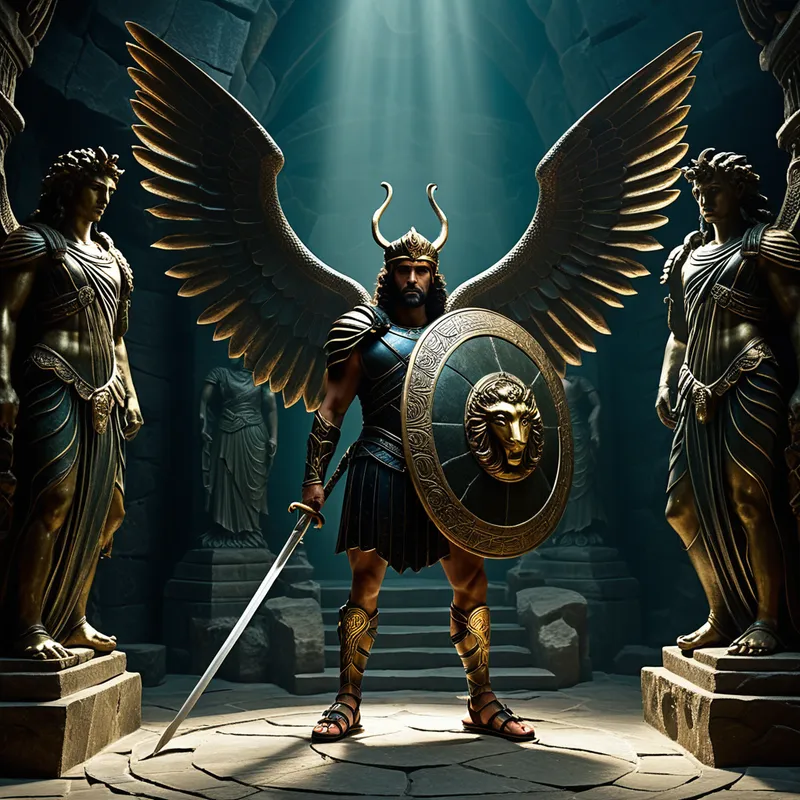
But the gods, in their capricious wisdom, offer not a sword, but tools of subtlety. From the Athena, he receives a shield of bronze, polished to a mirror’s sheen. From [Hermes](/myths/hermes “Myth from Global/Universal culture.”/), a sickle of adamant. The [Nymphs](/myths/nymphs “Myth from Greek culture.”/) of the North gift him a helm of darkness to shroud his presence, winged sandals to carry him swift and silent, and a kibisis—a magical pouch to safely carry his grim trophy.
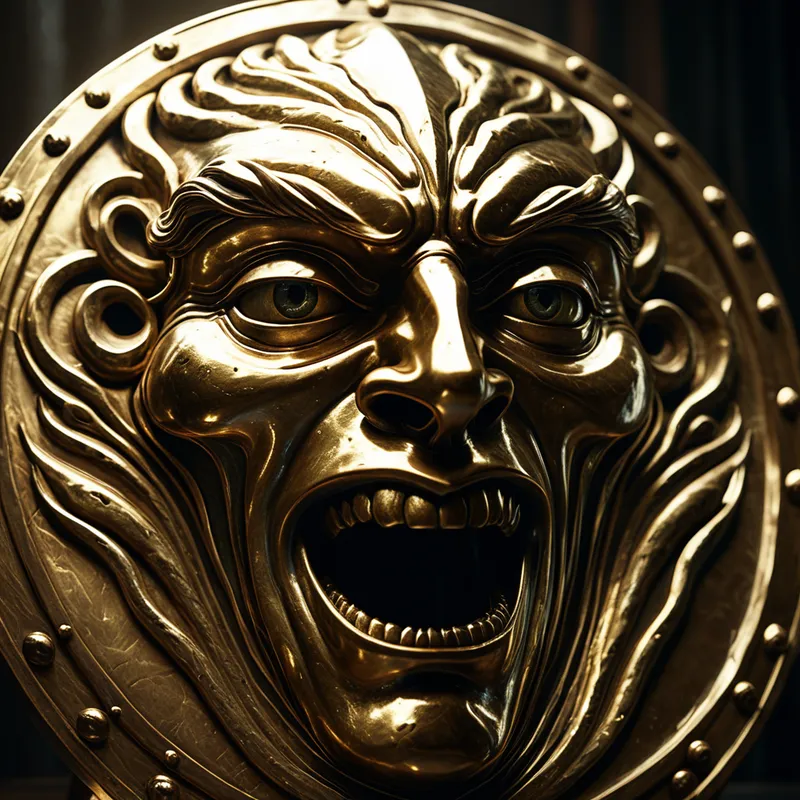
His journey is a descent into [the underworld](/myths/the-underworld “Myth from Greek culture.”/)’s edge, to the cavernous lair at [the world](/myths/the-world “Myth from Tarot culture.”/)’s end. The ground is littered with the stony figures of failed heroes, their faces locked in final screams. The air is thick with the dry rustle of scales and a profound, mournful silence. Perseus does not charge. He does not meet the monster’s eyes. Instead, he turns his back to the danger, moving forward only by watching the scene unfold in the cold, metallic surface of the shield. In that distorted mirror, he sees her: not a monster to be faced, but a reflection to be navigated.
With his gaze safely averted, guided only by the mirrored image, he raises the sickle. The strike is swift, guided by the reflection, not by sight. From the severed neck springs the winged horse [Pegasus](/myths/pegasus “Myth from Global/Universal culture.”/), and with a final, echoing wail, the deed is done. Using the shield’s reflection to guide his hands, he secures the still-potent head in the kibisis. The hero departs, not by conquering the gaze, but by refusing to meet it directly, leaving the cavern of statues behind.
Cultural Origins & Context
This core episode of the Perseus saga was immortalized most famously in Ovid’s [Metamorphoses](/myths/metamorphoses “Myth from Greek culture.”/), but its roots are far older, woven into the fabric of Greek mythology for centuries before. It was a story told not just in epic poetry but in the visual language of temple pediments, painted vases, and ornate shield devices. The myth functioned as a foundational narrative of heroic mētis—cunning intelligence. In a culture that valorized both physical prowess (bie) and cleverness (mētis), Perseus’s victory demonstrated that the latter could [triumph](/myths/triumph “Myth from Roman culture.”/) where the former was utterly futile.
The story was a societal lesson in strategic indirectness. For the Greek listener, it reinforced that some adversaries cannot be faced head-on. The shield, a tool of defense, is transformed into the ultimate tool of perception. This resonated in a world of complex politics, oracular riddles, and divine caprice, where understanding often came from oblique angles, not direct declarations. The myth was a map for navigating the impossible, teaching that the instrument of survival is often the ability to see the problem differently.
Symbolic Architecture
At its [heart](/symbols/heart “Symbol: The heart symbolizes love, emotion, and the core of one’s existence, representing deep connections with others and self.”/), the myth of Perseus’s [Shield](/symbols/shield “Symbol: A symbol of protection, defense, and boundaries, representing personal security, resilience, and the need to guard against external threats or emotional harm.”/) is an [allegory](/symbols/allegory “Symbol: A narrative device where characters, events, or settings represent abstract ideas or moral qualities, conveying deeper meanings through symbolic storytelling.”/) of [consciousness](/symbols/consciousness “Symbol: Consciousness represents the state of awareness and perception, encompassing thoughts, feelings, and experiences.”/) confronting the unconscious, specifically the petrifying power of the [Shadow](/symbols/shadow “Symbol: The ‘shadow’ embodies the unconscious, repressed aspects of the self and often represents fears or hidden emotions.”/). Medusa represents the [aspect](/symbols/aspect “Symbol: A distinct feature, quality, or perspective of something, often representing a partial view of a larger whole.”/) of [reality](/symbols/reality “Symbol: Reality signifies the state of existence and perception, often reflecting one’s understanding of truth and life experiences.”/)—or of [the self](/myths/the-self “Myth from Jungian culture.”/)—that is so terrifying, so overwhelming in its raw, chaotic [emotion](/symbols/emotion “Symbol: Emotion symbolizes our inner feelings and responses to experiences, often guiding our actions and choices.”/) (often symbolized by the serpents) that to face it directly paralyzes the [psyche](/myths/psyche “Myth from Greek culture.”/). She is the unintegrated [trauma](/symbols/trauma “Symbol: A deeply distressing or disturbing experience that overwhelms the psyche, often manifesting in dreams as unresolved emotional wounds or psychological injury.”/), the repressed rage, the monstrous [grief](/symbols/grief “Symbol: A profound emotional response to loss, often manifesting as deep sorrow, yearning, and a sense of emptiness.”/) that turns our inner [life](/symbols/life “Symbol: The symbol of ‘Life’ represents a journey of growth, interconnectedness, and existential meaning, encompassing both the joys and challenges that define human experience.”/) to cold, immovable [stone](/symbols/stone “Symbol: In dreams, a stone often symbolizes strength, stability, and permanence, but it may also represent emotional burdens or obstacles that need to be acknowledged and processed.”/).
The shield, then, is not a weapon, but the faculty of reflective consciousness. It is the capacity to observe the terrifying thing indirectly, through the medium of symbolism, art, or mindful awareness.
Perseus’s borrowed tools are the gifts of developed psychic faculties: the winged sandals (elevated [perspective](/symbols/perspective “Symbol: Perspective in dreams reflects one’s viewpoints, attitudes, and how one interprets experiences.”/), [intuition](/symbols/intuition “Symbol: The immediate, non-rational understanding of truth or insight, often described as a ‘gut feeling’ or inner knowing that bypasses conscious reasoning.”/)), the [helm of darkness](/symbols/helm-of-darkness “Symbol: The Helm of Darkness, often associated with invisibility and protection, symbolizes the hidden depths of the psyche and the unseen aspects of one’s character.”/) (the [ability](/symbols/ability “Symbol: In dreams, ‘ability’ often denotes a recognition of skills or potential that one possesses, whether acknowledged or suppressed.”/) to withdraw and observe unseen, introspection), and the divine [sickle](/symbols/sickle “Symbol: The sickle symbolizes the cyclical nature of life, harvest, and the labor involved in reaping rewards from hard work.”/) (the precise, discerning cut of [analysis](/symbols/analysis “Symbol: The process of examining something methodically to understand its components or meaning. In dreams, it represents the mind’s attempt to break down complex experiences.”/) that can separate the transformative [symbol](/symbols/symbol “Symbol: A symbol can represent an idea, concept, or belief, serving as a powerful tool for communication and understanding.”/) from its paralyzing [source](/symbols/source “Symbol: The origin point of something, often representing beginnings, nourishment, or the fundamental cause behind phenomena.”/)). He does not “kill” the unconscious content; he harvests it. The head, placed in the kibisis, retains its power, becoming a potent [weapon](/symbols/weapon “Symbol: A weapon in dreams often symbolizes power, aggression, and the need for protection or defense.”/)/[talisman](/myths/talisman “Myth from Global culture.”/)—a [symbol](/symbols/symbol “Symbol: A symbol can represent an idea, concept, or belief, serving as a powerful tool for communication and understanding.”/) of the integrated shadow, now under the conscious ego’s control, capable of freezing external threats (like [the sea](/myths/the-sea “Myth from Greek culture.”/) [monster](/symbols/monster “Symbol: Monsters in dreams often symbolize fears, anxieties, or challenges that feel overwhelming.”/) Cetus). The [birth](/symbols/birth “Symbol: Birth symbolizes new beginnings, transformation, and the potential for growth and development.”/) of [Pegasus](/symbols/pegasus “Symbol: A winged divine horse from Greek mythology, symbolizing inspiration, poetic genius, and spiritual ascension beyond earthly limitations.”/) from Medusa’s [neck](/symbols/neck “Symbol: The neck in dreams often symbolizes communication, vulnerability, and the connection between thoughts and emotions.”/) signifies the creative, soaring [spirit](/symbols/spirit “Symbol: Spirit symbolizes the essence of life, vitality, and the spiritual journey of the individual.”/) that can be liberated once the paralyzing complex is consciously addressed and transformed.

The Dreamer’s Resonance
When this mythic pattern stirs in the modern dreamer, it often manifests as dreams of indirect confrontation. You may dream of navigating a maze by watching a monitor, of fighting an opponent by using only their reflection in a window, or of trying to soothe a terrifying figure by speaking to it while looking away. The somatic feeling is one of extreme caution, a held breath, a focus on a secondary source of information to avoid a primary, overwhelming reality.
Psychologically, this signals a nascent engagement with a core complex or shadow aspect that has hitherto been too frightening to approach. The dream-ego is employing the “shield”—the reflective function of the dreaming mind itself—to begin the process of observation without full identification. The dream is rehearsing the act of seeing the “monster” without being destroyed by it, building the psychic muscles necessary for integration. It is the psyche’s innate wisdom, offering a safe, symbolic method to approach what feels unapproachable.

Alchemical Translation
The alchemical process mirrored here is not calcinatio (burning by direct fire) but [solutio](/myths/solutio “Myth from Alchemical culture.”/) (dissolution through reflection). The goal of individuation is not to destroy [the shadow](/myths/the-shadow “Myth from Jungian culture.”/), but to dissolve its petrifying power by bringing it into the reflective medium of consciousness. Perseus’s journey models this psychic transmutation perfectly.
First, the [Nigredo](/myths/nigredo “Myth from Alchemical culture.”/): The dark, impossible task, the descent to the cavern—the depression or crisis that forces a confrontation with the unconscious. Then, the Albedo: The gift of the polished shield, the principle of reflection. This is the stage of seeing differently, of turning the light of awareness onto the problem indirectly, through therapy, journaling, or active imagination. The terrifying figure begins to be seen as a reflection, a part of the self, not an external demon.
The act of “beheading” with the mirrored guidance is the separatio—the critical, conscious differentiation of the self from the identificatory grip of the complex.
Finally, the [Rubedo](/myths/rubedo “Myth from Alchemical culture.”/): The harvested head (the integrated complex) now serves the hero. The liberated Pegasus (inspired creativity) ascends. The modern individual undergoing this alchemy moves from being paralyzed by an inner truth to carrying that truth as a source of power and discernment. They learn that the most profound victories are not won by staring down our monsters, but by developing the polished surface of the soul—the reflective capacity—that allows us to see them for what they are, and in that seeing, to disarm their petrifying gaze forever. The shield becomes the self.
Associated Symbols
Explore related symbols from the CaleaDream lexicon: