Perseus vs. Medusa Myth Meaning & Symbolism
A hero, guided by gods, confronts a monstrous Gorgon whose gaze turns men to stone, in a myth of reflection, fate, and psychic transformation.
The Tale of Perseus vs. Medusa
Hear now a tale of impossible tasks and divine favor, of a monster’s curse and a hero’s cunning. It begins not with glory, but with a crime. Acrisius, fearing a prophecy that his grandson would kill him, cast his daughter Danaë and the infant [Perseus](/myths/perseus “Myth from Greek culture.”/) into [the sea](/myths/the-sea “Myth from Greek culture.”/) in a wooden chest. But [the fates](/myths/the-fates “Myth from Greek culture.”/) are not so easily thwarted. Father Zeus himself had visited Danaë as a shower of gold, and he guided the chest to the island of Seriphos. There, the fisherman Dictys drew them from the waves, offering sanctuary.
Years passed. Perseus grew strong. But the king of Seriphos, Polydectes, desired Danaë and saw her son as an obstacle. At a feast, he demanded a wedding gift from each man. Perseus, poor in wealth but rich in pride, declared he would bring anything—even the head of the Gorgon [Medusa](/myths/medusa “Myth from Greek culture.”/). The king seized upon this boast, binding the youth to his word. An impossible quest, a death sentence disguised as an honor.
But the hero is never truly alone. From the shadows of his despair, divine aid emerged. Athena, who held a particular enmity for Medusa, and [Hermes](/myths/hermes “Myth from Global/Universal culture.”/), [the psychopomp](/myths/the-psychopomp “Myth from Various culture.”/), came to him. They spoke of the Graeae, crones who knew the path to the [Nymphs](/myths/nymphs “Myth from Greek culture.”/) of the North. With [Hermes](/myths/hermes “Myth from Global/Universal culture.”/)’s guile, Perseus stole the single eye of [the Graeae](/myths/the-graeae “Myth from Greek culture.”/), forcing them to reveal the secret.
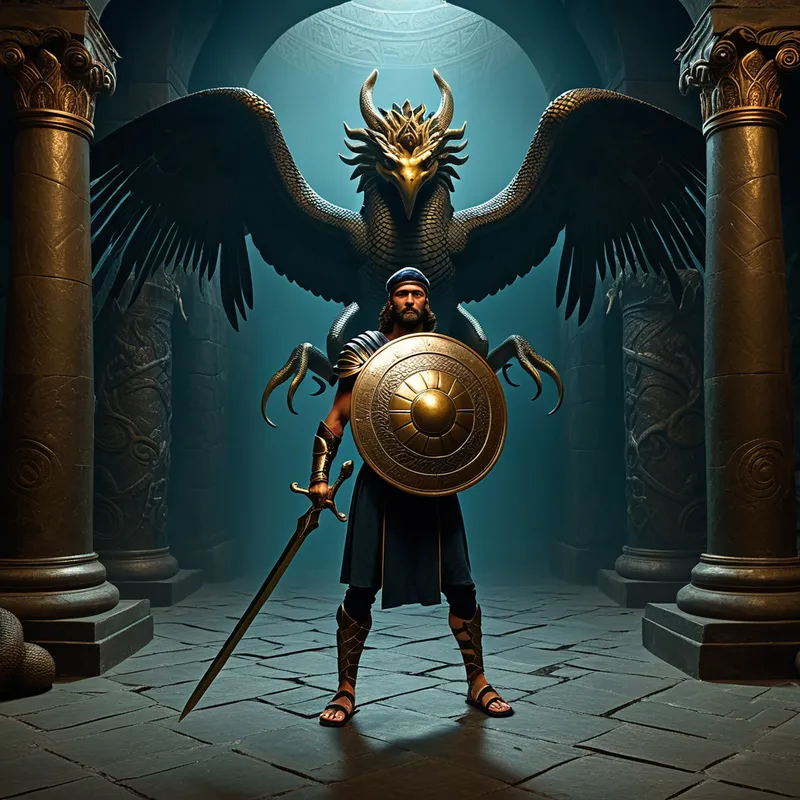
From the Nymphs, he received the tools of his destiny: [talaria](/myths/talaria “Myth from Greek culture.”/) to fly, a magic wallet to safely carry his grim trophy, and the cap of [Hades](/myths/hades “Myth from Greek culture.”/) to render him invisible. To these, Hermes added a divine, adamantine sickle, and Athena gave him her own, brilliantly polished bronze shield. “Do not look upon her directly,” the goddess warned, her grey eyes grave. “Use this as your mirror. Let her gaze fall upon itself.”
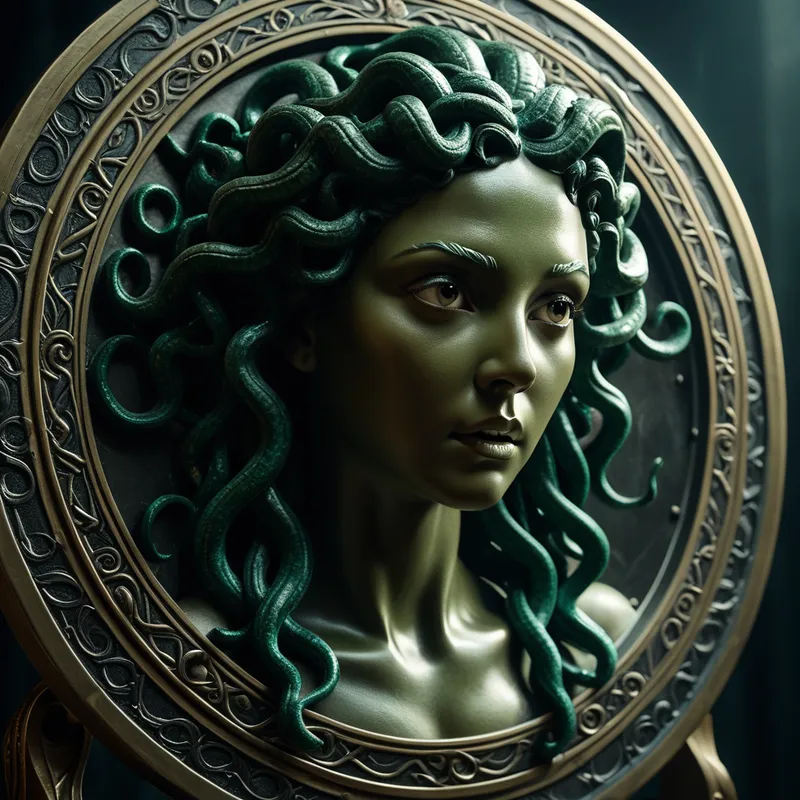
And so he flew, a ghost upon [the wind](/myths/the-wind “Myth from Various culture.”/), to the ends of [the earth](/myths/the-earth “Myth from Hindu culture.”/), to the hyperborean realm of night and stone. The Gorgons’ lair was a cavernous place, littered with the statues of men and beasts—forever frozen in their final moments of terror. There, amidst her immortal sisters, slept Medusa. The air hissed with the sound of the serpents that crowned her head. Perseus, his heart a drum against his ribs, hovered above. He fixed his eyes not on the monster, but on her reflection in the shield’s burnished surface. In that mirror-world, he saw her—not as a mere monster, but as a tragic figure, a beautiful woman cursed, her face twisted in eternal anguish. Guided by the reflection, he struck. The sickle of Hermes flashed. There was a sound like a sigh, and the head was severed.
From her neck sprang the winged horse [Pegasus](/myths/pegasus “Myth from Global/Universal culture.”/) and the giant Chrysaor. Perseus, swift as thought, seized the head, its venomous blood dripping, and placed it in the wallet. Donning the cap of darkness, he fled the wrath of the other Gorgons, invisible and triumphant.
Cultural Origins & Context
This myth, as we know it, is crystallized in the poetic works of Hesiod and later in the library of Ovid. For the ancient Greeks, it was not merely an adventure story but a foundational narrative woven into the fabric of their cosmology and civic identity. It explained the origin of Pegasus and the coral of the Red Sea (born from Medusa’s blood). It was a tale told in symposia, enacted in plays, and depicted on temple metopes and pottery, serving as a powerful metaphor for the [triumph](/myths/triumph “Myth from Roman culture.”/) of civilized order (represented by Athena and her favored hero) over the primal, chaotic, and petrifying forces of nature.
The myth functioned as a societal instruction. Perseus is the model of the kourios, the young man who, through divine favor (theoxenia), cunning intelligence ([metis](/myths/metis “Myth from Greek culture.”/)), and precise action, navigates an impossible set of trials to secure his lineage and place in [the world](/myths/the-world “Myth from Tarot culture.”/). His journey from castaway to founder of great cities (like Mycenae) reinforced ideals of heroism, piety, and the belief that fate, while potent, could be negotiated with courage and divine alliance.
Symbolic Architecture
At its core, this is a myth about the confrontation with the unfaceable. Medusa is not just a [monster](/symbols/monster “Symbol: Monsters in dreams often symbolize fears, anxieties, or challenges that feel overwhelming.”/); she is the ultimate [Shadow](/symbols/shadow “Symbol: The ‘shadow’ embodies the unconscious, repressed aspects of the self and often represents fears or hidden emotions.”/) made manifest. Her gaze represents that which, when confronted directly, paralyzes us—be it [trauma](/symbols/trauma “Symbol: A deeply distressing or disturbing experience that overwhelms the psyche, often manifesting in dreams as unresolved emotional wounds or psychological injury.”/), overwhelming [emotion](/symbols/emotion “Symbol: Emotion symbolizes our inner feelings and responses to experiences, often guiding our actions and choices.”/), or a [truth](/symbols/truth “Symbol: Truth represents authenticity, honesty, and the quest for knowledge beyond mere appearances.”/) about ourselves we cannot bear. She turns [consciousness](/symbols/consciousness “Symbol: Consciousness represents the state of awareness and perception, encompassing thoughts, feelings, and experiences.”/) to [stone](/symbols/stone “Symbol: In dreams, a stone often symbolizes strength, stability, and permanence, but it may also represent emotional burdens or obstacles that need to be acknowledged and processed.”/), halting the flow of [life](/symbols/life “Symbol: The symbol of ‘Life’ represents a journey of growth, interconnectedness, and existential meaning, encompassing both the joys and challenges that define human experience.”/) and growth.
The hero’s task is not to destroy the shadow with brute force, but to approach it with indirect consciousness, using reflection as both shield and sword.
Perseus’s arsenal is deeply symbolic. The [shield](/symbols/shield “Symbol: A symbol of protection, defense, and boundaries, representing personal security, resilience, and the need to guard against external threats or emotional harm.”/) of Athena represents reflective consciousness—the [ability](/symbols/ability “Symbol: In dreams, ‘ability’ often denotes a recognition of skills or potential that one possesses, whether acknowledged or suppressed.”/) to observe a terrifying psychic content without being identified with it or destroyed by it. The cap of [Hades](/symbols/hades “Symbol: Greek god of the underworld, representing death, the unconscious, and hidden aspects of existence.”/) is the [capacity](/symbols/capacity “Symbol: A measure of one’s potential, limits, or ability to contain, process, or achieve something, often reflecting self-assessment or external demands.”/) for withdrawal, the necessary retreat into the unconscious or into a protected state to strategize. The winged sandals are transcendent mobility, the agility of [spirit](/symbols/spirit “Symbol: Spirit symbolizes the essence of life, vitality, and the spiritual journey of the individual.”/) to move above the paralyzing [terrain](/symbols/terrain “Symbol: Terrain in dreams often represents the landscape of one’s life, including challenges, opportunities, and feelings about one’s current circumstances.”/) of the [problem](/symbols/problem “Symbol: Dreams featuring a ‘problem’ often symbolize internal conflicts or challenging situations that require resolution and self-reflection.”/). The myth tells us we cannot stare down our deepest fears head-on; we must approach them sideways, with tools forged in the realms of wisdom (Athena) and the [spirit](/symbols/spirit “Symbol: Spirit symbolizes the essence of life, vitality, and the spiritual journey of the individual.”/) (Hermes).
The Dreamer’s Resonance
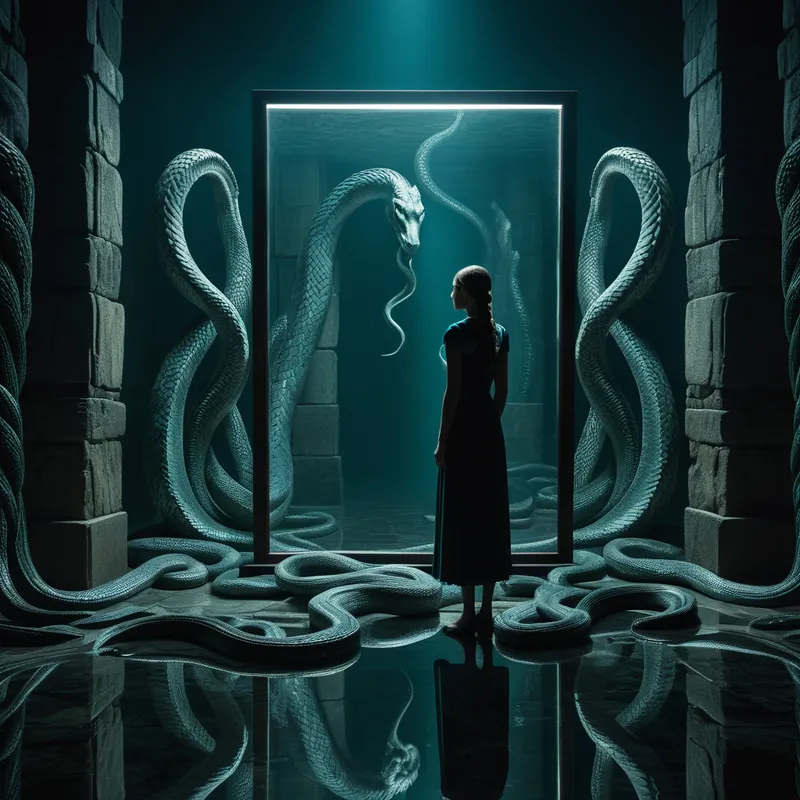
When this mythic pattern stirs in the modern dreamer, it often signals a profound encounter with a petrifying complex. To dream of being pursued by a figure whose gaze freezes, or of confronting a mirrored surface that shows a terrifying visage, is to stand at [the threshold](/myths/the-threshold “Myth from Folklore culture.”/) of the Medusan realm.
The somatic experience is one of literal paralysis—sleep paralysis, or the feeling of being weighed down, turned to stone upon waking. Psychologically, the dreamer is facing a aspect of their [psyche](/myths/psyche “Myth from Greek culture.”/) or a life situation that feels monstrous, ancient, and utterly arresting. It could be the frozen rage of a past hurt, the stony silence of a depression, or the paralyzing fear of a necessary truth. The dream is not a prescription for battle, but an announcement: [the Gorgon](/myths/the-gorgon “Myth from Various culture.”/) is present. The heroic task, should one choose to accept it, has been issued from the depths.
Alchemical Translation
The alchemical journey of Perseus is a precise map for individuation. The initial state is one of [nigredo](/myths/nigredo “Myth from Alchemical culture.”/)—the blackening. Perseus is cast adrift, given a death-sentence task. This is the despair and confusion that often precedes deep psychological work.
The acquisition of the divine tools is the stage of albedo—the whitening. It represents the gathering of resources: therapy, meditation, creative practice, supportive relationships (the gods). These are the reflective capacities and spiritual supports that allow one to approach [the shadow](/myths/the-shadow “Myth from Jungian culture.”/) without being consumed by it.
The act of severing the head is not annihilation, but separatio—the crucial differentiation of Self from the identificatory grip of the complex.
The final stage is [rubedo](/myths/rubedo “Myth from Alchemical culture.”/)—the reddening, the return with the boon. Perseus does not destroy Medusa’s power; he contains and wields it. He uses the head to petrify his enemies, turning the very power that once threatened to paralyze him into a tool for protection and the establishment of his kingdom. For the modern individual, this is the integration of the shadow. The paralyzing fear, once faced through reflection and indirect approach, loses its absolute power. Its energy is transmuted. What once turned you to stone becomes a source of fierce protection, a clarified boundary, or a creative force (Pegasus, the winged inspiration, is born from the very act). The hero returns not having slain the monster, but having mastered the art of seeing it, thereby transforming its curse into a guarded, potent part of the whole self.
Associated Symbols
Explore related symbols from the CaleaDream lexicon: