Persephone's Garden Myth Meaning & Symbolism
The story of a goddess abducted to the underworld, whose fate creates the seasons and reveals the soul's necessary descent into darkness.
The Tale of Persephone's Garden
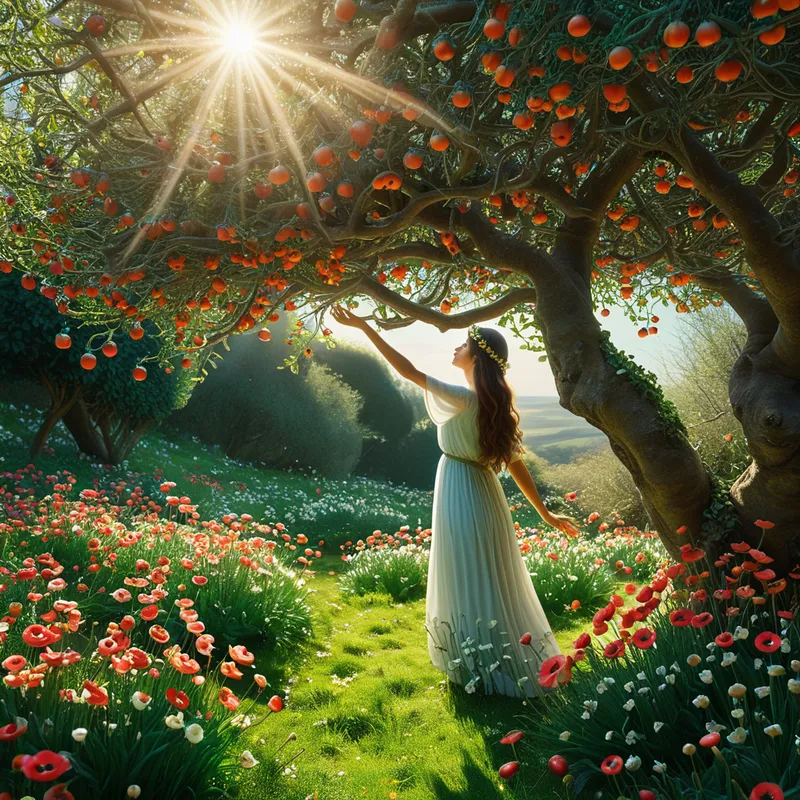
Before the world knew winter, there was only an eternal, gentle spring. In this world of unbroken light, Demeter tended the earth with a mother’s devotion, and by her side was her daughter, Kore, whom we would come to know as Persephone. Kore was the very spirit of the blossoming meadow, her laughter the sound of rustling leaves, her footsteps causing hyacinths and violets to rise from the soil.
On a day that seemed like all others, she wandered in a temenos of her mother’s making, a garden of such profound beauty it hurt the heart to behold it. She was gathering saffron crocuses, white lilies, and irises with her companions, the Oreades, when her eye was caught by a narcissus of a hundred blooms, a flower planted by the earth itself as a lure. Its radiance was unearthly, a trap of sublime beauty. As she reached for its stem, the ground at her feet groaned and split asunder.
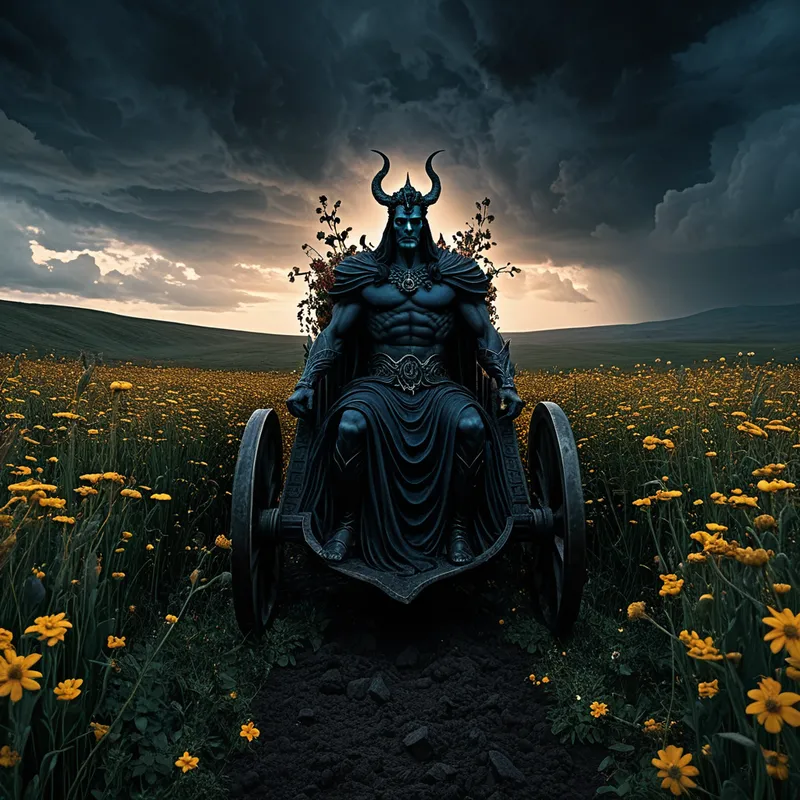
From the yawning chasm came a thunder of hooves and the clatter of a chariot wrought from black rock. Hades, lord of the unseen realms, seized her. Her cry was swallowed by the depths as the earth closed above them, leaving only a scar upon the meadow and a single fallen garland. Demeter’s scream of loss echoed across the world. For nine days and nights, the goddess roamed the earth, torch in hand, a figure of purest grief, refusing all ambrosia and nectar. The land, feeling her sorrow, began to wither. Green turned to grey, fruit shriveled on the branch, and a cold silence fell.
Guided by the all-seeing Helios, Demeter learned the truth: that her brother, Zeus, had sanctioned this marriage of heaven to hell. In her rage and despair, she withdrew her grace entirely, cloaking the world in the first true famine. Mortals perished, and the gods received no smoke of sacrifice. Confronted with this cosmic strike, Zeus relented. He commanded Hermes to descend to the sunless land and bring Persephone back, on one condition: if she had eaten any food of the dead, she must remain.
Hermes found Persephone in the throne room of Hades, no longer a carefree maiden but a queen, seated beside a somber king who loved her. She rose with joy at the news of her return. But as she turned to go, a gardener of the underworld—some say the king himself—stepped forward and bore witness. She had eaten. Not a feast, but a simple, fateful act: seven seeds from a pomegranate, offered perhaps in loneliness, perhaps in a moment of dawning sovereignty. That small, ruby nourishment was a contract written in the soul’s own blood.
A compromise was forged in the halls of Olympus, a law for gods and mortals alike. For each seed eaten, Persephone would spend one month of the year in the kingdom below. Thus, she is divided, and so is the world. When she ascends to her mother, the earth erupts in the riot of spring and ripens into summer’s abundance. When she descends to her throne beside Hades, Demeter mourns, and the world grows cold and still. The maiden is gone; the Queen has arisen. And in this eternal rhythm, the first winter was born, and the first hope of spring was promised.
Cultural Origins & Context
This central myth, known as the Homeric Hymn to Demeter, was not mere entertainment. It was the sacred narrative underpinning the most profound mysteries of the ancient Greek world: the Eleusinian Mysteries. For nearly two millennia, initiates traveled to Eleusis to undergo rites that promised a blessed lot in the afterlife, a hope rooted directly in Persephone’s journey. The myth was performed, chanted, and enacted, making the participants’ own psychological journey mirror that of the goddess.
Its societal function was multifaceted. On a practical level, it was an etiological tale explaining the seasonal cycle, giving meaning to the agricultural anxiety of winter and the relief of harvest. On a deeper, cultural level, it modeled the traumatic but necessary transitions in a woman’s life—from maiden (kore) to married woman (nymphe)—and the profound grief of separation felt by mothers. It served as a container for the universal human experiences of loss, abduction by fate, and the hard-won wisdom that comes from surviving the unseen realms of experience.
Symbolic Architecture
The myth’s power lies in its perfect symbolic architecture. Persephone is the archetypal ego, the innocent consciousness dwelling in the perpetual spring of the maternal psyche (Demeter). Her garden is the protected, conscious world.
The abduction is not a crime, but an initiation. It is the inevitable summons of the unconscious, the call of the Self that shatters the comfortable, sunlit world.
Hades represents the lord of this inner world—not evil, but absolute, impersonal, and sovereign. He is the shadow and the deep psychic ground from which new consciousness must be forged. The underworld is not hell, but the unconscious itself, a place of riches (Hades means "the Unseen One" and was also a god of wealth) and profound transformation.
The pomegranate is the central symbol of irrevocable choice and integration. Its blood-red seeds symbolize life, fertility, and the bonds of fate. By eating them, Persephone internalizes the substance of the underworld. She is no longer a visitor; she becomes part of its sovereignty. This act transforms her from a victim of circumstance into a conscious participant in her own destiny, the Queen who rules the realm of her own depths.

The Dreamer's Resonance
When this myth stirs in modern dreams, it signals a profound somatic and psychological process: the necessary descent. Dreaming of being pulled underground, of finding a hidden garden that turns ominous, of eating a strange, compelling fruit, or of being a queen in a dark palace—these are all manifestations of the Persephone process.
The dreamer is likely experiencing a feeling of being "abducted" by life: a sudden loss, a depression, a diagnosis, or a life transition that forcibly removes them from their familiar "garden." This is not pathology, but the psyche’s initiation into a deeper layer of being. The somatic feeling is often one of weight, coldness, or paralysis—the felt sense of the underworld. Psychologically, it is the ego’s confrontation with all it has avoided: grief, rage, powerlessness, or the raw, unlived parts of the self. The dream invites the dreamer to stop resisting the descent and to begin the work of finding what sovereignty might exist in that dark place.

Alchemical Translation
The myth is a perfect map for the alchemical process of individuation. The initial state (albedo) is the pure, white maiden in the sunlit garden—consciousness unaware of its shadow. The abduction is the nigredo, the blackening, the descent into the prima materia of the soul where everything seems ruined and dead.
The pomegranate seeds are the rubedo, the reddening. They represent the moment of commitment to the process, the sealing of the vessel. One cannot taste the fruit of the depths and remain unchanged.
Persephone’s cyclical journey models the ultimate goal: not to escape the unconscious, but to establish a rhythmic dialogue between the realms. The integrated individual is not perpetually in the light, nor lost in the darkness. They are the one who, like the Queen, can rule the inner depths with authority and return to the world of action and relationship, enriched and complexified. The "garden" is no longer just a place of naive innocence; it is cultivated with the wisdom of what lies beneath. The winter of the soul is not a punishment, but a sacred, fallow time, a required period of gestation in the dark, knowing that the capacity for spring is held within the very seeds of one’s underworld nourishment. The myth teaches that wholeness is not a static state of perfection, but a living, breathing rhythm between becoming and unbecoming, between the blossom and the root.
Associated Symbols
Explore related symbols from the CaleaDream lexicon: