Penjing Myth Meaning & Symbolism
The myth of the cosmic gardener who shapes miniature worlds, revealing the profound art of cultivating the vast within the small.
The Tale of Penjing
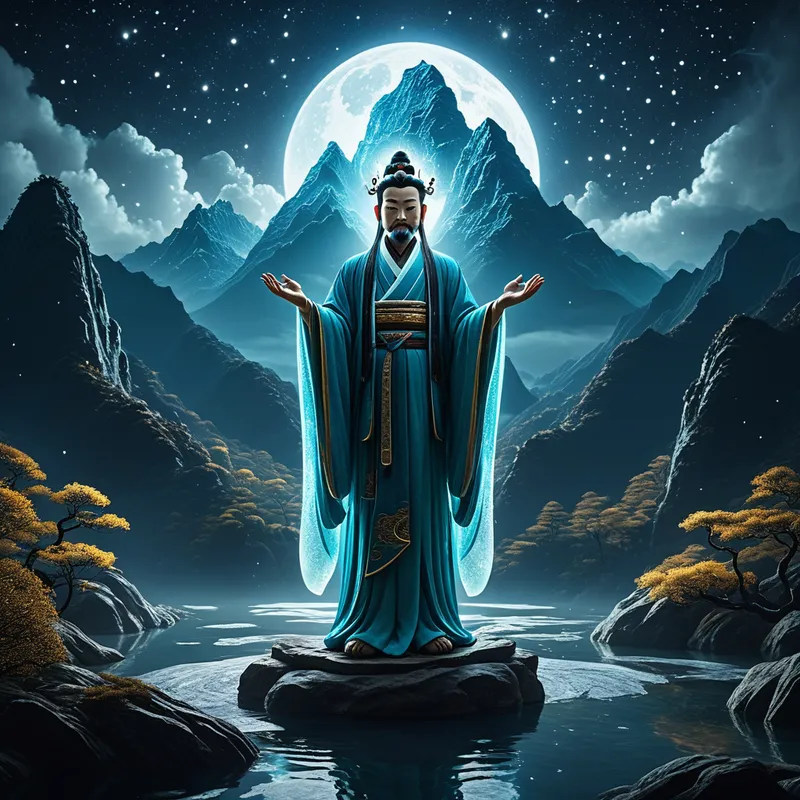
Before the Middle Kingdom had a name, when the mists of the Hundun still clung to the bones of the earth, there walked a solitary figure. He was known as the Shijie Yuanyi, and his footsteps did not echo, for he walked the seam between the solid and the spectral. His realm was the liminal space where mountain peaks dreamed of being clouds, and rivers yearned to be veins of jade.
He carried with him no grand tools, only a sack of humble river stones, a gourd of clear water, and a heart attuned to the whisper of roots. One day, he came upon a vast, silent plain beneath a sky heavy with unshed rain. The land was formless, a blank slate of dust and longing. A deep melancholy settled in the Gardener’s spirit. He saw not emptiness, but potential trapped in stillness—the scream of a mountain that could not rise, the silent song of a forest that could not grow.
Kneeling, he took a stone, rough and cold from a forgotten riverbed. He did not carve it with force, but held it, listening. His breath fogged its surface, and in that condensation, he saw the memory of a cliff face. With a touch as gentle as a falling leaf, he coaxed that memory outward. The stone yielded, not to strength, but to recognition, its form shifting to reveal a miniature crag, complete with the ghostly striations of ancient winds.
From his sack, he took a seed, a tiny, hard thing like a fleck of obsidian. He placed it in a crevice of the newborn rock and watered it not from his gourd, but with a single tear of concentration—a tear that held the essence of time and patience. The seed stirred. A filament of green, finer than a silk thread, emerged, seeking the light. It grew not with the frantic haste of the wild, but with deliberate, condensed intention, becoming a gnarled pine in the span of a single afternoon, its branches curling like calligraphy against the sky.
One by one, the Gardener repeated this act of profound attention. He gathered moss to be forests, flecks of mica to be lakes that reflected entire skies. He shaped not just landscapes, but worlds—complete with the illusion of distance, the feeling of altitude, the breath of humidity in a shaded grove. He built mountains that housed the spirit of the Kunlun, and fashioned winding paths that echoed the mysterious course of the Dao. In a space no larger than a spread of arms, he contained the awe of ten thousand li. He was not building a model, but performing a ceremony of containment, a sacred act of making the boundless, bounded; of making the cosmic, intimate.
When the final twist of “river” was laid with a sprinkle of silver sand, the Gardener sat back. The rain finally fell, but it fell only upon his creation, a gentle drizzle that beaded on the miniature leaves and filled the tiny ravines. In that moment, the first dragonfly of the world, drawn by the concentrated essence of place, alighted on a peak no taller than a finger. The myth tells us it was then that the great Shangdi looked down, and in seeing the infinite reflected in the finite, understood a new way to behold creation itself.
Cultural Origins & Context
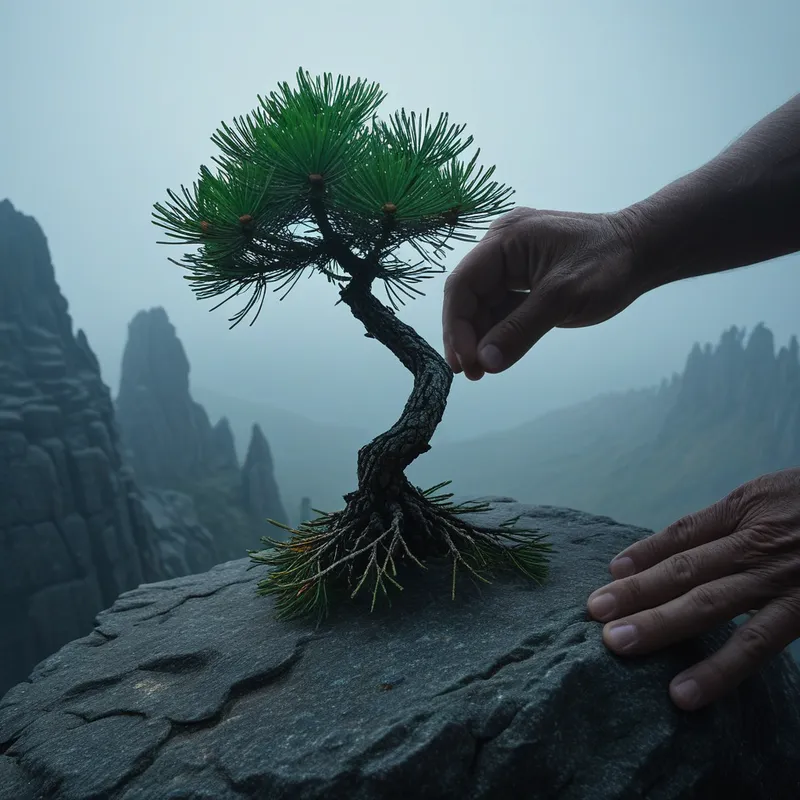
The story of Penjing, meaning “pot scenery” or “tray landscape,” is less a single codified myth and more a living, breathing cultural archetype that grew from the rich humus of Daoist and later Chan (Zen) Buddhist thought. It is a narrative embedded in practice, passed down not solely by bards but by masters to apprentices across generations of gardeners, poets, and scholars. Its origins are intertwined with the ancient Chinese spiritual pursuit of Dao, and the aesthetic principles of Qi and Shen in art.
The societal function of this “myth-in-action” was multifaceted. For the imperial court, a Penjing was a symbol of power—the ruler’s ability to contain and order the very world. For the scholar-recluse, it was a profound spiritual tool. In a society where long journeys were perilous, the miniature landscape on a desk allowed for a “travel of the spirit,” a woyou that cultivated the mind. It served as a physical anchor for meditation, a three-dimensional poem that expressed the core Daoist belief in the macrocosm existing within the microcosm. The myth legitimized and sanctified the art form, framing it not as hobby, but as a sacred dialogue with the fundamental principles of nature.
Symbolic Architecture
At its heart, the myth of Penjing is a profound allegory for the human relationship with nature, creativity, and the self. The Gardener is the archetypal creator, but his creation is one of collaboration, not imposition. He does not conquer the stone; he converses with it. This reflects the ideal of Wu Wei—acting in harmonious alignment with the intrinsic nature of things.
The miniature world is not a reduction of nature, but a concentration of it. It is the cosmos made comprehensible to the hand and the heart.
The river stone represents latent potential, the unformed Self. The seed is the spark of life, the nascent idea or instinct. The tear of concentration is the focused energy of consciousness—Yi—necessary to bring inner potential into manifested form. The resulting landscape is a symbol of the psyche itself: a contained, complete world with its towering heights (aspirations, the conscious ego), its deep valleys (the unconscious, the shadow), winding paths (the process of individuation), and still pools (the reflective Self).
The act of containment is the central psychological magic. It symbolizes the human need and ability to create meaning by drawing boundaries around the boundless—to give form to the formless contents of the soul. The dragonfly’s arrival signifies the moment when an inner creation becomes “real,” attracting life and spirit from the wider world, achieving Shen.
The Dreamer's Resonance
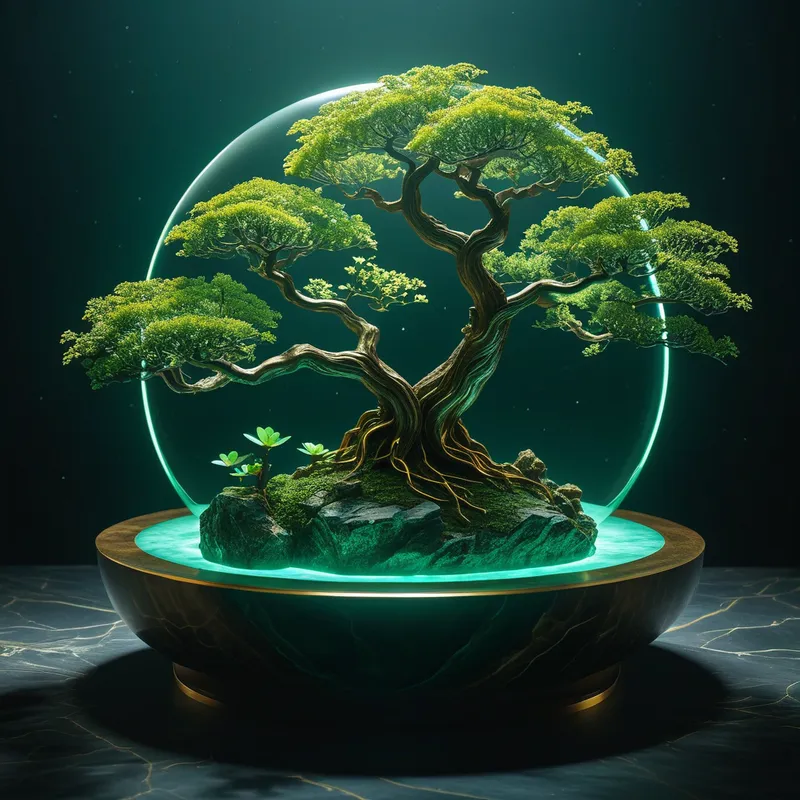
When a modern dreamer encounters Penjing—dreams of tending miniature trees, discovering tiny, perfect landscapes in a drawer, or being a giant observing a small, intricate world—they are engaging with a profound somatic process of inner organization and containment.
Such a dream often arises during periods of overwhelm, when the “world” (one’s responsibilities, emotions, or psychic material) feels too vast, chaotic, and unmanageable. The dream image is the psyche’s innate solution: it instinctively shrinks the cosmos of the problem down to a manageable scale. To dream of creating a Penjing is to dream of active self-cultivation. The dreamer is, in their unconscious, practicing the art of focusing their scattered Qi into a coherent, beautiful form. It is a somatic metaphor for integration.
Conversely, to dream of a neglected or dying Penjing landscape points to a feeling of inner neglect—a creative spirit withering, a personal world left untended. The dream calls for attention, for the restorative “water” of conscious care.
Alchemical Translation
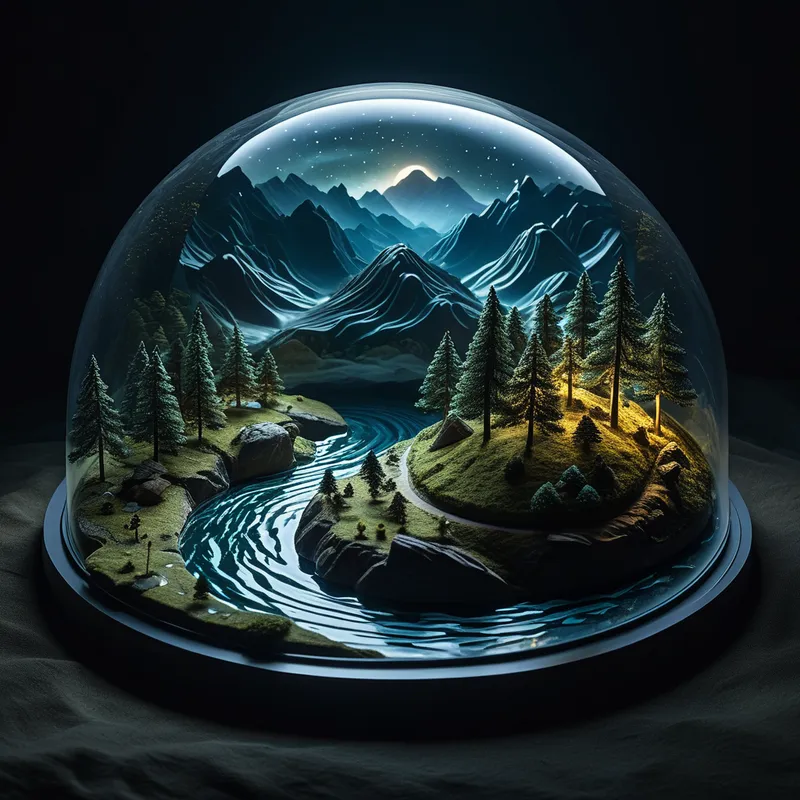
The myth of Penjing models the entire alchemical process of individuation—the Jungian journey toward psychic wholeness. The prima materia, the raw, chaotic stuff of the soul, is the formless plain and the rough stones. The Gardener’s conscious attention is the alchemist’s fire.
The first stage is containment (the vas or vessel). One must first create a sacred, bounded space for the work—the “tray” of introspection, therapy, or dedicated practice. Within this vessel, the work of circumambulation begins: examining the self from all angles, like the Gardener walking around his tray. The shaping of the landscape is the process of differentiation—pulling forth the mountain of the animus from the stone of parental complexes, coaxing the tree of personal growth from the seed of trauma.
Individuation is not about becoming enormous, but about becoming whole. It is the art of making your inner world so complete, intricate, and resonant that it reflects the entire human condition.
The final, and most crucial, alchemical translation is the shift from doing to being. The Gardener does not force; he facilitates. The goal is not to build a trophy, but to enter into a relationship with the creation until the boundary between cultivator and cultivated blurs. This is the unio mentalis, the mystical union. The perfected Penjing is the lapis philosophorum, the Philosopher’s Stone—which is not a stone, but a state of being. It is the achieved Self, a microcosm that perfectly mirrors the macrocosm, a small, contained world that, by virtue of its completeness, holds infinite depth. The modern individual’s triumph is not in conquering the external universe, but in successfully, lovingly, and attentively cultivating the universe within.
Associated Symbols
Explore related symbols from the CaleaDream lexicon: