
Paul of Tarsus Myth Meaning & Symbolism
A zealous persecutor of a new sect is struck blind by a divine vision, transforming into its most ardent apostle and architect.
The Tale of Paul of Tarsus
Listen. The story begins not with a saint, but with a storm. A man named Saul walked the earth with a fire in his belly, but it was a cold fire, a fire of absolute certainty. He was a man of two worlds: a citizen of Rome, yet a Pharisee of the Pharisees, a guardian of the ancestral law. A new whisper troubled the air of Judea—a whisper of a crucified peasant hailed as the Messiah. To Saul, this was not hope, but a blasphemous contagion. He breathed threats and murder against these followers of The Way.
He sought authority, received it, and set his face toward the city of Damascus, where the contagion had spread. The road was dust and heat, the journey a righteous purge. Then, at midday, the world shattered.
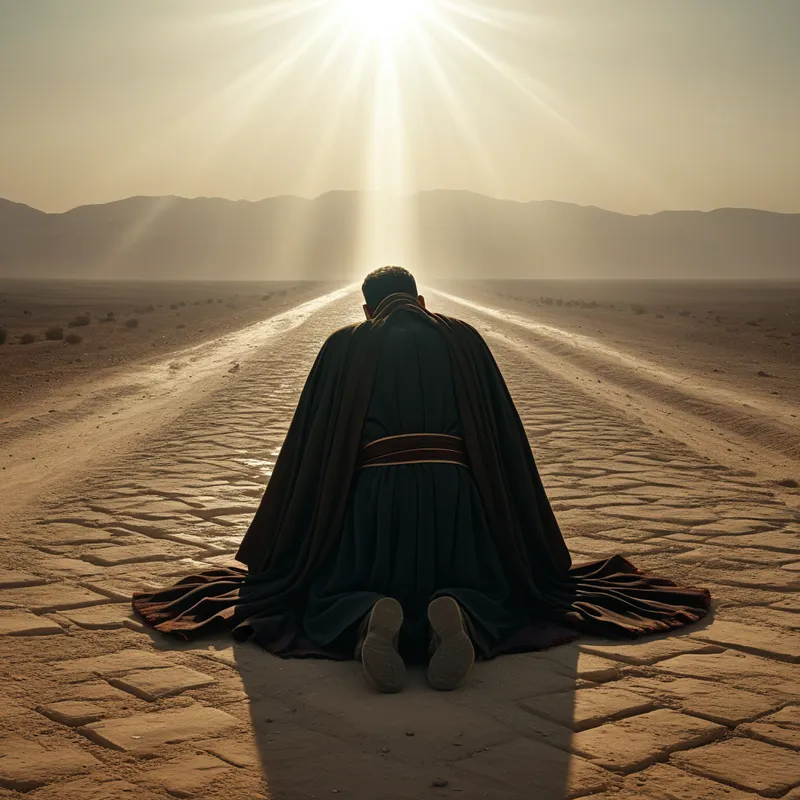
A light from heaven, brighter than the sun, exploded around him. He fell to the ground, the grit of the road pressing into his cheek. A voice spoke from the brilliance, a sound that vibrated in the marrow of his bones: “Saul, Saul, why do you persecute me?”
“Who are you, Lord?” he gasped, blind and trembling.
“I am Jesus.”
The words were not heard; they were etched. The man who knew everything was suddenly a child in utter darkness. His companions led him by the hand into Damascus, where for three days he neither ate nor drank, seeing nothing but the afterimage of that terrible, beautiful light. In that darkness, the architecture of his soul was dismantled.
In the city, a disciple named Ananias received a vision of his own, commanded to go to the very enemy he feared. He went, laid hands on Saul, and called him “Brother.” Something like scales fell from Saul’s eyes, and he saw again. But he did not see the same world. He was baptized. The fire in his belly remained, but its nature had been utterly inverted. The persecutor was gone. In his place stood Paul, the called one.
He did not retreat to silence. He went into the synagogues and proclaimed, “He is the Son of God.” The hunters now hunted him. He escaped Damascus in a basket lowered through a hole in the city wall. Thus began the great odyssey: shipwrecks and stonings, prisons and parchments, journeys across the known world. He walked between temples and marketplaces, arguing with philosophers in Athens and weaving tents in Corinth, penning letters that would become the theological spine of a faith he once tried to bury. He became all things to all people, a vessel utterly remade, carrying the message of the light that had struck him blind until his own journey ended in the shadow of Rome’s sword.
Cultural Origins & Context
This is not a legend from a distant, misty past, but a foundational narrative born in the first turbulent century of the Common Era. The myth of Paul is primarily transmitted through the text of the Acts of the Apostles and the collection of his own Epistles. These were documents of community formation, read aloud in early house churches. The story was told by evangelists and teachers to explain the seemingly impossible: how the faith’s most virulent enemy became its most prolific architect.
Its societal function was multifaceted. For early communities facing persecution, it was a testament to the power of divine reversal—no one was beyond redemption. For a movement struggling to define its relationship with Jewish law and the non-Jewish world, Paul’s biography embodied the crisis and its resolution. He was the archetypal boundary-crosser: a Jew deeply trained in the law who argued for the inclusion of Gentiles without requiring full conversion to Judaism. His story legitimized the radical, universalizing trajectory of the early church, transforming a Jewish sect into a potential world religion.
Symbolic Architecture
At its core, the myth of Paul is the ultimate drama of metanoia—a fundamental turning of the mind and soul. It is not a gentle evolution but a violent, gracious seizure of the psyche by a reality it refused to see.
The most dangerous prison is the fortress of absolute conviction. Liberation often arrives not as a key, but as a cataclysm that shatters the walls.
Saul represents the ego at its most rigid, identified entirely with a religious and ideological persona. The Damascus event is the eruption of the Self into ego-consciousness. The blinding light is a classic symbol of overwhelming numinosity, a truth so potent it destroys the capacity for old ways of seeing. The three days of blindness are a symbolic death and gestation in the womb of the unconscious. Ananias represents the necessary human mediator, the community that must welcome the transformed self back into the world. Paul’s subsequent life—his travels, writings, and sufferings—symbolizes the arduous process of integrating this shattering revelation into a new, coherent, and purposeful identity.

The Dreamer’s Resonance
When this mythic pattern stirs in the modern dreamer, it signals a profound psychic upheaval. To dream of being struck blind by a light, or of falling from a horse (a later tradition added to the story), speaks to a foundational worldview being forcibly dismantled. The somatic experience is often one of disorientation, vertigo, or a feeling of being “brought to your knees” by an insight or life event.
Psychologically, the dreamer is in the grip of a necessary, but deeply uncomfortable, conversion process. It may relate to a career, a relationship, a political belief, or a core identity that has become a persecutory force, stifling other parts of the self. The dream announces that the psyche’s own guiding center (the Self) is intervening to break a pathological identification. The subsequent phase—the “blindness” or confusion—is not punishment, but the fertile void where the new orientation must form. Dreaming of receiving help from an unexpected or feared source (an Ananias figure) suggests the emerging need for external support to integrate this radical change.

Alchemical Translation
The alchemical journey of Paul is a master map for individuation. It begins with nigredo, the blackening: Saul’s fervent persecution is a state of psychic one-sidedness, a leaden, destructive certainty. The divine encounter is the mortificatio—the death of the old, rigid personality.
The spirit does not negotiate with the prison-warden self; it invades, shatters, and rebuilds from the rubble.
The blindness represents the solutio, dissolution into the unconscious waters, where all former structures are melted down. Ananias’s healing touch is the albedo, the whitening, the first glimpse of a purified, clarified new consciousness. Paul’s lifelong mission embodies the final stages: citrinitas (the yellowing, the spreading of this insight through work and word) and rubedo (the reddening, the full embodiment of the transformed self, often through suffering and ultimate sacrifice).
For the modern individual, this myth does not counsel waiting for a heavenly light. It illustrates the psychic truth that profound growth is often precipitated by a crisis that feels like an attack on one’s very identity. The alchemical work is to endure the blinding confusion, to accept the death of a former “certain” self, and to have the courage to be led into a new city of meaning—to become the apostle of your own deepest, and perhaps once most persecuted, truth.
Associated Symbols
Explore related symbols from the CaleaDream lexicon: