Paschal Candle Myth Meaning & Symbolism
A single flame, kindled from primordial darkness, journeys through the night to proclaim a victory over death, becoming the enduring light of the world.
The Tale of Paschal Candle
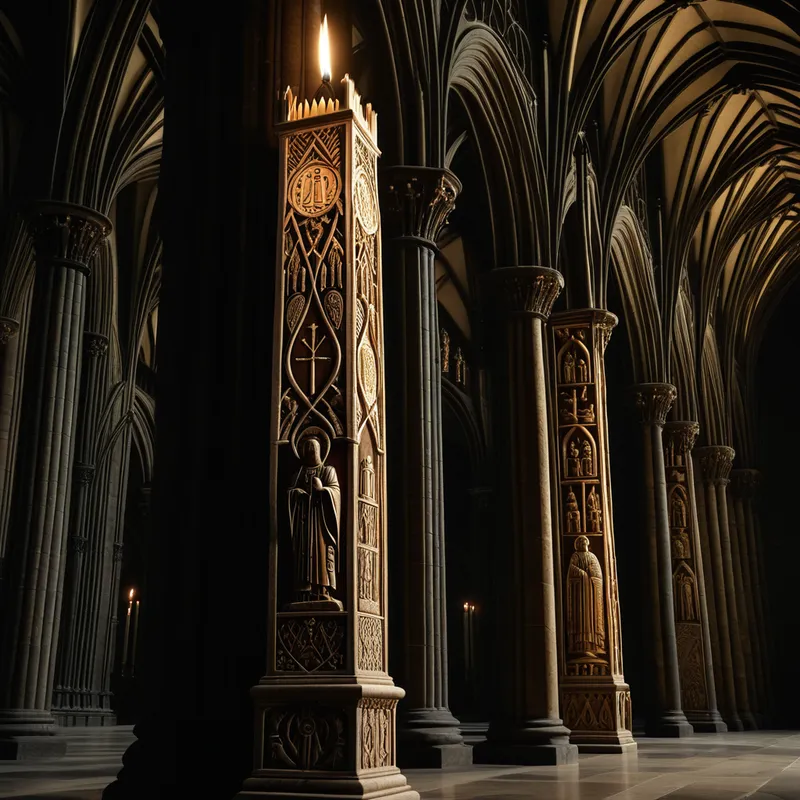
Listen. There is a night unlike any other. A night so deep and total that [the world](/myths/the-world “Myth from Tarot culture.”/) itself seems to have forgotten the sun. The great stone vaults of the cathedral are swallowed by this darkness, a living, breathing void that presses upon the shoulders of the gathered people. They are a sea of shadows, holding their breath. Outside, the chaos of a world without order reigns. But here, within, they wait at the tomb of hope.
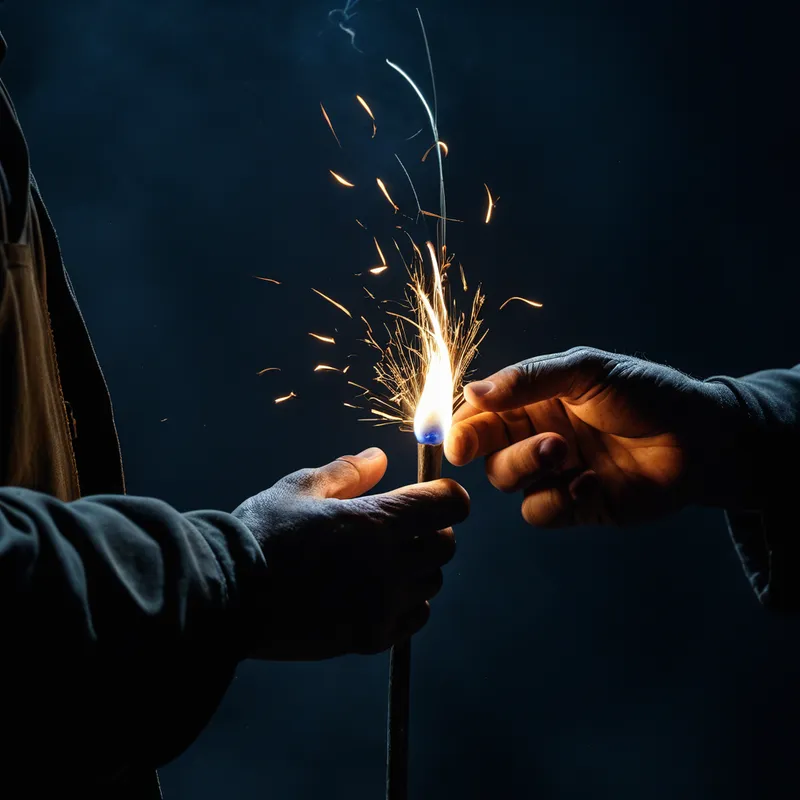
Then, a sound splits the silence—the sharp, dry crack of flint on steel. Once. Twice. A third time. A spark, a tiny, defiant star, is born in [the abyss](/myths/the-abyss “Myth from Kabbalistic culture.”/). It falls onto a nest of prepared tinder and catches. A fragile, trembling flame awakens. It is the Lumen Christi—the Light of Christ. A collective sigh, half relief, half awe, ripples through the darkness.
This is no ordinary fire. It is fire drawn from the very stone, a light wrested from the heart of darkness. From this primal spark, the deacon lights a single, massive candle—the Paschal Candle. It is a pillar of pure beeswax, marked with the wounds of time: the cross, the Alpha and Omega, the numerals of the present year. Into its very flesh, five grains of incense are thrust, remembering the perfumed spices of burial and the wounds of sacrifice.
“Christ our Light!” the deacon sings, his voice a lone trumpet in [the void](/myths/the-void “Myth from Buddhist culture.”/). The people respond, “Thanks be to God!” The candle, now a sovereign of light, begins its procession. It is a journey through the kingdom of night. The darkness recoils before its advance. The people, each lighting their own small taper from this one great source, become a river of stars flowing into the nave. The lone flame multiplies, until the entire vault, once a tomb, is a galaxy of soft, golden light. The single candle takes its place by the ambo, a sun around which this new cosmos orbits. It stands through the long vigil of readings, through the story of creation from chaos, through the parting of seas and the promise of dry bones. It burns as a silent witness, a declaration that the long, cosmic winter is over. The Light has entered the world, and the darkness has not, cannot, will not overcome it.
Cultural Origins & Context
The ritual of the Paschal Candle is not a medieval invention but a profound synthesis of ancient human impulses woven into the fabric of Christian liturgy. Its roots sink deep into the Jewish Passover, the Pesach, a night of vigil marked by lamplight and remembrance of liberation from bondage. Early Christians, many of whom were Jewish, naturally saw the death and resurrection of [Jesus](/myths/jesus “Myth from Christian culture.”/) through this lens—the ultimate Passover from death to life.
By the 4th century, as Christianity emerged from persecution, the Easter Vigil developed into the most spectacular liturgy of the year. The kindling of the new fire became its dramatic opening act. In a world lit only by flame, the sudden creation of light in a pitch-dark church was a visceral, unforgettable experience of the gospel narrative. The candle itself, originally a practical necessity for reading scriptures through the long night, was gradually ritualized and symbolically enriched. The marking of the candle, the insertion of the incense grains, and the triumphant Exsultet hymn—sung by the deacon in its praise—formalized a living myth in ritual action. It was a story told not just with words, but with scent, sight, and the shared somatic experience of emerging from darkness into a community ablaze with borrowed light.
Symbolic Architecture
The Paschal [Candle](/symbols/candle “Symbol: Candles symbolize illumination, hope, and spiritual guidance, often representing the light within amidst darkness.”/) is a dense, [multi](/symbols/multi “Symbol: Multi signifies multiplicity and diversity, often representing various aspects of life or identity in dreams.”/)-layered [symbol](/symbols/symbol “Symbol: A symbol can represent an idea, concept, or belief, serving as a powerful tool for communication and understanding.”/), a vertical [axis](/symbols/axis “Symbol: A central line or principle around which things revolve, representing stability, orientation, and the fundamental structure of reality or consciousness.”/) connecting the [depths](/symbols/depths “Symbol: Represents the subconscious, hidden emotions, or foundational aspects of the self, often linked to primal fears or profound truths.”/) of the [earth](/symbols/earth “Symbol: The symbol of Earth often represents grounding, stability, and the physical realm, embodying a connection to nature and the innate support it provides.”/) to the [heights](/symbols/heights “Symbol: Represents ambition, fear, or spiritual elevation. Often symbolizes life challenges or a desire for perspective.”/) of the [spirit](/symbols/spirit “Symbol: Spirit symbolizes the essence of life, vitality, and the spiritual journey of the individual.”/). It is, first and foremost, a pillar of [presence](/symbols/presence “Symbol: Presence in dreams often signifies awareness or acknowledgment of something significant in one’s life.”/). The beeswax, produced by the collective labor of the [hive](/symbols/hive “Symbol: A symbol of collective society, organized productivity, and communal interdependence, often representing both harmonious cooperation and potential loss of individuality.”/), symbolizes the pure, incarnate humanity of Christ—[nature](/symbols/nature “Symbol: Nature symbolizes growth, connectivity, and the primal forces of existence.”/) offered and transformed. The single flame is the irreducible point of divine [consciousness](/symbols/consciousness “Symbol: Consciousness represents the state of awareness and perception, encompassing thoughts, feelings, and experiences.”/), the scintilla that cannot be extinguished.
The light does not deny the darkness; it is born from friction with it. The victory is not in the absence of night, but in the kindling of a witness within it.
The five wounds of [incense](/symbols/incense “Symbol: Incense represents spiritual communication, purification, and the transformation of the material into the ethereal through smoke.”/) speak directly to the [psychology](/symbols/psychology “Symbol: Psychology in dreams often represents the exploration of the self, the subconscious mind, and emotional conflicts.”/) of transformation. They signify that wholeness—sanctity, enlightenment, individuation—is not achieved by avoiding suffering or erasing scars, but by integrating them. The wounds become the very points where sacred fragrance is released. The [Alpha](/symbols/alpha “Symbol: The first letter of the Greek alphabet, often representing beginnings, leadership, dominance, or the highest rank in competitive systems.”/) and Omega etched upon it declare this process to be the beginning and end of the meaningful [journey](/symbols/journey “Symbol: A journey in dreams typically signifies adventure, growth, or a significant life transition.”/), the arc of a complete [life](/symbols/life “Symbol: The symbol of ‘Life’ represents a journey of growth, interconnectedness, and existential meaning, encompassing both the joys and challenges that define human experience.”/). The candle is thus the axis mundi of the personal [psyche](/myths/psyche “Myth from Greek culture.”/): the central, stabilizing pillar around which the [chaos](/symbols/chaos “Symbol: In Arts & Music, chaos represents raw creative potential, uncontrolled expression, and the breakdown of order to forge new artistic forms.”/) of the unconscious (the darkness) is organized and made meaningful by the illuminating flame of conscious [awareness](/symbols/awareness “Symbol: Conscious perception of self, surroundings, or internal states. Often signifies awakening, insight, or heightened sensitivity.”/).
The Dreamer’s Resonance
To dream of the Paschal Candle is to encounter a symbol of [the Self](/myths/the-self “Myth from Jungian culture.”/) in its most consolidating aspect. It often appears during periods of profound disorientation, grief, or existential crisis—the “dark night of the soul.” The dream setting is typically one of vast, empty spaces: a derelict cathedral, an endless plain at night, the bottom of a sea trench. The dreamer is alone in consuming darkness.
The act of lighting the candle, or struggling to protect its fragile flame from a howling wind, becomes the central drama. This is the psyche’s ritual. The somatic feeling is crucial: the relief when the flame catches, the anxiety as it gutters, the warmth that spreads from its light. This dream signals that [the ego](/myths/the-ego “Myth from Jungian culture.”/), lost in the darkness of a depression, a trauma, or a life transition, is attempting to re-establish a connection to the inner center, the guiding Self. The candle’s light does not reveal the path forward in the dream; instead, it simply establishes a point of orientation. “Here I am. Here is a center. From this fixed point, I can begin to see.”
Alchemical Translation
The myth of the Paschal Candle is a perfect map for the alchemical opus, the work of individuation. The ritual begins in [nigredo](/myths/nigredo “Myth from Alchemical culture.”/)—the blackening, the state of confusion, despair, and primal unity with [the shadow](/myths/the-shadow “Myth from Jungian culture.”/). The striking of the flint is the coniunctio oppositorum, [the sacred marriage](/myths/the-sacred-marriage “Myth from Various culture.”/) of opposites (stone and steel, will and resistance) that generates the liberating spark of insight.
The alchemical gold is not manufactured; it is discovered, already present in the leaden mass of our suffering, awaiting the flame of attention.
The lighting of the candle from the new fire is the birth of the filius philosophorum, the divine child or true Self, from the murk of the unconscious. Its procession through the church is the conscious integration of this new awareness into all the “chapels” of the personality. The sharing of the light, where one flame lights many without diminishing itself, represents the stage of [rubedo](/myths/rubedo “Myth from Alchemical culture.”/)—the reddening, where the integrated Self radiates its influence into relationships and the world, not by proselytizing, but by simple, contagious presence. Finally, the candle burning steadfastly through the long vigil symbolizes the enduring, vigilant consciousness required to hold the center against the perpetual pull of forgetfulness and fragmentation. The individual becomes, like the candle, a living lumen Christi—not a source of their own light, but a faithful witness to the Light that kindled them, a stable pillar around which a coherent and meaningful life is built.
Associated Symbols
Explore related symbols from the CaleaDream lexicon: