Papa Legba
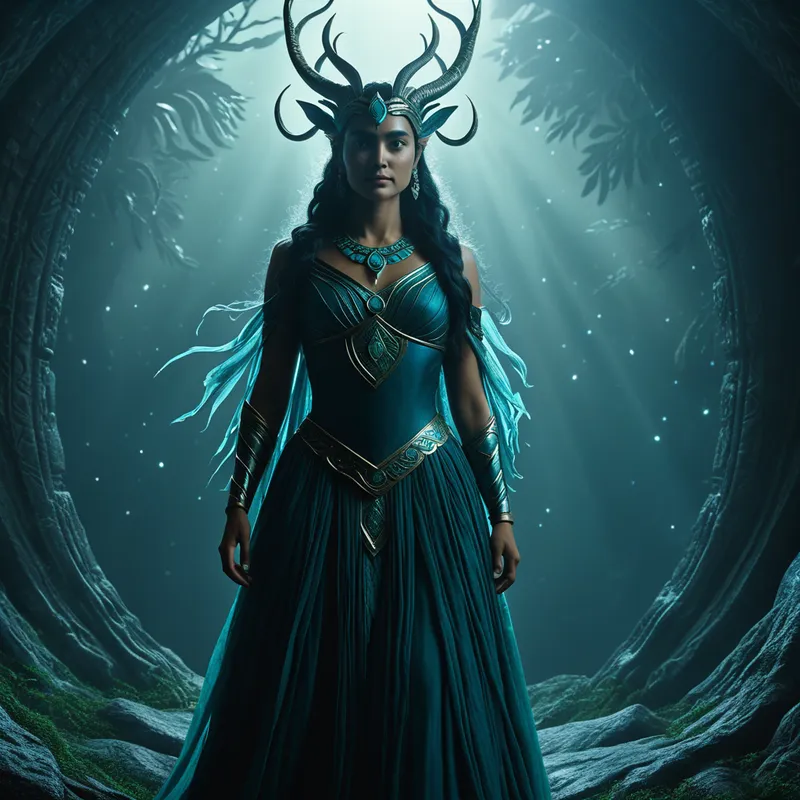
The crossroads guardian and trickster deity who controls communication between worlds, fate, and destiny in African Diaspora traditions.
The Tale of Papa Legba
Before the first word is spoken, before the first prayer is offered, one must stand at [the crossroads](/myths/the-crossroads “Myth from Celtic culture.”/). Here, where the dust of four paths mingles under a twilight sky, an old man waits. He leans on a crutch, his clothes tattered, his face a map of deep wrinkles and ancient laughter. A pipe smolders between his lips, and from his belt hangs a heavy ring of iron keys. This is Papa [Legba](/myths/legba “Myth from African Diaspora culture.”/).
He is the first and the last. In the rituals of Vodou and the related traditions of the diaspora, no spirit, no lwa, can be approached without his permission. He is the gatekeeper, the linguist of the divine. The prayers of the living are a babble of human tongues; the language of the spirits is the rustle of leaves, the crackle of fire, the silent speech of the stars. Legba translates. He takes the plea, the song, the desperate cry, and he opens the door—la porte—between the worlds. With a turn of his key, [the veil](/myths/the-veil “Myth from Various culture.”/) parts, and the mighty lwa may ride their horses, the human devotees who welcome them into their bodies.
But do not mistake his necessity for simplicity. Legba is a trickster. His help is not a transaction but a relationship, often negotiated with riddles and tests. He may appear as a feeble beggar at a [crossroads](/myths/crossroads “Myth from Celtic culture.”/), asking for a share of your rum or a pinch of your tobacco. To refuse him is to find your path home endlessly convoluted, your message forever lost. To give with an open heart, to see the divine in the seemingly infirm, is to receive his blessing: a clear road, a delivered message, a sudden understanding that cuts through confusion like a lantern in fog. He controls the flow of all things—words, fates, opportunities. A chance meeting, a missed turn, a whispered secret that changes everything—these are the fingerprints of Papa Legba, playing his silent tune on the hinges of destiny.
Cultural Origins & Context
Papa Legba’s roots sink deep into the soil of West Africa, particularly among the Fon and Ewe peoples of Dahomey (modern-day Benin and Togo). There, he is known as Legba or Elegba, a pivotal deity in the Yoruba-influenced [pantheon](/myths/pantheon “Myth from Roman culture.”/). He is the messenger of the gods, the divine linguist, and the master of roads and crossroads. His iconic symbol, a phallic clay mound often placed at village entrances, speaks to his role as a conduit of life force and a protector of boundaries.
The [Middle Passage](/myths/middle-passage “Myth from African Diaspora culture.”/) did not drown this spirit; it transformed him. In the brutal crucible of slavery, where diverse African ethnicities were forcibly blended in the Caribbean and the Americas, Legba survived. He became a [cornerstone](/myths/cornerstone “Myth from Biblical culture.”/) of the new syncretic spiritual systems forged in resistance and remembrance. In Haitian Vodou, he is Papa Legba, often syncretized with [Saint Peter](/myths/saint-peter “Myth from Christian culture.”/), who holds the [keys to the Kingdom](/myths/keys-to-the-kingdom “Myth from Christian culture.”/) of Heaven. In Brazilian Candomblé, he is Exu, a more volatile and explicitly trickster figure guarding the crossroads. In Cuban Santería (Lucumí), he is Eleguá, [the child](/myths/the-child “Myth from Alchemy culture.”/)-like but powerful opener of ways.
This diaspora context is crucial. Legba is the spirit of communication in a reality defined by rupture—the rupture from homeland, from language, from family. He became the psychic and spiritual infrastructure necessary to maintain connection: connection to the ancestral African gods, connection between the enslaved community, and connection between the visible and invisible worlds. He is the answer to a profound cultural need: to keep the lines open when every material condition conspired to shut them down.
Symbolic Architecture
Papa Legba is not merely a [character](/symbols/character “Symbol: Characters in dreams often signify different aspects of the dreamer’s personality or influences in their life.”/) in a myth; he is an operating [system](/symbols/system “Symbol: A system represents structure, organization, and interrelated components functioning together, often reflecting personal or social order.”/) for navigating a multidimensional [reality](/symbols/reality “Symbol: Reality signifies the state of existence and perception, often reflecting one’s understanding of truth and life experiences.”/). He embodies [the principle](/symbols/the-principle “Symbol: A fundamental truth, law, or doctrine that serves as a foundation for a system of belief, behavior, or reasoning, often representing moral or ethical standards.”/) of interface.
He is the living synapse between the human nervous system and the divine current, the necessary transformer that steps down infinite voltage into a frequency the mortal mind can bear.
His [crutch](/symbols/crutch “Symbol: A symbol of temporary support, vulnerability, and the need for assistance during physical or emotional healing.”/) signifies not weakness, but the third point that creates [stability](/symbols/stability “Symbol: A state of firmness, balance, and resistance to change, often represented by solid objects, foundations, or steady tools.”/)—the triangulation of [human](/symbols/human “Symbol: The symbol of a human represents individuality, complexity of emotions, and social relationships.”/), [spirit](/symbols/spirit “Symbol: Spirit symbolizes the essence of life, vitality, and the spiritual journey of the individual.”/), and the [space](/symbols/space “Symbol: Dreaming of ‘Space’ often symbolizes the vastness of potential, personal freedom, or feelings of isolation and exploration in one’s life.”/) between. It is the [axis](/symbols/axis “Symbol: A central line or principle around which things revolve, representing stability, orientation, and the fundamental structure of reality or consciousness.”/) upon which worlds pivot. The [crossroads](/symbols/crossroads “Symbol: A powerful spiritual symbol representing a critical decision point where paths diverge, often associated with fate, transformation, and life-altering choices.”/) themselves are his primary [temple](/symbols/temple “Symbol: A temple often symbolizes spirituality, sanctuary, and a deep connection to the sacred aspects of life.”/)—a place of pure potential, of [choice](/symbols/choice “Symbol: The concept of choice often embodies decision-making, freedom, and the multitude of paths available in life.”/) and [chance](/symbols/chance “Symbol: A representation of opportunities and unpredictability in life, illustrating how fate can influence one’s journey.”/), where [linear](/symbols/linear “Symbol: Represents order, predictability, and a direct, step-by-step progression. It symbolizes a clear path from cause to effect.”/) time and singular [destiny](/symbols/destiny “Symbol: A predetermined course of events or ultimate purpose, often linked to spiritual forces or cosmic order, representing life’s inherent direction.”/) dissolve into a field of possibilities. To stand there is to stand in Legba’s [presence](/symbols/presence “Symbol: Presence in dreams often signifies awareness or acknowledgment of something significant in one’s life.”/), at the [junction](/symbols/junction “Symbol: A point of convergence, decision, or transition where paths meet, representing choices, opportunities, or life changes.”/) of past, present, and future; of the physical, spiritual, and psychological realms.
His [trickster](/symbols/trickster “Symbol: A boundary-crossing archetype representing chaos, transformation, and the subversion of norms through cunning and humor.”/) [nature](/symbols/nature “Symbol: Nature symbolizes growth, connectivity, and the primal forces of existence.”/) is not mere mischief but a profound pedagogical tool. He teaches that the [path](/symbols/path “Symbol: The ‘path’ symbolizes a journey, choices, and the direction one’s life is taking, often representing individual growth and exploration.”/) to the sacred is not always straight, that wisdom often comes disguised as [folly](/symbols/folly “Symbol: Folly represents whimsical, often impractical architecture that challenges traditional norms, symbolizing human folly and pride.”/), and that the gatekeeper must be respected on his own terms. He inverts expectations to reveal deeper truths. He guards the [door](/symbols/door “Symbol: A door symbolizes transition, opportunity, and choices, representing thresholds between different states of being or experiences.”/) because what lies beyond is powerful and potentially overwhelming; his tricks test the readiness, humility, and discernment of the [seeker](/symbols/seeker “Symbol: A person actively searching for meaning, truth, or a higher purpose, often representing the dreamer’s own quest for identity or fulfillment.”/).
The Dreamer’s Resonance
To encounter Papa Legba in the inner landscape is to stand at a personal crossroads. Psychologically, he represents the critical function of the [psyche](/myths/psyche “Myth from Greek culture.”/) that mediates between the conscious ego and the vast, unconscious totality—[the Self](/myths/the-self “Myth from Jungian culture.”/), in Jungian terms. He is the archetypal threshold guardian encountered at the outset of any profound transformation.
When one dreams of a forgotten path, a locked door for which a key is suddenly found, or an enigmatic old figure offering a cryptic choice, Legba is at work. He presides over those moments in life where a decision irrevocably alters one’s destiny: to speak or stay silent, to stay or go, to accept or reject an offer. He is the psychic faculty that allows for introspection, for the “communication” between our daily [persona](/myths/persona “Myth from Greek culture.”/) and our deeper instincts, complexes, and ancestral memories.
His resonance is felt in the anxiety and excitement of possibility, in the gut-knowing that one is at a turning point. To ignore this inner Legba is to feel stuck, unheard, and disconnected from one’s own fate. To engage with him—to make the offering of attention, to sit with the uncertainty of the crossroads—is to activate the psyche’s innate capacity to dialogue with the depths and to find the right word, the right symbol, the right path forward.
Alchemical Translation
In the alchemy of the soul, Papa Legba is the [prima materia](/myths/prima-materia “Myth from Alchemical culture.”/) at the crossroads, the mercurial spirit that initiates all work. He is the essential first step of [separatio](/myths/separatio “Myth from Alchemical culture.”/)—the division that must occur before any new synthesis can be achieved.
He is the catalyst without which no reaction proceeds, the spark in the interstitial space between elements. To invoke Legba is to consent to the dissolution of old, rigid structures of meaning so that new communication can be born.
His alchemical role is that of the [psychopomp](/myths/psychopomp “Myth from Greek culture.”/), not of the dead, but of living meaning. He guides intentions across [the threshold](/myths/the-threshold “Myth from Folklore culture.”/) from latent potential into manifest reality. The “keys” he holds are symbolic codes, the precise images or insights that unlock a stalled developmental process. The trick he plays is the necessary disillusionment, the shattering of a naive fantasy that allows for a more grounded, authentic relationship with the sacred and with oneself.
The ultimate alchemy he oversees is the transformation of noise into message, of fate into destiny. Fate is the road laid out; destiny is the road walked with awareness. Legba controls the gate between them. He teaches that while we may not control the roads that appear before us, we are in constant dialogue with the guardian who reveals them, and the quality of that dialogue shapes the journey itself.
Associated Symbols
Explore related symbols from the CaleaDream lexicon:
- Crossroads — The sacred junction of possibilities, the place of decision and encounter with the unknown, where worlds and fates intersect.
- Key — The instrument of opening and access, representing the solution, the code, or the permission needed to unlock hidden realms or potentials.
- Door — The threshold between states of being, a barrier that is also a passage, guarded by the liminal consciousness.
- Trickster — The archetypal agent of change, [chaos](/myths/chaos “Myth from Greek culture.”/), and revelation who breaks rigid order to expose deeper truths and fluid possibilities.
- Fate — The woven threads of causality and consequence, the predetermined pattern that the guardian of thresholds both reveals and allows one to navigate.
- Message — The unit of meaning in transit between realms, carried by the mediator who ensures its delivery and correct interpretation.
- Bridge — A constructed span over a divide, symbolizing the conscious connection made between separated shores of experience or identity.
- Mask — The persona or guise worn by the divine, especially [the trickster](/myths/the-trickster “Myth from Various culture.”/), concealing infinite potential behind a specific, approachable face.
- Journey — The fundamental movement along a path, undertaken only after the gatekeeper’s blessing, representing the soul’s progression through experience.
- Destiny — The personal, lived engagement with fate, the path as actually walked and shaped by the choices made at each crossroads.