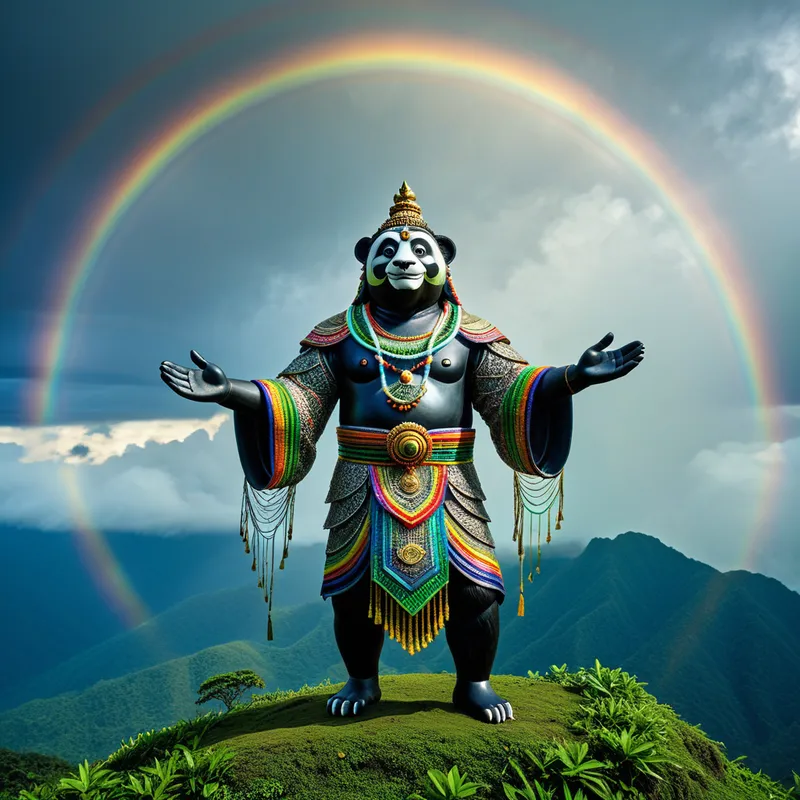
Pandaque the Rainbow Deity Myth Meaning & Symbolism
A myth of a deity born from strife, who weaves a bridge of light to reconcile the sundered realms of Sky and Earth.
The Tale of Pandaque the Rainbow Deity
Listen, and let the old winds carry you back to the First Days, when the world was a raw and weeping thing. In the beginning, there was only Kaptan of the Sky, and Magwayen of the Sea and Earth. Their love was the first song, a harmony that birthed islands from the deep and hung stars like fruits from the celestial vine. But love, in its immensity, can turn to a pride as vast as the horizons.
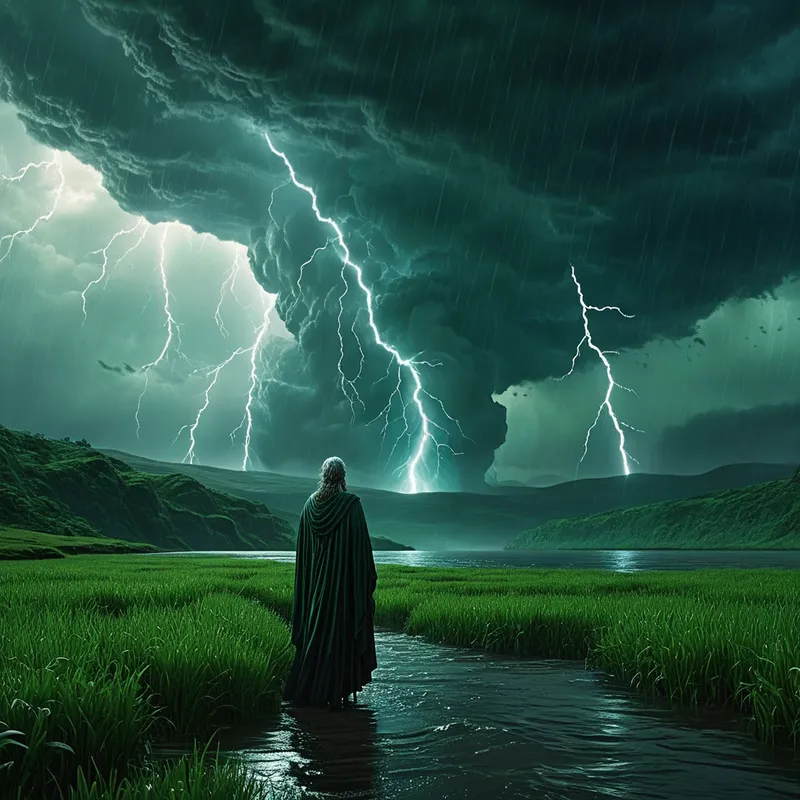
A great quarrel erupted, born from a word misunderstood, a glance taken as challenge. Kaptan’s voice became the thunder, shaking the pillars of heaven. Magwayen’s sorrow became the deluge, her tears swelling the seas to drown the mountains. In his rage, Kaptan seized the sun and the moon, casting the world into a perpetual, angry twilight. In her grief, Magwayen withdrew her fertility, and the land became a skeletal husk, the rivers running salty with her weeping.
Between them, in the churning, chaotic space where storm met flood, a new presence coalesced. Not born of their union, but of their separation. From the prism of their clashing sorrow—the light of Kaptan’s stolen stars fractured by the tears of Magwayen—a being of pure, reconciling light was woven. This was Pandaque. They had no form that could be held, only a presence that could be felt: a sigh of color in the gloom, a promise whispered on the wind.
Pandaque beheld their parents, these titans of creation, now architects of desolation. The Sky, proud and desolate, aching in its empty victory. The Earth, wounded and barren, drowning in her own lament. The silence between them was a wider gulf than any ocean.
So Pandaque began to dance. A slow, deliberate dance across the bruised sky. Where their feet touched the tumult, the chaos stilled. They stretched their being, an arc of impossible gentleness, from the highest, storm-wracked peak where Kaptan brooded, down to the deepest, salt-choked valley where Magwayen mourned. They became a bridge. Not of stone or wood, but of refracted light—red of heart’s blood, orange of ember’s hope, yellow of dawning understanding, green of returning life, blue of deep forgiveness, indigo of solemn vow, violet of transcendent peace.
Across this bridge of seven hues, a new sound traveled. Not the crash of thunder, nor the sob of the sea, but the first birdsong after a storm. The scent of damp soil, rich with potential, rose. Kaptan, from his end of the bridge, felt the warmth of the colors and remembered the warmth of love. Magwayen, from hers, felt the light penetrate her depths and remembered the light of life.
They did not speak. Words had broken them. Instead, Kaptan let a single, clear drop of rain—not of anger, but of release—fall. It traced the curve of Pandaque’s arch, catching fire from each color, and landed on Magwayen’s soil. Where it fell, a single, resilient shoot of bamboo pushed forth, its segments a ladder of green.
The bridge remained, a covenant written in light. Pandaque did not vanish but became a condition of the world. Now, after every conflict of elements, after every storm of passion or flood of grief, they appear. A silent testament that from the very matter of our clashes, a bridge back to each other can be woven. A reminder that the most beautiful creations are often born not in unity, but in the heartfelt mending of a rift.
Cultural Origins & Context
The narrative of Pandaque finds its roots in the pre-colonial mythologies of the Philippine archipelago, particularly among Visayan and some Mindanaoan oral traditions. It is a myth that belongs to the complex tapestry of Anitism, where the natural world is imbued with spirit (anito) and deities ([diwata](/myths/diwata “Myth from Filipino culture.”/)) are intimately tied to ecological and cosmological phenomena.
Unlike myths centered on human-like heroes, Pandaque’s story is an elemental one, passed down not as a chronicle of deeds but as an explanation for a sublime natural occurrence—the rainbow. It was likely recounted by babaylan (shaman-priestesses) and community elders during times of seasonal transition, after typhoons, or during rituals aimed at restoring harmony (pagkakaisa) within a community or with the environment. Its function was deeply societal: to model reconciliation. In a culture where community (bayanihan) is paramount, the myth served as a divine parable for conflict resolution. It taught that even the most profound rifts—between families, clans, or humanity and nature—could be bridged by an act of conscious, beautiful creation that acknowledges the pain of both sides.
Symbolic Architecture
At its core, Pandaque is the [archetype](/symbols/archetype “Symbol: A universal, primordial pattern or prototype in the collective unconscious that shapes human experience, behavior, and creative expression.”/) of the reconciling third. They are not a [child](/symbols/child “Symbol: The child symbolizes innocence, vulnerability, and potential growth, often representing the dreamer’s inner child or unresolved issues from childhood.”/) of Sky and [Earth](/symbols/earth “Symbol: The symbol of Earth often represents grounding, stability, and the physical realm, embodying a connection to nature and the innate support it provides.”/) in the traditional sense, but the child of their conflict. This is a profound psychological [truth](/symbols/truth “Symbol: Truth represents authenticity, honesty, and the quest for knowledge beyond mere appearances.”/): the [solution](/symbols/solution “Symbol: A solution symbolizes resolution, clarity, and the overcoming of obstacles, often representing a sense of accomplishment.”/) to a deep schism often arises from the schism itself, not from a return to a prior, forgotten state.
The bridge does not deny the chasm; it is the chasm made beautiful and traversable.
Pandaque symbolizes the active principle of reconciliation. They are not a passive [peace](/symbols/peace “Symbol: Peace represents a state of tranquility and harmony, both internally and externally, often reflecting a desire for resolution and serenity in one’s life.”/), but a dynamic, creative force that must do something—dance, stretch, become. The [Rainbow](/symbols/rainbow “Symbol: Rainbows symbolize hope, promise, and the beauty found after turmoil, often viewed as a bridge between the earthly and divine.”/) itself is the perfect [symbol](/symbols/symbol “Symbol: A symbol can represent an idea, concept, or belief, serving as a powerful tool for communication and understanding.”/): it is ephemeral, requiring the specific conditions of storm (conflict) and sun ([illumination](/symbols/illumination “Symbol: A sudden clarity or revelation, often representing spiritual awakening, intellectual breakthrough, or the dispelling of ignorance.”/)/[consciousness](/symbols/consciousness “Symbol: Consciousness represents the state of awareness and perception, encompassing thoughts, feelings, and experiences.”/)). It is a bridge that cannot be walked in the physical sense, only witnessed and understood. It represents a pact, a new understanding that exists in the [realm](/symbols/realm “Symbol: The symbol of ‘Realm’ often signifies the boundaries of one’s consciousness, experiences, or emotional states, suggesting aspects of reality that are either explored or ignored.”/) of meaning and [relationship](/symbols/relationship “Symbol: A representation of connections we have with others in our lives, often reflecting our emotional state.”/), not in [material](/symbols/material “Symbol: Material signifies the tangible aspects of life, often representing physical resources, desires, and the physical world’s influence on our existence.”/) possession.
The Sky and Earth represent the fundamental binaries of existence: [spirit](/symbols/spirit “Symbol: Spirit symbolizes the essence of life, vitality, and the spiritual journey of the individual.”/) and [body](/symbols/body “Symbol: The body in dreams often symbolizes the dreamer’s self-identity, personal health, and the relationship they have with their physical existence.”/), order and [chaos](/symbols/chaos “Symbol: In Arts & Music, chaos represents raw creative potential, uncontrolled expression, and the breakdown of order to forge new artistic forms.”/), masculine and feminine, conscious and unconscious. Their quarrel is the primordial inner conflict every individual faces. Pandaque is the emergent Self, the psychic function that can hold these opposites in [tension](/symbols/tension “Symbol: A state of mental or emotional strain, often manifesting physically as tightness, pressure, or unease, signaling unresolved conflict or anticipation.”/) and produce a new, transcendent [perspective](/symbols/perspective “Symbol: Perspective in dreams reflects one’s viewpoints, attitudes, and how one interprets experiences.”/).
The Dreamer’s Resonance
When the pattern of the Pandaque myth stirs in the modern dreamer, it signals a profound internal process of reconciliation. This is not the resolution of a simple argument, but the mending of a foundational split within the psyche.
One might dream of two warring figures or landscapes (a scorched desert vs. a frozen tundra) with a luminous, fragile bridge appearing between them. Often, the dreamer is not on the bridge but observing it, feeling a sense of awe and relief. Somatic sensations can accompany this: a release of tension in the chest, a deep sigh, or the feeling of light pressure along the spine—the very architecture of one’s support becoming the bridge. Psychologically, this dream emerges when one has finally stopped identifying exclusively with one side of an internal conflict (e.g., “I must be perfectly disciplined” warring with “I must be completely free”) and is ready to witness a third, more encompassing possibility being born from the struggle itself. It is the dream of the transcendent function in action.

Alchemical Translation
The individuation journey modeled by Pandaque is one of transmuting conflict into connective tissue. The alchemical prima materia is the raw, painful substance of a major inner or outer rift—a betrayal, a loss of identity, a clash of core values.
The first stage is nigredo: the blackening, represented by the raging storm and the drowning flood. This is the necessary descent into the full, chaotic truth of the conflict, without mitigation. From this despair, the albedo emerges: the whitening, the first hint of reflective consciousness. This is Pandaque coalescing from the clash—the initial, fragile awareness that “this pain itself might become something.”
The crucial operation is the coniunctio oppositorum—the sacred marriage. But Pandaque’s myth presents a nuanced version. It is not Sky and Earth merging back into one. It is the creation of a new, third entity—the Rainbow Bridge—that allows for communication and relationship between the still-separate opposites. This is the birth of the filius philosophorum.
Individuation is not the eradication of opposites, but the development of a capacity to span them.
For the modern individual, this translates to a practice. When faced with an irreconcilable inner split, the task is not to choose a side, but to ask: “What beautiful, useful, or meaningful thing can be created from the very energy of this conflict?” The answer is one’s personal rainbow—perhaps a work of art, a new philosophy, a compassionate action, or simply a hard-won wisdom that allows one to hold complexity without breaking. One becomes, in moments of grace, the bridge-builder, the creator of Pandaque.
Associated Symbols
Explore related symbols from the CaleaDream lexicon:
- Rainbow — The central symbol of Pandaque themself, representing a bridge of reconciliation, a covenant of peace, and the beautiful, transient result of storm and light meeting.
- Sky — Represents the father principle, Kaptan, embodying order, spirit, authority, and the often-distant realm of ideals and consciousness.
- Earth — Represents the mother principle, Magwayen, embodying chaos, fertility, the body, the unconscious, and the receptive, nurturing ground of being.
- Bridge — The core action of the myth; a structure for crossing a divide, symbolizing transition, connection, and the conscious effort required to span psychic opposites.
- Rain — The tears of the Sky Father, which transform from weapons of flood into agents of cleansing and, finally, into the nurturing drop that allows new life (the bamboo) to grow.
- Water — The domain and tears of Magwayen, representing the emotional, unconscious, and life-giving (or life-drowning) forces that must be reconciled with the spirit.
- Light — The fractured substance of Pandaque, representing consciousness, understanding, and the illuminating quality that makes reconciliation visible and meaningful.
- Storm — The embodied conflict between Sky and Earth, representing the necessary, chaotic, and destructive phase that precedes a new synthesis.
- Dance — The creative, ritual action through which Pandaque weaves the bridge, symbolizing the active, embodied process of making peace and creating new forms.
- Grief — The primal emotion of both Magwayen and, ultimately, Kaptan, which becomes the fertile, watery ground from which the possibility of reconciliation grows.
- Healing — The ultimate function of the myth and the rainbow bridge, representing the restoration of relationship and flow between sundered parts of the self or the world.
- Deity Figurine — A potential modern or ritual representation of Pandaque, serving as a tangible focus for invoking the principle of reconciliation and beautiful mending in one’s life.