Palden Lhamo Myth Meaning & Symbolism
A wrathful protector goddess, born from cosmic necessity, who enacts a terrible sacrifice to save the world from her own destructive son.
The Tale of Palden Lhamo
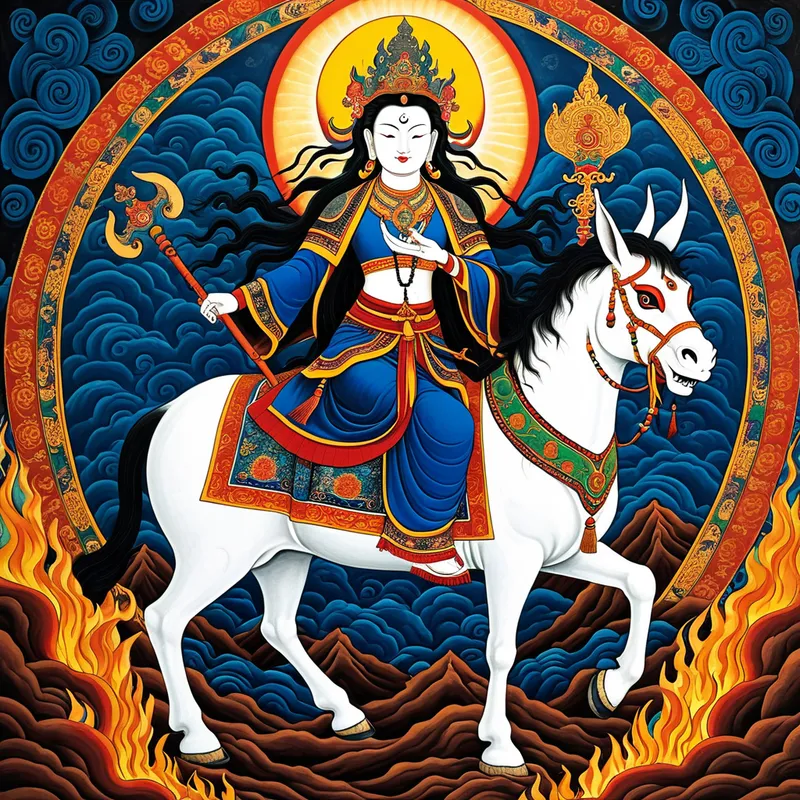
In the time before time, when the realms of gods and demons were freshly drawn and the winds of karma blew with primordial force, there existed a kingdom of unimaginable splendor. Its ruler was the Dharmapala king, [Mahakala](/myths/mahakala “Myth from Tibetan Buddhist culture.”/), and his queen, the radiant Palden Lhamo. Their land was a jewel of order, a bastion against the creeping chaos that gnawed at the edges of the world.
Yet, from this union of divine protectors, a shadow was born. Their son, a prince of formidable power, grew not with the heart of a guardian, but with the soul of a destroyer. He made a pact with the barbarian kings of the outer darkness, vowing to raze every temple, extinguish every prayer, and drown the world in a tide of suffering. His armies gathered like storm clouds on the horizon, a tide of iron and malice poised to sweep away the light.
The queen, Palden Lhamo, beheld this coming cataclysm. She saw the future written in the entrails of stars and heard the weeping of generations yet unborn. Appeals to reason fell on ears stopped with pride; maternal love was met with scorn. The cosmic scales trembled, and she understood the unbearable equation: the salvation of countless beings balanced on the death of one—her own child.
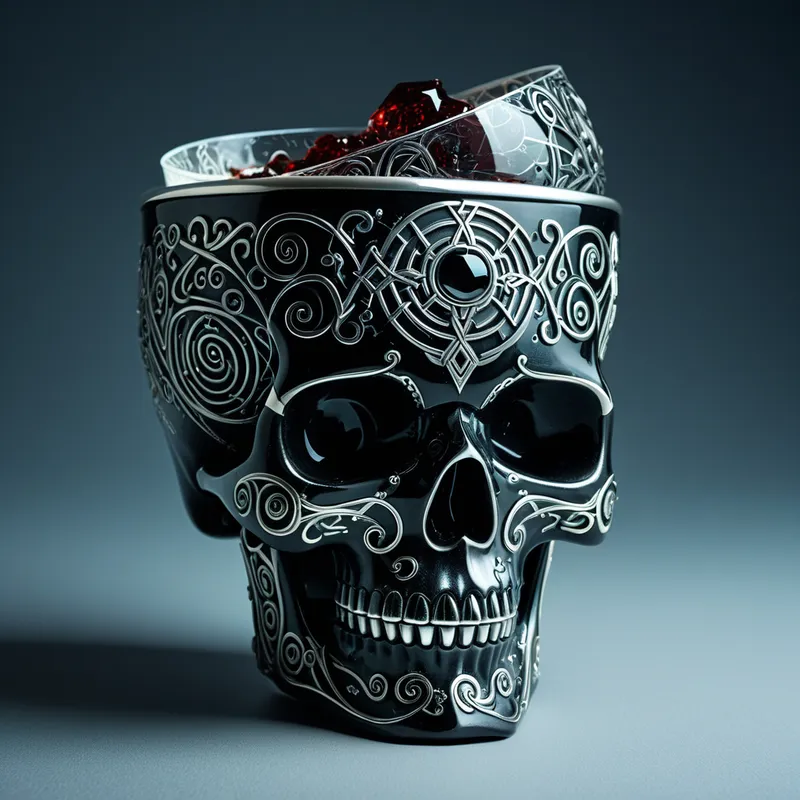
On a night when the moon hid its face, she entered his chamber. The air was thick with the scent of impending doom. With a hand steady not from lack of love, but from the weight of infinite compassion, she performed the unthinkable act. She slew her son. Then, flaying his skin to make a saddle, she fashioned his skull into a drinking cup. Seizing his still-warm heart and lungs, she mounted her celestial white mule and fled the kingdom.
The king, Mahakala, in a fury of grief and misunderstanding, gave chase. He loosed a magical arrow that struck the mule’s rump. From the wound, a miraculous lake sprang forth—the lake now known as Lhamo La-tso, the Oracle Lake. At its shore, Palden Lhamo turned. She faced her consort, not with defiance, but with the terrifying serenity of one who has passed through the ultimate fire. She held aloft the cup made from their son’s skull, and declared her eternal vow: to drink the blood of all who would harm the sacred teachings, to be the fierce mother who devours chaos to protect the world. In that moment, her grief transformed into an indomitable, wrathful grace. She crossed the vast, steaming sea of blood that separates samsara from nirvana, and took her place as the supreme protector, her love forever cloaked in the terrifying armor of necessary fury.
Cultural Origins & Context
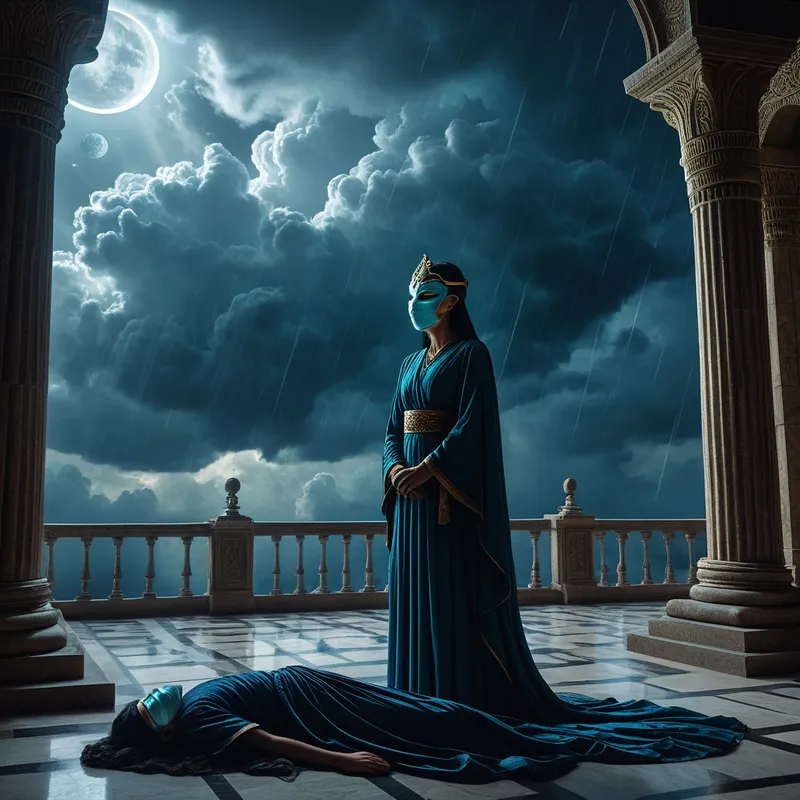
Palden Lhamo, or Shri Devi, is not merely a character in a story but a living, breathing force within Tibetan Buddhism. Her origins weave together pre-Buddhist Tibetan mountain and protector deities with the imported Indian Buddhist pantheon, a classic syncretism where indigenous spirits were often subjugated and then sworn as protectors of the new Dharma. She is considered the principal protector of the Gelug tradition and, by extension, the Tibetan state, with a special connection to the Dalai Lamas. Her oracle is consulted at the Lhamo La-tso.
The myth was passed down through monastic lineages, detailed in ritual texts (sadhanas), and vividly depicted in thangka paintings. Its societal function is multifaceted: it explains the origin of a sacred geographical site, it legitimizes the use of fierce, seemingly violent imagery in a religion grounded in compassion, and it provides a model of absolute, world-saving responsibility that transcends personal attachment. The story is told not to shock, but to illustrate the radical, often paradoxical nature of enlightened action.
Symbolic Architecture
At its core, the myth of Palden Lhamo is a masterclass in the [alchemy](/symbols/alchemy “Symbol: A transformative process of purification and creation, often symbolizing personal or spiritual evolution through difficult stages.”/) of [shadow](/symbols/shadow “Symbol: The ‘shadow’ embodies the unconscious, repressed aspects of the self and often represents fears or hidden emotions.”/). The son represents the ultimate personal shadow—one’s own progeny, one’s own creation, which has become corrupted and threatens to destroy everything one holds sacred. He is the ego run amok, the id unleashed, the personal flaw magnified into a world-ending [threat](/symbols/threat “Symbol: A threat in dreams often reflects feelings of vulnerability, anxiety, or fear regarding one’s safety or well-being. It can indicate unresolved conflicts or the presence of external pressures.”/).
The most profound protection often requires the sacrifice of that which we hold most dear, not out of hatred, but to prevent a greater suffering.
Palden Lhamo’s actions symbolize the conscious, agonizing [integration](/symbols/integration “Symbol: The process of unifying disparate parts of the self or experience into a cohesive whole, often representing psychological wholeness or resolution of internal conflict.”/) of this shadow. She does not deny it, nor does she let it run its catastrophic [course](/symbols/course “Symbol: A course represents direction, journey, or progression in life, often choosing paths to follow.”/). She takes full [responsibility](/symbols/responsibility “Symbol: Responsibility in dreams often signifies the weight of duties and the expectations placed upon the dreamer.”/) for it, “skinning” it to understand its [nature](/symbols/nature “Symbol: Nature symbolizes growth, connectivity, and the primal forces of existence.”/) (the [saddle](/symbols/saddle “Symbol: A saddle represents the concept of guidance and support in one’s journey, often associated with control and desire for freedom.”/)), containing its essence (the [skull](/symbols/skull “Symbol: The skull often symbolizes mortality, the afterlife, and the fragility of life.”/) cup), and internalizing its vital force (the [heart](/symbols/heart “Symbol: The heart symbolizes love, emotion, and the core of one’s existence, representing deep connections with others and self.”/) and [lungs](/symbols/lungs “Symbol: Symbolizes the vital force, breath of life, and often represents the capacity for emotional expression.”/)). The sea of [blood](/symbols/blood “Symbol: Blood often symbolizes life force, vitality, and deep emotional connections, but it can also evoke themes of sacrifice, trauma, and mortality.”/) she crosses is the [ocean](/symbols/ocean “Symbol: The ocean symbolizes the vastness of the unconscious mind, representing deeper emotions, intuition, and the mysteries of life.”/) of samsaric suffering, which she now navigates as its [guardian](/symbols/guardian “Symbol: A protector figure representing safety, authority, and guidance, often embodying parental, societal, or spiritual oversight.”/). Her [wrath](/symbols/wrath “Symbol: Intense, often destructive anger representing repressed emotions, moral outrage, or survival instincts.”/) is not base anger; it is the incandescent fire of [compassion](/symbols/compassion “Symbol: A deep feeling of empathy and concern for others’ suffering, often involving a desire to help or alleviate their pain.”/) directed against ignorance itself. She becomes the Vajrayana ideal: using the poison as the [medicine](/symbols/medicine “Symbol: Medicine symbolizes healing, transformation, and the pursuit of knowledge, addressing both physical and spiritual health.”/), transforming the [energy](/symbols/energy “Symbol: Energy symbolizes vitality, motivation, and the drive that fuels actions and ambitions.”/) of destruction into the energy of protection.
The Dreamer’s Resonance
When this myth stirs in the modern dreamer, it signals a profound confrontation with the shadow on a monumental scale. One might dream of a beloved child or a cherished creative project turning monstrous. One might find themselves in a position of terrible, solitary responsibility, forced to make a choice that feels like a betrayal of personal love for a greater, incomprehensible good.
Somatically, this can feel like a gripping in the chest, a weight of impossible duty. Psychologically, it is the process of facing the part of oneself—or one’s life—that has become toxic and must be consciously, painfully ended to allow for new growth. The dreamer is not Palden Lhamo the goddess, but the human soul experiencing the archetype of the Sacred Executioner. The dream asks: What in your life, born of you, now threatens to consume you? What beloved attachment must be sacrificed not out of neglect, but out of the deepest, most ruthless form of care?
Alchemical Translation
The individuation journey modeled here is not one of gentle expansion, but of catastrophic, loving violence directed inward. The “son” is any deeply identified aspect of the self—a long-held identity, a treasured narrative, a foundational relationship—that has outlived its purpose and become an obstacle to the soul’s further development. To cling to it is to allow it to destroy the psychic ecosystem.
The alchemical operation is mortificatio and sublimatio: the killing of the old form and the raising of its essence to a higher plane. The dreamer must become both the loving mother and the ruthless surgeon. One must “skin” the situation—examine its raw, uncomfortable truth without the familiar narrative hide. One must make a “cup” of the skull—create a container (a new perspective, a ritual, a therapeutic framework) to hold the lessons learned. One must ingest the “heart and lungs”—integrate the vital energy and breath of that old identity into a new, more resilient self-structure.
The ultimate act of self-care can look, from the outside, like an act of supreme self-betrayal. This is the paradox at the heart of transformation.
The triumphant figure astride the mule is the new self that emerges, one that has metabolized its own darkest potential. It is a self capable of navigating the seas of pain (both personal and collective) not as a victim, but as a protector. The fierce, tear-stained compassion of Palden Lhamo becomes the internal authority that guards one’s own psychic boundaries and sacred values with unwavering, transmuted strength.
Associated Symbols
Explore related symbols from the CaleaDream lexicon:
- Mother — The archetype of ultimate, generative care, which in this myth is pushed to its most extreme limit, demonstrating that true protection can require unimaginable sacrifice.
- Sacrifice — The core action of the myth, representing the conscious surrender of a deeply cherished part of the self or one’s life for a greater, transcendent purpose.
- Blood — Symbolizes both the pain of samsaric existence (the sea she crosses) and the vital, life-force energy of the sacrificed son, which she transforms into protective power.
- Cup — The skull cup made from her son’s cranium, representing the container of consciousness that holds and transforms the essence of one’s greatest pain into a tool for wisdom.
- Ocean — The vast, churning sea of blood, representing the overwhelming nature of suffering, emotion, and karmic consequence that the integrated self learns to traverse.
- Horse — Specifically the white mule, a hybrid creature symbolizing the vehicle of transformation, bearing the weight of her deed and connecting different realms of existence.
- Shadow — The disowned, destructive potential embodied by her son, which must be faced, owned, and integrated rather than exiled or ignored.
- Goddess — The divine feminine in its most fierce, active, and protective aspect, a force that maintains cosmic order through terrifying, compassionate means.
- Ritual — The entire myth can be seen as a cosmic ritual of transformation, where specific, symbolic actions (the killing, flaying, crafting) enact a permanent change in the nature of reality.
- Death — Not as an end, but as the essential catalyst for a higher form of life and function; the death of the old identity to birth a new, more potent form of being.
- Order — The ultimate goal of Palden Lhamo’s sacrifice: the preservation of cosmic and spiritual order (Dharma) against the forces of chaos and destruction.
- Buddhist Lotus — Symbolizing purity rising from mud, it parallels Palden Lhamo’s enlightened, compassionate nature arising from the bloody mire of her terrible, necessary action.