Oya Myth Meaning & Symbolism
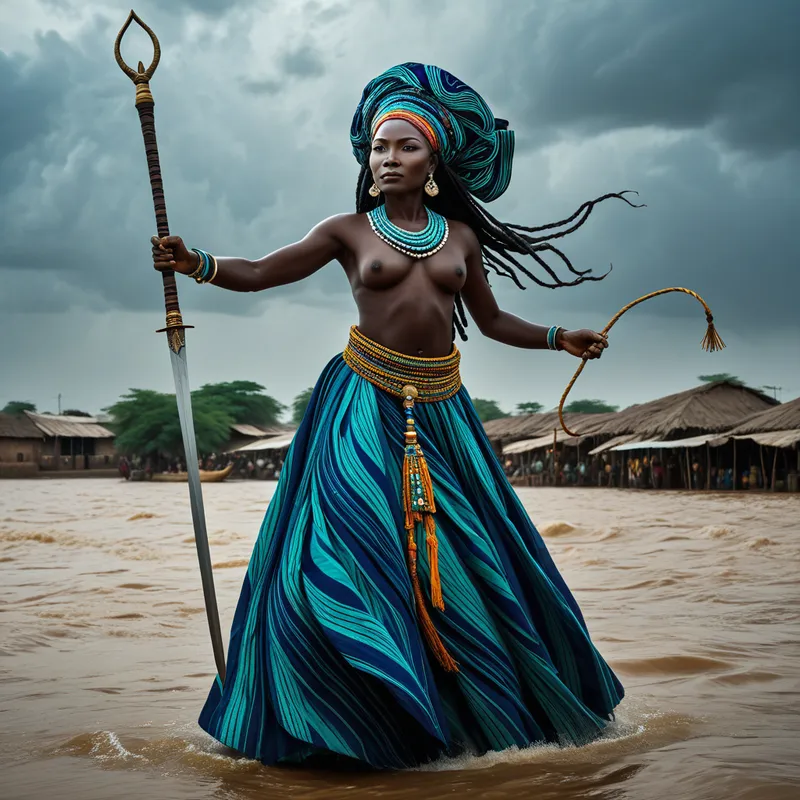
The Yoruba orisha of winds, storms, and the Niger River, Oya embodies the fierce, necessary power of radical change and the transformation of the psyche.
The Tale of Oya
Listen, and hear the tale of the One Who Tears. In the time when the world was still being woven, when the marketplace of life was a constant hum of creation and barter, there lived a power that could not be contained. Her name was Oya.
She was the breath of the Odò Òya, the great river that was also her body, and she was the sudden, violent gust that precedes the world’s remaking. She was wife to Shango, the King of Thunder, and while his fire fell from the sky, hers rose from the earth, a whirlwind of red dust and purpose.
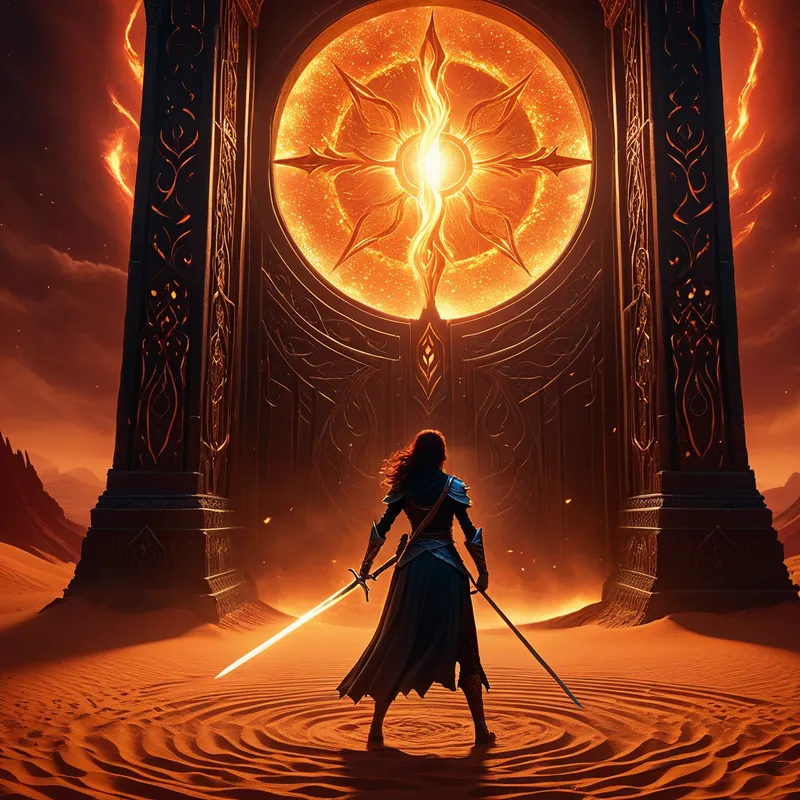
The story whispers of a journey to the very edge of being. It is said that Iku, the force of death itself, guarded a secret grove at the border of worlds. None who drew breath could pass its gates and return. But Oya’s spirit was not merely breath; it was the wind that carries breath away. Driven by a need to know the truths that lie beyond the veil, to claim the power that governs transition itself, she went to that dreaded gate.
She did not go as a supplicant, but as a force of nature. The air crackled around her, charged with the electricity of her husband’s domain and her own wild tempest. At the gate, Iku stood, immense and final. Oya did not plead. She became the argument. She summoned the nine winds—for she is Iyansan—and with them, she did not fight the guardian, but transformed the very ground of the confrontation. She became the hurricane that scours the earth clean, the tornado that uproots the ancient tree to make space for the new. She wielded not just a sword, but the cyclone.
And the gate, forged from the fear of endings, could not withstand the power that understands ending as a door, not a wall. She passed through. What she learned in that realm of ancestors and unborn spirits is hers alone, but when she returned, she carried with her the authority over the cemetery, over the winds of change that escort the soul. She became the guardian of the threshold she had stormed, the goddess of the marketplace who also holds the keys to the spirit world. Her dance is the whirlwind; her voice, the howl in the eaves before the old world falls away.
Cultural Origins & Context
The myth of Oya springs from the rich spiritual soil of the Yoruba people. This is not a fossilized tale from a dead past, but a living, breathing narrative central to systems like Santería (where she is syncretized with Our Lady of Candelaria) and Candomblé. Her stories were not penned in scrolls but woven into the fabric of daily life—passed down by Ayan drummers whose rhythms called her forth, by priests and priestesses in ritual, and by elders explaining the necessity of the storm that destroys the old crops to fertilize the field for the new.
Societally, Oya’s narrative functioned as a profound container for understanding radical, often violent, change. She explained the literal hurricanes and the sudden shifts in fortune. She governed the marketplace, the place of exchange and social fluidity, and the cemetery, the ultimate place of transition. This dual domain made her a deeply pragmatic goddess; she was invoked for success in business and for navigating grief, for protection and for the courage to enact necessary, sweeping endings. Her myth taught that destruction and creation are not opposites, but two phases of the same sacred, cyclical process.
Symbolic Architecture
Psychologically, Oya is the archetypal embodiment of the psyche’s own transformative storms. She represents the necessary, often terrifying, force that dismantles outgrown structures of the self—rigid identities, stagnant relationships, complacent beliefs.
The wind does not ask the tree for permission to reshape it; it is the nature of the wind to change, and the destiny of the tree to be changed or to fall.
Her nine skirts symbolize multiplicity and the many facets of a complex personality, while her sword is the incisive clarity required to cut away what no longer serves. The marketplace is the arena of the ego and social persona, where we barter and perform. The cemetery is the realm of the shadow and the ancestors—our personal and collective past. Oya’s mastery of both signifies a consciousness that can operate in the world of action while being intimately acquainted with the depths of the unconscious. Her rebellion at the gates of Iku is not mere defiance, but the ego’s courageous confrontation with the ultimate shadow: the fear of annihilation, which is the prerequisite for rebirth.

The Dreamer's Resonance
When Oya stirs in the modern dreamscape, she announces a psychic weather system of immense power. To dream of violent, cleansing winds, of tornadoes targeting one’s own home, or of standing fearless in a storm is to feel Oya’s presence. These are not dreams of random anxiety, but of profound somatic and psychological processing.
The dreamer may be undergoing what feels like an involuntary demolition. A long-held career identity collapses, a foundational relationship ends abruptly, a deep-seated belief is shattered. The somatic experience is one of upheaval: restlessness, a racing heart, a feeling of being “blown about” by circumstances. Psychologically, this is the self’s innate healing intelligence forcing a crisis where stagnation has set in. The dream is the inner drama of the old self, represented by the familiar “house” or structure, being dismantled by a force that is both terrifying and awe-inspiringly purposeful. The dream asks: Can you, like Oya, stand at the center of your own storm and recognize it not as an enemy, but as the fierce midwife of your next becoming?

Alchemical Translation
The alchemical journey modeled by Oya’s myth is the nigredo, the blackening, undertaken with conscious, fierce grace. Individuation is not a gentle path of incremental growth alone; it requires episodes of revolutionary change where the psyche must storm its own gates.
The individual does not find their true power by building higher walls, but by gaining the courage to dismantle the fortress and face the wild, open plain.
Oya’s path teaches that transmutation begins with a holy rebellion against internalized limitations and the silent contracts we’ve made with a diminished life. Her “sword” is the application of ruthless truth to our own illusions. Her “winds” are the emotional and intellectual energies that must be unleashed, not suppressed, to clear the psychic landscape. The triumph is not in avoiding the cemetery—the realm of loss, death, and shadow—but in claiming authority over it. To integrate Oya is to develop the capacity to consciously engage with our endings, to sit with our grief and fear, and to understand that within that very darkness lies the seed of a more authentic, powerful, and liberated self. She offers no comfort, but instead, the supreme empowerment that comes from aligning with the inevitable, terrifying, and beautiful force of your own transformation.
Associated Symbols
Explore related symbols from the CaleaDream lexicon: