Oya in Candomble Myth Meaning & Symbolism
A myth of the Yoruba goddess of winds and storms, Oya, embodying the power of radical change, the threshold of death, and the fierce love of the ancestors.
The Tale of Oya in Candomble
Listen. The world holds its breath before the storm. In the realm where the Axé of the earth meets the Axé of the sky, there is a stirring. It begins as a whisper in the tall grass, a sigh through the branches of the Iroko. This is the breath of Oya.
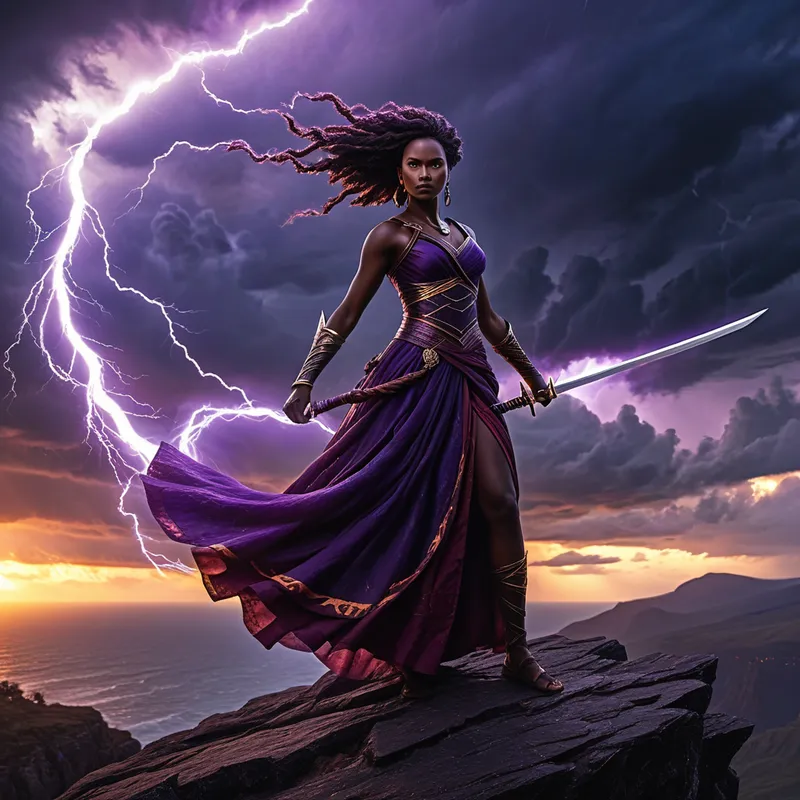
She is the one who wears nine skirts, the colors of the rainbow and the grave—violet, maroon, russet brown. She is the wife of the king, Shango, but she is no consort bound to his throne. Her throne is the tempest. Her crown is the forked lightning that splits the old, rotten tree to make way for the new shoot. She dances not to a drum of skin, but to the drum of thunder, her steps whirling the winds into a fury that can tear the roof from a house or the veil from the world.
The story is told of a great stagnation. A kingdom, a soul, a pattern of life had become like a swamp—thick, still, and festering. The old ways were crusted over; the spirits of the ancestors could not be heard through the muck. The people moved through a heavy air, their prayers falling to the ground like stones. This was an offense to life itself, a stillness that denied the turning of the world.
Oya felt this stagnation in her very bones, as a pressure in the atmosphere. From the marketplace of the world, she took up her tools: the sword of swift justice and the Irùkẹ̀ to sweep clean. She did not announce her coming with a herald’s cry, but with a sudden drop in temperature, a metallic taste on the tongue. The sky bruised to the color of her skirts.
Then, she moved. She was the rushing front, the gale that uproots. She was the tornado, the spiral that draws up the stagnant water, the dead leaves, the crumbling structures, lifting them high into the chaotic air. The people heard a sound like a thousand voices screaming—it was the sound of change itself, relentless and terrifying. Roofs flew, trees bent and broke, the swamp was churned into a froth. In the heart of this maelstrom stood Oya, her eyes flashing with the same fire that dances on Shango’s axe. This was not destruction for its own sake. This was the necessary violence of life against death.
When the winds finally stilled, the world was drenched and raw. The air was washed clean, sharp to breathe. The stagnant swamp was gone, its waters now flowing in new channels toward the river. The broken branches littered the ground, but light—clear, golden light—now reached the forest floor for the first time in ages. Where the tornado had passed, a path was cleared. And on that path, faint at first, then clearer, came the sound of the ancestors’ drums, their voices now audible in the cleansed air. Oya stood at the border between the ravaged old and the possible new, her sword lowered, her skirts settling. She had opened the Èsù of transformation. The work was done.
Cultural Origins & Context
This mythic force of Oya traveled across the Atlantic in the memories, songs, and embodied spirituality of the Yoruba people, enslaved in Brazil. In the brutal crucible of the diaspora, the Orishas did not die; they transformed and took root in new soil, giving birth to Candomblé. Here, Oya (often syncretized with Catholic figures like Saint Barbara) found a new home.
The myth was not preserved in written texts but in the living body of the community. It was passed down through the Oriki (praise songs) sung in the Ilê, through the specific drum rhythms (toques) that call her, and through the explosive, whirling dance of her initiation when she “mounts” her devotee. The societal function was profound: Oya provided a sacred narrative for radical, often terrifying change. For a people subjected to the ultimate storms of slavery, displacement, and cultural fracture, she was the divine force that could explain and sanctify upheaval. She governed the cemetery (Egún), making her the guardian of the ultimate transition and the link to the ancestors—a critical function in a culture where connection to lineage was violently disrupted.
Symbolic Architecture
Oya is the archetypal principle of the necessary storm. Psychologically, she represents the psychic forces that arise when stagnation becomes intolerable to the soul. She is not merely change, but the violent, catalyzing event that shatters a calcified complex or a life structure that has outlived its purpose.
The wind does not ask permission to clear the deadwood; it is the breath of the world insisting on circulation.
Her domain over the cemetery symbolizes her mastery of psychic death—the ending of identities, relationships, and ego-structures. Her sword is the incisive clarity that cuts through illusion and compromise. The tornado is the perfect symbol for her function: a chaotic, destructive vortex that, at its still center (the eye), contains a profound clarity and purpose. She is the guardian of the threshold, the one who holds the door to the underworld of the psyche open, forcing a confrontation with what we have buried and what must be released to make space for new life.

The Dreamer’s Resonance
To dream of Oya is to dream of impending, inevitable upheaval. The somatic signature is often present before the dream images: a feeling of atmospheric pressure, restlessness, or a sense of being “wind-blown.” Dreamscapes may feature sudden, powerful winds that rearrange or destroy familiar landscapes (one’s home, workplace). One might dream of standing at a cemetery gate that blows open, of witnessing a violent but awe-inspiring storm, or of finding a sword amidst chaotic weather.
Psychologically, this signals that the dreamer’s psyche has reached a point of critical mass. A long-held pattern—be it a toxic relationship, a stifling career, or a buried trauma—has created such psychic stagnation that the Self (the total, regulating psyche) is activating storm forces. The dream is not a prophecy of literal disaster, but an announcement from the unconscious: a structure must fall. The process underway is the terrifying, liberating work of de-integration, where the old self is dismantled by forces that feel beyond personal control.

Alchemical Translation
The myth of Oya models the nigredo and solutio stages of alchemical transmutation applied to individuation. The nigredo is the blackening, the decay and confrontation with shadow. Oya’s cemetery is this phase—the facing of psychic death. The solutio is the dissolution, the washing away by a flood or storm. Her tornado is the agent of this dissolution, breaking down rigid forms into their constituent parts.
Individuation often requires a storm to clear the path the conscious mind has overgrown.
For the modern individual, the “alchemical translation” is the conscious engagement with this archetypal energy. It means recognizing when life’s storms are not random misfortunes, but the psyche’s fierce attempt at course-correction. The work is to find the “eye of the storm” within—the still, centered point of witness amidst the chaos. It is to wield Oya’s sword to cut away what one has outgrown, however painful, and to use her Irùkẹ̀ to sweep the soul clean of old grievances and identities. The triumph is not in avoiding the storm, but in emerging from it with a cleansed perception, able to hear the “ancestral drums”—the deeper, guiding voice of the Self—that were previously inaudible. One becomes, in part, a vessel for the transformative wind.
Associated Symbols
Explore related symbols from the CaleaDream lexicon:
- Wind — The primary manifestation of Oya, representing invisible force, sudden change, the breath of spirit, and the power to cleanse and rearrange reality.
- Storm — The chaotic, catalytic event orchestrated by Oya, symbolizing necessary destruction, emotional and psychic upheaval, and the release of pent-up energy.
- Lightning — The illuminating flash of Oya’s sword, representing sudden insight, divine justice, cutting truth, and the spark that ignites transformation.
- Sword — Oya’s tool of decisive action, symbolizing the incisive cut that severs attachments, enforces boundaries, and executes necessary endings.
- Door — Oya as the guardian of the cemetery gate, representing the threshold between life and death, the conscious and unconscious, and the moment of passage.
- Death — Oya’s domain over the cemetery and ancestors, symbolizing psychic death, the end of cycles, release, and the fertile ground from which rebirth springs.
- Rebirth — The inevitable consequence of Oya’s storm, representing the new life, clarity, and growth that can only emerge after a period of radical dissolution.
- Ancestor — Oya’s intimate connection to the Egún, symbolizing the wisdom of the past, the guidance of lineage, and the voices that become audible after the storm clears.
- Chaos — The state Oya governs and utilizes, representing the primal, creative disorder that precedes the emergence of a new order.
- Dance — The whirling, ecstatic movement of Oya’s possession, symbolizing the embodiment of transformative power and the surrender to a force greater than the individual ego.
- Fire — The element often associated with her through her link to Shango, representing the purifying, transformative, and passionate aspect of her destructive-creative power.
- River — The flowing state Oya creates from stagnation, symbolizing the return of movement, emotion, and life force to a blocked or arid psychic landscape.