
Oxum Goddess of Sweet Water Brazil Myth Meaning & Symbolism
A myth of the river goddess Oxum, who teaches that true wealth flows from the sweet waters of the heart, beauty, and deep self-knowledge.
The Tale of Oxum Goddess of Sweet Water Brazil
Listen. The world was younger, and the air hummed with the raw power of creation. The [Olodumare](/myths/olodumare “Myth from Yoruba culture.”/) had set the Orixás to their tasks, but the earth was a place of struggle, of dust and toil. The rivers ran, but they were merely water—functional, life-giving, but without grace.
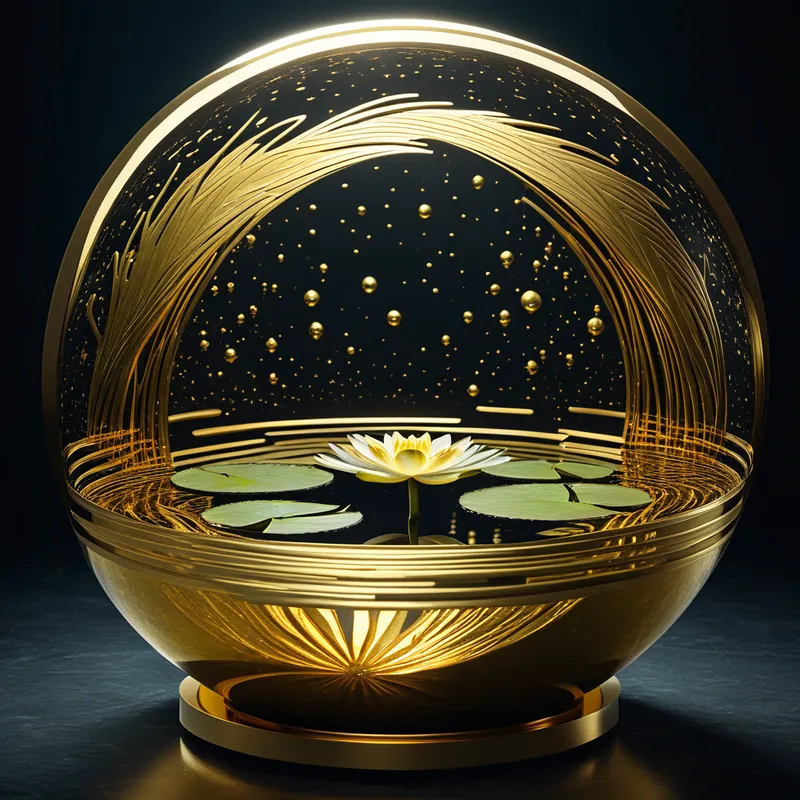
In the lush, hidden places where the land softened, there lived Oxum. She was not of the roaring ocean, nor of the life-giving rain. Hers was the domain of the sweet waters: the gentle rivers that meander through forests, the clear springs that bubble from mossy stones, the serene lakes that hold the sky in their embrace. She was beauty incarnate, adorned not with thorns but with the gleam of polished brass and the warmth of gold. She carried a mirror, not out of vanity, but as a tool of profound truth.
Yet, in the councils of the Orixás, her voice was like the whisper of a breeze—heard, but not heeded. The work of shaping humanity, of granting them the gifts of civilization, was seen as a serious endeavor for the strong and the severe: Ogum the warrior, Xangô the king. What need had creation for sweetness? For beauty? For the subtlety of a reflection?
Oxum watched as humanity labored. They had fire, tools, law. But their hearts were arid; their spirits, brittle. They knew how to build and to fight, but not how to soften, to cherish, to value the invisible currents that give life its savor. A great discontent settled over the world, a silent famine of the soul.
So, Oxum retreated. Not in defeat, but in strategic silence. She withdrew her essence from the world’s waters. The rivers did not dry up, but they lost their sweetness. They became merely wet. The springs lost their sparkle. The lakes became dull mirrors, reflecting only grey. Life continued, but it was a hollow echo. The people, and even the mighty Orixás, felt a thirst no common water could quench—a thirst for delight, for pleasure, for the gentle touch that makes existence not just endurable, but desirable.
Confusion turned to despair. The council of gods convened, their power useless against this subtle drought. It was then they understood. The world lacked the principle of attraction, the alchemy that turns survival into life. They lacked the currency of the heart. They needed Oxum.
They found her at the source of her most secret river, a place where the water tasted of honey and light. She did not rage. She simply gazed into her mirror, and in its surface, the petitioners saw not their own worried faces, but the reflection of what was missing: the gold of genuine feeling, the liquidity of love, the wealth of inner peace.
Oxum laid down her terms. Not for dominance, but for integration. She would restore the sweetness to the waters, and in doing so, to existence itself, but her domain would be recognized as essential. She demanded her place at the forge of human destiny. Her province would be love, fertility, diplomacy, and—most crucially—wealth. Not just gold, but the wealth of healthy children, of joyful unions, of art, music, and the profound riches of self-awareness that come from looking clearly into one’s own soul.
With her return, the waters sang again. Humanity discovered not just the relief of drink, but the joy of it. They learned to trade, to adorn, to court, to create beauty for its own sake. Oxum taught that true power flows not only through the arm that wields the sword, but through the eyes that meet in understanding, through the heart that knows its own worth, and through the reflective surface that reveals the deepest, most valuable truths.

Cultural Origins & Context
This narrative of Oxum finds its roots in the Yoruba cosmology of what is now Nigeria and Benin. Transported across the Atlantic in the hearts and memories of enslaved Africans, the myth of Oxum survived the Middle Passage, taking profound root in Brazil, Cuba, Haiti, and elsewhere. In Brazil, particularly within the traditions of Candomblé and Umbanda, she became a central, beloved figure.
The myth was not preserved in written texts but in the living body of the community: through oral storytelling, sacred songs (orikis), ritual dances, and the embodied knowledge of priestesses and priests. It served a vital societal function, encoding a world-view where the feminine principle, especially one associated with beauty, sensuality, and fresh water, was not frivolous but foundational to cosmic and social balance. In the harsh realities of the diaspora, Oxum’s myth offered a spiritual technology for preserving dignity, cultivating inner beauty, and accessing a form of power that was subtle, persuasive, and life-nourishing in the face of brute force.
Symbolic Architecture
Oxum is the [archetype](/symbols/archetype “Symbol: A universal, primordial pattern or prototype in the collective unconscious that shapes human experience, behavior, and creative expression.”/) of the reflective principle. Her domain—sweet [water](/symbols/water “Symbol: Water symbolizes the subconscious mind, emotions, and the flow of life, representing both cleansing and creation.”/)—is the [symbol](/symbols/symbol “Symbol: A symbol can represent an idea, concept, or belief, serving as a powerful tool for communication and understanding.”/) of [life](/symbols/life “Symbol: The symbol of ‘Life’ represents a journey of growth, interconnectedness, and existential meaning, encompassing both the joys and challenges that define human experience.”/)’s attractive, nourishing, and flowing essence. It is not the [water](/symbols/water “Symbol: Water symbolizes the subconscious mind, emotions, and the flow of life, representing both cleansing and creation.”/) of purification (which is more the domain of Yemanjá) or the [water](/symbols/water “Symbol: Water symbolizes the subconscious mind, emotions, and the flow of life, representing both cleansing and creation.”/) of storm, but the water that sustains, pleases, and invites.
The mirror does not lie; it reveals the truth we are often too busy or too afraid to see. Oxum’s mirror is the surface of consciousness itself.
Her association with [wealth](/symbols/wealth “Symbol: Wealth in dreams often represents abundance, security, or inner resources, but can also symbolize burdens, anxieties, or moral/spiritual values.”/) is profoundly psychological. It represents the [treasure](/symbols/treasure “Symbol: A hidden or valuable object representing spiritual wealth, inner potential, or divine reward.”/) of the integrated self. The gold and [brass](/symbols/brass “Symbol: A durable alloy of copper and zinc, symbolizing resilience, tradition, and a blend of strength with warmth. Often associated with craftsmanship and ceremonial objects.”/) are not merely [metal](/symbols/metal “Symbol: Metal in dreams often signifies strength, transformation, and the qualities of resilience or coldness.”/); they are the luminosity of a psyche that has acknowledged and refined its own value. The myth posits that a civilization—or an individual—without this principle is functionally alive but spiritually impoverished, capable of building towers but not homes, waging wars but not making [peace](/symbols/peace “Symbol: Peace represents a state of tranquility and harmony, both internally and externally, often reflecting a desire for resolution and serenity in one’s life.”/).
The conflict—her withdrawal—symbolizes the catastrophic consequence of repressing the feminine, reflective, and aesthetic dimensions of life. The resulting “thirst” is a spiritual and emotional [aridity](/symbols/aridity “Symbol: Aridity symbolizes emotional or spiritual barrenness, a lack of nourishment, and a state of profound dryness or emptiness.”/), a world reduced to utility. Her return and the conditions she sets model the necessary reconciliation: the [warrior](/symbols/warrior “Symbol: A spiritual archetype representing inner strength, discipline, and the struggle for higher purpose or self-mastery.”/) must acknowledge the [lover](/symbols/lover “Symbol: A lover in dreams often represents intimacy, connection, and the emotional aspects of relationships.”/), the [king](/symbols/king “Symbol: A symbol of ultimate authority, leadership, and societal order, often representing the dreamer’s inner power or external control figures.”/) must heed the diplomat, and the external [quest](/symbols/quest “Symbol: A quest symbolizes a journey or search for purpose, fulfillment, or knowledge, often representing life’s challenges and adventures.”/) must be balanced by the inner [journey](/symbols/journey “Symbol: A journey in dreams typically signifies adventure, growth, or a significant life transition.”/).
The Dreamer’s Resonance
When this myth pattern surfaces in modern dreams, it often signals a process of re-evaluating one’s source of value and nourishment. Dreaming of serene rivers, golden jewelry, or particularly of gazing into a mirror with unusual focus or results, can point to the psyche’s call to engage with the Oxum principle.
Somatically, this may manifest as a felt sense of dryness or depletion despite outward success—a “sweet water” famine. Psychologically, the dreamer may be confronting questions of self-worth, beauty (in a deep, non-superficial sense), or the health of their relationships and creative flows. The dream is an invitation to retreat not into escapism, but into reflective self-assessment, to locate the hidden spring of one’s own joy and attractiveness. It asks: What do you truly value? Where have you allowed your inner waters to become merely functional, losing their sweetness?

Alchemical Translation
The myth of Oxum is a precise map for the alchemical stage of albedo, following the initial blackening (nigredo). It is the process of washing the raw, dark matter of the psyche in the “sweet waters” of conscious reflection and self-acceptance to reveal its inherent value.
The individual’s “withdrawal of Oxum” is the state of living a one-sided life, over-identified with logos, achievement, or persona, while neglecting feeling, relatedness, and eros. The resulting psychic drought is a crisis of meaning. The “return of Oxum” is the conscious act of reintegrating these banished values.
Individuation requires not just confronting the shadow, but recovering the gold hidden within it. This gold is the unique, irreplaceable value of the individual soul, glimpsed only in the mirror of honest self-reflection.
This transmutation involves turning from purely external pursuits to cultivate inner wealth: engaging in activities that bring authentic pleasure, honoring one’s feelings and aesthetic sensibilities, practicing self-compassion, and learning the diplomatic art of relating to oneself and others with grace. The goal is not to become Oxum, but to integrate her principle, thereby transforming one’s inner landscape from a barren field into a fertile, flowing riverbank, rich with the gold of self-knowledge and the sweet water of a heart flowing freely.
Associated Symbols
Explore related symbols from the CaleaDream lexicon:
- Goddess — The divine feminine principle as nurturer, reflector, and bestower of inner and outer wealth, embodied by Oxum’s sovereignty over love, beauty, and sweet waters.
- River — The flowing, life-sustaining essence of Oxum’s domain, representing the course of emotions, fertility, and the gentle, persistent power of eros.
- Mirror — The central tool of Oxum, symbolizing self-reflection, truth, consciousness, and the surface in which one discovers one’s true value and beauty.
- Gold — The metal sacred to Oxum, representing not merely material wealth but the psychological treasures of self-worth, refinement, and the luminous integrated self.
- Sweet — The essential quality of Oxum’s waters and her influence, denoting pleasure, attraction, delight, and the aspect of life that makes existence desirable, not just endurable.
- Heart — The organ of feeling and value, directly connected to Oxum’s domain of love, which teaches that true wealth flows from an open and self-knowing heart.
- Wealth — The profound bounty Oxum governs, encompassing children, joy, art, harmonious relationships, and the deep riches of psychic integration.
- Beauty — The aesthetic and attractive principle Oxum embodies, understood as a cosmic force of harmony, balance, and the visible expression of inner gold.
- Reflections in Still Water — The act of gazing into a calm surface, mirroring Oxum’s primary method of imparting wisdom through inviting deep, contemplative self-seeing.
- Cup — A vessel for holding sacred liquid, symbolizing the capacity to receive, contain, and offer the nourishing “sweet waters” of love, insight, and emotional abundance.