Ovoo Spirit Mound Myth Meaning & Symbolism
A myth of sacred reciprocity where a traveler's ritual offering at a stone mound awakens the land's spirit, forging a covenant between humanity and the wild.
The Tale of Ovoo Spirit Mound
Listen. The wind does not blow across the steppe; it sings. It carries the memory of ten thousand hooves, the whisper of grasses older than empires, and the silence that lives between stars. In such a land, a person is a speck, a breath. To be lost here is to be unmade.
So it was for a traveler, whose name the wind has long since taken. His ger was distant, his horse faltering, his waterskin a hollow skin. The sun was a hammer on the crown of the sky, and the horizon shimmered like a fever dream. He climbed a low, bald hill, seeking a vantage, finding only more endless, rolling gold. Despair, cold and heavy, settled in his bones. This was not a place for men. This was the domain of the sky and the unblinking earth.
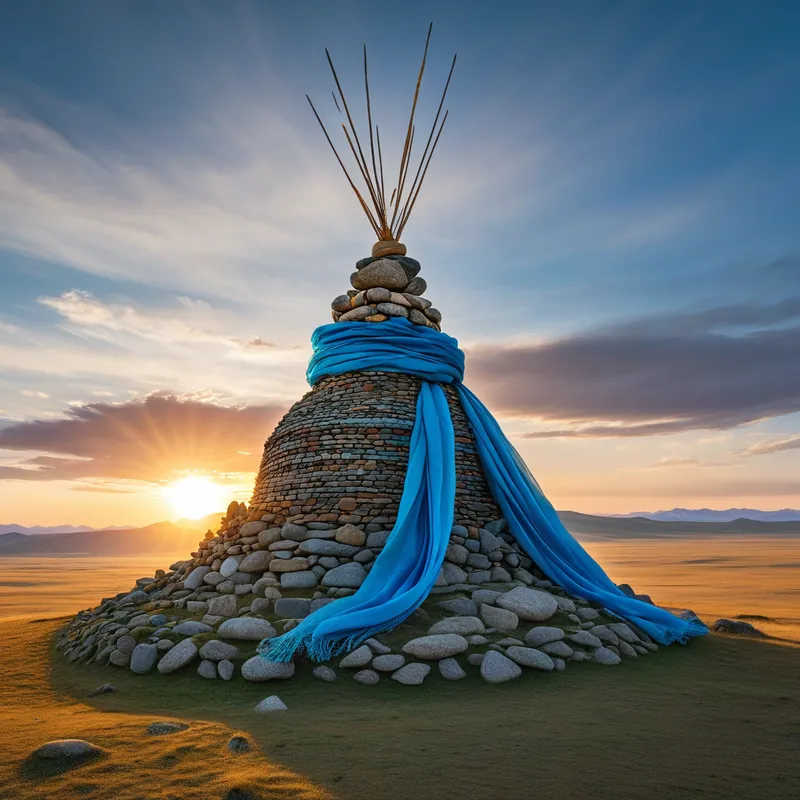
At the hill’s crest, he saw it: a simple pile of stones. Not a natural formation. Each stone had been placed by a hand—some large and mossy, others small and sharp. Scraps of faded blue silk, khadags, fluttered from a weathered pole. It was humble. It was a sign.
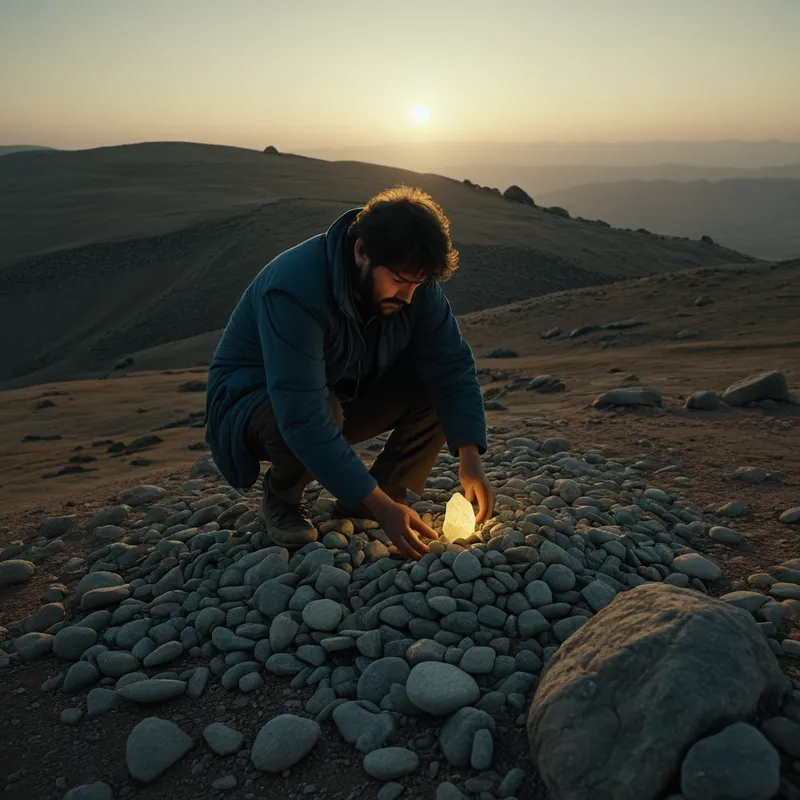
With the last of his strength, he did not take. He gave. He searched the ground, found a stone the size of his heart, and with a murmured breath—a prayer without words—he added it to the pile. He had nothing else. No milk, no coin, no song. Only this act of participation, this small, deliberate weight.
He sat in the mound’s lee, waiting for the end. But the end did not come. Instead, a coolness breathed from the stones. The relentless wind softened, coiling around the hill like a gentle animal. The air grew thick with the scent of damp earth and distant rain. From the mound itself, a presence emerged—not a shape, but a quality. It was the feeling of the hill watching, the awareness of the valley below, the patience of the bedrock.
A voice, woven from the rustle of grass and the grind of stone, spoke without sound. You added to the body of the land. You acknowledged the whole.
Before the traveler, the air shimmered. A faint path, like a seam in the world, glimmered into being, leading down the hill toward a line of willows he had not seen. The presence remained, a silent guardian. The traveler drank from the stream beneath the willows, his horse reviving. He knew his way. As he left, he looked back. The Ovoo stood silent, but he felt its gaze—a pact made, not in blood, but in stone and intention.
Cultural Origins & Context
The Ovoo is not merely a myth from a forgotten past; it is a living, breathing ritual technology of the Mongolian worldview. Found atop mountain passes, at river sources, and on significant promontories, these cairns function as altars to the Lus Savdag, the spirits of the land. The myth encapsulates the essential nomadic ethic: you cannot own the land, but you can enter into a relationship with it through reciprocity.
The story was never confined to a single bard’s tale. It was passed down through the act itself. Each traveler who adds a stone, who ties a khadag, who circles the mound three times sunwise, is re-enacting the myth and transmitting its core truth. Parents teach children by doing. The societal function is profound: it instills ecological mindfulness, reinforces community through shared ritual sites, and provides a psychological anchor in a landscape of overwhelming scale and power. It transforms the terrifying sublime of the wilderness into a communicative sacred.
Symbolic Architecture
At its [heart](/symbols/heart “Symbol: The heart symbolizes love, emotion, and the core of one’s existence, representing deep connections with others and self.”/), the Ovoo myth is about the psyche’s [relationship](/symbols/relationship “Symbol: A representation of connections we have with others in our lives, often reflecting our emotional state.”/) with the Other—the vast, non-[human](/symbols/human “Symbol: The symbol of a human represents individuality, complexity of emotions, and social relationships.”/) world of [nature](/symbols/nature “Symbol: Nature symbolizes growth, connectivity, and the primal forces of existence.”/) and the unconscious.
The mound is not a barrier, but a synapse; the point where human consciousness touches the mind of the world.
The [traveler](/symbols/traveler “Symbol: A person on a journey, representing movement, transition, and the search for new experiences or self-discovery.”/) represents the conscious ego, isolated, directionless, and depleted by its [journey](/symbols/journey “Symbol: A journey in dreams typically signifies adventure, growth, or a significant life transition.”/) through [life](/symbols/life “Symbol: The symbol of ‘Life’ represents a journey of growth, interconnectedness, and existential meaning, encompassing both the joys and challenges that define human experience.”/)’s arduous [terrain](/symbols/terrain “Symbol: Terrain in dreams often represents the landscape of one’s life, including challenges, opportunities, and feelings about one’s current circumstances.”/). The barren [hill](/symbols/hill “Symbol: A hill represents challenges, progress, or obstacles in life’s journey, often symbolizing effort and perspective.”/) is the critical [juncture](/symbols/juncture “Symbol: A critical point of decision, transition, or convergence where paths, choices, or timelines meet, demanding action or reflection.”/), the [moment](/symbols/moment “Symbol: The symbol of a ‘moment’ embodies the significance of transient experiences that encapsulate emotional depth or pivotal transformations in life.”/) of existential [crisis](/symbols/crisis “Symbol: A crisis symbolizes turmoil, urgent challenges, and the need for immediate resolution or change.”/) where old resources fail. The simple pile of stones symbolizes the accumulated psyche—the collective wisdom, prayers, and struggles of all who came before. It is the inherited cultural and psychic [structure](/symbols/structure “Symbol: Structure in dreams often symbolizes stability, organization, and the framework of one’s life, reflecting how one perceives their environment and personal life.”/).
The act of adding a [stone](/symbols/stone “Symbol: In dreams, a stone often symbolizes strength, stability, and permanence, but it may also represent emotional burdens or obstacles that need to be acknowledged and processed.”/) is the critical move from narcissistic need to participatory offering. It is the ego’s humility, acknowledging it is part of a larger [system](/symbols/system “Symbol: A system represents structure, organization, and interrelated components functioning together, often reflecting personal or social order.”/). The awakened [spirit](/symbols/spirit “Symbol: Spirit symbolizes the essence of life, vitality, and the spiritual journey of the individual.”/) of the mound is the [anima](/symbols/anima “Symbol: The feminine archetype within the male unconscious, representing soul, creativity, and connection to the inner world.”/) mundi, the world [soul](/symbols/soul “Symbol: The soul represents the essence of a person, encompassing their spirit, identity, and connection to the universe.”/), or in psychological terms, the dynamic, guiding intelligence of the unconscious itself. It responds not to demand, but to respectful engagement. The [path](/symbols/path “Symbol: The ‘path’ symbolizes a journey, choices, and the direction one’s life is taking, often representing individual growth and exploration.”/) revealed is not a pre-existing road, but the [emergence](/symbols/emergence “Symbol: A process of coming into being, rising from obscurity, or breaking through a barrier, often representing birth, transformation, or revelation.”/) of meaning and [direction](/symbols/direction “Symbol: Direction in dreams often relates to life choices, guidance, and the path one is following, emphasizing the importance of navigation in personal journeys.”/) from the [dialogue](/symbols/dialogue “Symbol: Conversation or exchange between characters, representing communication, relationships, and narrative flow in games and leisure activities.”/) between the conscious self and the deep psyche.
The Dreamer’s Resonance
When this myth pattern stirs in modern dreams, it often manifests as a profound sense of being lost in a vast, impersonal, or bureaucratic landscape (the inner steppe). The dreamer may encounter a strange, neglected pile of objects—books, tools, forgotten toys—or a peculiar architectural feature like a neglected garden cairn or a messy altar.
The somatic feeling is one of deep weariness and spiritual thirst. The psychological process underway is the soul’s craving for ritual and belonging. The dream is highlighting a life lived in extraction—taking energy, time, validation—without making offerings back to the soul or the world. The act of noticing the “mound” and feeling compelled to add to it or care for it in the dream signals the nascent impulse toward psychic reciprocity. The resolution—finding water, a guide, or simply a feeling of peace—marks the beginning of the psyche’s own guidance system coming online, fed by this new attitude of participation.
Alchemical Translation
The alchemical process modeled here is coagulatio—the making solid, the embodiment of spirit. It is the antithesis of spiritual bypassing or seeking escape from the earthly condition.
Individuation is not a flight from the world, but a deeper marriage to it, stone by negotiated stone.
The traveler’s initial state is one of separatio—alienated from the land (the body, the instincts, the unconscious). The crisis on the hill is the nigredo, the dark night of the soul, where the old ego-centric mode blackens and fails. The offering of the stone is the first stage of albedo, the whitening. It is a conscious, willed act of humility that begins to purify the relationship between ego and Self.
The awakened Ovoo spirit represents the coniunctio, the sacred marriage between the individual consciousness and the transpersonal psyche (the spirit of the land). This union does not dissolve the ego but grants it a new role: steward and communicant, rather than conqueror. The revealed path is the beginning of the rubedo, the reddening, where the integrated personality finds its authentic, embodied way forward in the world. The modern individual’s “stone” might be a creative act offered without demand for fame, a moment of true listening, or a commitment to tend a small piece of the physical or psychological world. The myth teaches that our wholeness is found not in what we acquire, but in what we sincerely contribute to the great, silent mound of being.
Associated Symbols
Explore related symbols from the CaleaDream lexicon:
- Stone — The fundamental unit of the covenant, representing permanence, offering, and the accumulated weight of tradition and prayer within the psychic landscape.
- Mountain — The elevated place of encounter with the transpersonal, symbolizing the arduous climb toward consciousness and the meeting point between earth and sky.
- Ritual — The prescribed act of circling and offering, which structures the chaotic encounter with the sacred, providing a vessel for the numinous experience.
- Earth — The ultimate ground of being that the Ovoo represents, the physical and psychic territory with which the individual must forge a conscious relationship.
- Spirit — The animating presence of the land that awakens through reciprocity, representing the autonomous, guiding intelligence of the unconscious.
- Journey — The traveler’s path across the steppe, mirroring the soul’s progression through life’s trials toward integration and meaningful direction.
- Ancestral Spirits — The collective presence felt in the mound, embodying the wisdom and continuity of all who have performed the ritual before, forming a psychic lineage.
- Circle — The sunwise path walked around the Ovoo, symbolizing wholeness, completion, and the cyclical nature of offering and receiving in the ecosystem of the soul.
- Grounded Spirit — The outcome of the myth, a state where spiritual awareness is not airy but deeply rooted in place, action, and respectful relationship.
- Earth Mound — The Ovoo itself as a geographical and psychological landmark, a man-made yet natural focal point for collective and individual psychic energy.
- Mound of Stones — The specific, accumulated form of the Ovoo, representing the slow, collaborative building of sacred space and conscious connection over time.
- Protective Spirit Animal — The quality of the awakened land spirit that guides and safeguards, representing the instinctual, animal wisdom that emerges when approached with respect.